Hodges' Model: Welcome to the QUAD

Hodges' model is a conceptual framework to support reflection and critical thinking. Situated, the model can help integrate all disciplines (academic and professional). Amid news items, are posts that illustrate the scope and application of the model. A bibliography and A4 template are provided in the sidebar. Welcome to the QUAD ...

Wednesday, June 28, 2023

ii Design with People in Mind: Seclusion Issue related to Hodges' model

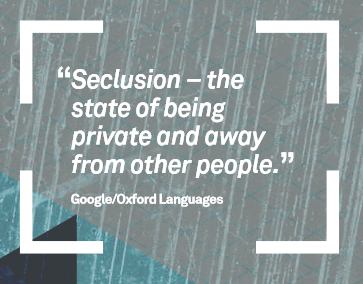
The Seclusion Issue


INDIVIDUAL
|
     INTERPERSONAL    :     SCIENCES               
HUMANISTIC --------------------------------------  MECHANISTIC      
SOCIOLOGY  :   POLITICAL 
|
GROUP

psychological harm / safety / seclusion

privacy, dignity and respect

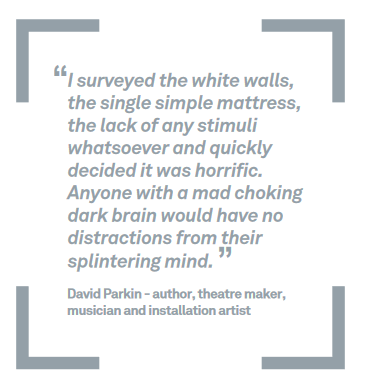
Sensory stimuli, calm, distraction

Parity of Esteem

psychological restraint/control

Reaching for the person amid complexity

Staff / Service User attitudes to x,y,z

Lived/Patient experience
sensory -

NATURE - outdoors 'Green'

Design: (sterile?) space, colour, temperature, walls, light, warmth, cold, fresh air, homely/clinical, doors - locks, alarms, noise, violence resistant spaces ...

physical agression / harm / safety / seclusion

'built' environment / 'sensory room'

physical restraint/control, clothing, toilet, access to outdoors

Ecological and Integrative Physiology

- modulation

Social spaces

supportive spaces

scope for therapy

social autonomy

community

music / arts

experience in isolation - stigma in-situ?

trauma-informed services

in-patient services, funding

risk reduction; policies

use of technology/observation

length of stay, reporting

impact of restraint on staff


Hodges' model is situated and can be used in all health, educational and policy contexts.

Hodges' model can assist to initially scope, plan and evaluate research studies not only across all the care (knowledge) domains above (including the spiritual) but the model's structure incorporates such dichotomies as subjective-objective; qualitative-quantitative; person-services; patient-staff; therapy-control/restraint; person-centred--service-centred; private/personal-public; care-custodial; psycho-political; socio-technical and others.


There is of course much more that could be added above, and relationships considered between concepts and perspectives: the patient's, nurse's, doctor's, the multidisciplinary team, manager's, policy makers, architect,s anthropologists, public, professional and regulatory bodies and commissioners?


Please keep 'me' safe safely - yes, and the team!


Even though and especially because I may not currently know exactly who - how ...  I am?


My source: https://twitter.com/DIMHN

Related post i

Sunday, June 25, 2023

Design with People in Mind Books - The Seclusion Issue

Design with People in Mind
The Seclusion Issue


Design with People in Mind is the Design in Mental Health Network’s annual round up of the latest research evidence on therapeutic outcomes and the evidence for them relating to the built environment in mental health. In partnership with London Southbank University and Nottingham Trent, so far we’ve looked at a variety of issues, from nature to sound design to boundaries and borders. The latest issue is Seclusion, launched at this years conference and focusing on the evidence for and impact of the practice of seclusion units, how to use them if at all, and best practice in the field to maintain psychological as well as physical safety for service users and staff.


The link to the publication is: 

https://dimhn.org/wp-content/uploads/2023/06/1DWPIM_I8_250x210_24PP_AW_V02_HI_RES.pdf

It’s a member only resource, so you will need to register (free for individuals) before viewing.

Very best,

Hannah

Hannah Chamberlain
CEO
Design in Mental Health Network
m: 07811169609
www.dimhn.org


My source: https://twitter.com/DIMHN

See also:
ii Design with People in Mind

Saturday, June 24, 2023

Being Reflective and Reflexive


INDIVIDUAL
|
     INTERPERSONAL    :     SCIENCES               
HUMANISTIC --------------------------------------  MECHANISTIC      
SOCIOLOGY  :   POLITICAL 
|
GROUP

"Benner suggested five levels of practice, from the rule-bound novice or beginner who nurses literally 'by the book', following non-contextualised rule-governed procedures, to the expert who:

'with an enormous background of experience, now has an intuitive grasp of each situation and zeroes in on the accurate region of the problem without wasteful consideration of a large range of unfruitful, alternative diagnoses and solutions.'" (Benner 1984) p.22.

"A moral agent is any being who is capable of thinking, deciding, and acting in accordance with moral standards and rules. A moral agent may not always fulfill the requirements of a moral standard or rule; that is, he need not be morally perfect. But he must have the capacity to judge himself on the basis of such criterion and to use it as a guide to his choice and conduct." (Taylor 1975, p.6).

"When the practitioner reflects in action in  a case he perceives as unique, paying attention to the phenomena and surfacing his intuitive understanding of them, his experience is at once exploratory, move testing, and hypothesis testing. The three functions are fulfilled by the very same actions. And from this fact follows the distinctive character of experimenting in practice." (Schon 1987). p.27.

"When someone reflects-in-action, he becomes a researcher in the practice context. He is not dependent on the categories of established theory and technique, but constructs a new theory of the unique case . . . because his experimenting is a kind of action, implementation is built into his inquiry."  (Schon 1983) p.28.

Transforming Nursing Through
Reflective Practice


"This approach approach represents a new call for the:
'.. integration of reason and emotion, the personal and the political, the public and the private. In moral theory ... this is part of a general effort to reverse the segregation of intellectual inquiry from personal experience in moral deliberation.'" (Lauritzen 1996,p.6) p.37.

"Greene (1998) noted:
'To become [different] is not simply to will oneself to change. There is the question of being able to accomplish what one chooses to do. It is not only a matter of the capacity to choose; it is a matter of the power to act to attain one's purposes. We shall be concerned with intelligent choosing and, yes, humane choosing, as we shall be with the kinds of conditions necessary for empowering persons to act on what they choose." (p.3) p.52.


Johns, C. and Freshwater, D. (eds). (1998). Transforming Nursing Through Reflective Practice. London: Blackwell Science. [1st edition.]

Chapter 2 Rolfe. Reflective and Reflexive Nursing Practice. pp.21-31.
Chapter 3 Ferrell. Customary vs Reflective Morality. pp.32-42.
Chapter 5 Johns and Hardy. Voice as a Metaphor for Transformation. pp.51-61.

Friday, June 23, 2023

Evidence-based care: What are 'we' missing?

Perhaps, proof of (what) works? 

Blockchain Revolution

"The mechanism for reaching consensus is critical. 'Consensus is a social process,' blogged Vitalik Buterin, pioneer of the Ethereum blockchain. Human beings are fairly good at engaging in consensus . . . without any help from algorithms." He explained that, once a system scales beyond an individual's ability to do the math, people turn to software agents. In peer-to-peer networks, the consensus algorithm divvies up the right to update the status of the network, that is, to vote on the truth. The algorithm doles out this right to a group of peers who constitute an economic set, a set that has skin in the game, so to speak. According to Buterin, what's important about this economic set is that its members are securely distributed: no single member or cartel should be able to overtake a majority, even if they had the means and incentive to do so.

To achieve consensus, the bitcoin network uses what's called a proof of work (PoW) mechanism. This may sound complicated but the idea is a simple one. Because we can't rely on the identity of the miners to select who creates the next block, we instead create a puzzle that is hard to solve (i.e., it takes a lot of work), but easy to verify (i.e., everyone else can check the answer very quickly). Participants agree that whoever solves the problem first gets to create the next block. . . . For each block they find, miners receive  bitcoin as a reward." p.31.

INDIVIDUAL
|
     INTERPERSONAL    :     SCIENCES               
HUMANISTIC --------------------------------------  MECHANISTIC      
SOCIOLOGY  :   POLITICAL 
|
GROUP


'proof of activity'
'proof of work'
'proof of burn'

'proof of capacity'
'proof of disk'
'proof of storage'
'proof of existence'


'proof of asset'
'proof of storage'
'proof of stake'
'proof of property'


Hodges' model = Proof of Care* ?

Proof of Concepts (at least?)

How do we prioritise and focus
our energy expenditure, and energies in the 21st century?

*And education?

Tapscott, D. and Tapscott, A. (2018) Blockchain Revolution How the Technology behind Bitcoin Is Changing Money, Business, and the World. Penguin, New York.
[See also index, p.355 'proof of a,b,c...'.]

Wednesday, June 21, 2023

Thanks for the memories . . .

. . . may they last your life time and then some . . .

INDIVIDUAL
|
INTERPERSONAL    :     SCIENCES               
HUMANISTIC --------------------------------------  MECHANISTIC      
SOCIOLOGY  :   POLITICAL 
|
GROUP
53.38737144811205, -2.6100497479996965
Peter Jones 20 June, 2023, Warrington, UK

 self-storage (physical)


Photo: Peter Jones 20th June, 2023, Warrington, UK.

Tuesday, June 20, 2023

'Anthropologically strange'


INDIVIDUAL
|
INTERPERSONAL    :     SCIENCES               
HUMANISTIC --------------------------------------  MECHANISTIC      
SOCIOLOGY  :   POLITICAL 
|
GROUP

"Phenomenology focuses on the inter-subjective constitution of the social world and everyday social life. Schütz (1964), in a seminal essay on 'The Stranger', shows how a social group has its own cultural pattern of life - folkways, mores, laws, habits, customs, etiquette, fashions and so on - that, as far as its members are concerned, are taken for granted, are habitual and almost automatic.
Schütz's stranger provides a model for the ethnographer using participant observation. The ethnographer tries to treat the familiar world of 'members' as anthropologically strange, to expose its social and cultural construction. This is particularly demanding when a researcher is studying a group with which he or she is familiar, but represents an ideal attitude of mind for the researcher to pursue nevertheless." p.246.


 Researching Society and Culture


"Anthropological strangeness: The art or mental trick of making a social setting and behaviour within it appear as if the observer is encountered as a stranger. If applied to mundane 'taken-for-granted' events, this can lead to unusual and original insights." p.556, (Glossary).
This ethnographic idea 'strangeness' provides an extension to the role of Hodges' model as a template, a clean slate across disciplines, settings and contexts. A means to 'reset' conceptually, to clear the mind, mindset, attitudes and start afresh.

Walsh, D. (2012). Doing Ethnography. (Chapter 14. pp.245-262) In. Researching Society and Culture, Seale, C. (Ed.). 3rd edition. London: SAGE.

See also:

Schuetz, A. (1944). The Stranger: An Essay in Social Psychology. American Journal of Sociology, 49(6), 499–507. http://www.jstor.org/stable/2771547

Another book student bound.

Sunday, June 18, 2023

"Isomorphism of structures": intra- interDomain & model as theory?

"Another illuminating example of the advantages of a posthuman scientific position is the One Health Initiative. The movement is inspired by Rudolf Virchow (1821-1902), who coined the term zoonosis, arguing that there should be no dividing lines between animal and human medicine. This position has been gathering momentum in the last fifteen years. The One Health Initiative is a rather daring interdisciplinary alliance that unites physicians, osteopaths, veterinarians, dentists, nurses, and other scientific-health and environmentally related disciplines, on the basis of a simple hypothesis, which is the isomorphism of structures between humans and animals in immunology, bacteriology, and vaccine developments. This means that humans are both exposed and vulnerable to new diseases, like bird flu and other epidemics, which they share with animal species." p.16.

 
Rosi Braidotti. (2015). Yes, There Is No Crisis. Working Towards the Posthumanities. DiGeSt. Journal of Diversity and Gender Studies, 2(1–2), 9–20. https://doi.org/10.11116/jdivegendstud.2.1-2.0009

<>

I have felt for many years that there is an implicit 'theory' in Hodges' model.

"Lastly, model is defined by May Brodbeck as "an isomorphic representation of objects that leads to an unmistakable identification of the expression of the object with the physical object." p.235.

"Though, Models like theories, are systems of generalizations based on empirical findings yet there are differences between them. A theory basically involves a set of statements, called either laws or propositions which are related to each other and which express relationships between variables under varying states of the system. It has to be kept in mind that although some tentative or untested theories are called models, a model and a theory are only roughly identical, because a model has a more static connotation. Unlike concepts, models are not arbitrary, and can be confirmed or disconfirmed. They differ in the degree of isomorphism they have with the modelled phenomena. In social science, a model is not a concrete of "real" structure. For that would be complete and idiosyncratic, from which it would be difficult to develop generalizations. An important distincton between theory and model is that while the model has primarily predictive power, a theory has both predictive and explanatory power. However, this is not true in all cases. Apart from making predictions, models can also direct us towards new materials and ground which are not yet covered thereby helping us to discover more relationships, thus serving few heuristic functions." p.237.

PATNAIK, L. K. (1989). MODEL BUILDING IN POLITICAL SCIENCE. The Indian Journal of Political Science, 50(2), 234–250. http://www.jstor.org/stable/41855908

<>

I will add other useful references from here:

"Furthermore, in philosophy of science, a pragmatic view on modelling has emerged over the last decade, in which the relation between a model and its target, traditionally expressed as representation in the form of formal, structuralist or syntactic morphism (such as isomorphism), is being replaced by emphasizing a pragmatic relationship, often simply described as a situation where somebody creates a model of something with some purpose (Gelfert 2016, 113)." pp.344-45.

Ciula, A., Eide, Ø., Marras, C., & Sahle, P. (2018). Models and Modelling between Digital and Humanities. Remarks from a Multidisciplinary Perspective. Historical Social Research / Historische Sozialforschung, 43(4), 343–361. https://www.jstor.org/stable/26544261

Plus for completeness:
Gelfert, Axel. 2016. How to do science with models: a philosophical primer. Cham: Springer. 

<>

In the conclusion: "Despite the growing body of research pertaining to a nascent theory of emergence, its central themes are based on a limited theory–model–phenomena conception that does not adequately support those conceptual abstractions. Take, for instance, the direct transfer of microscopic concepts to macroscopic levels of analysis. Strengthening the conceptual link beyond metaphorical device is essential to a robust process of theory building and holds numerous applications, such as underpinning further social science research and theory-building pursuits. Without an effective isomorphism of theory and structures to real-world behaviour, it is an arguable conclusion that a theory of emergence for human organisation does not currently exist. Such is the importance of ontological adequacy and the interchange between conceptual models. It facilitates the practice of interdisciplinary science that characterises much of complexity research." p.319.

Yezdani, O., Sanzogni, L., & Poropat, A. (2015). Theory of emergence: introducing a model-centred approach to applied social science research. Prometheus, 33(3), 305–322. https://doi.org/10.1080/08109028.2016.1144669

My emphasis.

Saturday, June 17, 2023

'Process-based art' in Hodges' model

Process-based art appears to confirm my association of 'process' with the sciences care (knowledge) domain in Hodges' model. Hopefully, we all have the opportunity to confirm this as small children #PaintOnTheHandsFeet 

INDIVIDUAL
|
INTERPERSONAL    :     SCIENCES              
HUMANISTIC --------------------------------------  MECHANISTIC
SOCIOLOGY :   POLITICAL
|
GROUP


“I layer the lidocaine [the numbing agent used by dentists before uncomfortable procedures] onto the white,” explains Estep, “which has been painted around the edges with black paint.” At this point he takes the canvas off of the stretcher and, in a nod to his former work as an art technician, restretches it, but this time disturbing the still-wet borders and creating smudgy mistakes as he loses all feeling in his hands. This audacious dulling of the senses raises questions of authorship, randomness and the very idea of painting – while also creating beautiful works.

The materials and methods sit mostly within the canon of manual labour,” Estep explains, hinting at the discrepancy between the physical work that goes into his paintings and their eventual impracticality. Asked about the safety of the procedure, Estep, a robust and charismatic 33-year-old, shrugs his lack of concern. More worryingly, he then laughingly recalls one time when he got the measurements wrong and lay completely immobilised on his studio floor for several hours."


Art
Culture


Artists mentioned include:

Oscar Tuazon: https://www.luhringaugustine.com/artists/oscar-tuazon#tab:thumbnails

Ryan Estep: https://www.artnet.com/artists/ryan-estep/

Analia Saban: https://analiasabanstudio.com/

Holmes, Pernilla, A piece of the action, FT Weekend, HTSI, Nov-Dec 2014? pp.14-18.
(I did not record the date on the pages.)

See: https://www.arthistorynews.com/articles/3143_Guffwatch__Processbased_art