Hodges' Model: Welcome to the QUAD: EPSRC

Hodges' model is a conceptual framework to support reflection and critical thinking. Situated, the model can help integrate all disciplines (academic and professional). Amid news items, are posts that illustrate the scope and application of the model. A bibliography and A4 template are provided in the sidebar. Welcome to the QUAD ...

Showing posts with label EPSRC. Show all posts

Thursday, April 22, 2010

A call for applications for the 3rd phase of Lifelong Health and Wellbeing (LLHW)


Advanced Notice

A call for applications for the third phase of Lifelong Health and Wellbeing (LLHW) will be announced in early May 2010.

Lifelong Health and Wellbeing is a major cross-council initiative involving AHRC, BBSRC, EPSRC, ESRC and MRC in partnership with the UK health departments. LLHW supports multi-disciplinary research addressing factors across the life course that influence healthy ageing and wellbeing in later life.

The initiative aims to lead to improvements in health and quality of life in later life, inform policy and practice and increase capacity building in ageing related research.

Phase 3 will invite high-quality innovative multidisciplinary applications that focus on major ageing-related challenges faced by the UK in the 21st century. Proposals will be welcome from multidisciplinary teams in the areas of, but not restricted to the following:

  • Mental Health and Wellbeing including quality of life, preserving cognitive function and exploiting mental capital
  • Resilience for successful ageing: from cell to society including life course influences, markers for ageing and processes of ageing
  • Age-related conditions, including frailty and interventions to promote independence in later life.
Structure of the call
Funds will be available through two modes of support:

LLHW Research Grants - up to £10m will be available for multi-disciplinary research awards from £300k up to £2.5m over three to five years.

LLHW Pilot Studies - a total of £2.5m to fund up to 10 pilot or feasibility studies for a maximum of two years, aimed at informing the development of future cross-disciplinary research proposals.

Selection Criteria
Successful proposals will be of strategic importance, be truly multi-disciplinary, encompassing the remits of more than one Research Council, and have clearly articulated and robust methodology and design.

Further information
Updates and further information about phase 3 can be found on the website:
https://mrc.ukri.org/research/initiatives/lifelong-health-wellbeing/

My source:
Charlotte Jones
NDA Programme Secretary
The University of Sheffield
Department of Sociological Studies
Elmfield, Northumberland Road
Sheffield, S10 2TU, UK

Monday, December 07, 2009

KT-EQUAL workshop: Who is the (research) User?

Dear Colleagues

Just a reminder that the next KT-EQUAL workshop will be on the subject of "Who is the User"

This will be held on 26th January at Loughborough University. As with all KT-EQUAL events there is no charge for attendance.

The workshop will be of interest to a wide range of professionals and policy makers, health and social care practitioners, employers, charitable and government bodies concerned with the needs of older and disabled people, all those involved in the provision of services and, of course, researchers and academics from engineering, biological, social science, medical and health care disciplines. Older people, who have the biggest stake in ageing research, are especially welcome.

To register please go to ... and follow the links.

Specific enquiries should be made to:

Heather Williams
Project Officer (KT-EQUAL)
School for Health, University of Bath

Kind regards
Peter Lansley

^^^^^^^^^^^^^^^^^^^^^^^^^^^^^^^^^^^^^^^^^^^^^^^^^^^^^^^^^^^^^^^^^^^^^^^^^^^^^^^^^^
Professor Peter Lansley, BSc, MSc, PhD, MCIOB, FCOT
Director, KT-EQUAL – Knowledge Transfer for Extending Quality Life
School of Construction Management and Engineering, URS Building,
University of Reading, Whiteknights, PO Box 219, Reading, RG6 6AW, UK

Thursday, November 05, 2009

Watch this caring space: Workshop - Robots 4 independence

The KT-EQUAL initiative has another event scheduled for later this month, another workshop on the application of technology to improve the quality of life of older people and their carers. Please find the call copied below. The workshop I attended in September and reported on here was very enjoyable and a great source of information and inspiration.

The topic for the 24th November paradoxically sends me back to The Which Computer Shows at the NEC in Birmingham which I used to attend with my father. In the late 80s and 90s the pace of change was clear to see. The topic for the 24th November is Robots and of course they are already everywhere, but the combination of:

  • demographic change - ageing population(s)
  • hence need to focus the skills and knowledge of the care workforce
  • emerging and refinement of safety and quality standards
  • design and innovation
  • the rise of 'single households'
  • mobile comms and ubiquitous computing
  • the expectations of the baby-boomer generation (and those who follow!)
  • lessons learned through early telecare(?)
  • and much more besides
- means that change isn't just on the cards, it's in neural nets, speech synthesis and the programme for this event. So as they say watch this space - it will change and move! Here is a marvellous opportunity to find out what is really happening in this field ....

Robots supporting personal independence and rehabilitation

This workshop organised with the University of Hertfordshire will present and discuss the role of technology in the rehabilitation of older people and children, including some of the latest developments in the use of 'robotic' technologies. The perspectives of research scientists, clinicians and users will be explored through presentations, videos and breakout sessions.
Hosted by: University of Hertfordshire
Sponsored by: KT-EQUAL
Event organisers:
Dr Farshid Amirabdollahian, University of Hertfordshire
Professor Kerstin Dautenhahn, University of Hertfordshire
Professor Gail Mountain, KT-EQUAL Director
Verity Smith KT-EQUAL Coordinator
Date: 24 November 2009

Venue: The Comet Hotel (Ramada Hatfield Hotel)
St. Albans Road West
Hatfield, AL10 9RH
Hertfordshire
United Kingdom
This workshop aims to stimulate debate among key stakeholders regarding the nature of assistive technologies developed using the latest developments in robotic technologies.
It will include presentations from experts working across the spectrum of development, from basic technology to neuroscience.
The workshop will be of interest to a wide range of practitioners and policy makers, health and social care practitioners, employers, charitable and government bodies concerned with the needs of older and disabled people, as well as researchers and academics from engineering, biological, social science, medical and health care disciplines especially those who are interested in looking forward to a time when radically new technologies will be available. Older people are especially welcome at this workshop.
There is no charge for attendance just an enthusiasm and interest in extending the quality of life through informed user-focused research and its application. Registration is essential. To book a place, please refer to the registration page.

Wednesday, September 23, 2009

KT-EQUAL event Ageing Research 17 September

I was really pleased to be able to attend this event last Thursday (do check the site as there is an ongoing programme of workshops):

Making the most of the potential of Assistive Technology

This workshop organised in conjunction with BIAS (Brunel Institute for Ageing Studies) will provide a round-up of recent developments in AT and the underlying research aimed at enhancing independence in the home, improving safety and security, extending the use of the car, managing continence, maintaining the body and stimulating the brain.
 
Hosted by: Brunel Institute for Ageing Studies
Sponsored by: BIAS and KT-EQUAL

10:20 Welcome and Introduction, The world of  BIB and older people, Chair for the morning, Professor Emeritus Heinz Wolff, Founding Director, Brunel Institute for Bioengineering (BIB), Brunel University 
10:30 New Service Quality to Support Self-Care, Keren Down MBE, Director of FAST
10:55  Tackling Ageing Continence, Felicity Jowitt, Brunel Institute for Bioengineering
11:20 Refreshments
11:40 From chairs to stairs, Dr Ruth Mayagoitia, Applied Medical Research Group, King's College London,
12:05 "The Companion" - Independence, choice and self-sufficiency, Edward Varney, Brunel Institute for Bioengineering
12:30 Discussion
12:45 Lunch
13:45 Introduction to the afternoon, The world of BIAS and older people, Chair for the afternoon, Professor Mary Gilhooly, Professor of Gerontology, School of Health Sciences and Social Care, Brunel University 
13:50 KT-EQUAL: its mission for older people, Professor Peter Lansley, Director KT-EQUAL, University of Reading
14:00 Older drivers & older IT users: designing new technology, Suzette Keith, Middlesex University
14:25 Safety and Security in Later Life, Professor Rachel McCrindle, KT-EQUAL Consortium, University of Reading
14:50 Tea
15:10 Nourishing the body and saving the soul, Dr Arlene Astell, St Andrews University
15.35 Technology for people with dementia, Eleanor van den Heuvel, Brunel Institute for Bioengineering
16:00 Discussion
16:30 End

As noted above Prof. Heinz Wolff duly and delightfully introduced proceedings and chaired the morning. As a community mental health nurse for older adults and informatics / ICT enthusiast the day certainly proved worthwhile for me. Here are some reflections on two sessions:

While clinical and information standards have and remain a preoccupation for me, Keren Downs' session raised the chicken and the egg problem of standards and quality in the development of self-care and assistive technologies. Keren's presentation highlighted the stasis in design in the older adults sector and the question of how to energise future vision and models for innovation. There was reference to Shaping the future of care together and Common Core Principals to Support Self Care 2008, Department of Health.

Funding inevitably featured - the green paper listing three options:

Partnership - government pays for between a quarter and a third of care costs ...
Insurance - government pays for between a quarter and a third of care costs ...
Comprehensive - everyone pays into a state insurance scheme, whether or not they need care, and everyone gets free care when they need it.

The next slide reminded me of the tilting, table fitted geriatric chairs of old as Keren Downes highlighted the relative stasis in design and need for change for this population group.

While form follows function - can it also stifle innovation? When you consider change in materials, people's homes, care environments, attitudes ... there must be opportunities for innovation?

I also recalled similarities between this market of assistive technology and that of benefits realization within nursing (health) informatics. Especially as barriers were considered such as:
  • poor design (usability)
  • information provision
  • workforce competency
  • procurement
  • (To which I would add 'value added services' - maintenance, life-cycle management.)
As the speaker and work of FASTUK made clear, older adults represent a growing and emerging market, for whom standards and design will be critical if self-care and assisted living are to be fully realised *.

The final slide listed some reports and a web link as follows:

FAST reports: www.fastuk.org

• Assistive Technology supporting self care, July 2006
• Assistive Technology –Workforce Development, June 2007
• Annual Report to Parliament on Research and Development in Assistive Technology, July 2009

Felicity Jowitt in another session:

TACT3: Tackling Ageing Continence through Tools, Theory and Technology

- provided a concise non-medicalized definition:
Urinary Incontinence 'is a condition in which involuntary urine loss 
is a social or hygienic problem and is objectively demonstrable'.
International Continence Society definition of incontinence

The talk included explanations of the problems and how they arise, prevalence, management, available AT options and the anatomically - stigma driven challenges that male and female continence presents. To close new assistive devices were discussed. The creation and production of discrete, well-designed person- (in a social context) friendly aides, special pads and devices to detect the odour that signifies the need to change a continence pad before the human nose is alerted.

The sessions featured a Q&A session and amongst the many questions raised, I wondered about the ideal of continence aids that also help nurses and carers maintain high quality standards of care and professional values. ... Perhaps from the late 1970s I have antiquated notions of basic nursing care? It is shocking to hear stories of people being told to "do it anyway - you've got a pad on!". Does it not occur to these people that if the person is asking they obviously have insight and are distressed by their urgent situation. As to people who are confused and asking as a result of agitation - the mind boggles and the heart aches at the standards of care evident in such an attitude.

So, this was a really thought provoking and - despite the subjects - enjoyable event and I have only of course scratched the surface.

A related reference I am following up:

Duarte, L.R., Marquié, L., Marquié, J-C. et al. (2009) Analyzing feature distinctiveness in the processing of living and non-living concepts in Alzheimer’s disease, Brain and Cognition, Volume 71, Issue 2, November 2009, Pages 108-11.

Sunday, March 29, 2009

Independence and Quality of Later Life: A decade of research to support older people 14th May


The next KT-EQUAL event for all-comers is on 14th May in Bath.

It will showcase the outcomes of a decade of research to support older people and disabled people, especially:


- improving accessibility to the world outside of the home:
streets, neighbourhoods, parks, transport systems
the very spaces and places that many older people look forward to visiting.

- the better design of everyday products and packaging:
products which are not stigmatised as being for older or disabled people but are mainstream products, which are enjoyed by everyone.

- using new technology to support individuals in the self-management of chronic conditions such as diabetes, heart conditions, and the effects of stroke:
Can these technologies be easy to use and unobtrusive? Do they really they boost health, activity, confidence and well-being?

As well as presenting some of latest findings and developments, the workshop will also be looking to the future, especially at how researchers are coming together to make certain that older people benefit from the best of British Science by getting their findings into policy and practice.

The event is free and is open to anyone with an interest in improving the quality of later life - professionals from all sectors, policy makers, representatives of charities and voluntary bodies, older people and their carers, as well as researchers. It is being held in the centre of Bath so is easy to reach from the railway station. Bath in May can be idyllic!

Full details can *could* be found on the SPARC website.

Best wishes

Peter Lansley

^^^^^^^^^^^^^^^^^^^^^^^^^^^^^^^^^^^^^^^^^^^^^^^^^^^^^^^^^^^^^^^^^^^^^^^^^^^^^^^^^^
Professor Peter Lansley, BSc, MSc, PhD, MCIOB, FCOT
Director, KT-EQUAL – Knowledge Transfer for Extending Quality Life
School of Construction Management and Engineering, URS Building,
University of Reading, Whiteknights, PO Box 219, Reading, RG6 6AW, UK
^^^^^^^^^^^^^^^^^^^^^^^^^^^^^^^^^^^^^^^^^^^^^^^^^^^^^^^^^^^^^^^^^^^^^^^^^^^^^^^^^^
My source SPARC mailing list

Tuesday, February 03, 2009

1st KT-EQUAL Workshop: Enabling people with dementia and their carers through the use of new technologies

As you will know the mantle of SPARC is being passed to KT-EQUAL. This new EPSRC initiative is determined to ensure that older people, disabled people and society benefit from the nation's investment in research by making sure that research knowledge is transferred and used by those many stakeholders with an interest in the wellbeing and quality of life of older and disabled people. It will take a while for KT-EQUAL to be fully up-and-running, as staff have to be recruited and resources aligned to its special mission, however we do plan to run plenty of workshops in the months to come.
I am pleased to tell you that the first workshop, convened by Professor Gail Mountain, Enabling people with dementia and their carers through the use of new technologies will take place on 16th March, at Reading Town Hall (very near the railway station).
Dementia is an area of significant policy concern, demonstrated through the forthcoming publication of the National Dementia Strategy. This will identify targets for early diagnosis and improved interventions to promote better care. This workshop will provide participants with illustrations of best practice from existing and current research with a focus upon use of technologies which can promote enablement and quality of life for people living with dementia and their carers.
The workshop is free but places are limited, so please register your interest as soon as possible via the SPARC website www.sparc.ac.uk and follow the links.
Stop Press there are two new interviews with researchers available on the SPARC website: Dr Meredith Shafto talks about her research into those annoying tip of the tongue lapses which seem to become more familiar with advancing years, and Dr Maria Wolters discusses her research into improving computerised speech used by automated call centres, lifts, sat navs and other devices. These can be found on the audio interview panel on the right hand side of the home page. There are now 20 interviews available about a broad range of SPARC projects. Also, the SPARC web site has executive summaries of most of these projects.
Best wishes
Peter Lansley
^^^^^^^^^^^^^^^^^^^^^^^^^^^^^^^^^^^^^^^^^^^^^^^^^^^^^^^^^^^^^^^^^^^^^^^^^^^^^^^^^^
Professor Peter Lansley, BSc, MSc, PhD, MCIOB, FCOT
Director, SPARC - Strategic Promotion of Ageing Research Capacity
School of Construction Management and Engineering, URS Building,
University of Reading, Whiteknights, PO Box 219, Reading, RG6 6AW, UK
^^^^^^^^^^^^^^^^^^^^^^^^^^^^^^^^^^^^^^^^^^^^^^^^^^^^^^^^^^^^^^^^^^^^^^^^^^^^^^^^^^

Saturday, April 26, 2008

Listening and Seeing: The Next Generation

On the latest Sky At Night Sir Patrick Moore brought the most welcome news that Jodrell Bank is not to close due to a recent science funding cock-up. This is a great relief as in addition to seeing - we need to listen too. The Hubble Space Telescope will have its final servicing mission in August.

This will prolong the life of Hubble a true wonder with the images it has sent home to Earth and a fitting last flight for Space Shuttle Atlantis.

As we look forward even further to the Next Generation Telescope now called the James Webb Space Telescope astronomy is not only cool but it's hot and heavy too. Here is a discipline that ensures it samples all the available data streams open to it in order to test, verify, learn and progress. Out on the leading edge of astronomical data windows such as gravity waves, it is a case of discovering just how to listen and see. Diagnostic medicine benefits enormously from existing and new ways to investigate anatomy, physiology and pathological processes.

Astronomers need dishes the size of Jodrell Bank and bigger - such as Arecibo and arrays. People come equipped with telescopes and dishes of their own. As multidisciplinary (multi-eared) research teams develop proposals to take advantage of major initiatives such as the Towards Next-Generation Healthcare programme, let's hope the young stars are able to listen to and connect with the older stars.

(Original links removed.)

Friday, February 08, 2008

New Dynamics of Ageing - cross-council research programme

A new website has been launched devoted to New Dynamics of Ageing [NDA] a cross-council research programme. The first newsletter is available on the site and introduces specific research projects that include:

  • KISS – Keeping Individuals Safe and Secure: Safety and Security for Older People
  • Smart Clothing for Older People
  • Experiences and Uses of Technology in Older Age
  • Self Management of Chronic Disease in Older People Using Wireless Technologies
  • The Development of an Interdisciplinary Rural Ageing Research Agenda Using the OPeRA (Older People in Rural Areas) Network
  • Detecting and Preventing Financial Abuse of Older Adults: An Examination of Decision-making by Managers and Professionals in Health, Social Care, Banking and Asset Management
  • Quality of Life (QoL) in Older Age: Psychometric Testing of the Multidimensional Older People’s Quality of Life (OPQOL) Questionnaire and the Causal Model of QoL Under-pinning It

Monday, October 23, 2006

Ideas Factory: Research Theory and Practice - Bridging the Divide

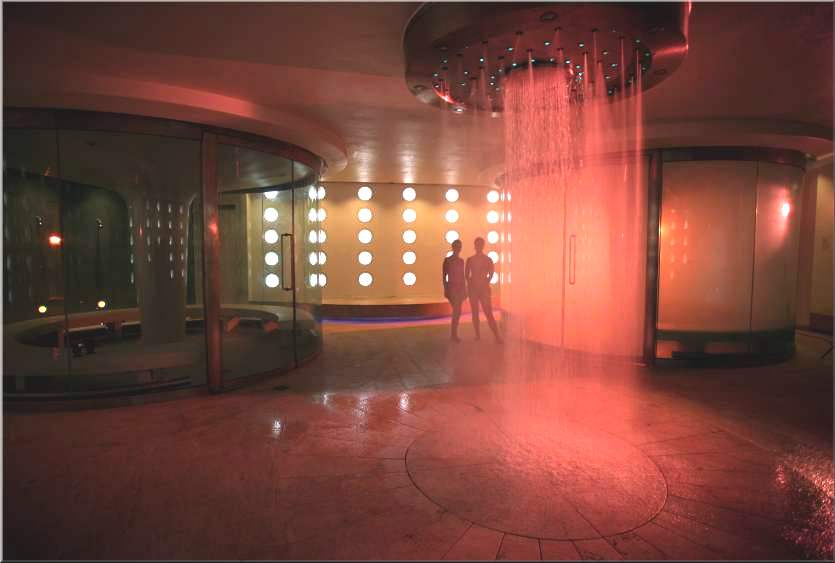
As mentioned last week, I was in Bath from 16-20 October and when in Bath like the Romans I managed to visit the (new) spa complex. The hot pool and steam room were a really welcome free-time treat and at £9.50 - because the rooftop pool was closed - lead the way or should that be "beam us up Scotty!"

Steam Room Thermal Spa @ Bath, UKAfter three days getting to know 26 new colleagues and wrestling with health care issues and the creation of worthy and novel research projects it was definitely time for a break.

The Ideas Factory Taking care to the patient: new thinking in mobile healthcare delivery was very hard work, intensive, challenging and exciting all at the same time. It was marvellous to take part, to share and work together.

At the end there were clearly some sound and winning research proposals: - seedlings - if you like. Those that did not get through were still winners, but as mere 'seeds' they had not yet germinated. All they need is more work and an appropriate funding stream.

I really do hope to stay in touch with people, the range of backgrounds, expertise and experience was startling. Thanks to the organisers, after the first day we all more or less knew each other recognising faces and names. A great way to cross the divide.

And there was I ... thinking it's just a website and blog that has you working into the early hours ...