Hodges' Model: Welcome to the QUAD

Hodges' model is a conceptual framework to support reflection and critical thinking. Situated, the model can help integrate all disciplines (academic and professional). Amid news items, are posts that illustrate the scope and application of the model. A bibliography and A4 template are provided in the sidebar. Welcome to the QUAD ...

Thursday, August 31, 2023

The need for Holism 2.0 ... (c/o Porter, 1997)

 or 4.0?

"Disease became conceptualized after 1900 as a social no less than a biological phenomenon, to be understood statistically, sociologically, psychologically - even politically. Medicine's gaze had to incorporate wider questions of income, lifestyle, diet, habit, employment education and family structure - in short, the entire psycho-social economy. Only thus could medicine meet the challenges of mass society, supplanting outmoded clinical practice and transcending the shortsightedness of a laboratory medicine preoccupied with minute investigation of lesions but indifferent as to how they got there. It was only radicals and prophets who appealed to a new holism - understanding the whole person in the whole society; respected figures with the temple of medical science, including Kurt Goldstein (1878-1965) and René Dubos (1901-82), author of Mirage of Health (1959), were emphatic that the mechanical model of the body and the sticking plaster formula would at best palliate disease (too little, too late) but never produce true health." p.634.


Roy Porter, The greatest benefit to mankind: a medical history of humanity from antiquity to the present, London, HarperCollins, 1997.

INDIVIDUAL
|
     INTERPERSONAL    :     SCIENCES               
HUMANISTIC --------------------------------------  MECHANISTIC      
SOCIOLOGY  :   POLITICAL 
|
GROUP


"The psychiatrization of everything occurred first in the United States. It was a trend deliciously mocked in some of Stephen Sondheim's lyrics to West Side Story (1956), in which the crazy mixed-up New Yorkers taunt the police officer on the warpath:

Officer Krupke, you're really square;
This boy don't need a judge, he needs an analyst's care!
It's just his neurosis that oughta be curbed,
He's psychologic'ly disturbed.
We're disturbed, we're disturbed, we're the most disturbed,
Like we're psychologic'ly disturbed. " p.519.

Socio-Economic Determinants of Health
Social Justice
History
Culture

Police
'the Law'
Mental Health Act
Political determinants of Health


Image - frontispiece in Porter's book "Renaissance anatomical illustrations often followed artistic conventions (situating the skeleton in a lifelike pose in a landscape) and played wittily on the tensions between life and death. The contemplating of the skull prefigures Hamlet's later meditation. Line drawing, Valverde de Hambusco, Historia Historia de la composicion del cuerpo humano, Roma, 1556."

Image source:
https://www.royalacademy.org.uk/art-artists/work-of-art/lateral-view-of-male-skeleton
Wednesday, August 30, 2023

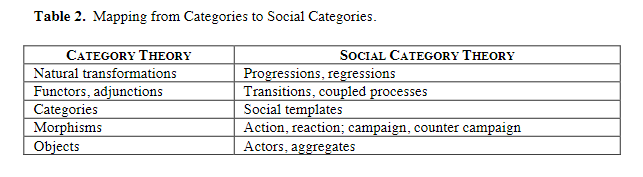
Paper - Categorical Social Science: Theory, Methodology and Design by Sallach (2012)

This conference paper from 2012 - cited at length here - is very encouraging as I try to work on category theory within Hodges' model. This is timely too, as a new (northern) academic year begins - post to follow ...

Sallach, D.L. Categorical Social Science: Theory, Methodology and Design. In: Conference Paper - 4th World Congress on Social Simulation. Taipei, Taiwan (September 2012). https://www.researchgate.net/publication/275584554

"The prospect of representing social processes at multiple scales, at an arbitrary level of detail, is likely to produce rich, interwoven models with the potential to provide a more effective map of historical and policy-oriented dynamics. However, this potential will also raise significant challenges in validating such a model [15].

One approach to managing the complexity (both conceptual and computational) of social models is to move them toward a higher level of abstraction."

"Category theory requires specification of a type of mathematical object in terms of identity, composition, and a group of morphisms that preserves their structure. This definition of objects and morphisms, in conjunction with two standard axioms (associativity & identity), defines a framework that is simple enough to be broadly applicable."

Conclusion:

"The present analysis introduces more analytical potential than can currently be demonstrated. Nonetheless, it makes a case for the relevance of category theory for the representation of social applications, and illustrates a variety of ways in which these conclusions are, or ultimately can become, compelling.

Category theory provides a rigorous yet expressive formalism for representing and integrating challenging modeling domains. It is also a formalism that can support extensive theoretical and modeling syntheses, while still maintaining appropriate levels of exactness. These strengths make CT particularly appropriate for providing a mathematical foundation for computational social science.

Ultimately, it is important to return to the issue of the validation of social models. The practical use of historical and/or policy-oriented models is highly dependent upon their credibility. Category theory provides a formalism that can be precise when applied to theory, explicit during the design stage, and definitive at the assessment stage, while also attending to the consistency of intermediate stages. It deserves serious exploration and investigation."

Monday, August 28, 2023

Mary Mattingly - "Life of Objects" 2013


INDIVIDUAL
|
     INTERPERSONAL    :     SCIENCES               
HUMANISTIC --------------------------------------  MECHANISTIC      
SOCIOLOGY  :   POLITICAL 
|
GROUP


Mary Mattingly - "Life  of Objects" 2013


"Mary Mattingly's work Life of Objects (2013) is part sculpture, part performance piece. It forces the viewer to feel the weight of an irregular sphere of the artist's collected and nearly discarded possessions. The visceral experience of seeing this trash boulder pinning the artist to the floor communicates the harms of overconsumption perhaps more strongly than familiar reminders to reduce, reuse,and recycle." p.278. 
With thanks to: Mary Mattingly - Artist


My source:
Chianese, R.L. Sculpting Science, American Scientist, Sept-Oct 2022: 110;5. pp. 276-281.

Wednesday, August 23, 2023

"Coal Fired Computers" c/o MUTE


"Graham Harwood and Matsuko Yokokoji (YoHa) build
contraptions that expose and collapse down the productive
chains linking telecommunications media to some of the
raw materials that constitute them.
In this interview with 
ANTONY ILES, however,
Harwood rejects theoretical discourses
of resistance in favour of a more direct and technical
method of 'action research' which skirts art and politics." p.159.


INDIVIDUAL
|
     INTERPERSONAL    :     SCIENCES               
HUMANISTIC --------------------------------------  MECHANISTIC      
SOCIOLOGY  :   POLITICAL 
|
GROUP


Poster image for YoHa's Coal Fired Computers exhibition, AV Festival, Newcastle 2010

"AI: Though these projects do not work solely within a logic of 'representation' they do, almost as a side effect, produce awful images. I am thinking in particular of the film still from Aluminium and the blackened lung hooked up to a coal fired computer. If the 'contraptions' you make can be thought of as diagrams of socio-technical relations, what are the qualities of the images they produce? To what extent are these images necessary by-products of the processes.

GH: We can see the images arising out of the forces that threaten to break the machine, or assemblages arising out of its in-betweenness. Its unfinished nature always requires the imagination of the participant/viewer to finish the job, fill in the details. This is a powerful strategy." p.164.


Source: Iles, A. (2011) Double Negative Feedback. In the mud and blood of networks: an interview with Graham Harwood, MUTE. Spring/Summer, Vol. 3, #1, pp.158-171. 

Image: http://yoha.co.uk/cfc

https://www.metamute.org/editorial/magazine/mute-vol.-3-no.-1-double-negative-feedback

Note 'Anti-disciplinary' in this issue too:
https://www.metamute.org/editorial/articles/anti-disciplinary-feedback-and-will-to-effect

Will investigate anti-disciplinary, as this appears to strike a discordant note in nursing in Hodges' model promulgating genericism. A quick check was encouraging leading to MIT Lab, but then disappointing in terms of personnel and resignations - but a lead for the future (inter- multi- transdisciplinary and Hodges' model).

(Yes, second post from this issue of MUTE, a random yet informative purchase. It cost £12.00. Still clearing, boxing, moving ...).

Saturday, August 19, 2023

Evidence-based care: The original Gordian Knot

or - Choose your audience carefully.

Within health and social care (and other - safety-critical - academic and professional fields) evidence-based care is pivotal as proof of safety, reproducibility, effectiveness, efficacy, professionalism, and benefits for the subjects of care and public. How best then to prove the scope, scale, relevance and safety of Hodges' model? How to demonstrate in theory and practice the utility and increasing relevance of Hodges' model? There are times I have to temper my belief, passion and enthusiasm for h2cm; am I too ardent, and at risk of coming across as preaching? There is a further tension. The one that is constant: language.

As a nurse, attention to language and terminology is vital to effective communication, establishing and sustaining rapport and empathy. This concern applies across situations, contexts and encounters; with patients, patient and carer (family), and colleagues. We are encouraged to avoid jargon, abbreviations  and technical terms. I use Hodges' model implicitly (aide-mémoire, assess, plan, evaluation, prioritise) and explicitly - sharing the model on some occasions but not all.

In the role of researcher / author, the audience, especially - editors, reviewers, and readers have expectations in how concepts, ideas, theories are expressed and explained. To a degree, the very title of a publication, preempts the language to follow. As I present, or write, sources must be declared and  referenced. Again, resort to jargon is discouraged. Clarity and brevity are strengths. And yet how likely is it that at least 1/3 reviewers will demand more technical rigour and explanation? If terms are used from other disciplines, the expectation follows that their cross-disciplinary application is explained and argued for, and meanings differentiated.

With potential theoretical underpinnings for Hodges' model to be found in Gärdenfors's Conceptual Spaces, and Meyer & Lands's Threshold Concepts and others (nursing and healthcare no-less); John D. Cook provides additional pause for thought - as I look even further afield:

"When I was in college, I sat in on a communication workshop for Latin American preachers. ...

Another lesson from that workshop, the one I want to focus on here, is that you don’t always need to convey how you arrived at an idea. Specifically, the leader of the workshop said that if you discover something interesting from reading the New Testament in Greek, you can usually present your point persuasively using the text in your audience’s language without appealing to Greek. This isn’t always possible—you may need to explore the meaning of a Greek word or two—but you can use Greek for your personal study without necessarily sharing it publicly. The point isn’t to hide anything, only to consider your audience. In a room full of Greek scholars, bring out the Greek.

This story came up in a recent conversation with Brent Yorgey about category theory. You might discover something via category theory but then share it without discussing category theory. If your audience is well velrsed in category theory, then go ahead and bring out your categories. But otherwise your audience might be bored or intimidated, as many people would be listening to an argument based on the finer points of Koine Greek grammar. ...

Some things may sound profound when expressed in esoteric language, such as category theory or Koine Greek, that don’t seem so profound in more down-to-earth language. Expressing yourself in a different language helps filter out pedantry from useful ideas. (On the other hand, some things that looked like pure pedantry have turned out to be very useful. Some hairs are worth splitting.) 

Sometimes you have to introduce a new terms because there isn’t a colloquial counterpart." ...

 Category theory and Koine Greek: John D. Cook. 

Category theory and Koine Greek: John D. Cook. 
https://www.johndcook.com/blog/2016/06/27/category-theory-and-homiletics/

See also: Applied category theory: John D. Cook

https://www.johndcook.com/blog/applied-category-theory/

Friday, August 18, 2023

23rd UKSS International Conference: Systems: Transition to a Sustainable World

Systems: Transition to a Sustainable World

15th of September 2023 in the Richmond Building, University of Portsmouth

The Conference programme for the 15th of September is as follows: UKSS 2023 Conference programme Friday the 15th of September Time Activity 10.00 – 10.30 a.m. Arrival and registration, Reception, The Richmond Building 10.30 – 10.45 a.m. Welcome by the UKSS President, Professor Stowell, Room 201 10.45 – 11.45 p.m. Keynote presentation, Ray Ison, Read More …

I thought I had posted this news, but it seems not. I'm pleased to do so now and have only recently  booked. As above, the conference is for one day and costs £25.00 while free for UKSS members, which will make you a UKSS member if not already. You can attend in-person or virtually.

As per 2018 when I presented Hodges' model in Portsmouth, I plan to attend physically, visiting Oxford on the way down.

Thursday, August 17, 2023

Identity, entity and continuity - c/o Evans (2009)

"Many things are defined by their identity, and not by any attribute. In our typical conception, a person ... has an identity that stretches from birth to death and even beyond. That person's physical attributes transform and ultimately disappear. The name may change. Financial relationships come and go. There is not a single attribute of a person that cannot change; yet the identity persists. Am I the same person I was at age five? This kind of metaphysical question is important in the search for effective domain models. Slightly rephrased: Does the user of the application care if I am the same person I was at age five? 

A conceptual identity has to be matched between multiple implementations of the objects, its stored forms, and real-world actors such as a phone caller. Attributes may not match." p.90.

"Object modeling tends to lead us to focus on the attributes of an object, but the fundamental concept of an ENTITY is an abstract continuity threading through a life cycle and even passing through multiple forms.

"Some objects are not defined primarily by their attributes. They represent a thread of identity that runs through time and often across distinct representations. Sometimes such an object must be matched with another object even though the attributes differ. An object must be distinguished from other objects even though they might have the same attributes. Mistaken identity can lead to data corruption.

An object defined primarily by its identity is called an ENTITY. ...

Domain-Driven Design
Of course, most "ENTITIES" in a software system are not people or entities in the usual sense of the word. An ENTITY is anything that has continuity through a life cycle and distinctions independent of attributes that are important to the application's user. It could be a person, a city, a car, a lottery ticket, or a bank transaction." p.91.


Eric Evans, (2009). 
Domain-Driven Design: Tackling Complexity in the Heart of Software, Model-Driven Design. Addison-Wesley.
[Emboldened text as per book.]

Sunday, August 13, 2023

History: Hepatoscopy and the Census


INDIVIDUAL
|
     INTERPERSONAL    :     SCIENCES               
HUMANISTIC --------------------------------------  MECHANISTIC      
SOCIOLOGY  :   POLITICAL 
|
GROUP

"Perhaps it was merely an oversight of this historian that he failed to mention another religious practice, hepatoscopy. For this, the Romans down to imperial times relied on Etruscans. Divination from the liver of sacrificed animals was a most complicated business. 


To get the interpretation right required a sound knowledge not only of astronomy but also of anatomy and pathology.

In 1877 at Piacenza a bronze model of a liver was found. It was evidently a model used in a priests' school for teaching the art of haruspicy, and of a fairly late period. On the upper surface are marked sixteen divisions in which are inscribed the names of some thirty gods, some more than once. Each of the sixteen divisions corresponded to a section of the heavens, for the Etruscans regarded the liver as an image of the cosmos, as a microcosm of the universe. The liver, it was believed, exactly reproduced the heavenly firmament with its sacred laws and controlling divinities and its division, first into four, by the intersecting axes and then into sixteen subdivisions." p.87.

 
The Etruscans

"Censuses for purposes of taxation and military service still exist. But not many know that it was an Etruscan king who first legally established such a registration in Rome, from whence, with the rise of the Roman empire, it spread throughout Europe." 

"What this measure was is stated by Livy thus: 'The population was divided into classes and 'centuries' according to a scale based on the census, and suitable for both peace and war." p.146.


Keller, W. (1975) The Etruscans. Norfolk: Book Club Associates. [Cover image: AbeBooks]
