Hodges' Model: Welcome to the QUAD

Hodges' model is a conceptual framework to support reflection and critical thinking. Situated, the model can help integrate all disciplines (academic and professional). Amid news items, are posts that illustrate the scope and application of the model. A bibliography and A4 template are provided in the sidebar. Welcome to the QUAD ...

Tuesday, May 31, 2022

Key Safeguarding Legislation [UK]

I have been catching up on mandatory e-learning for work, which included safeguarding. This included a review of forms of abuse:

Physical abuse
Domestic violence or abuse
Sexual abuse
Psychological or emotional abuse
Financial or material abuse
Modern slavery
Discriminatory abuse
Organisational or institutional abuse
Neglect or acts of omission
Self-neglect  [SCIE]

In addition to the list of legislation below, readers may wish to relate these forms of abuse to the care (knowledge) domains of Hodges' model. 

Remember the model is an idealisation, but it is a very useful starting point for reflection, critical thinking, problem solving, analysis and synthesis.   [ Re. (self) - see below. ]


INDIVIDUAL

|
 INTERPERSONAL    :     SCIENCES               
HUMANISTIC --------------------------------------  MECHANISTIC      
SOCIOLOGY  :   POLITICAL 
|
GROUP

(self)

(self)


"Care Act 2014

Mental Capacity Act 2005 / Court of Protection

Human Rights Act 1998

Domestic violence crimes and victims act 2004  (amended in 2012)

Mental Health Act 1983

Safeguarding vulnerable groups act 2004 amended by Protection of Freedoms Act in 2012

Sexual Offences Act 2012"
(list not exhaustive)


As a means to help understand a situation, the model is applicable in risk and public safety more generally. In assessing risk students often recognise 'risk to self' and 'risk to others', but self-neglect can be a key part of the picture.

 
My source/prompt: E-learning


https://twitter.com/imathematicians/status/1530724466073952261?s=20&t=eF1XRD9HbkSJ2XWWbIk2qQ

Monday, May 30, 2022

1+1=2

INDIVIDUAL
|
 INTERPERSONAL    :     SCIENCES               
HUMANISTIC --------------------------------------  MECHANISTIC      
SOCIOLOGY  :   POLITICAL 
|
GROUP

belief
my purpose


1+1=2

0,1 ...
society
social groups
social networks
1+1= ?

"When people talk about how math is or should be apolitical, because "1+1=2" does not depend on politics and neither does the Riemann hypothesis, it seems that the only math that they can think of is pure math. This line or argument completely falls apart for applied math."  @imathematicians [thread]


My source:
twitter imathematicians

Previously: 'maths' ,  '2 + 2 = ?'

https://twitter.com/imathematicians/status/1530724466073952261?s=20&t=eF1XRD9HbkSJ2XWWbIk2qQ

Tuesday, May 24, 2022

A Panopoly of Panopticons

INDIVIDUAL
|
 INTERPERSONAL    :     SCIENCES               
HUMANISTIC --------------------------------------  MECHANISTIC      
SOCIOLOGY  :   POLITICAL 
|
GROUP


Cognitive (Care) Panopticon:

You're looking at the whole thing now

'a' mind ...


PANOPTICON:
Architectural design
Lines of in-sight

Digital Currency Electronic Payments
[DCEP]


The primary Panopticon:

The community ...

"Jeremy Bentham, an 18th century philosopher and social theorist, envisaged a building designed to allow all prisoners of an institution to be observed by a single security guard. It was called a Panopticon; and in today's world the equivalent will be digital - the emergent property of a swathe of various technologies welded together by a regime intent on total control of billions of minds."

 Panopticoin  [DCEP]


My source:

"China's new 'panopticoin', What Investment, Dec. 2019. p.50.

Saturday, May 21, 2022

Book - "Criminal: How Our Prisons Are Failing Us All"

INDIVIDUAL
|
 INTERPERSONAL    :     SCIENCES               
HUMANISTIC --------------------------------------  MECHANISTIC      
SOCIOLOGY  :   POLITICAL 
|
GROUP

LIFE CHANCES

LIFE SKILLS

(mental) health
learning disability
acquired brain injury
post traumatic disorder
...


Personalised medicine:

"If you use substance 'x' or this class of drugs, then there is a 'y' probability that 'z' will happen." ...
... future ...?

Traumatic Brain Injury Screening
Collective Life Chances

Society ...?

Life Skills 'fit' for 21st C.

EDUCATION
EDUCATION
EDUCATION

Pre-School!
Pre-School!!
Pre-School!!!

equity

Social Justice


I heard Angela Kirwin being interviewed about her book on Times Radio earlier today.

Prisons have changed. Haven't they? Prison reform 'happened'. It is a fact of history after all - Elizabeth Fry et al.? At least according to Social and Economic History GCSE in the 1970s.

Mental asylums changed. They have closed. 

Prisons have (apparently) changed markedly since the 19th - 20th century.

With the 'asylum system' of institutionalised 'care' they share a few things in common..

The 'estate' was Victorian (Winwick Hospital is long gone - leaking, cockroach infested, red carpet at the main entrance - with frequent reference to custodial care and how to change - challenge this.).

Now community care, or care in the community (take your pick) holds sway. 

We are a fifth of the way into the 21st century - can you believe it?

Decades from now will they look at the prison system now and see it as archaic as we see the 'lunatic asylums' pre-20th century (terrible for much of the 20th in fact), and yet we often forget the rationale for their original establishment?

From a mental health perspective what do the social determinants (of health) mean?

Mechanistically speaking, it seems determinism is very much doing its work - too many enter the political system and it's not the one - to represent the community in Parliament.

I've viewed Hodges' model as a resource to highlight parity of esteem at an individual level (physical AND mental health).

Increasing in relevance, I can see its utility in the pursuit of collective parity of esteem.

The most troubling commonality here: care in the community is unfinished. It sort of got started. It fledged, but never took flight.

There were many compassionate, caring, professional staff in the asylums. Exceptional role models. They saw the theory - practice gap. Pointing it out. Aptitude - Attitude. They were the heart in the Victorian shell, even as science struggled (and still does) with the ghost in the machine.

Historically speaking the ‘workhouse’ is closer than we think.

The UK rightly lauds its National Health Service, created in 1948. The Poor Law was also abolished in 1948 (Hillam and Bone, 1999).

Prisons, mental health care, preventive health, health education and community care .. so much still to do.

This sounds an interesting new book too! :-)

Hillam, Christine., and J.M. Bone. THE POOR LAW AND AFTER: workhouse hospitals and public welfare. Liverpool: Liverpool Medical History Society, 1999. ISSN 1364-999x

Friday, May 20, 2022

Join us 6/16 - Virtual tour of The Healing Project's new digital archive

"Join us on Thursday, June 16, 2022 from 12-1p PT / 3-4p ET for a virtual tour of The Healing Project’s brand new digital archive! We’ll discuss what the art, stories, and realities of incarcerated people in the US mean for health professionals’ work to advance health equity in the context of historical and contemporary social justice movements."
 
INDIVIDUAL

|
 INTERPERSONAL    :     SCIENCES               
HUMANISTIC --------------------------------------  MECHANISTIC      
SOCIOLOGY  :   POLITICAL 
|
GROUP

(mental) health equity*


(physical) health equity*

arts
social justice
history
social health equity^
healing communities

incarcerated people
detention
police
health workers
political health equity^


*individual (lived) experience

^collectively experienced (and also 'lived')

Where does violence sit, stand, shout, strike, stun ... in h2cm?

My source: 

Spiritof1848 Listserv WWW.SPIRITOF1848.ORG #Spiritof1848

Thursday, May 19, 2022

Finding motivation ...

INDIVIDUAL
|
 INTERPERSONAL    :     SCIENCES               
HUMANISTIC --------------------------------------  MECHANISTIC      
SOCIOLOGY  :   POLITICAL 
|
GROUP

INTRINSIC

EXTRINSIC
INTRINSIC

If 'you' activate the intrinsic motivation of a people 'here' by extrinsic means, be prepared to suffer the consequences.


Previously:

Conveying the Message: Channel, Noise, Redundancy, Information ...   

Social care ... 


Saturday, May 14, 2022

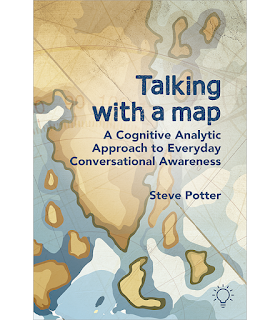
New book: "Talking with a Map"

- A Cognitive Analytic Approach
to Everyday Conversational Awareness

 INDIVIDUAL
|

   INTERPERSONAL    :     SCIENCES               
HUMANISTIC --------------------------------------  MECHANISTIC      
SOCIOLOGY  :   POLITICAL 
|
GROUP

MENTAL MAPS

PSYCHO-THERAPIES


MAPS

PHYSICAL-THERAPIES


META-COGNITION


Fingers-crossed please! 

I've contacted Pavilion Publishing and Media Ltd with a review copy request of this new book - available for pre-order:

"Talking with a Map takes cutting-edge techniques for structuring and navigating conversations out of the therapy room and into everyday life, describing a versatile method that anyone can use to develop better skills, interactions and relationships."

Working with two co-authors three papers will hopefully (yes - cross them again) be complete soon. Then I can resurrect the piece on case formulation, diagrams and Hodges' model. 

If anyone is interested please get in touch:

peter.jones AT h2cm.info

Previously on W2tQ:

map :: therapy

Thursday, May 12, 2022

LMIC: Opportunity to get involved with the National Institute for Health and Care Research, UK

Hello,


We have an exciting opportunity for people with lived experience based in low and middle income countries to get involved with the National Institute for Health and Care Research (NIHR) as funding committee members and reviewers, and we’d very much appreciate your help.


The NIHR is funded by the UK government and is a major funder of high quality global health research. Our next research programme is the Research and Innovation for Global Health Transformation (RIGHT) Call 5 , which is focused on strengthening health service delivery and resilience in low and middle income countries (LMICs) in the context of extreme weather events.


Would you be interested in joining us and giving your recommendations on which research proposals to fund? We are looking for people with lived experience of extreme weather events. Your insights and ideas can help shape research that is important to people living in LMICs, and improve healthcare services for some of the most vulnerable and marginalised communities.


The role of public committee member or reviewer involves reading funding proposals and providing a written summary of reflections. We pay a fee for involvement as a way of thanking you for your support. 

Please complete the Expression of Interest Form and submit this to us by Monday 16 May 2022.

If you have any questions or would like to discuss this in more detail, please get in touch with Razina Hussain at ccfcei AT nihr.ac.uk. 

Thank you and best wishes,

Razina

Razina Hussain

Programme Manager, Community Engagement and Involvement | PPI and Engagement | NIHR Central Commissioning Facility (CCF)

e. razina.hussain AT nihr.ac.uk
Central Commissioning Facility
Grange House
15 Church Street
Twickenham
TW1 3NL

My source: HIFA

Wednesday, May 11, 2022

Social care [ Not... ]

 INDIVIDUAL
|

   INTERPERSONAL    :     SCIENCES               
HUMANISTIC --------------------------------------  MECHANISTIC      
SOCIOLOGY  :   POLITICAL 
|
GROUP


"No minister,
a “protective ring”
was not thrown around care homes"


McKee M. No minister, a “protective ring” was not thrown around care homes doi:10.1136/bmj.o1116