Hodges' Model: Welcome to the QUAD: Search results for engineer

Hodges' model is a conceptual framework to support reflection and critical thinking. Situated, the model can help integrate all disciplines (academic and professional). Amid news items, are posts that illustrate the scope and application of the model. A bibliography and A4 template are provided in the sidebar. Welcome to the QUAD ...

Showing posts sorted by date for query engineer. Sort by relevance Show all posts

Sunday, April 12, 2026

Seminar: 'MedGemma and HAI-DEF: A family of open models'


Dear Madam/Sir, 

We are glad to announce the following seminar: 

MedGemma and HAI-DEF: A family of open models by Andrew Sellergren, Software Engineer & Researcher at Google.

Save the date: 

Thursday, April 16, 2026 - 4:30 PM (CEST) 
Aula Pitagora - MT11 (Cubo 30B), Unical 
Hybrid Format / Live Streaming 

Link: https://dub.sh/medgemma2026

See also: https://goo.gle/medgemma

MedGemma Technical Report

My source: francesco.calimeri AT unical.it

Thursday, July 31, 2025

'Nurse as Engineer' by Josefson

'Engineering' and 'architecture' have both been co-opted by cross-disciplinary explorers to help traverse what are usually cravasses between disparate fields. Or, if not a serious journey - more a day-trip than an expedition, it's an effort to create the impression of progress being (rapidly) made. Fields of knowledge being pulled - fused-together. These are transdisciplinary times:

'Individualization is best achieved in the engineering model, in which cach patient is seen as a unique case. The nurse collects and analyses the patients' data to arriye at a diagnosis, which includes, but is not limited to, issues that concern medical diagnosis and treatment. "The nurse sets obiectives based on knowledge and experience of what is desirable and achievable and designs an individualized care plan by selecting from a known repertoire of nursing interventions those most likely to lead to achievement of the objectives. After implementing the interventions, the nurse evaluates their effectiveness by comparing the client's subsequent condition with previous diagnoses and objectives."

In the last model - the non-routine model, which is a research model - the patient is still seen as unique. The problem is that the search procedures cannot be analysed because more judgement and intuition is required in making decisions.' p.25.

n.b. Two other models are described: the nurse acting as a craftsman; and the routine.

Josefson asks in a section (pp.28-29):

Who draws the boundary between Man and Machine?

Who - indeed!

Ingela Josefson. The nurse as engineer—the theory of knowledge in research in the care sector. In.  Knowledge, Skill and Artificial Intelligence. Bo Göranzon & Ingela Josefson (Eds). (1988), ISBN038719519X. pp.19–30. Berlin, Heidelberg: Springer-Verlag.

In the above paper/chapter Josefson draws upon the work of Katie Eriksson and Judy Ozbolt.

Previously: 'engineer' : 'architecture'

Friday, July 04, 2025

Diagrams - AMO/OMA at Prada Foundation Venice

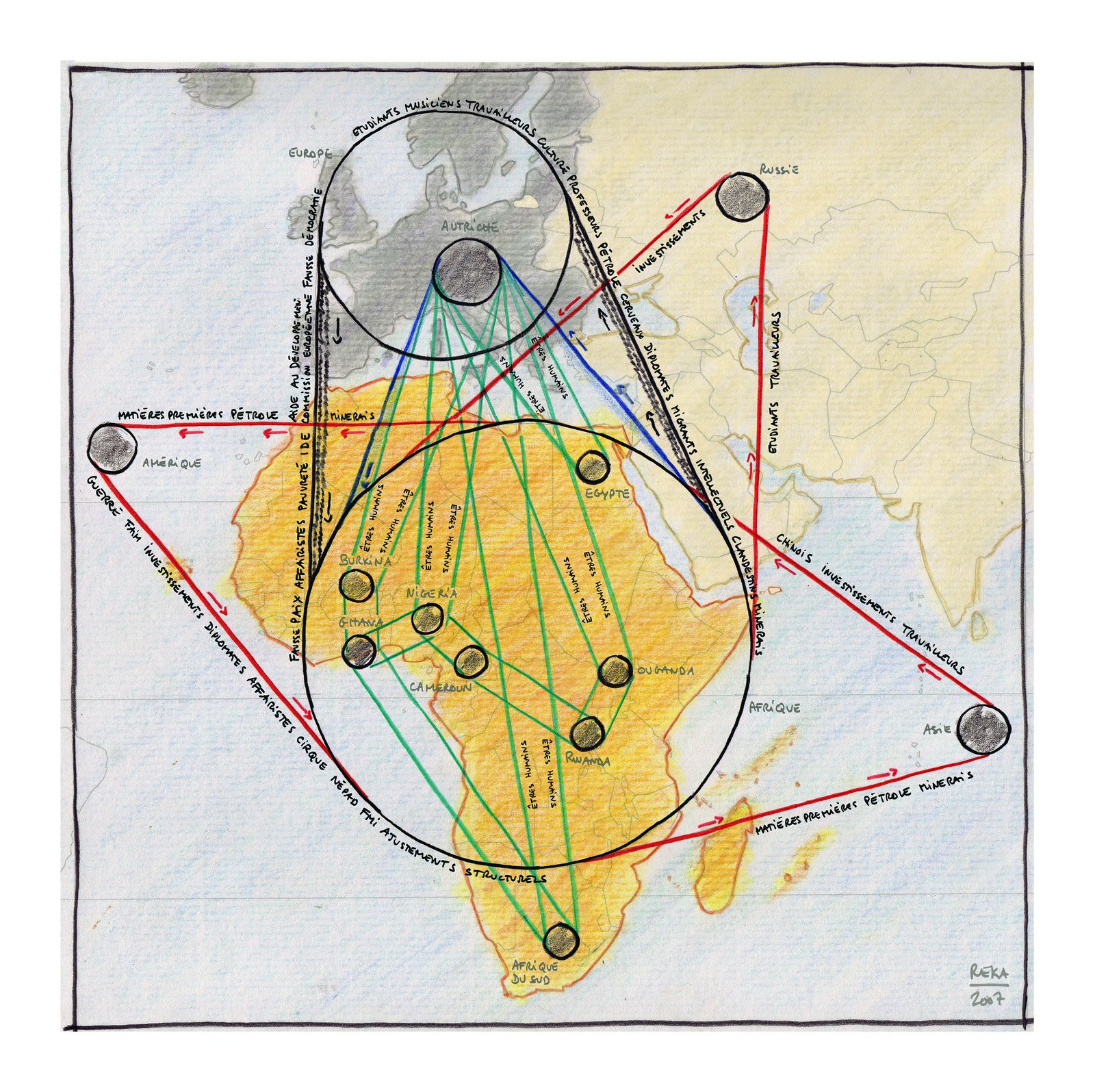
"There is no such thing as an innocent map, observes Philippe Rekacewicz in his catalogue essay that accompanies Diagrams, a new exhibition at the Prada Foundation in Venice.

A renowned cartographer, the Paris-born Rekacewicz is well aware of his medium's capacity to transform narratives for good and ill. His own work includes maps that illustrate the deaths of migrants as they bid for new lives in Europe. "A map," Rekacewicz continues, "is above all a social and political act - and therefore inherently subjective."' p.5.

Individual
|
      INTERPERSONAL    :     SCIENCES               
HUMANISTIC  --------------------------------------  MECHANISTIC      
 SOCIOLOGY  :    POLITICAL 
|
Group
Am I Free?

My history ...
Philippe Rekacewicz / The African big wheel, 2007
The wheel symbolizes permanence and continuity in the context of a profoundly unequal exchange, drawing, color pencil and ink, exhibition copy.
Courtesy Philippe Rekacewicz
(Image credit: Philippe Rekacewicz)

SOCIETY

... is our history ...

Freedom

National & International Law

Justice


'Other pictures are equally revealing for what they conceal. Consider the diagram entitled "Universal commercial history", a visual analysis drawn up by the Scottish engineer William Playfair in 1805 which traces the rise and fall of global wealth since 1500 BC against what he terms "Remarkable Events Relative to Commerce". Playfair, who is said to have invented the pie chart, includes moments such as "Rome founded" "Mahomet's Flight" and "America discovered". He never mentions slavery.

With such a broad-brush approach, lacunae are inevitable. It is a shame that the work of Viennese social scientist Otto Neurath - who, along with his wife Marie and colleague Gerd Arntz, invented the Isotype (International System of Typographic Picture Education) - is not on show. Based on pictograms, Neurath's Isotypes are an lmportant forerunner to the digital vernacular (from emojis to icons) so familiar to us today. Nor does the exhibition include maps of the devastation of Gaza since October 2023, such as those made by investigative research agency Forensic Architecture, which are proving among the most critical diagrams of our time.' p.5.

Philippe Rekacewicz - https://www.grida.no/resources/10988

My source:
Rachel Spence. Hidden truths in the best laid plans. Diagrams | What charts, maps and graphics can - and can't - tell us. Collecting, FTWeekend. 26-27 April 2025. p.5. 
With many thanks acknowledging length of quotation.

Image source:
https://www.wallpaper.com/architecture/oma-amo-diagrams-prada-foundation-venice

See also: 'icon' : 'symbols' : 'diagram' : 'map' : 'Forensic Architecture'

Archived listing Links II Sciences - inc. 'Diagrams' & 'Visualization I' and 'II': 

Tuesday, January 21, 2025

A Voyage in Cosmic Health ... loneliness

Individual
|
     INTERPERSONAL    :     SCIENCES               
HUMANISTIC --------------------------------------  MECHANISTIC      
SOCIOLOGY  :   POLITICAL 
|
Group
[2] 'Most pressingly, Voyager 1 has severe memory loss It stopped speaking clearly on November 14. All they received at JPL was a carrier signal. This was described to me in many ways: flatlining, an interstellar dial tone, useless ones and zeros, gibberish, no data. Imagine your friend is on a long journey and sends you a detailed letter every day, then, one day, empty envelopes start arriving. What happened to your friend? How do you help?' p.21.
[1] 'VOYAGER 1 SUFFERS MANY AILMENTS OF AGE. It has arthritis. During its planetary encounters, the team excitedly swung the camera and other instruments this way and that; this squeezed the lubricant out of the bearings of its articulated platform. Only painstakingly slow movements could loosen its joints. It also has heart disease, as Todd Barber, its propulsion engineer, explained. The arteries that deliver its propellant, which keeps it perfectly pointed at Earth, are partially clogged. Barber calls himself a space plumber and wore a shirt with flying saucers on it as we spoke in the Voyager office. He had considered all the usual cardiological remedies. 
Diet: unfortunately, Voyager eats only the propellant hydrazine, total junk food. 
Exercise: they haven't thought of a way to fire the thrusters to clear the blockage. 
Medication: so they've relaxed its alignment a bit and fire its thrusters less often; in other words, Voyager is on beta blockers.' p.21.

The Sounds of Earth Record Cover - GPN-2000-001978


My source - with thanks - brilliant writing! 

Roeder O. TERMINATION SHOCK. Last Days of a Lonely Interstellar Spacecraft. FT Magazine, August 3/4 2024. pp.18-27. https://www.ft.com/content/0f2dce04-ec78-4aeb-808c-cff5b5135699

https://www.ft.com/content/90b6aaaa-b192-48d9-bd43-e6f41978ad1c

Thursday, January 25, 2018

Conference: The Foundations of Conceptual Engineering

A conference on The Foundations of Conceptual Engineering at NYU, on Sept 14 and 15, 2018. To attend, please register by following this link no later than August 31, 2018.

One dimension of cognitive success is getting it right, i.e gaining knowledge of facts. Another dimension of cognitive success is using the right concept, i.e. framing a topic in the right way. This view, if correct, tasks inquirers with critically examining the concepts they are using and perhaps replacing those concepts with new and better ones. This task is often known as “conceptual engineering”.

The idea that conceptual engineering is an important task for inquirers in and outside philosophy has recently gained traction. Some philosophers think conceptual engineering is an important task for inquirers to pursue.  The conference is focused on foundational issues in connection with conceptual engineering. Topics to be addressed include the following:
  • What are the semantic mechanisms that underlie conceptual engineering?
  • What are concepts, and which role (if any) do they play in conceptual engineering?
  • How can a theory of conceptual engineering be integrated with large-scale semantic theories? 
  • Which precise changes does a language undergo when its speakers engineer concepts?
  • Is conceptual engineering something that speakers can ever purposefully bring about?
  • What is the relation between changing concepts and changing reality? 
The planned conference will focus especially on the semantic foundations of conceptual engineering and push towards a better understanding of the process.

The conference is organized collaboratively by members of NYU (Vera Flocke and David Chalmers) and members of the research project ConceptLab, located at the University of Oslo (Herman Cappelen and Andrew Peet).

 More...

<>

If this conference needs a workshop, a workbench, or conceptual engineering facility they might care to look at Hodges' model. Whether for conceptual brainstorming, requirements, prototyping, refactoring, combination ... Hodges' model can have a role. Some musings in this vein follow...

individual
|
INTERPERSONAL : SCIENCES
humanistic --------------------------------------- mechanistic
SOCIOLOGY : POLITICAL
|
group

One dimension of cognitive success is getting it right,
i.e gaining knowledge of facts.
Another dimension of cognitive success is using the right concept,
 i.e. framing a topic in the right way.
Acceptable to the patient (or advocate) and ethical?
Achieving concordance - agreed 
relevant to the context, issue, problem?
Logical consistency, coherence and permanence?
Holistic bandwidth is tested - semantic scope?
Conceptual Engineering instantiated in software, argumentation? AI? Conceptual Spaces?
Topic is person-centred 
(patient, student, carer...)
Testing: Concepts with positive :: negative are switched - re-framed? 
Other dichotomies? Conceptual slide-rule?
Known 'semantic drift' in vocabulary - concepts: disuse, archaic, new, re-purposed?
Assessment is comprehensive?
Knowledge of 'conceptual engineering' 
how to - rules, laws (mechanisms)?
Concepts were measurable (as were previously defined) quantifiable?
Flagged interdisciplinary use of concept? Transdisciplinary?
Visual tools - representation, diagrams?
Reversible quality: 'engineering' disassembly?
Conceptual dependency on threshold(s)?
Engineering concepts: 
tolerance, project, professionalism, failure, risk, benefits, techne?
'Conceptual engineering' defined units & standards: word, words ... corpora?
Research methodologies, methods?
Literature
Available social sources were utilised, or at least pursued?
Narrative derived from concepts references life history (story)?
Tested and accepted by peers - multidisciplinary team?
Inclusive?
Quality criteria were met
Cultural, ethnic due regard  met

legal?
concepts used were appropriate
 to outcome(s)?
'Space' for uncertainty, constraints, unwise decisions?
Policy influence on language, examples found in health and social care 2008-2018 austerity?
Accords with and assures the Sustainability Development Goals?
'Macro conceptual engineering' - 
Level of required change in health systems: 
new & existing


Saturday, May 21, 2011

The Difference that Makes a Difference: an interdisciplinary workshop on information and technology


Location: The Open University, Milton Keynes, UK

Dates: 7-9 September 2011

Few people would argue that the development of information technologies has had a profound impact on modern society. Information is communicated, stored and manipulated using digital computers, the Internet, and fixed and mobile telephony, resulting in a deep and extensive impact upon all aspects of our lives. While talk of information is routine and unproblematic for engineers and technologists, it has been recognised since the early days of digital technologies that there is an uneasy relationship between the engineer’s concept of ‘information’ and wider uses of the word (cf. Roszak, 1986).

It is nevertheless appreciated that information, whatever is meant by this concept, is important – indeed it is foundational – to a quite remarkably diverse range of disciplines. Information is emerging not only as the new language of science - from quantum information to the genetic code - but as a key commodity of business, a major concern of the state, the front line for crime and crime prevention, the primary arena of technological development, an increasing concern of philosophy, and even a focus for conceptual art. Indeed, it is difficult to identify any field of life in the developed world that can not now be seen to some degree to have a significant information aspect, and to a greater or lesser extent this has all emerged because of developments in information technology.

The idea of information as a distinct concept, applicable across a wide range of disciplines, is growing in prominence. It has been especially emphasised within the natural sciences (von Baeyer, 2003; Vedral, 2010; Davies and Gregersen, 2010) and philosophy (Floridi, 2010). Much of this work takes information theory as developed by technologists, beginning with Shannon (1948), as its starting point, but draws little on contemporary work of technologists. At the same time, a different strand of work has arisen, drawing its inspiration from the growing influence of the Internet, and largely conducted by technologists (e.g. Weinberger, 2007; Brown and Duguid, 2000). This research in turn has little connection with the work in natural sciences and philosophy.

As we move further into the ‘information age’, we need to make the bridge between information of the information technologist and understanding of information in other disciplines. As researchers and practitioners in diverse fields grapple with an understanding of information – what it is, how it can be modelled and tools for coping with it – now more than ever is the time to share insights and bring some clarity and coherence to these differing perspectives.

We have begun some of that work, largely with colleagues around the Open University, resulting in a recent edited book (Ramage and Chapman, 2011). However, these discussions need to go much wider and deeper. We therefore propose to hold an international workshop to bring engineers and technologists together with scientists, philosophers, social scientists and artists – leading thinkers from all and any discipline that uses the language of information – to talk and listen, and to share their insights with us all.

There have been and continue to be many conferences, symposia and workshops addressing the technology, the applications and the consequences of information technology, but it is rare to find opportunities to address the understanding of the nature of information itself.

The need for work addressed more specifically at understanding the nature of information is exemplified by a problem expressed by Terrence Deacon (2010):
For more than half a century we have known how to measure the information-conveying capacity of any given communication medium, yet we cannot give an account of how this relates to the content that this signal may or may not represent. These are serious shortcomings that impede progress in a broad range of endeavors, from the study of basic biological processes to the analysis of global economics.

This workshop seeks to bring together those working with information in a wide range of disciplines - engineers and technologists together with scientists, philosophers, social scientists and artists - to discuss and expand our collective understanding of what we mean by information in our different disciplines. We are not seeking to combine these different understandings, but to share them and to explore commonalities.

The title of the workshop is based on a celebrated definition of information by Gregory Bateson (1972, pp.457-9), who wrote:
A difference is a very peculiar and obscure concept. It is certainly not a thing or an event. This piece of paper is different from the wood of this lectern. There are many differences between them – of color, texture, shape, etc. But if we start to ask about the localization of those differences, we get into trouble. Obviously the difference between the paper and the wood is not in the paper; it is obviously not in the wood; it is obviously not in the space between them, and it is obviously not in the time between them. (Difference which occurs across time is what we call “change”.) ...

Kant, in the Critique of Judgment – if I understand him correctly – asserts that the most elementary aesthetic act is the selection of a fact. He argues that in a piece of chalk there are an infinite number of potential facts. ... I suggest that Kant’s statement can be modified to say that there is an infinite number of differences around and within the piece of chalk. There are differences between the chalk and the rest of the universe, between the chalk and the sun or the moon. And within the piece of chalk, there is for every molecule an infinite number of differences between its location and the locations in which it might have been. Of this infinitude, we select a very limited number, which become information. In fact, what we mean by information – the elementary unit of information – is a difference which makes a difference.
The workshop will consist of four main sessions, each with keynote speakers and a number of presentations from others. Our goal is for maximum participation. If you are interested in the role and nature of information, we invite you to join us in Milton Keynes in September.

Magnus Ramage and David Chapman
Thanks to David for my being able to post these details here. I have registered and if time permits will submit an abstract. I'm really looking forward to this workshop. pj

Jones, P. (1996) Humans, Information, and Science, Journal of Advanced Nursing, 24(3),591-598.

'information' on W2tQ

Sunday, April 18, 2010

Musings in the nursing domain (specific language)

It is one giant leap from the humanistic world of nursing, health and social care to the m(a-e)chismo of information technology. It is no Earth-bound chasm that greets us in considering the vaguest possibility that nursing could ever be captured, distilled and represented in a domain specific language (DSL). Given the full title of Hodges' model my attraction to DSLs should be obvious, but how realistic is this fascination?

Here are some links to definitions / resources on DSLs:

I am not advocating DSLs as a real time clinical software application, there is neither time here, nor on the wards. Since the sky above is clear blue with not a contrail in sight I am indulging in a little blue sky thinking, a reverie...

Nursing already has its concept analysis, but taken at face value this says nothing about domains as per h2cm (other than the context / application is nursing). To avoid confusion with career in the job-work sense, I have emphasized the notion of domains. By this I mean a partition of specific knowledge about a discipline or subject. This disciplinary focus or subject is often the province of expert practitioners. My forte then in Hodges' model are the INTERPERSONAL and SOCIAL care domains. This is my rationale for the musings here, as all experts were learners once upon a time, and are still as lifelong learners. It is an educational application that I have in mind.

I have come across a paper by Reinhartz-Berger, who describes the movement - Towards automatization of domain modeling. The author refers to domains artifacts and domain analysis:
(I have removed the reference numbers and inserted from prev para*)

A domain in this context [Domain engineering, also known as software product line engineering]* can be defined as a set of applications that use common concepts to describe requirements, problems, capabilities, and solutions. Domain artifacts are built and reused through domain analysis, which identifies the domains and captures their ontology to assist and guide system developers with particular applications in those domains. Despite the rapid growth of technologies and technical solutions, domain analysis models usually remain valid longer than domain designs and implementations, potentially justifying the cost and effort required for their development. Domain analysis artifacts may also serve as the basis for defining Domain-Specific Languages (DSL). Reinhartz-Berger (2010), p.491.
As the previous post - Reading the signs... Idealised Care - amongst several revealed, the domains within the health career model are broad to say the least. So broad that from the INDIVIDUAL-GROUP axis the left-hand margin of the INTRAPERSONAL-SOCIOLOGY# care domains are but distant horizons (with no curvature in-sight). It's no surprise that I keep wondering about how to get a grasp on that 'space', for reasons of a website, a potential community of explorers, educational objectives and sheer enthusiasm for trying to mix IT up. Reinhartz-Berger continues:
Several domain analysis methods have been proposed over the years. However, they all can be criticized as making the domain engineer alone responsible for developing correct, complete, and consistent domain analysis artifacts. Since domains may cover broad areas and are usually understood only during the development process, creating domain models can be a very demanding task. It requires expertise in the domain, reaching a very high level of abstraction, and providing flexible, yet formal, artifacts. Reinhartz-Berger (2010), p.491.
Also in the literature Chavarriaga and Macías (2009) highlight two approaches that are the focus more generally to help get a grip and the big wide world of knowledge: The Semantic Web and Web 2.0.:
... However, in spite of its semantic power, one of the main underlying problems with this [semantic] paradigm is the explicit representation and visualization of information, mainly focused on ontologies and the complex relationships that these code. This has made the Semantic Web inaccessible and unmanageable by most designers that are not expert on ontological representations and languages, but on domain specific applications and creative design.
On the contrary, the Web 2.0 paradigm provides a rather pragmatic vision. It is based on the use of wikis, folksonomies and protocols like SOAP, mainly intended to the automatic management of services and the collaborative maintenance of (mainly) syntactic knowledge-based information. Moreover, Web 2.0 can be considered an end-user paradigm. ... Chavarriaga and Macías (2009), p.1329.
The Semantic Web, Web 2.0 will (at some point) figure in the new site. A folksonomy can be quite broad by definition, as there is no strict control on the definition of terms. As to DSLs in Hodges' model, there we have four VERY broad domains. Exactly how domain analysis proceeds and what domain artifacts might emerge from this model would no doubt depend on reducing each of the domains, sub-dividing, being more specific.

If nothing else at present the health career model is a hybrid cognitive domain specific language.

References: (my source: Science Direct)

Iris Reinhartz-Berger (2010) Towards automatization of domain modeling, Data & Knowledge Engineering, Volume 69, Issue 5, May 2010, Pages 491-515. doi:10.1016/j.datak.2010.01.002

Enrique Chavarriaga, José A. Macías (2009) A model-driven approach to building modern Semantic Web-Based User Interfaces, Advances in Engineering Software, Volume 40, Issue 12, December 2009, Pages 1329-1334. doi:10.1016/j.advengsoft.2009.01.016