Hodges' Model: Welcome to the QUAD: Search results for compound

Hodges' model is a conceptual framework to support reflection and critical thinking. Situated, the model can help integrate all disciplines (academic and professional). Amid news items, are posts that illustrate the scope and application of the model. A bibliography and A4 template are provided in the sidebar. Welcome to the QUAD ...

Showing posts sorted by date for query compound. Sort by relevance Show all posts

Saturday, August 22, 2026

Re. 'Population mental health in England, 2003–2022: Teasing apart psychological distress, mental illness and activity limitation'

Last month I was struck reading John Burn-Murdoch's regular opinion piece 'Data Points' in the FTWeekend.

This one 'What's really going on with mental health around the world?' concerned a report:

Henking, C. and Baumberg Geiger, B. (2026), 'Population mental health in England, 2003–2022: Teasing apart psychological distress, mental illness and activity limitations'. ESRC Centre for Society and Mental Health, King's College London.
https://osf.io/preprints/socarxiv/8ygrz_v2

Below I have mapped some points to Hodges' model and added others. 

By accident or not, Mr Burn-Murdoch continued this theme last weekend, discussing pandemic lockdowns and how they never ended for some people (citations below):

individual
|
INTERPERSONAL
: SCIENCES             
humanistic ------------------------------- mechanistic
SOCIOLOGY : POLITICAL   
|
group


Getting stuck in a psychological minima. Becoming fixed in mindset, lack of self-development through others - empathy, rapport. 

Subtle self-harm becoming more serious.

What is character in the 21st C?

Lack of measures.
^Lack of coherence - parity in health policy.

Lack of assertiveness, self-advocacy, prone to self-stigma (non-help seeking!)

Qualitative lived experience becomes self-reinforcing (and other - family?)

Getting fixed with a physique, posture - shaped by technology.
Physical equivalent-complement 
of 'mindset'.

Getting stuck in a physical minima 'long-term'. Subtle self-harm becoming more serious.


'Systems medicalisation'
PROCESSES

Convenience (POLITICAL) of binary responses, e.g. 
DISABLED -------- NOT DISABLED

Search for 'answers' - diagnosis

Search for 'solutions' interventions

Early effect of lack of external play, risk-taking with others, friends - testing - trust.
Lack of social skills.
Impact of social and other media - reduction of stigma.
Social roles models - father-
figure? 

Lack of 'real' socialisation - meeting peers.

Socio-Political Power, hence resort to 'sick role'.

Social media - contribution to self-diagnosis. 

Support inc. Social prescribing: "You're not listening! How dare you suggest walking, gardening, volunteering, discussion group .. as a way to deal with this!"

'It's life - get on with it!' 

The compound effect of 'World News' on young people: cost of living; housing; cost of/access to education; employment options - related to AI; geopolitical events; climate change, state of economics since birth; COVID; housing; and isolation.
'Jobs' for teenagers?
(I had a 7-day paper-round)

 ^Parity of esteem (see above)

Welfare traps - 
especially by age xx

Realisation of the importance of outdoors play. Streets being protected for children.

Early Start Nursery


Imagine four characters called Harlequin meet for dinner. Halfway through another Harlequin gatecrashes the party, called spirit, then add psychiatry, anti-psychiatry, psychology, service users, policy-makers, the pharma-industry and education to the guest list and you are set for a marvellous time.

My source: John Burn-Murdoch, What's really going on with mental health around the world? FTWeekend, 11-12 July 2026, p.10.

John Burn-Murdoch, Pandemic lockdowns never ended for some people. FTWeekend, 15-16 August 2026, p.8.

Previously: 'young people' : 'mental illness' : 'behaviour' : 'Serres'

Tuesday, May 05, 2026

iii Picking up sticks: when axes matter

It is one thing for us to break the stick, but quite another from a concept's perspective. They are accustomed to the dynamics at work, when as search terms they are exploded, or not. And, not just any concept but one that can be unique. Consider the concept, and how or where it finds itself [ in Hodges' or another model ]? Let us use the intra-INTERPERSONAL domain, as an example, and ask:

  1. Is 'mood' fixed by the I-axis alone?
  2. Does the humanistic axis have a role in where in the doomain the user of Hodges' model places 'mood'?
  3. Acknowledging person-centredness, if the patient/client had a view, to what extent would this agree (with annonymity assured) with the professional's judgement, or a relatives / guardian?
  4. What is as a result, 'mood' has become 'very low mood'? (To continue in this vein , invites complication, but we will continue.)
  5. Introducing the 'Other' whatever their role and relationship, pushes us to the humanistic, but whether this is achieved in a person-centred manner (triage excluded) is a matter of opinion and judgement (evaluation).

If mood is fixed by the I-axis then if we determine the issue is 'low mood' are we introducing a combined quantitative and qualitative dimension, a continuum, at the selected point in the interpersonal domain? Writing previously about threshold concepts, I wondered, and proposed compound threshold concepts. There is a progression from the patient's subjective self-assessment, to in all likelihood of an objective measure being introduced, so spanning two domains. Definition of 'compound' aside; there is a compound structure at work.

What points 1-5 above reveal is triangulation. When it is argued that Hodges' model facilitates navigation as per my presentation on 21st April, this is a strategy from mixed-methods research in practice. Many years ago, Hodges' model was described as a 'cognitive periplus', reflecting the way ancient mariners initially charted the coastlines creating the first map, as per their culture and dispora. In the west more recently the value of social approaches and activities, especially in mental health. Care navigation is a role. Literally sign-posting to individually suited (which must be stressed) activities, resources, and agencies. So, in Hodges' model what are our three triangulation points? They are:

  1. Axial;
  2. Intra- InterDomain; 
  3. Person-centred. 

Perhaps, we can describe 1-2 as conceptual anchors at least when dealing with a concept, while #3 is more about approach, values and philosophy. So, there is something of a 'cheat' going on, because each one is compound:

1. Axial: The axial is comprised of four points. The axes create a Cartesian plane (figure). And, as far as a patient is concerned, they mark off a point on the respective Individual and Humanistic-Sciences parts of the axes. This form of triangulation point can claim a general conceptual precision (language) in the applied terminal labels; but what happens in-between can be patently fuzzy. A mix of what may be objective and subjective.

2. Intra- Interdomain: This may be the most imprecise triangulation point. It appears the axes of Hodges' model are composite (figure). They have two-sides as a boundary. To be pedantic, in our example, one plays to the interpersonal domain, the other the sciences.

[The relationship between the axis and the domains in Hodges' model, is far from unique; but I wonder if there is something else here?]

2. Person-Centred: There is a paradoxical nature to person-centred(ness). It is also nebulous in nature, and yet in care it is definitive in practice (safety, purposes, values, professionalism, competency, ...).  It forms locus which can also be classed as a traingulation point, at the centre of the model. This is the point around which Hodges' model is built. This captures the individual's (life, care) context and situation, all influenced by their life chances as consequent health - and other - careers. Salience and our attention^ is key. Is it possible to frame our purpose(s)?

^A focus for [N] autumn.

Marrakech, Le Jardin Secret. 24th April. 1000-1830.

Monday, February 23, 2026

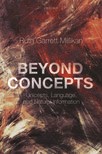
Millikan's Unicepts and Unitrackers

An underpinning theory of Hodges' model must help us make sense of what is happening within the care domains, between the domains, and possibly say something about what may be significant relation[s]-ships that are diametric. Arriving at threshold concepts I wondered in Hodges' model about there being compound threshold concepts. Consider, when 2-3 thresholds are (b)reached in one (the sciences) domain? Contrast this then, with 4-5 thresholds across care domains? There may also be care concepts applicable that are for example, person-centred: that is, patient, carer, 'management', or policy defined? These concepts while not threshold related per se, are nonetheless relevant.

I came across the work of Ruth G Millikan in London, several years ago as I followed 'epistemology' around the shop. It is time to pick this up and earlier work:

Millikan, Ruth Garrett. “Biosemantics.” The Journal of Philosophy 86, no. 6 (1989): 281–97. https://doi.org/10.2307/2027123

https://www.researchgate.net/publication/235734046_Biosemantics 

INTRODUCTION TO PART I

0.4 Unicepts and Unitrackers

'Neither the clusters in the world nor their properties are found at the sensory surfaces. The properties characterize distal objects and events. They are manifested in diverse and irregular ways through signs impinging on the sensory surfaces, energy patterns that are contingent on shifting intervening circumstances.' ...

'A unitracker is a mechanism or faculty for same-tracking something, for recognizing when incoming information concerns it, then linking and storing this information together as information about one and the same thing. Only then can it can be brought to bear together on inference and action. The link connecting stored information about the same thing together is a "unicept." The information is recognized, paradigmatically,by the initiation or strengthening of an intentional attitude of credence, which we tentatively model as a temporary or enduring connection between the unicept and unicepts for other things.'

'Both unicepts and unitrackers are particulars. You and I do not have any of the same unicepts or unitrackers. What we have in common is unicepts and unitrackers for many of the same things.' ...

'Unitrackers are same-trackers used for collecting knowledge about their targets.' pp.7-8.

Millikan, Ruth Garrett, Beyond Concepts: Unicepts, Language, and Natural Information (Oxford, 2017; online edn, Oxford Academic, 19 Oct. 2017), https://doi.org/10.1093/oso/9780198717195.001.0001, accessed 16 Feb. 2026.

Wednesday, November 12, 2025

The INDIVIDUAL ↔ GROUP axis

Looking at the axes of Hodges' model, specifically the INDIVIDUAL ↔ GROUP axis, I realise (as ever) there's more than meets the eye. 

The labels for the axes are placeholders. To a certain degree they are open, flexible. In the template (link and figure in the sidebar), the what should now be familiar labels are provided for guidance, and convenience.

The care, knowledge domains can be viewed as giant - compound placeholders, even as an opportunity to abstract away a lot of detail. In care delivery, as we concentrate on patient care, , clinical interactions, procedures ... we tend to do this in political terms. Until that is, we are jolted to the wider situation and the true realities of policy, law, and practice.

While the HUMANISTIC ↔ MECHANISTIC labels are fixed, I've often shown how the I ↔ G is itself situated, so you could variously have (titles & names to follow...):

person, self, I, individual, client, patient,
carer, student, nurse x, dr y, allied health z ..

|

nurse .., husband, wife, partner, kin, couple, guardian, friend, family, team, group, community, region, nation, populations, Planet

Usually, what we have is a ONE-TO-MANY relationship, that is 1:N.

In Hodges' model can we also say that the team is the 'individual' and the organisation the group?

Another thought regarding self-care. ... Some times this state might be concurrent with being a patient.

Part of the journey in a patient's recovery. But at some point the person does not need a professional and is indepedently self-caring. Care episodes are not what they used to be. Although when 'true' self-care is achieved, it might appear One-to-None, but this is not correct. Not correct, that is, if we can credit society acting as a safety net. Usually, it would be One-to-Family; if there is no family, then the One-to-Community should (must) be the placeholder of choice.

On self-care, and the vertical axis of Hodges' model, is this also a way to define sustainable health and social care?

See also: https://hodges-model.blogspot.com/2025/10/l-shaped-model.html

Sunday, December 01, 2024

ii Comparison and Contrasting the Meikirch Model and Hodges' model

Meikirch Model

Quite some time has passed since June 1st and part 1. I don't think this post can wait 18 years like that preceding! It is good to see '(Biologically given) potential' emphasized in the Meikirch Model; and the arrows which refer to:


'Whenever the five components and the ten complex interactions (double arrows) cooperate in a purposeful way, health may result. More specifically, a person is healthy, if by the two potentials she or he is in a position to respond satisfactorily to the demands of life.'


The interactions are explained in more detail. Mental health (illness) is there in 'personally acquired potential', but I wonder if it needs to be more explicit? Although, is this a welcome 'break' from the mind-BODY Cartesian divide and its legacy? A shift that enables a more constructive (less stigmatizing) formulation?

Given the climate crisis and experience of COVID, we can hopefully retain a sense of our individual proximity to the environment and green spaces. The importance of access to 'green spaces' seems to be sustained, even if action on air quality (and plastics in the environment) is still playing catch up with WHO air quality recommendations. The interdependence of nations and geography crystallizes more each month. The need for international cooperation apparent in cities, such as Lahore (1). Pollution and smog in Pakistan depends on what happens in India. Water flows, the how, when and whether is noted as a potential trigger for future conflicts.

Both models, the Meikirch, and Hodges' are of course idealizations. As such there are inevitable limitations, assumptions, pros and cons. Like many concepts, environment is a compound or expansive term. Simultaneously, from a primary meaning, we can proceed from the physical environment, to the social, political and the mental environment that these invoke or foster. 

In the SCIENCES domain of Hodges' model we are in 'a' - the environment. Physical reality presents itself in raw and fundamental terms. Across the world climate change is threatening many homes and places a stress the importance of 'shelter' and the homeless. Natural disasters, and acute local weather events which are now repetitive disrupt life and population. Conflicts continue to displace people, climate refugees will follow: (https://www.unhcr.org/refugee-statistics). Contrast this with the ideals of housing design that is sustainable and also enables occupants and communities to feel the environment. 

'Ecosystem' is being applied in ways beyond its original articulation. This past N. summer-autumn reading and reviewing -

Capra and Luisi's (2014) The Systems View of Life - A Unifying Vision.
(i) https://hodges-model.blogspot.com/2024/09/i-systems-view-life.html

- there was much emphasis on complexity, ecosystems, emergence, education, and obviously systems.

In their model, Bircher and Hahn incorporate Complex Adaptive Systems (CAS).
https://meikirch-modell.ch/wp-content/uploads/2017/12/Health-and-diease-as-CAS.pdf

This is helpful as the ecosystem is transformed, before our eyes. Clearly, there isn't one ecosystem, but several and they are all dynami: even if, outdoor clothing and car manufacturers want us to believe that we can create our own private ecosystem that is trans-portable. Systems are like the whirls in moving water, they come and go. Ironically there are now more opportunities to study them - if we so choose. Now weather events reveal the risks of people trying to sustain these mindsets when a local catastrophe strikes. The website for the Meikirch Model includes the table below. 

Theories Concerning
Health and Disease
Type of thinking Epistemology Means for comprehension
Prescientific Personal experience Intuition
Scientific: Meikirch-Model
Scientific argumentation Rational mind

This is constructive as models should encompass what can be presented as 'knowledge' and from there: data, information, facts, myth, wisdom and folk theory. Intuition is listed as a prescientific 'means for comprehension'. Intuition is highly subjective, in contrast to the (supposed) objectivity of the sciences. Intuition is nonetheless significant in mental health care - psychotherapy, and in truth more generally (interpersonal skills); even if it remains 'unscientific' and an enigmatic phenomena. 

On twi/X and here on W2tQ, I've suggested that the bio-medical, and the biopsychosocial models are inadequate as conceptualisations for healthcare and education. We need to fully encompass the subjective and humanistic dimensions of health care and lived experience, giving more attention, if not credence to 'personal experience'. In England and Wales these past months and to follow our parliament has been debating assisted dying for people with terminal illness. Both sides acknowledge the sorry state of palliative care. Policy and ethics - hence the politics of health needs to be explicit in a model of/for healthcare.

Working in mental health you quickly understand how critical it is being able to relate to others, and  develop therapeutic relationships. Get this wrong, and problems may follow. If interpersonal - communication are essential to a health professional's knowledge then awareness and competence in relational skills are also key. In the past two years or so, I've realised the importance of this for Hodges' model and trying to develop a theory to underpin Hodges' model. I believe that this is a strength of Hodges' model. So we need to extend the table above. 

Individual
   |
      INTERPERSONAL    :     SCIENCES               
HUMANISTIC  --------------------------------------  MECHANISTIC      
 SOCIOLOGY  :   POLITICAL 
|
Group

choice - life style

reasoning - rationality

my literacy - responsibility

mental illness - fear of stigma

intuition / subjectivity


geography - environment

air pollution - smog & plastics

traffic regulation - metrics

Planetary health

'truth' objectivity

community - relationships

culture

social systems

family

social (all) determinants

international cooperation

transparency / accountability

policies - funding

determinants of health

reporting - citizen science


As part 1 started, I will finish with the title of the paper that prompted these reflections:

Bircher J. und Hahn E. G., (2017). Will the Meikirch Model, a New Framework for Health, Induce a Paradigm Shift in Healthcare? Cureus 9(3): e1081. DOI 10.7759/cureus.1081 

The Meikrich model is not alone in seeking to facilitate and deliver a paradigm shift in healthcare; and, at individual, collective, planetary levels, across social care and education and the disciplines - old and new.
 
(1) https://www.independent.co.uk/climate-change/news/pakistan-lahore-air-pollution-schools-shut-aqi-b2640783.html

Saturday, November 30, 2024

"Integrated - care": What's in a word, or two?

This blog post was sat in 'drafts' since 28/01/2007 (yes, I know what that suggests). It concerns an issue, or more properly a theoretical and experiential aspiration in health AND social care that should in truth have provoked many papers for Hodges' model by now.

In the almost 18 years since, I wonder about the total number of papers devoted to this subject, the service's delivery, policy, outcomes, reviews and reports on integrated care? In nursing theory, philosophy and the start of many 'learned papers', it is customary to begin with a definition of terms. What happens when we divide 'integrated care' and first treat integrated and care separately? Does this aid our understanding? Do we divide and conquer? Is there a difference in results? Conceptual analysis would see us do both, and conduct a literature search.

In practice, (and clinical - especially) we often use words in rather lackadaisical way. Not surprising really, after all we've got a job to do! When pronouncements are made regards health and social policy I hear it as good intentions. I also reach for my soap box. It is often hyperbole, rhetoric. The same applies to the related idea and ideal(?) of holistic care, and person-centredness. I'm biased, of course, but I believe that Hodges' model can help to scope, and define these idealised features of health and social care (and education). As noted, people don't have the luxury of time to stop and deliberate on the precise meaning of the language they routinely use. As noted, at the end of the day - if it gets the job done then that's sound.

In a poll of words that are both much used and the meaning taken for granted integrated must be near the top for several reasons:
  • its seniority: it has been around for decades.
  • its scope across sectors and day-to-day life.
  • our dependence on its fulfillment.
N-Gram suggests some possible insights into integrated and related forms of care:


https://books.google.com/ngrams/graph?content=integrated+care,holistic+care,person-centered+care&year_start=1800&year_end=2022&corpus=en&smoothing=3 
[Trying to embed, results in 1/3 white space at the bottom?]

It seems that integrated care [IC] has been a standing agenda item in health and social care media, education, the workforce, conference, exhibition and policy for several decades. Perhaps, things have calmed somewhat? So either IC is either very important, complex, a hard thing in practice or maybe it's all of these and more besides? IC is a undeniably a compound concept. Is this a cop-out though? You declare something 'compound' then sit back - job-done? I've suggested the same of threshold concepts in health (and probably other contexts?). Time will tell. In the meantime I have reflected on 'integrated care' across the domains of Hodges' model:
self
|
INTERPERSONAL : SCIENCES              
humanistic ------------------------------- mechanistic
SOCIOLOGY : POLITICAL   
|
other
INTEGRATION OF:
PRACTITIONER; Team; service; org... Philosophy*
assessments
threshold for acceptance into service
(referral criteria)
patient experience & engagement
health education / literacies programmes
spiritual
research involvement

INTEGRATION OF:
health record (e- or paper)
location - team base
care disciplines
geographical area
referral sources
assessments - tools/scales
data and statistics
research involvement


INTEGRATION OF:
HEALTH & SOCIAL CARE
public engagement
hospital 
carer (parent/guardian) experience
community services
social care - NHS
family experience
public engagement in research
Patient / Public Community Advocacy
Treat demand :: Support prevention


INTEGRATION OF:
funding
leadership / management
accountability - complaints
(not the same thing!)
outcome measures
ILLNESS - PREVENTION / education
self-care <> planetary care - 
Sustainability
assisted dying! palliative care!
Public - Private - Voluntary Sectors
Provider :: Purchaser [Systems]
All-Party Parliamentary Groups^


*ethics, values.
^One aspect of so-called 'joined-up government'.

Tuesday, July 18, 2023

studium and punctum c/o Rose (2012)

'Care' as a Photograph - duality . . .

Visual Methodologies
"It is as if the Photograph always carries its referent with itself, both affected by the same amorous or funereal immobility, at the very heart of the moving world; they are glued together, limb by limb, like the condemned man and the corpse in certain tortures." [Barthes 1982: 5-6] p.121.

 "The referent is there in photographic images in ways it is not in other sorts of visual imagery, Barthes argues. And a result, he suggests that photographs can be interpreted in two ways. First, there is a level of the studium, which is a culturally informed reading of the image, one that interprets the signs of the photographs. But he says that some photographs produce a different response, which is a second kind of reading, by containing what he called a punctum. A punctum is unintentional and ungeneralisable; it is a sensitive point in an image which pricks, bruises, disturbs a particular viewer out of their usual viewing habits. And he went so far as to suggest that 'while the studium is ultimately always coded, the punctum is not [Barthes 1982: 51]. That is, there are points in some photographs that escape signifiers and shock the viewer with their 'intractable reality' [Barthes 1982: 119]. And while shock is something that most adverts aim to achieve, it is the case that recent advertising is relying more and more, not only on the transfer of meaning between signs, but on the evocation of a feeling or a mood attached to a brand that is difficult to analyse using semiological terminology." p.122.


On twitter* @h2cm over the years I've noted a certain stance, an aversion even, to generalist approaches in nursing (as suggested apparently by Hodges' model). The simplicity of Hodges' model in its template (basic) form belies how the model can address both generalist and specialist practice and theory. Bluntly: choose your domain; slice, dice and drill as you wish. 

Rose's reference to Barthes, in-particular studium and punctum stands out. We can equate the former with the situation as found, the clues provided in the referral details, the initial cues, data and information gleaned upon assessment. What might be expected, so to speak, including assumptions. 

But the punctum, may be described - interpreted in person-centred (yet professionally balanced) terms. Especially in assessment, planning, intervention and evaluation. The punctum signifies salience: what is important to this person. If the academic emphasis is upon ‘reflection in action’, ‘reflection on action’, ‘single loop learning’ and ‘double loop learning’ (Schön, 1987), can the punctum represent empathy, rapport, the sustenance of dignity and respect, an individual's sense-making? 

Our photograph, taken through Hodges' model is comprised of four frames. The photograph is  compound, and with several exposures it can be animated.^ When played, it reveals a hint, a fraction, an interval in an individual's (potential) health career. A light upon the several-fold determinants of health and their influence and impact upon life chances experienced and exercised to date - and to follow (climate change). 
 

Rose, G. (2012). Visual Methodologies: An Introduction to Researching with Visual Materials (3rd ed.). London: Sage. PB. [Now in 5th edition.] Image - Amazon.

Schön , D. (1987). Educating the reflective practitioner. San Francisco, CA: Jossy Bass. 

*Yes, I know.

^The Producer - Director depends on your Spiritual stance.

Rose (2012) now with student nurses [on placement from Chester University].

Saturday, September 17, 2022

What's in a word - 'hysteric-al'?

 INDIVIDUAL
|
 INTERPERSONAL    :     SCIENCES               
HUMANISTIC --------------------------------------  MECHANISTIC      
SOCIOLOGY  :   POLITICAL 
|
GROUP
Hysterical:
Exploding the Myth of Gendered Emotions
Pragya Agarwal
"Rolling resistance is a compound of two factors: hysteric and dampening losses. Hysteric loss is the energy surrendered when a soft tyre deforms; as pressure rises, deformation decreases, therefore diminishing hysteric loss." p.17.


Sources:

Book - various.

Bates, D. How time lords win race against clock. Sport, Cycling, The Times, 17 September 2022, p.17.

Cycling image: c/o @DavidSBates

https://twitter.com/_DavidSBates/status/1570789552985632771?s=20&t=KPyb7YjvVHMZhuvtAFDa7A

Wednesday, April 13, 2022

c/o Gärdenfors: "Events and Causal Mappings Modeled in Conceptual Spaces"

Personal circumstances mean that over the past decade I've given up on several memberships and hence the benefits that were to be had. The British Computer Society was invaluable, and I'm sure still is even at the 'Associate' level. In addition to the Nursing Specialist Group, the Expert Systems Group, Medical Informatics, SocioTechnical and a Methods group have proved an engrossing distraction and a more remote source of ongoing interest. I'm not sure if this is persistence, or stubbornness, but it surely qualifies as sustainable - as I hope this blog demonstrates.

Following the workshops in 2012, and 2016 on Conceptual Spaces I checked online for developments. Amongst the results a paper (added to Zotero):

"Another field of learning that is required for robotic reasoning
about causation and for communicating, for example in a
planning situation, is action categorization. Representations of
actions in terms of conceptual spaces, such as those proposed
by, for example, Chella et al. (2001), Gärdenfors (2014), and
Gharaee et al. (2017a,b), provide a potentially fruitful method for
implementations. Simulating an action and then using the event
mapping that has been learned to predict a result vector, can then
be used to generate plans and to reason about complex situations.
In this way, simulations can provide the robotic system the power
to imagine events that is needed to understand the physical, social
and, eventually, the emotional world we live in.

The event structure has not yet been implemented in any
concrete system. However, a cognitively motivated architecture
for holistic AI systems, including robotic ones, that integrates
machine learning and knowledge representation has been
proposed in Gärdenfors et al. (2019). The central idea of the
proposal is to use ‘event boards’ representing components of
events as an analogy to blackboards that formed the backbone
in some earlier AI systems." p.8. [with my emphasis].


For years - ever since learning and applying Hodges' model I've been carrying a requirement - a project. As Prof. Gärdenfors notes blackboards were an approach artificial intelligence systems, plus frames, cases, neural networks and others. The Health Career Model can be viewed as a series of boards, frames, conceptual spaces and compound threshold concepts. With so many purported forms of informatics and literacy, h2cm can ultimately represent the general state of affairs. It is situated (previously):

h2cm = 'GI - General Intelligence'?

'general problem'

Englemore, Robert; Morgan, Tony (1988). Blackboard Systems.
Addison-Wesley. ISBN 978-0-201-17431-1.
McCord Nelson, Marilyn / W.T. Illingworth
(1990) A Practical Guide to Neural Nets.
Addison-Wesley, ISBN 10: 0201523760.

Over the years, I've been asked about the number of books on shelves and boxed. This week on BBC Radio 4 or Times Radio(?), I caught a snippet of how we hold on to books and why. Your library: can be part of your identity. 

Knowing the life story of a resident in a nursing home, they may be comforted carrying a book; if staff can manage their anxiety about its potential use as a weapon in the event of an altercation. Having several books on a window sill [they do have a window?], can help. The light damage to the book pales in contrast to the reduced anxiety.

I realise what books mean to me - on 'display' even though nobody else sees them and even as I try to reduce the count. I still hold on to some cherished titles, and will return to those above. Originally, I picked up the Health Career Model and created the now archived website, so it would not gather dust on the shelf. Without action now though - there isn't much difference.

Gärdenfors P (2020) Events and Causal Mappings Modeled in Conceptual Spaces. Front. Psychol. 11:630. doi: 10.3389/fpsyg.2020.00630


Friday, December 11, 2020

Book review: "After Ethnos" iv

After Ethnos

The nurse literature has drawn attention to transcultural nursing and ethnography in nursing theory and practice. There are books, conferences, societies, journals - papers, dedicated posts and a history derived from Madeleine Leininger's model. While tempted, I'm not about to go off-topic, suffice to emphasize the initial point about nurses being 'anthropologists' and the conceptual scope of Hodges' model.

Rees provides reassurance in this respect. As mentioned, be it lines, contours (p.41), theory, practice or concepts all play a part in avenues to disrupt, break away, escape. 

 Within this (for me) movement and moment are equivalent - leading to surprise, discovery, recognition, observation ...

"Put in a formula, the idea is to render visible ruptures and mutations of established conceptions of the human (an analysis of movement) by way of bringing into view how instances in the here and now derail and defy the normative conceptions of the human (or other things, really) that are silently transported by the analytical concepts on which anthropology thus far has relied (in terms of movement).

The form such analysis of movement / in terms of movement would take is what I refer to as exposure: the exposure of oneself, of one's analytical categories, of the established conceptions of the human that are built into these categories, in one's fieldwork/research. The task would consist in immersing oneself into scenes of everyday life in order to let the chance events that make up fieldwork/research give rise to an unanticipated, unforeseen difference." p.41

"... I mean a discovery of a space/a realm, the dynamic of which - its speed, its velocity, its logic of composition - is no longer reducible to this conceptual history, that escapes it." p.42.

I'm sorry to interpret this text in terms of Hodges' model, but I noted; "h2cm as a carrier for the 'human'". Perhaps this book can prove as pivotal and thought provoking for you?

From a health perspective I see irony in Rees's talk of new concepts and their emergence. (The book is about finding this opportunity and if not creating the opportunity?) In healthcare at present we seem to be suffering 'conceptual churn' as terminology (concepts) is called into question. Perhaps this is facet of (academic?) and the everyday life to which Rees refers. This is why and how Hodges' model can help assure 'carriage' and person-centredness that is experiential (clinically and ethnography?).

Yes, the center of Hodges' model can be a scary place too. Research in the 'open' (p.51). I'd like to think some people may find this blog and my 'take' of Hodges' model somewhat abstract if not theory-laden (I do make things more complicated than necessary). I know I need data, data, data in order to propose Hodges' model as evidence-based (with a theoretical underpinning). Rees differentiates (somewhat) between theory and theoretical and admits due to the mission to a certain disregard - disrespect for theory (p.52). This is music to the four (five -- spiritual) domains: Foucault (1972) - the echo, 'theory as a prison.'. The paradox - 'after ethnos' as a theory - is recognised too.

Rees signposted to specificity within anthropology and books on bees, insects, and cheese. This reminded me of the extracts I had heard of Sheldrake's 'Entangled Life' on fungi (roots, biomass volumes Vs human-made). I noted 'compound' but added 'compound fracture'. Philosophers may enjoy the discussion on epistemology with emphasis upon ontology. Health and medicine figures here too: public health, Pasteur, microbes, malaria (evidence back in time: the bones often have it?). Ethnoi also; what is the unit of analysis in Hodges' model (single concept, conceptual space, threshold concept, pattern, schema ...?

Rees quotes Descola (2013, xx) that includes:

"Anthropology is faced with a daunting challenge: either to disappear as an exhausted form of humanism or else to transform itself by rethinking its domain and its tools in such a way as to include in its object far more than the anthropos: ..."

 On page 65, "Latour is exemplary here. ... the distinction between nature and culture has, insofar as it runs diagonal to how the world is, ..."

Very diagonal:

 individual 
|
INTERPERSONAL : SCIENCES
humanistic ----------------------------------------------- mechanistic
SOCIOLOGY : POLITICAL
|
group
modernity (individualism...?)
nature
culture
modernity (capitalism...?)

The present to follow Latour early in the book, is reference to Michel Serres (p.85). This really warmed me. Ensembles - assemblages are clearly structures, forms to add as units of analysis in Hodges' model..

Despite my initial rock onto the back-foot, there is so much I can still draw upon here (bio-politics). Chapters 4 and 5 deserve re-reading. This is a brilliant book. Clear typology, comprehensive index. Prescient too, even though pre-COVID: with SARS and reference to avian and swine flu.

I hope to return to the notes at some point in the future.

Thank you again to Duke University Press for the review copy.


Saturday, November 02, 2019

Healthcare & Nursing: A select sport

Ed Smith: ‘We can’t risk stars’ mental health by playing too much’

Gruelling summer proved to England selector that player welfare is critical

Apparently, cricket is a late arrival to team building around a strong core and leader and then using a selection strategy. According to Wilde (below*), cricket is playing catch up with baseball (1880) football (1990) and rugby in 2010s. Even with a squad and substitution some players can play too much with physical and mental impacts. Delivery of healthcare is no 'game' even though certain aspects are open to gamification. Everyone understands the need to stay 'fresh' and avoid injury (burnout too). Nurses are not the only professionals and team players to experience the paradox of a break. On the one hand it's like you've never been away; on the other it is great to pick up the threads of cases, caseloads, referrals old and new. Key here too is the cover provided by colleagues while you were temporarily 'off the field'.
"Eddie Jones was asked after England's quarter-final
win over Australia if he felt vindicated in his decision
 to drop George Ford. He said, we didn't drop him, we
changed his role - welcome to modern rugby."
In health, the appliance of sport's 'win ratio' is not in dispute. We can test this! What is the satisfaction rating of the patient and family? But, let's broaden things to include the tax-payer and the patient's recovering, staying that way and becoming self-caring as far as possible. What has to be considered is the context, for example, palliative, end-of-life care and the aims of care.

Nurses have no choice but to 'play'. Sometimes an astute manager will recognise that a specific staff member is best suited to deal with a specific referral, or re-referral even.

As you guessed it, 'selection' does not end there. 

If Hodges' model is the compound field of play, then the selection of care concepts is the vital strategy to assure -
  • person-centredness;
  • integrated care;
  • parity of esteem;
  • reflective practice;
  • critical thinking;
  • a learning encounter;
    • preventive approaches
    • addressing health and other literacies ?
  • teamwork ...

Yes, care assessment, evaluation can be a team effort. The significant care concepts (social determinants ... ), associations and priorities, risks and opportunities can be identified by an individual practitioner and also as a collective effort (group case discussion) and always with the patient / carer - guardian.

So, let Play commence  - and congratulations South Africa!


INDIVIDUAL
|
INTRA- INTER-PERSONAL : SCIENCES
HUMANISTIC -------------------------------------------------- MECHANISTIC
SOCIOLOGY : POLITICAL
|
GROUP


Simon Wilde, Cricket correspondent, The Big Interview. ‘We can’t risk stars’ mental health by playing too much’. The Sunday Times. October 27 2019. p.9.

Sunday, May 05, 2019

Innovations: From Myths To Reality (Revisiting - Berkun, 2007)


Even though Brexit may have normalised hoarding, temporarily(?) at an economic level, I've been sorting some books to 'go' because of  'new' arrivals. Here then are some further reflections on Hodges' model as an innovation in response to Scott Berkun's 2007 title. As you can see there are many overlaps between Berkun's myths of innovation, which in the book are each given a chapter:

Myth #1: The Myth of the Epiphany

The creation of Hodges' model by Brian Hodges in the mid-1980s might be likened to an epiphany of sorts. I didn't ask that particular question when we met in 1998. It was however, more accurately a solution to the forthcoming challenge of Project 2000 and the revolution in the nurse education from schools of nursing to university based, undergraduate courses of study.


This educational, theory and practice-based focus is evident in the four purposes for the model's creation:
  1. Person-centred - holistic care;
  2. To bridge the theory - practice gap;
  3. To facilitate reflection and reflective practice;
  4. To support curriculum development.
If we are talking 'myths' too, how many of these issues were at the model's creation in the mid-1980s what we would term legacy issues now?

Myth #2: We Understand the History of Innovation

If the rise of ideas and the existence of 'fads' suggests that innovations wax and wane - falling out of fashion then - yes. There is a history. I'm assuming that the emphasis on models and theory development in nursing is past its 'golden age'? Whether we understand innovation in the healthcare, medicine, nursing, other disciplines is another question; especially socio-technically. I will return to this at #4.

Myth #3: There is a Method For Innovation

In healthcare there is a method: it is, the method (and methodology of) research that provides evidence for practice and hopefully policy.

(There's brainstorming too of course - for which h2cm is the gift.)

Myth #4: People Love New Ideas

New starters and students in many lines of work are usually made aware of their potential and status (wanted or not) as 'change agents'. Student nurses should be torch-bearers of new ideas that are evidence-based. Whatever our age as lifelong learners we should always be open to new ideas, especially with the advantages that experience brings to the work and testbench of ideas. Constructive criticism should help - by definition - to construct.

So often though, there is marked resistance to ideas whatever 'age' they are. The ongoing mantras are "We've always done it this way!"; or "This is quicker! Tried and tested!" ...

For the past decade (at least) the UK economy has been plagued by a productivity crunch. This is also affecting health care. Myths 1-4 can also be considered under the heading of 'progress'. How much do we understand 'progress'? An examination must reveal productivity and innovation as fundamental elements.

Myth #5: The Lone Inventor

As I may have mentioned before when we were taught Hodges' model (1987-1988 Manchester Polytechnical College - MMU) as students and informed that we must apply h2cm in a marked case study/assignment there were some mutterings. Students often contribute to the development and testing of countless theories and models.

Brian did not publish much on the model beyond a book chapter. In this sense there is a lone inventor and a lone champion drawing an immense number of additional sources (here since 2006 for example).

Myth #6: Good Ideas Are Hard to Find

Ideas are not hard to find. For Hodges' model this is quite ironic. Ironic because, of course, the model provides a net to help 'capture' not just good ideas - but a brainstorm full of them.

There's something even more important though:

Hodges' model can help us find ideas not as 'good' or 'bad' in the first instance, but to test the ideas across contexts to see how an idea might perform. Only then is an idea 'good' and suitable for purpose (see #9).

Myth #7: Your Boss Knows More About Innovation Than You

The defences of ritualised practice and accepted (ideas) practice are well established ...
  • Not invented here!
  • Not created - owned by me!
  • Who is Hodges?
Social media constantly espouses on 'true' leadership and how power is exercised and distributed (if at all), but for many leaders power is a factor and the pedigree of the ideas and strategies that are deployed is a political football.

Myth #8: The Best Ideas Win

The videotape recording standards is a regular lesson here. The best ideas often do not win.

Sometimes building something is not enough ... or is it?

Whatever the 'truth' here - I still believe there is a great resource in this model.

Is h2cm a compound instrument?
Is h2cm an implicit holistic theory?
Is h2cm a series of conceptual spaces?
Is h2cm all of these ... ?

I also believe the challenge of individual and population health has a long-tail as a legacy problem.

Whether h2cm 'wins' or not - its relevance for the problems and solutions of the 21st and 22nd centuries grows each day ...

Myth #9: Problems and Solutions

Management and organisational gurus often extol the virtue of 360 degree vision. Hodges' model can encourage this as there are several dimensions and dichotomies 'embedded' within. Of particular note in myth 9 is objective versus subjective qualities - and what counts as good or bad (to follow).

A key in healthcare is that 'the' problem is not ours.

It is 'ours' - if factors impose upon clinical decision making are a distraction 
- such as economics.

Identifying what the problem is - requires that we validate and integrate several sources of information: the referrer, the person - patient/client with the problem and what can be observed and investigated.

In healthcare again there is a need for co-production and Hodges' model can play a role in this. Sometimes the 'solution' may not be what is expected when a patient's choices are taken into account.  Hodges' model can work to the patient's strengths and the situation. The model can be used explicitly or implicitly to help assure the working out of the problems and the solution. A by-product of this is that we are prompted in consequence to ask questions and act on an individual's health and other literacies. What becomes evident given the challenges of productivity, demographics, public engagement is a gap in our understanding were co-production is concerned.

Myth #10: Innovation is Always Good

Berkun highlights how some innovations are not always good. H2cm may be challenging in terms of fears of 'runaway' reflection or navel-gazing. Could h2cm lend itself to a mechanistic response to problems. Is that a robot I can hear?

Could h2cm be a gift to those who wish to deskill the health and social workforce?

From models of care and theories of nursing to checklist A, B, C & D?

Use of the model on paper is one thing, but what of e-based forms of application? How can we assure accessibility to the model? Can we make an e-reflective workbench a reality for our students?

As noted in #9 the need for research to innovate in co-production, collaborative, person-centred care within developed and developing health care systems remains marked.

Scott Berkun (2007) The Myths of Innovation, CA: O'Reilly.
Friday, February 23, 2018

Depression Workshop: c/o and with thanks to AffecTech

As posted last September I enjoyed an evening at the launch of AffecTech at Lancaster. This post is prompted by a tweet:
I should add that this post is not intended to represent an endorsement by AffecTech but there is an opportunity to reflect and show how Hodges' model can be used.  I contacted the researchers who - in the spirit just mentioned - kindly forwarded higher resolution images. Of course, not being present at the workshop a lot of information is lost. The reference to art is interesting in itself. It is difficult to capture the context of the whole workshop but - as per the tweet - a short article sets the scene:

AffecTech Design Workshop: Discussion on Cross-disciplinary Methods for Depression Treatment

I have provided two examples of Hodges' model mapping the contents of the workshop. The first,  covers Figure 1: Concept maps of depression causes and symptoms. I don't have a key so there may be the thoughts of several individuals - as per the colours and codes on the flipcharts. Some terms are immediately not only cross-disciplinary but multicontextual in terms of their everyday meaning, for example, darkness, falling, stuck-ness, negative spiral (thoughts, actions), imprisonment mentally, physically, and politically due to dependency, financial constraints.

individual
|
INTERPERSONAL : SCIENCES
humanistic --------------------------------------- mechanistic
SOCIOLOGY : POLITICAL
|
group
Unreachable hope                                     Pain
                                          Weight - burdened
       Immobility - motivation
                  DEPRESSION    Anxiety
DESPERATION                                          Stuck
                Darkness    Grief             Falling
Insomnia
      Negative filter         No hope
Nowhere
  Negative spiral                             Lack of
interest and motivation
Internalising rage   Suppressed emotions
Anger Not being listened to                  Darkness
Pain
Im-mobility 
Physical decline Weight

Stuck
Chained/Locked


to go
energy

imprisonment
Darkness
Imprisonment – Social Isolation

No support

Hiding

Loneliness
Imprisonment – Powerlessness?

Loss of control

Next, I have examined the text immediately following and mapped this [my emphasis] to the model.

individual
|
INTERPERSONAL : SCIENCES
humanistic ----------------- THE SYSTEM --------------- mechanistic
SOCIOLOGY : POLITICAL
|
group
Identified, general state of lack of interest as a main symptom of depression (lack of energy, negative spiral), and as one of the obstacles for technology-based treatment of it.

Therapist input: the emotion regulation component of the system should be suggestion-based (promoting novelty in the patient daily routine). system should be able to continuously monitor* (and predict) the user mood

should have an appealing and trust-worthy interface from which it can communicate with the user and modifying his/her immediate context.

If depressed - the agent engages the user in a discussion in which a range of emotion regulation techniques is proposed to him/her.
Includes: (i) modifying environment (light changes, playing music); (ii) recommending activities; (iii) proposing mindfulness exercises; (iv) engaging the user in a discussion; or (v) recommending the user to look for the support of a friend.

Further, at the end of each day the user and the agent discuss progress made over recent days, and define small steps that could be taken in the near future.

Requirement for a pro-active intervention system, and engage the user as soon as (or better just a bit before) a critical situation is detected.

System should: *real time - 'always on'? provide daily feed-back to the user (giving a sense of incrementally overcoming problems).

Low-fidelity prototype of a system that meet these requirements. Composed of two components: (i) wrist-band device worn by the user that monitors the user mood; and (ii) an assistive agent that is responsible for the emotion regulation system component.


Working principle of system - wrist-band devices communicates to the agent when the user is in a depressed mood (- use of biosensors)


Should strive to connect the user with his/her close friends. 

Emotion regulation techniques - (v) recommending the user to look for the support of a friend (see above).


The above is provided as a 'pause for thought'. I'm no expert on NLP, but I am acutely aware of the power of the words we use. And how what is said to patients, carers can be returned as a sizzling hot potato that may reveal: great foresight in what you have missed; a major lack of understanding of a situation and treatment plan; and (then) as follows a need for urgent educational intervention. In applications such as this - care needs to be taken in when and were particular words are used. 'Treatment' is in the title, but can be a loaded term as understood by the patient, client, carer, or user. People will say, "No it isn't - this is a 'balanced' approach." but herein risks lie.

Services should be non-ageist and yet culturally if you survey treatment and related terms - from a decennial perspective I wonder what you would find? I have patients who refer to Dr Google and will challenge and ask about their care and if not satisfied seek further opinions - a fresh pair of eyes; and others who are quite institutionalised in respect of passively accepting what is 'prescribed'. This may be reflected in the length of their mental 'health career' and their previous mental health history.

Please note the inclusion of THE SYSTEM above in the axes and domains of Hodges' model. This is non-trivial. 

At the end of the day (and the start of the night - for someone with depression?) what is the system? I'm not being awkward, but the 'system' in research can become a lay-by. As a compound term it is shorthand, but obviously we need to focus on the elements, constituents and what glues the system together: coherence. As an example, how often in IT project are 'Requirements' the sought after token that signifies "We are on the right track!"? The focus from the above is laudable being clearly person- patient-centred. Is there more that can be said about the system and requirements in the social and political domains? Is there a way also for the agent to figure higher up the design ecosystem (hierarchy)? This is no doubt were the hard work matters - theory, practice - the thesis!

Given the complexity of the (design, care, technical, global...) problems we face I do believe that Hodges' model may serve a purpose in helping to sustain, or ‘recover’ the context – of a situation. This is the purpose of stories of course. The aim of AffecTech's project here is no less than detecting a critical situation. Perhaps this is the truth of 'integrated health records' from wrist device, to agent, patient's record and health services'? It is brilliant to see such initiatives getting underway they are the future....

 (I may add to this post in coming days - weeks.)

With thanks to Alan Cole and Andrea Patane of AffecTech at Lancaster University.
