Hodges' Model: Welcome to the QUAD: Search results for economics

Hodges' model is a conceptual framework to support reflection and critical thinking. Situated, the model can help integrate all disciplines (academic and professional). Amid news items, are posts that illustrate the scope and application of the model. A bibliography and A4 template are provided in the sidebar. Welcome to the QUAD ...

Showing posts sorted by relevance for query economics. Sort by date Show all posts

Saturday, October 08, 2016

Heterodoxy in Economics and Healthcare

I may as well face it: I am tarred with the same brush that paints psychiatry, hospital and community mental health services these days (and nights). Sometimes the media, with due cause I sadly add, dispenses with the brush: the paint comes by the bucket full and is hurled.

As a product of the Victorian asylum system I am bound to be tainted. This seems to be the case when seeking feedback on Hodges' model from activists for anti-psychiatry, patient activism, engagement, self-care, carers rights and recovery. There are those who feel even the latter is a political foil that stabs at the heart and mind of those in desperate need of mental health care. The situation is exacerbated even further, such is the politicisation of healthcare and mental health in-particular since austerity cast its shadow on funding.

In seeking comment on Hodges' model this is very much about pros and cons. Hodges' model being from the 1980's is an historical artifact, but I beg to differ as to its relevance. To that audience Hodges' model is probably the antithesis of "Love at First Sight". Like the psychiatric system and the legal powers it can exercise, the model says;

"Look I can help you. Let me show you how much I care.
Don't worry. We can make sense of this.
I'll just put you and everything not just in one box but several" 
NOW COME ON GET IN THERE!

If that is the reaction then the possibilities: creative, innovative, reflective, person centred... of then blurring and erasing these lines, divisions and gathering the whole person and their situation is lost.

So, if the new wave thinking in mental health provision eschews the paraphernalia of models and framework then what is the alternative?

The question is important, vital even when we look at the mental health nursing curriculum. Curricula are never fixed in the sense that the new emerges from the old. How radical is this change?

The above reflections are prompted by an excellent piece in the FT Weekend (1-2 October) by David Pilling on the teaching of economics. I recalled a few years ago the rumpus on campus reported across the media.

Individuals and families do seek explanations, both of what ails them, their treatment and the plan of care whether enacted as self-care - a care partnership - or emergency care in the first (and vital) instance. Pilling writes about the how economics is taught, the call for broader curricula (which is underway) and the role for heterodoxy.

So I've a few questions: Where is the heterodoxy in healthcare (beyond alternative medicine/homeopathy)? Is there really no need of a generic conceptual framework in healthcare?

If the new Econocracy needs a framework then students across disciplines may also find some value in Hodges' model...

Given the cross-disciplinary pressures on healthcare systems the world-over there really is a need rethink healthcare as well as economics. Arguing in response about the economic benefits of technology is indicated and well-justified, but it is not e-nough.


individual
|
INTERPERSONAL : SCIENCES
HUMANISTIC-------------------------------  mechanistic
SOCIOLOGY : POLITICAL
|
group-population
"The students gathered
in response to an email ...


Philosophy


Ethics


Individual Psychology

(Robinson Crusoe)

(email...) It asked whether the economics
they were learning, dominated by
mathematical formula and abstract
models, was relevant to the real world."
"How far can economics be called
a real science?"


"Earle complains that the repeated
use of such formulaic models presents
a "closed system", immune to
external interrogation. "You are taught
a narrow way of thinking 
about the economy as this 
set of rules and laws 
not to be questioned and
 not to be engaged 
with," he says. ..."

(Robinson Crusoe & Friday)


Group Psychology

Behavioural Economics

He would like, he says,
to "put politics, and
philosophy and, well,
ethics back into economics
by teaching it as a "contested",
cross-disciplinary subject..."

"Post-Crash Economics 
has folded into
Rethinking Economics"

Post-Crash Economics Society


My source:
Pilling D. (2016). Crash and learn, Life & Arts, FT Weekend, 1-2 October, p.1-2.

Sunday, July 07, 2024

Book for review: v "Philosophy of Care - New Approaches to Vulnerability, Otherness and Therapy"

I think this is the final post for Philosophy of Care (think! There is so much more ...). There are other chapters more salient to me personally, but for Hodges' model and the collective human enterprise, I think chapter 5 by Virginia Held is the most important. There's not just a chapter, but three in Part II 'Care and Economy'. I appreciate the reminder of Kate Raworth's Doughnut Economics which challenges;"the dominant assumption of the economy as a machine". I notice on Twi/X Kate Rowarth reflects on the UK's election:
The book 'Doughnut Economics' opens with the story of Yuan Yang who, as a young economics student back in 2008, was challenging the outdated theory she was being taught. Last night she was elected as the first-ever MP for Earley & Woodley. Huge congratulations @YuanfenYang!
    https://x.com/KateRaworth/status/1809216007518507248
I gave Keir Starmer a copy of Doughnut Economics just 10 days before he became Labour Party Leader. So will the book make it onto his bookshelves in Number 10? More importantly: will policies for a regenerative & distributive UK become real under this government?...

     https://x.com/KateRaworth/status/1809235013403136029

While in Philosophy of Care, another three words stood out:
"'Big-picture thinkers'^, Raworth notes, have offered alternative visions, but they have been dismissed by the field of economics." p.102.

continued ... 

Tuesday, February 23, 2010

Greenspan wins Dynamite Prize in Economics

Alan Greenspan has been judged the economist most responsible for causing the Global Financial Crisis. He and 2nd and 3rd place finishers Milton Friedman and Larry Summers have won the first – and hopefully last — Dynamite Prize in Economics.

In awarding the Prize, Edward Fullbrook, editor of the Real World Economics Review, noted that “They have been judged to be the three economists most responsible for the Global Financial Crisis. More figuratively, they are the three economists most responsible for blowing up the global economy.”

The prize was developed by the Real World Economics Review Blog in response to attempts by economists to evade responsibility for the crisis by calling it an unpredictable, “Black Swan” event. In reality, the public perception that economic theories and policies helped cause the crisis is correct.

The prize winners were determined by a poll in which over 7,500 people voted—most of whom were economists themselves from the 11,000 subscribers to the Real-World Economics Review. Each voter could vote for a maximum of three economists. In total 18,531 votes were cast.

Fullbrook cautioned that not all economics and economists were bad. “Only ‘neoclassical’ economists caused the GFC. There are other approaches to economics that are more realistic—or at least less delusional—but these have been suppressed in universities and excluded from government policy making.”

“Some of these rebels also did what neoclassical economists falsely claimed was impossible: they foresaw the Global Financial Crisis and warned the public of its approach. In their honour, I now call for nominations for the inaugural Revere Award in Economics, named in honour of Paul Revere and his famous ride. It will be awarded to the 3 economists who saw the GFC coming, and whose work is most likely to prevent another GFC in the future.”

Dynamite Prize Citations:

Alan Greenspan (5,061 votes)
As Chairman of the Federal Reserve System from 1987 to 2006, Alan Greenspan both led the over expansion of money and credit that created the bubble that burst and aggressively promoted the view that financial markets are naturally efficient and in no need of regulation.

Milton Friedman (3,349 votes)
Friedman propagated the delusion, through his misunderstanding of the scientific method, that an economy can be accurately modeled using counterfactual propositions about its nature. This, together with his simplistic model of money, encouraged the development of fantasy-based theories of economics and finance that facilitated the Global Financial Collapse.

Larry Summers (3,023 votes)
As US Secretary of the Treasury (formerly an economist at Harvard and the World Bank), Summers worked successfully for the repeal of the Glass-Steagall Act, which since the Great Crash of 1929 had kept deposit banking separate from casino banking. He also helped Greenspan and Wall Street torpedo efforts to regulate derivatives.


The poll was conducted by PollDaddy. Cookies were used to prevent repeat voting.
For further information and interviews email: pae_news AT btinternet.com


My source: (with additional links and image) CIRE

Image source: http://sveccha.wordpress.com/2007/11/19/laws-of-and-black-swan/


Tuesday, January 11, 2022

The Fact/Value Dichotomy in Economics

Convenor: Catarina Tello de Castro and Julian Reiss

All inquiries about the panel should be sent to
catarinatellodecastro AT gmail.com and julian.reiss AT jku.at.
 
Participants in this panel will include Julian Reiss.
 
Panel link:
 
Much of modern economics follows the scientific method to have a grip on human conduct so that useful predictions are possible. This way, economics as a discipline distanced itself from moral philosophy as it was firstly thought by Adam Smith. Nevertheless, this presumption of objectiveness has been accused of being very little objective, separating economics into normative and positive economics as well as originating the fact-value dichotomy. These distinctions are now being disputed by the proposal of an entanglement of both facts and values (Putnam, 2002; Dasgupta, 2005; Kincaid, Dupré, & Wylie, 2007; Reiss, 2008; Putnam & Walsh, 2011; Hausman, McPherson & Satz, 2017, et al.). As so, it is possible to think about ways of doing economics with moral, ethical or any other normative criteria.
 
This panel seeks to promote an interesting debate between any scholar or student (undergraduates included). We welcome works on subjects such as value theory, normative economics, positive economics, economic transformations in contemporary times, rational choice and utility maximization, scientific method on economic theories, and others regarding the main areas and topics proposed.
 
If you want to apply, please submit an abstract, of 400-500 words along with five keywords, of your paper prepared for peer review by 5 April 2022. We will respond by 28 April 2022. All proposals must be submitted online through our website using the Abstract submission Form (please, click “Submit Abstract” and fill the form).

Prof. Dr. Julian Reiss, lic. oec. HSG
Institute for Philosophy and Scientific Method

JOHANNES KEPLER
UNIVERSITY LINZ

Altenberger Straße 69
4040 Linz, Austria
Phone +43 732 2468-3681

julian.reiss AT jku.at
www.jreiss.org

Administrator: Evelin Stockinger
T +43 732 2468-3680
philo AT jku.at

My source and in liaison with the panel convenors:

Philos-L "The Liverpool List" - Department of Philosophy, University of Liverpool
https://www.liverpool.ac.uk/philosophy/philos-l/

Thursday, November 07, 2019

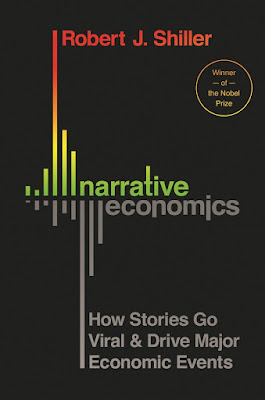
Book: Narrative Economics - "Happy Care-day to me!"


"Stories matter. It's a truism for journalists, but not much for economists. Robert Shiller, the Yale professor and Nobel laureate who predicted the housing crisis and also put behavioural economics on the map, aims to change that in a book dedicated to the thriving field of narrative economics."
https://press.princeton.edu/books/hardcover/9780691182292/narrative-economics
Narrative Economics:
How Stories Go Viral and Drive Major Economic Events


INDIVIDUAL
|
INTRA- INTER-PERSONAL : SCIENCES
HUMANISTIC -------------------------------------------------- MECHANISTIC
SOCIOLOGY : POLITICAL
|
GROUP
(My) mental health

(My) narrative


(My) physical health

"While many economists are still busy creating mathematical formulas to decode and contextualise our supposedly "rational" behaviour -

... people's actions are more often based on human interest stories than hard data."

narrative
behavioural


(Who owns your story?)

economics
economics

"Novelty often catches on - Shiller explains how the "Happy birthday" song, which used the same tune as an earlier piece of music, was much more successful because it allows us to place our own name in the lyrics."
Just imagine if there was a tool in health care, social care, education - formative, professional and lifelong learning, that was generic and suited to personalisation whatever the context - whatever the name and story?


My life chances - my health career ...


Rana Foroohar, Stories of value, FT Weekend. Life&Arts, 2-3 November 2019, p.10.

Sunday, December 22, 2019

Book: "Good Economics for Hard Times"

INDIVIDUAL
|
INTER-PERSONAL : SCIENCES
HUMANISTIC -------------------------------------------------- MECHANISTIC
SOCIOLOGY : POLITICAL
|
GROUP


Hodges' model provides interdisciplinary and even transdisciplinary bridges across often disparate fields of knowledge and specialties (epistemologies). In this instance consider SOCIO-economics, the consumerism of supply and demand. The influence of this in the economics of health care and the environment. The impact of relentless growth when values are knotted with value and commodified.

Even the book's cover points to the preoccupation of economics with mechanics (process!?). The view of economies as machines, which this book and the work of the authors and others now seeks to challenge and change.


Abhijit V. Banerjee, Esther Duflo (2019) Good Economics for Hard Times, Better Answers to Our Biggest Problems, Allen Lane, ISBN: 9780241306895

My source:
Ed Conway. Fighting the fake news with hard evidence, The Times, Saturday Review. December 14, 2019, p.16.

Monday, April 06, 2020

Sticking with 'nudge' - behaviour and economics ...

individual
|
INTERPERSONAL : SCIENCES
humanistic ----------------------------------------------- mechanistic
SOCIOLOGY : POLITICAL
|
group - population

psychological
realism

cognition


neoclassical model

"The most well-known critique of behavioural economics comes from a psychologist, Gerd Gigerenzer of the Max Planck Institute for Human Development. Gigerenzer argues that it is pointless to keep adding frills to a mathematical account of human behaviour that, in the end, has nothing to do with real cognitive processes. ... He [Laibson] concedes that Gigerenzer has a point but adds: 'Gerd's models of heuristic decision-making are great in the specific domains for which they are designed but they are not general models of behaviour.'"

"There is a tendency to propose some new theory to explain each new fact. The world doesn't need a thousand different theories to explain a thousand different facts. At some point there needs to be a discipline of trying to explain many facts with one theory." [David K Levine, Is Behavioural Economics Doomed?, 2012]

social proof

Source: Financial Times


behavioural 
economics

"The challenge for behavioural economics is to elaborate on the neoclassical model to deliver psychological realism without collapsing into a mess of special cases. Some say that the most successful special case comes from Harvard's David Laibson. It is a mathematical tweak designed to represent the particular brand of short-termism that leads us to sign up for the gym yet somehow never quite get around to exercising. It's called "hyperbolic discounting", a name that refers to a mathematical curve, and which says much about the way behavioural economists represent human psychology." 


Harford, T. (2014) Nudge or fudge? Life&Arts, Financial Times, 22-23 March. pp.1-2.

Clearly indoors, clearing papers ...

Sunday, December 28, 2025

Feedback on Hodges' model in 'mathematical' terms

Through HIFA, I noticed an introduction by a new subscriber - Mr James Twahirwa; and noted a maths-oriented skillset:

'HIFA profile: James Twahirwa works on Research and data analysis in Rwanda. He is deeply interested in contributing to the global effort to improve health equity through reliable, accessible information. His background in statistics, data analysis, and research methods equips him to support evidence-based decision-making and strengthen health systems.

By email, I got in touch seeking an independent reading of the draft h2cm-maths paper (part 1).

Prior to this, Mr Twahirwa kindly made the following observations on Hodges' model which he is happy for me to post here:

==============

Dear Peter Jones 

I find your work interesting and really well-positioned.

Overall impression

Your work is intellectually ambitious and unusually well-positioned. You are attempting something that many disciplines struggle with: creating a unifying conceptual framework that can bridge practice, theory, and abstraction without collapsing into reductionism. The fact that Hodges’ model originates in nursing and has sustained relevance across decades already gives it credibility as a practice-informed epistemic structure, not just a diagram.

Your effort to reinterpret it through mathematics and category theory is especially interesting, because health economics often suffers from exactly the fragmentation your work seeks to address: disconnected models of behavior, outcomes, ethics, and systems.

1. The 2x2 structure aligns naturally with health systems thinking

Health economics constantly balances dualities such as:

  • Individual vs population
  • Clinical outcomes vs social value
  • Quantitative evidence vs lived experience
  • Efficiency vs equity

A 2x2 framework provides a powerful way to hold these tensions without collapsing them into a single metric. This is one reason cost-effectiveness frameworks often feel incomplete. Hodges’ model appears capable of holding multiple dimensions of value simultaneously.

2. Conceptual clarity over mathematical dominance

Health economics has increasingly recognized that mathematical rigor alone does not guarantee insight. Your attempt to treat Hodges’ model as a conceptual object rather than a predictive algorithm is aligned with modern critiques of over-formalization in economics and health policy.

Where your work could be strengthened

1. Clarify the “mathematical” claim carefully

From a health economist’s perspective, the risk is not that the model lacks mathematics, but that readers may misunderstand what kind of mathematics is being invoked.

You may want to explicitly distinguish between:

  • Mathematics as computation or formal proof
  • Mathematics as structural reasoning (relations, mappings, constraints)

Making this distinction early will help avoid criticism that the model is “not really mathematical,” while still defending its rigor.

2. Connect to applied decision-making

To attract health economists and policy researchers, it may help to show how Hodges’ model could:

  • Frame health technology assessment decisions
  • Structure evaluations of complex interventions
  • Support mixed-methods research designs

Even one concrete example (e.g., health service redesign, chronic disease management, or resource allocation) would strengthen its practical relevance.

3. Position the work in relation to existing frameworks

Your work resonates with, but is distinct from:

  • Systems thinking in health
  • Capability approach (Sen, Nussbaum)
  • Complex adaptive systems
  • Multi-criteria decision analysis

Explicitly stating how Hodges’ model complements or improves upon these will help readers locate it intellectually.

I hope this feedback may be of help

Happy festive season.

=================

Thank you Mr James Twahirwa. These comments are very helpful. You have identified the many strengths of Hodges' model and its uses. On the mathematics, you make many points for me to address and balance in terms of the overall intent and content of this 'project'.

Mr Twahirwa is now in possession of the draft paper. Any further thoughts are always welcome. While rather remote from clinical practice (a debate in itself) health economics is ultimately grounded in health services and health systems development. So this perspective provides a critical counterbalance to my clinical (business) as usual approach.

Point #1 is a primary motivating factor for this 'project'. I'm sure I can use structure as an anchor, while acknowledging that Hodges' model is a conceptual model, an idealisation. Additional feedback regards reasoning, decision making and Bayes also apply here:
[ ii Learn your lines and the hyperplanes will follow ].

In Point #2 I may be able to leverage research, drawing from #1:

'Mathematics as structural reasoning (relations, mappings, constraints)'.

Point #3 will be considered in-part through April's complexity conference; and revisiting former work on systems.

Both points #2 and #3 may find their home in a second paper (part 2), but this is fine, as it may support a step-wise workflow, and something akin to a logical progression(?).

As posted before any assistance greatly appreciated.

Wednesday, August 28, 2019

Environment, Social, Governance [ESG]

As Greeta Thunberg arrives in New York for the:

CLIMATE ACTION SUMMIT, 23 SEPTEMBER 2019

... it is interesting to consider not just where 'health' sits within business and commerce, but the themes and issues that it has reached. Now, we are more aware of the dependencies, for example air quality, physical and mental health, but we are still to finish the chapter titled: "The Damage Done".

'Capitalism' remains rapacious in terms of resource use (ironically if the market and prices are cyclical) and we must acknowledge all of economics, from stock exchanges, to cities, to villages in developing countries, but the challenge remains to transform the geometry of our economics to that of a sustainable circle. As per the climate debate, in some instances, we might close certain industries and leave some classes of minerals, elements, fossil fuels in the ground. We should accept that while some economies are more circular than others, sometimes you cannot circle a square?

Below is an investment hierarchy in which I have highlighted health. Education, literacy and environmental awareness are, if not issues (which they are, especially their respective economics) they are much needed individual actions to achieve progress.

The media notes that next month's summit will include 'world leaders'. I wonder how many business leaders will be present? This would be an indicator of corporate social responsibility, looking very positive in the annual report (even if the self-regulation has not yet achieved homeostatis). If you can advise with figures, or if I find the information later next month I will post here.

MSCI ESG Key Issue Hierarchy

3 Pillars 


10 Themes


37 ESG Key Issues

Environment    Climate change
Carbon emissions  Product carbon footprint 
Financing environmental impact
Climate change vulnerability
Natural resources 
Water stress  Biodiversity & land use 
Raw material sourcing
Pollution & waste 
Toxic emissions & waste   Electronic waste Packaging 
Material & Waste
Environmental opportunities
Clean tech 
Green building   Renewable energy
Social    Human capital
Labor management   Health & safety
Human capital development Supply chain labor standards
Product liability 
Product safety & quality  Chemical safety
Financial product safety  Privacy & data security 
Responsible investment  Health & demographic risk
Stakeholder opposition
Controversial Sourcing
Social opportunities 
Access to communications  Access to Health care
Access to finance   Nutrition & Health
Governance  Corporate governance*
Board* Pay* Ownership* Accounting*
Corporate behavior 
Business ethics Anti-competitive practices
Tax transparency Corruption & instability
Financial system instability
* Corporate Governance Theme carries weight in the ESG Rating model for all companies. In 2018, we introduce subscores for each of the four underlying issues: Board, Pay, Ownership, and Accounting. https://www.msci.com/documents/10199/123a2b2b-1395-4aa2-a121-ea14de6d708a


My source (MSCI ESG Key Issue Hierarchy p.27):
Norrington, J. (2019) Future Proof Investments, Investors Chronicle, 18-25 April. pp.24-28.

Tuesday, September 29, 2020

Objectivity, Sociology and Measurement ... Hodges' model

individual
|
INTERPERSONAL : SCIENCES
humanistic ----------------------------------------------- mechanistic
SOCIOLOGY : POLITICAL
|
group - population


"Big data is all the rage. 

We have become increasingly obsessed in economics and in medicine and in public policy with what can be measured. Evidence-based is always better it would seem, than going with our gut or worse, a wild guess that springs from our biases. This passion for evidence is not new. Carved in stone, on the outside of the social science building where I got my PhD at the University of Chicago is a quote attributed to Lord Kelvin, the physicist who gave us the Kelvin temperature scale and who died in 1907:"

“When you cannot measure, your knowledge is meager and unsatisfactory.”

Russ Roberts


"Like Weber and Dilthey, Mannheim opposes the positivist approach which seeks to render all social facts measureable and 'unambiguously ascertainable'. He invites us:- 'to think what becomes of our psychic and social world when it is restricted to purely externally measureable relationships', and argues that 'There can no longer be any doubt that no real penetration into social reality is possible through this approach . . . It is clear that a human situation is characterizable only when one has also taken into account those conceptions which the participants have of it, how they experience their tensions in this situation, and how they react to the tensions so conceived." p.160-161.
 
THE TASKS OF SOCIOLOGY

"The tasks which are presented to sociology are of a two-fold character. On the one hand there is the need to establish a valid model for the analysis of a particular social system which he is studying. And on the other hand, once such a model is established he may be faced with explaining some partial and particularized form of behaviour in terms of the part it plays in the total system. However, in any particular research situation there will be a choice as to what shall be regarded as a total system, that is what the scale of our interest should be, or what segment of the total system we should study." p.185.
 
Mannaheim's "proposals for a sociology of knowledge". p.165.


Sources:

Adam Smith, Loneliness, and the Limits of Mainstream Economics
Russ Roberts

https://medium.com/@russroberts/adam-smith-loneliness-and-the-limits-of-mainstream-economics-f0be78940e17

Also summarised in MoneyWeek.

Rex, J. (1968) Key Problems of Sociological Theory, 4th Edition. London: Routledge & Kegan Paul Limited.

(... continued sorting through old books... )

Sunday, October 06, 2024

[v] Book: The Systems View of Life - A Unifying Vision

Part IV begins with the ecological dimensions of life. There's a reminder that ecology, comes from the Greek 'oikos' for "household". We need this -

move you rubbish (don't leave it in the first place), wipe your feet; switch the lights off when not in use, assuming you have them!; close and open the windows as needed; think less 'location, location, location' and having a home.

Given the pictorial form of Hodges' model - mind-mapping - I've always been attracted to diagrams, no-less here the pioneering work of the Odum brothers and 'Odum flow diagrams' which even today are an ecological currency in the literature (p.344-45). An update on ecosystems as dissipative structures and as autopoietic would be helpful. Of course, now for scholars and students have search terms then resources and learning can follow. While ozone depletion is acknowledged, the role of the atmosphere could possibly be (briefly) expanded (guest essay, box?), in-particular the role of the Van Allen belts and the fact of Earth's magnetic field and (still) molten core. 16.2.3 definitely points the way pp.348-351.

16.3.1 Defining sustainability - made me sit up. Lester Brown's 1980's work is not referenced in:

Jones P, Wirnitzer K. Hodges’ model: the Sustainable Development Goals and public health – universal health coverage demands a universal framework. BMJ Nutrition, Prevention & Health 2022;5:doi: 10.1136/bmjnph-2021-000254 (From the bibliography listing in the sidebar of this blog.)
It was Brown who defined sustainability, and the question is ongoing regards how to build a sustainable society (p.352). Key as Capra 2002 notes is that a sustainable human community would not interfere with nature's inherent ability to sustain life. Ecological literacy 16.3.2 was also welcome; a constant theme on this blog, given the many claimed forms of literacy, as with (schools of) informatics. The informational perspective can reveal its power across literacies and informatics, consider media and information literacy? A way to paraphrase the authors: "The market and the marketplace is information disordered." (p.354).

Three chapters include descriptions of agencies (with links) that work with knowledge in an interdisciplinary way; where ecological and spiritual dimensions of education are emphasized; and in chapter 18 several other centers of learning. Chapter 16 looks at organisations with a focus on ecoliteracy in schools, colleges and universities. Checking some of the links many are ongoing - alive!
Struck in the past by the original approach of Goethe to 'science', his work on patterns is described in the introduction and here in relation to the arts and curricula. You will find 'art' sprinkled throughout the posts on W2tQ. Key concepts are described networks, flows, cycles, nested systems, dynamic balance, and development. Chapter 17 joins the dots of the world's problems. 'Growth' appears a disposable term, in how it is applied and so little understood, even by politicians and policy makers? Recent UK politics is a prime example. There is a another concurrent thread (to informatics and literacy) on this blog, as it is inbuilt, hard and soft-wired into the structure of Hodges' model. It is dichotomy, polarity and oppositions, specifically, objective - subjective, quality - quantity.
'In fact, the new systemic conception of life makes it possible to formulate a scientific concept of quality. It seems that there are two different meanings of the term - one objective and the other subjective. In the objective sense, the qualities of a complex system refer to properties of the system that none of its parts exhibit. Quantities like mass or energy tell us about the properties of the parts, and their sum total is equal to the corresponding property of the whole - e.g., the total mass or energy. Qualities like stress or health, by contrast, cannot be expressed as the sum of properties of the parts. Qualities arise from processes and patterns of relationships among the parts. Hence, we cannot understand the nature of complex systems such as organisms, ecosystems, societies, and economies if we try to describe them in purely quantitative terms. Quantities can be measured; qualities need to be mapped (see Section 4.3).
With the recent emphasis on complexity, networks, and patterns of organization, the attention of scientists in the life sciences has begun to shift from quantities to qualities, and there has been a corresponding conceptual shift in mathematics. In fact, this began in physics during the 1960s with the strong emphasis on symmetry (see Section 8.4,3), which is a quality, and it intensified during the subsequent decades with the development of complexity theory, or nonlinear dynamics, which is a mathematics of patterns and relationships. The strange attractors of chaos theory and the fractals of fractal geometry are visual patterns representing the qualities of complex systems (see Sections 6.3 and 6.4). 

In the human realm, the notion of quality always seems to include references to human experiences, which are subjective aspects. This should not be surprising. Since all qualities arise from processes and patterns of relationships, they will necessarily include subjective elements if these processes and relationships involve human beings.' pp.368-369. (My emphasis - and encouraging for research and researchers in Hodges' model)
The authors point out how the conjoining of 'sustainable development' is problematic when viewed in qualitative and quantitative terms (17.2.2 pp.369-371). I wonder what Capra and Luis would make of the SDGs and the metrics employed today? This has been an issue (reading for Jones & Wirnitzer, 2022), with measures needing to catch up and the disruption of COVID. There really is a case for economic literacy for people globally, as 'freedom' is so readily passed-off - associated with economics and trade as a 'right'. Another potential update revolves around globalisation, what would they make of Doughnut economics?

An additional risk now are the bitcoin factories and energy needed to drive AI data-processing. How transparent are global corporations in declaring their energy use? The LIBOR scandal is raised, but what the cost involved in Bankman-Fried and FTX-Alameda Research fraud? Capitalism is built on speculation and always will be? But if we defer 'paying' for economic transformation in a decade the costs will rapidly increase. Capra and Luis acknowledge the need to think about future generations. An ethical stance that is, thankfully, changing policy, and deserves attention.

I pencilled in the margin - what is the conclusion of the lesson of Argentina? Do the economists, the IMF, the World Bank, the Argentinian people know? What of the economic predilections of other nations? Who are the exemplars, the pioneers? Must Africa follow the West's bad-habits? Can they leap-frog technologies (land-lines, fossil fuel reliance ...)? I understand they are! In the West, do we need to re-invent public information services, to address the prevailing mindset? Even as the financial industry has passed-through a 'quant' phase, but mathematics still (and will always) hold sway (p.379).

Page 381 reminded me of the need for gainful employment, and how this is threatened and has always been threatened by technology (very broadly defined). The varied forms of parity of esteem become evident not just in health (mental - physical); education (technical - vocational), but employment too, especially with automation and artificial intelligence. The decade since the book was published leaves room for new content: what might replace or complement The Occupy Movement, The Seattle Coalition? The socio-political rate of change is remarkable. Greta Thunberg and Extinction Rebellion, for example, are clearly post-publication. The claimed rationale for business as usual in 'trickle down economics' remains relevant (sadly) p.384. More could be made now of the two numbers - 565 gigatons and 2,800 gigatons of carbon (350.org); and the current debate on carbon capture (Ah! p.408). 

I have over the years associated the intra- interpersonal domain with the individual's cognition, reasoning, logic, intellect, thought, and education. Collectively though we need to invert this:

individual
|
INTERPERSONAL : SCIENCES
humanistic ------------------------------- mechanistic
SOCIOLOGY : POLITICAL
|
group
education
EDUCATION

EDUCATION
EDUCATION


It is essential for every person to be informed were possible, to get to this situation (e.g. this book in a sense is an appeal for the public's understanding of science; and our political leaders):


individual
|
INTERPERSONAL : SCIENCES
humanistic ------------------------------- mechanistic
SOCIOLOGY : POLITICAL
|
group
EDUCATION
EDUCATION

EDUCATION
ANOTHER WORLD
IS POSSIBLE!


Chapter 18 pulls everything together (and provides HOPE) in systemic solutions. The previous post:

- drew on this chapter (p.398). I didn't realise 'commercial speech' is protected in the USA. 

As expected - a moral compass is still needed (p.430). I really the section on acroecology. It might be an idea to read this final chapter first. If there is a response to the question (there's no answer) as to why we are here - this is it. Biotech has its section, genetic engineering, the scope and risks, as does, the third industrial revolution, citing Rifkin's five pillars (2011). Agribusiness, world hunger, and the twelve myths:

'At a time of unprecedented wealth, when almost one-half of all Americans own stocks and are able to watch their wealth and economic power grow on the nightly news, it is good to remember that over 800 million people worldwide are passing the same nights unable to feed themselves and their children. A full quarter of other Americans, especially children, have much in common with the world’s hungry, experiencing their own hunger intermittently. Frances Moore Lappe and co-authors Joseph Collins and Peter Rosset in World Hunger: 12 Myths are there to remind us. Remind us of the plight of the world’s hungry, as Frances Moore Lappe has done for over 20 years, and remind us too that there is enough food; that hunger is not necessary; that hunger is a social creation; hungry people a social phenomenon, and consequently one that depends on us and that we can change.'

https://www.worldhunger.org/world-hunger-12-myths/ 

The chapter and book closes with a meditation regards hope. A comprehensive bibliography and index follows.

Despite the age of this book it has proved well-worth reading. I am glad I pursued my original request for a review copy. Well recommended and I wonder if there would be another edition? Clearly this would take a great effort, but then needs must? I will revisit the chapter on health. In the past week, the  the UK's last coal power plant closed (BBC News). Change is happening. And the weather globally of recent months cannot be denied. 

My thanks are extended to the team at Cambridge University Press for the paperback copy.

Fritjof Capra and Pier Luigi Luisi (2014) The Systems View of Life - A Unifying Vision. Cambridge: Cambridge University Press.

https://www.cambridge.org/gb/universitypress/subjects/life-sciences/genomics-bioinformatics-and-systems-biology/systems-view-life-unifying-vision?format=HB&isbn=9781107011366


Sunday, April 03, 2022

MEMO TO: New College of Humanities and London Interdisciplinary School

Re. "Introduction to Lifelong Learning 101"

Since 1998, when I first went 'online' I've always been conscious of etiquette and note how this has changed - developed - over the years. The email associated with the former website domain p-jones.demon.co.uk saw a lot of emails to quite a diverse range of mail lists. Should I? Should I not? These questions remain a key consideration in trying to spread the thought and word on Hodges' model.

Stepping on toes a couple of times, someone also asked about links to blog posts on LinkedIn. Not had those queries recently so I think readers understand the 2x2 table is critical to the post in representing the model. Twitter presents its own challenges [ #WasteOfTime ]. So please pardon my shouting, but there's an important message here about an important resource.

I've lapsed again with no progress on the new site - maybe it is not just vapourware but a dream.

The creation of new education institutions: 

the New College of Humanities and London Interdisciplinary School

- is encouraging for the work here:

"The London Interdisciplinary School wants its students to be problem solvers with a wide range of academic interests."
(Nicola Woolcock, Polymaths plan to teach universities a thing or two. The Times, October 2, 2021. p.17.)

Does it, really - and by implication the NCH, plus New Model Institute for Technology and Engineering (NMITE) and others?

The Times Education Commission with proposals for reform due in June, adds further impetus and evidence ...

I read this evidence as supporting the argument that education and health are and always will be 'legacy issues', that is in need of change, investment, policy. All disciplines of study and knowledge are always dynamic and should be challenging, personally and collectively.

If institutions can distract themselves from fiscal incentive of the bums on seats for a few moments and policy makers look up from the dotting of  I's and crossing of T's then student's learning can be energised by Hodges' model: a generic bootstrap for lifelong learning.

Just to be clear. This model is NOT about boxes, it is about being aware of boundaries and being prepared to cross and use these journeys.

In the 21st century we are humbled by what now constitutes the pantology - the system of all knowledge. No individual can take in - apprehend and master it all, but we should have a means to at least conceptually touch this incredible gift.

INDIVIDUAL
|
 INTERPERSONAL    :     SCIENCES               
HUMANISTIC --------------------------------------  MECHANISTIC      
SOCIOLOGY  :   POLITICAL 
|
GROUP
Education
Philosophy (Ethics, Logic)
Psychology: (Applied, Child, Clinical,
Criminal - Forensic,
Occupational,
Artificial Intelligence ...
Cognitive Sciences
Theology
Arts
Creativity and Design
Eco-Anxiety
Happiness - Metrics
...

Sciences: Biology, Physics, Chemistry*
Health: (Medicine, Nursing ...)
Occupational Professions
Computer Science, Information
Mathematics
[macro - nano] Engineering
Architecture
Design and Creativity
Environmental Studies
Hydrology
Land use: Forestry ...

Arts (Music, Dance, Drama ...)
Literature
Anthropology, Archaelogy
Languages
Ancient-History, History
Future Studies
Social Work
Sociology (Culture, Ethnography ...)
Anthropology
Gender Studies
Philanthropy
...

Politics, Government
Security
Law & Crime - Fraud/Corruption
Policing - Law Enforcement
News and Media studies
Political Science - Citizenry
Economics
Socio-Economics
International Development
Peace Studies
Administration
Leadership and Management
War and Conflict ...


I am pleased to see that the post re. Nicholas Maxwell's work is popular here:

"How Universities Have Betrayed Reason and Humanity—And What's to Be Done About It" c/o Nicholas Maxwell 

*So many sub-disciplines: Climate studies, Epidemiology, Marine biology, Quantum Computing / Physics, Exobiology, Astronomy, Materials, Demographics, Geology, Genomics, Cybernetics, Systems, Epigenetics, Exobiology, Neuroscience, Public (Mental) Health, Allied Health Professions ...


Monday, October 03, 2022

@LJMU @UniofGreenwich @UniNorthants et al. *

Re. new Climate Change degrees ...

What do your students and faculty need to know
to nurture that green knowledge domain,
and turn the other domains green?

INDIVIDUAL
|
 INTERPERSONAL    :     SCIENCES               
HUMANISTIC --------------------------------------  MECHANISTIC      
SOCIOLOGY  :   POLITICAL 
|
GROUP
MENTAL HEALTH
CONNECTION
ATTITUDE
BELIEFS - SPIRITUAL
ADVERTISING (mental pollution)?
[meta-] ETHICS
ECOCIDE
ACTIVISM
EDUCATION - LIFELONG LEARNING
LITERACY - INFORMATICS SKILLS
...

BIOSPHERE
POLLUTION
EXPOSURE - EXPOSOME
THERMAL REGULATION
WATER CYCLE ... AGRICULTURE
GEOPHYSICS, GEOGRAPHY
MEGA-ENGINEERING
PHYSICAL HEALTH
URBAN - RURAL
METRICS, MONITORING
...

SOCIAL HISTORY
SOCIAL MEMORY, ARTS
QUALITY OF LIFE
WAYS OF LIFE - Communities (Nations!)
SOCIAL DETERMINANTS OF HEALTH
SOCIAL JUSTICE
'home-land' -
DISPLACEMENT - RESETTLEMENT
SOCIAL COHERENCE
SUSTAINABLE DEVELOPMENT GOALS
...
POLICY, LAW
PROTECT FUTURE PEOPLES
COP X, UN, UNESCO ...
REGULATION
TRANSFORMATION OF ECONOMICS
- CIRCULAR ECONOMICS
SUSTAINABILITY
COMMERCIAL DETERMINANTS OF HEALTH
FORCED MIGRATION
POLITICAL CHANGE (LONG-TERM)
...

What do they need to believe,
envision and be able to do,
to help transform the World?

My source: Nicola Woolcock, Universities offer first climate change degrees, The Times, March 23, 2021,p.16.

*Hope it is going well, and while we really need it to - this is, of course, a responsibility for us all.

Monday, March 23, 2026

Good - Bad AI? c/o FT Magazine et al.

My source: Tim Harford, How can we tell good AI from bad? FT Magazine. 21 March 2026. #1168: pp.9-10.

    'Two new working papers address the tricky issue of verifying quality. In "Some Simple Economics of AGI", Christian Catalini, xiang Hui and Jane Wu (assisted, sometimes gratingly, by generative AI) propose the inevitable 2x2 matrix in which economic activity can be easy to automate, easy to verify, both or neither. Automatable, verifiable output is the stuff that computers do for us. The non-automatable stuff remains reassuringly artisanal.
    The difficult quadrant is where tasks seem easy to complete but are hard to check. Catalini, Hui and Wu call this the "runaway risk zone". It is not a reassuring label and it is not meant to be.
...
    In the second paper, "A model of Artificial Jagged Intelligence", Joshua Gans offers an analogy in which asking AI to perform task is like trying to cross a river over a network of planks supported by occasional pylons. The jagged frontier is represented by the fact that some planks are long and wobbly, while others are short and sturdy. Problem one: even if the planks are typically sturdy, the wobbly planks will require most of your time and attention. Problem two: if you can't predict in advance which planks will let you down, you may quite sensibly prefer to eschew the AI entirely and row yourself across the old-fashioned way.'

Catalini, C., Hui, X., & Wu, J. (2026). Some Simple Economics of AGI. arXiv preprint arXiv:2602.20946.

Joshua S. Gans, 2026. "A Model of Artificial Jagged Intelligence," NBER Working Papers 34712, National Bureau of Economic Research, Inc.


Previously: 'safety' : 'ai' : 'domain' : 'matrix'

Tuesday, December 26, 2017

"Modern financial theory ..." Letter c/o FT

individual
|
INTERPERSONAL : SCIENCES
humanistic --------------------------------------- mechanistic
SOCIOLOGY : POLITICAL
|
group


"... for their quantitative models based on equilibrium, efficiency and rationality. By co-opting methods from the physical sciences, a bewildering array of fancy-looking graphs and complex equations was soon spawned. Having stripped out the fuzziness of mortal endeavours, these neo-economists were freed to use their slide-rules on a quantitative version of our world. ... Their Möbius-strip models go everywhere and arrive nowhere." (2)


"Since the early writings of 13th century theologians such as Thomas Aquinas, what we call economics had been taught as a broad discipline covering politics, society, ethics, husbandry and moral philosophy. But by the 19th century, academics such as Vilfredo Pareto, Alfred Marshall and Thorstein Veblen had jettisoned humanistic thinking ..." (1)


"For the rest of the 20th century, the cult of quants purged humanity from the study of finance. This was a big mistake. We don't build businesses, work in offices, service customers or sell products to satisfy arcane algorithms.
We pursue a very human set of needs: food, shelter, status, community and well-being. Economics needs to be re-entered on human ad societal conduct - however messy and irrational it actually is." (3) Aron Miodownik


Aron Miodownik, Modern financial theory is built on conceit, Letters, FT Weekend, 9-10 December 2017, p.10.

Monday, July 22, 2019

PRIMEtime CE: a multistate life table model for estimating the cost-effectiveness of interventions affecting diet and physical activity

When I saw Adam Brigg's tweet and thread the figure below stood out.

I have modelled some of the concepts using Hodges' model. I have added some additions, flagging gender* to highlight way this and other factors (often) need to be considered in a multicontextual manner.

There is a lot more of course, including the reference list; for example Squires, et al. which pose some interesting questions.

81. Squires H, Chilcott J, Akehurst R, Burr J, Kelly MP. A framework for developing the structure of public health economic models. Value Health. 2016;19:588–601.

Fig. 1 The PRIMEtime CE conceptual model

individual - self
|
INTERPERSONAL : SCIENCES
humanistic ----------------------------------------------- mechanistic
SOCIOLOGY : POLITICAL
|
group- population
Interventions
over time

individual behaviours
motivation

model: outputs
AGE, GENDER*
Active People Survey

DIET - PHYSICAL ACTIVITY

cardio-vascular disease - heart disease,
 stroke, diabetes,
 liver disease, cancers, raised blood pressure, cholesterol, and body weight

TIME: chronological-pathological
PROCESS
 PRACTICE

behaviours - social
over time

social care


socio -

population health

POLICY
health economics
health care costs
social care costs
return on investment
- economics

Wednesday, October 15, 2008

Blog Action Day 15 October: Poverty - Hodges' model

The table below indicates some of the main concepts and concerns that surround poverty presented using the four care domains of Hodges' model:
INTERPERSONAL : SCIENCES SOCIOLOGY : POLITICAL

Well-being,

mental health, mood, hope, human spirit. Education - literacies: 3Rs, ICT, social, visual, spiritual, health.... human potential, premature death, personal choices & autonomy.

ability to work, philanthropy, disability, gender, LEARNING - UNLEARNING,

adversity, personal development, making a difference - Giving. Awareness of poverty.

Attitudes, beliefs, sustainability.

Physical health, nutrition, DIAGNOSES: infectious diseases - diarrhoeal illness, malaria, tuberculosis, HIV/AIDS. Infant / maternal mortality. Water. Natural resources, fuel, crops, disasters. Geography, global warming, climate change, gender, age. WHO regional-global reporting, ICD. Complexity. Research: Dimensions of Poverty - "The human development index (HDI) includes income, longevity and education. This paper contends that poverty extends beyond these domains. It explores dimensions of poverty that poor people value, but for which little or no data is available."

Shelter, housing, schools, local environment, social inclusion,

work, social mobility, homelessness, stigma (poverty as a disease?), media, major - national & global fund-raising events. Access to information and communications technology.

Dependency. Social justice.

Social Impact Analysis (PSIA) Religion, humanitarianism, fatalism, leisure. http://www.poverty.com/

HUMAN RIGHTS, LAW, POLICY, U.N., FUNDING, GLOBAL ECONOMICS, MDG 2015. Governance. DEFINITIONS: Relative poverty, absolute poverty, exclusion. effects of globalisation, industrialisation, urbanisation, conflict, refugees, migration, loss of statehood, immigration, professional migration, corruption, economic costs, welfare, benefits, income thresholds, min. wage, inflation, poverty indicators, GDP, major philanthropic programmes, charities, NGOs. social exclusion, unemployment, 'knowledge' economy - learning disability, pension economics, micro lending. International Aid: Official Development Assistance 0.7% national targets.

Tuesday, December 27, 2022

Editorial: "The Meaning of Concept Analysis" i

Nursing Science Quarterly (NSQ)


This editorial, "The Meaning of Concept Analysis" is open access and concerns an academic activity that is 'bread and butter' in nursing theory. It is well worth reading, for students too.

"The purpose of this editorial is to clarify the meanings of the term concept and analysis and to offer some guidelines that show what is appropriate for publication of concept analyses."
 
The editorial is helpful in encouraging the effort here, even as it suggests I would be wasting my time, the editor's and referees (although quarterly has a certain appeal).
 
 
The journal's role and purpose is clearly described:
"Nursing Science Quarterly is unique in that it is the only journal devoted exclusively to the enhancement of nursing knowledge. Only Nursing Science Quarterly publishes original manuscripts focusing on nursing theory development, nursing theory-based practice and quantitative and qualitative research related to existing nursing frameworks, contributed by the leading theorists, researchers and nurse executives. including nurse theory development."
I've enjoyed the freedom here, on the periphery of academia. Afraid at the same time that this 'h2cm' obsession has, will ... impact my objectivity, subjectivity - by way of attitudes, openness and view within and without of nursing, in theory, practice and management. Added to being able to carry the weight that is nursing (responsibility). The load is made-up of history, the legacies, the global academic balance (or not), the current global state of the profession, the fight for professional recognition and more. All rolled-up, and rolled-out when the challenges of the 21st century warrant it. Yes, the future is always - out there.

Concepts are key in Hodges' model, as a conceptual framework, as a series of conceptual spaces, as domains for threshold concepts and much more. I think I'm struggling now, as I always have in giving 'a' concept my critical attention, and its being in uniform. Concepts are always 'seen' as a gestalt. This may explain why I'm not an academic and definitely not a professional philosopher. The editorial notes:
"Examples of some analyses of concrete concepts that would not contribute to discipline-specific nursing knowledge and therefore are not worthy of publication include nursing overtime, nursing shortage, cultural competencies, medical diagnoses, precision health, big data, sensor technology, health economics, omics, and symptom science, among others."
I have mapped these concepts to Hodges' model below (underlined), and added in italics some associated concepts:
 
 
 INDIVIDUAL
|
 INTERPERSONAL    :     SCIENCES               
HUMANISTIC --------------------------------------  MECHANISTIC      
SOCIOLOGY  :   POLITICAL 
|
GROUP
psychiatric diagnosis
data ethics [person-al]
symptom science [here]


person-centered care / health
emotional/spiritual intelligence

medical diagnoses, precision health,
big data
sensor technology,
omics, and symptom science


procedure x,y,z - cost $$$

cultural competencies

social prescribing

health literacy
public understanding of sciences


nursing overtime
nursing shortage

nursing crisis?
data ethics [COP15]
outcomes - patient safety
information governance
health economics


As an exercise you may like to consider the following, as relates to the care - knowledge domains of Hodges' model?
"For the discipline of nursing (which includes the extant theories and frameworks) appropriate analyses of abstract concepts that contribute to the advancement of discipline-specific knowledge include self-care, wellness, well-being, self-esteem, courage, trust, burden, comfort, resilience, betrayal, shame, and authentic presence, among others."
Along with the concern about my preoccupation with Hodges' model, every time I type reflection, reflective practice - it hurts. It feels like another form of navel gazing, and yet the need for reflection, and reflective practitioners, producing critical thinkers and reflective practitioners is recognised world-wide.

I can't help but get a sense that concept analysis is nurse's navel gazing. If I sound critical, it would be a greater problem if this was the view of others outside nursing? Maybe, this point itself, validates the production of discipline-specific knowledge for nursing? I can't escape though, the feeling that there is something limiting, narrowing, even apolitical here: (Is there a global nursing crisis)? There has been much needed conceptual work on race, justice, gender, equality [google 'concept analysis, ...']. I realise my expansive approach can - and does - fall dead from the press. If I can blame the Atlantic, then I hope that pluralism still has a role to play?
 
Parse concludes:
"Nurse researchers and emerging scholars should answer four questions before launching a concept analysis that could be worthy of publications.

1. Is the concept an abstract expression to illuminate the essences that can contribute to nursing knowledge development?
2. Is the conception critical to the advancement of discipline-specific knowledge?
3. Which extant concept analysis model is appropriate for this concept?
4. Will this concept analysis be worthy of publication in light of its level of abstraction and possible contribution to nursing science?"

In the 21st Century concept analysis will have its place, being key in philosophy, linguistics, ethics, law, artificial intelligence ... and yes, nursing too. But increasingly I think the true power of concepts (in theory, practice, management, policy) is found when they are related and conjoined.* 

More to follow ... then silence ... for a time ...

Parse RR. The Meaning of Concept Analysis. Nursing Science Quarterly. 2023;36(1):5-5. doi:10.1177/08943184221131957

*To state the obvious.
