Hodges' Model: Welcome to the QUAD: rooms

Hodges' model is a conceptual framework to support reflection and critical thinking. Situated, the model can help integrate all disciplines (academic and professional). Amid news items, are posts that illustrate the scope and application of the model. A bibliography and A4 template are provided in the sidebar. Welcome to the QUAD ...

Showing posts with label rooms. Show all posts

Tuesday, August 19, 2025

Dementia in 4x5 by Katherine Hubbard

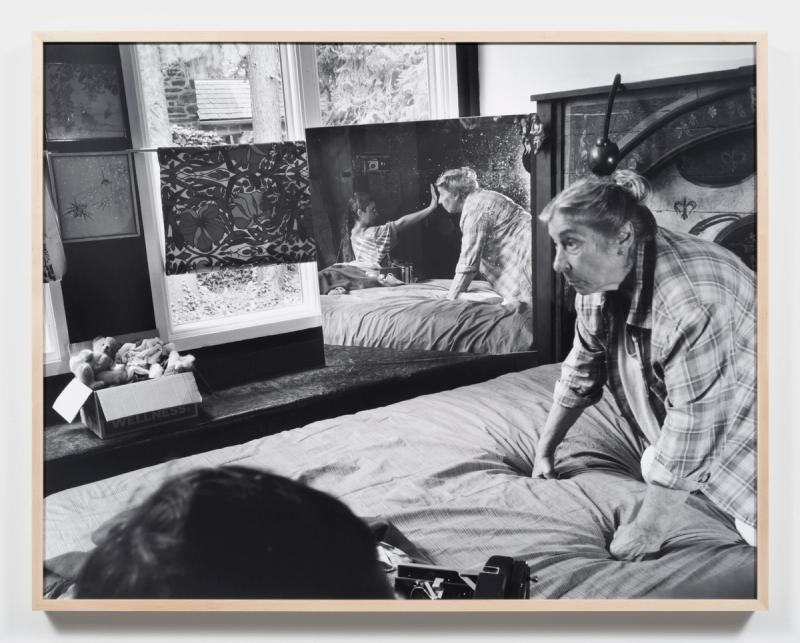
"The American interdisciplinary artist Katherine Hubbard has spent the past five years documenting her relationship with her ageing mother, Antonette Berger, who in 2020 began exhibiting the first signs of memory loss. Her book The Great Room, set between the four walls of Berger's home in Philadelphia, is a culmination of grief and intimacy, as Hubbard steps into her role as caregiver. Using two large- format 4x5 cameras (which she is both behind and in front of) and drawing on her background n performance art, Hubbard transforms the once safe, domestic space into a psychological playground as the pair navigate their new reality. ...
In this portrait, Hubbard sits with her mother on her bed. Their bodies are reflected in a square nirror offset by a series of other square and rectangular objects (picture frames, windows, the headboard) which fragment the viewer's gaze. "This photograph was taken before she had a diagnosis,' Hubbard tells me. "It was a very confusing time, with a lot of uncertainty and frustration between us. ... 
"І am using the camera as а means of creating time with my mom apart from the brutal task of managing her," Hubbard writes. And to the woman who gave her life: "You might like to know that, when І think of you and see you, it's as a whole person."  
Inès Cross. FTMagazine. 

Individual
|
      INTERPERSONAL    :     SCIENCES               
HUMANISTIC  --------------------------------------  MECHANISTIC      
 SOCIOLOGY  :    POLITICAL 
|
Group
one fifty one (hand to face), 2021. Silver gelatin photograph

'The
Great
Room'


Collaboration

Care in the Community

Direction

Gaze


Book: 
h290 x w219 mm. 88 pages
Text by Katherine Hubbard. Hardback. £46.00

https://loosejoints.biz/collections/current-titles/products/the-great-room

Photograph: https://companygallery.us/ - https://companygallery.us/exhibitions/the-great-room

Book cover: Amazon
https://www.amazon.co.uk/Katherine-Hubbard-Great-Room/dp/191271969X


My source:
Inès Cross. Katherine Hubbard, FTMagazine. August 9th 2025, #1137. pp.10-11.
Ack. Antonette Berger (mother ...).

Friday, February 14, 2025

Curtains ...

'I'm not sure many rational designers would set out to emulate, or even to echo the interiors in David Lynch's films. These are rooms that haunt us: the chevron carpets, the red velvet curtains, the peeling wallpaper suggesting that our environment is somehow theatrical, temporary, a dream - an expression of our subconscious. ...

"I don't know where it came from, but I love curtains," Lynch - famously reluctant to explain his work - said in 2014. "There is something so incredibly cosmically magical about curtains opening and revealing a new world. It resonates on a deep level with people."'


INDIVIDUAL
|
      INTERPERSONAL    :     SCIENCES               
HUMANISTIC  --------------------------------------  MECHANISTIC      
 SOCIOLOGY  :    POLITICAL 
|
GROUP

IMAGINE a curtain:
What colour is it?
Imagine opening the curtain -

<<== CURTAIN
                      [a room: LxDxH]
- is the wallpaper peeling? ...


Edwin Heathcote, Head spaces, Interiors, House&Home, FTWeekend, 1-2 February 2025. p.4.

Previously:

Wednesday, April 10, 2024

"David Lynch: A Thinking Room"


Where is the Thinking Room?


Individual
|
      INTERPERSONAL    :     SCIENCES               
HUMANISTIC  --------------------------------------  MECHANISTIC      
 SOCIOLOGY  :    POLITICAL 
|
Group

Ah! Surely this one?

It's deep!


Is it here?
This is deep too!

Please take a chair.


I trust you are comfortable, so
what about this place?


Yes, you can think here -
but you must check first
before you do: Think. 
If you must ...

N.B. Please rate your experience too.


Soraya Roberts. A Room Of His Own, FT Magazine, 30-31 March, 2024, 1067: pp.38-41.

https://www.ft.com/content/bf6a6eaa-30d1-4704-9aea-4ff2d117f407

David Lynch’s dreamlike rooms at the Salone del Mobile.Milano 2024:
https://www.salonemilano.it/en/articles/david-lynchs-dreamlike-rooms-salone-del-mobilemilano-2024

Wednesday, June 28, 2023

ii Design with People in Mind: Seclusion Issue related to Hodges' model

The Seclusion Issue


INDIVIDUAL
|
     INTERPERSONAL    :     SCIENCES               
HUMANISTIC --------------------------------------  MECHANISTIC      
SOCIOLOGY  :   POLITICAL 
|
GROUP

psychological harm / safety / seclusion

privacy, dignity and respect

Sensory stimuli, calm, distraction

Parity of Esteem

psychological restraint/control

Reaching for the person amid complexity

Staff / Service User attitudes to x,y,z

Lived/Patient experience
sensory -

NATURE - outdoors 'Green'

Design: (sterile?) space, colour, temperature, walls, light, warmth, cold, fresh air, homely/clinical, doors - locks, alarms, noise, violence resistant spaces ...

physical agression / harm / safety / seclusion

'built' environment / 'sensory room'

physical restraint/control, clothing, toilet, access to outdoors

Ecological and Integrative Physiology

- modulation

Social spaces

supportive spaces

scope for therapy

social autonomy

community

music / arts

experience in isolation - stigma in-situ?

trauma-informed services

in-patient services, funding

risk reduction; policies

use of technology/observation

length of stay, reporting

impact of restraint on staff


Hodges' model is situated and can be used in all health, educational and policy contexts.

Hodges' model can assist to initially scope, plan and evaluate research studies not only across all the care (knowledge) domains above (including the spiritual) but the model's structure incorporates such dichotomies as subjective-objective; qualitative-quantitative; person-services; patient-staff; therapy-control/restraint; person-centred--service-centred; private/personal-public; care-custodial; psycho-political; socio-technical and others.


There is of course much more that could be added above, and relationships considered between concepts and perspectives: the patient's, nurse's, doctor's, the multidisciplinary team, manager's, policy makers, architect,s anthropologists, public, professional and regulatory bodies and commissioners?


Please keep 'me' safe safely - yes, and the team!


Even though and especially because I may not currently know exactly who - how ...  I am?


My source: https://twitter.com/DIMHN

Related post i

Sunday, June 25, 2023

Design with People in Mind Books - The Seclusion Issue

Design with People in Mind
The Seclusion Issue


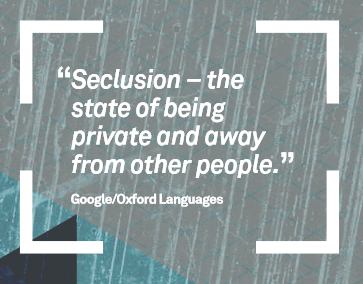
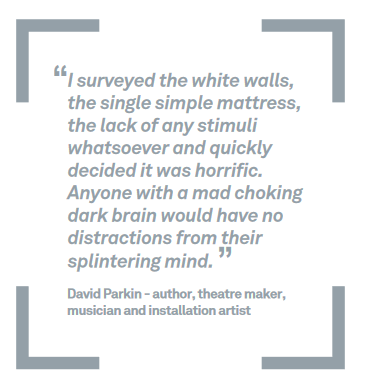
Design with People in Mind is the Design in Mental Health Network’s annual round up of the latest research evidence on therapeutic outcomes and the evidence for them relating to the built environment in mental health. In partnership with London Southbank University and Nottingham Trent, so far we’ve looked at a variety of issues, from nature to sound design to boundaries and borders. The latest issue is Seclusion, launched at this years conference and focusing on the evidence for and impact of the practice of seclusion units, how to use them if at all, and best practice in the field to maintain psychological as well as physical safety for service users and staff.


The link to the publication is: 

https://dimhn.org/wp-content/uploads/2023/06/1DWPIM_I8_250x210_24PP_AW_V02_HI_RES.pdf

It’s a member only resource, so you will need to register (free for individuals) before viewing.

Very best,

Hannah

Hannah Chamberlain
CEO
Design in Mental Health Network
m: 07811169609
www.dimhn.org


My source: https://twitter.com/DIMHN

See also:
ii Design with People in Mind

Sunday, April 19, 2015

Context, Rooms, Faces and Shots


"... The most revealing shot is always the wide shot. 

The room where the person is tells more about him than his face." Roy Andersson


Leigh, D. (2015) Funny ha-ha, and strange, Arts - Cinema, FT Weekend FT, 18-19 April, p.12.

A Pigeon Sat on a Bench Reflecting on Existence, Roy Andersson