Hodges' Model: Welcome to the QUAD: Search results for threshold concepts

Hodges' model is a conceptual framework to support reflection and critical thinking. Situated, the model can help integrate all disciplines (academic and professional). Amid news items, are posts that illustrate the scope and application of the model. A bibliography and A4 template are provided in the sidebar. Welcome to the QUAD ...

Showing posts sorted by date for query threshold concepts. Sort by relevance Show all posts

Tuesday, May 05, 2026

iii Picking up sticks: when axes matter

It is one thing for us to break the stick, but quite another from a concept's perspective. They are accustomed to the dynamics at work, when as search terms they are exploded, or not. And, not just any concept but one that can be unique. Consider the concept, and how or where it finds itself [ in Hodges' or another model ]? Let us use the intra-INTERPERSONAL domain, as an example, and ask:

  1. Is 'mood' fixed by the I-axis alone?
  2. Does the humanistic axis have a role in where in the doomain the user of Hodges' model places 'mood'?
  3. Acknowledging person-centredness, if the patient/client had a view, to what extent would this agree (with annonymity assured) with the professional's judgement, or a relatives / guardian?
  4. What is as a result, 'mood' has become 'very low mood'? (To continue in this vein , invites complication, but we will continue.)
  5. Introducing the 'Other' whatever their role and relationship, pushes us to the humanistic, but whether this is achieved in a person-centred manner (triage excluded) is a matter of opinion and judgement (evaluation).

If mood is fixed by the I-axis then if we determine the issue is 'low mood' are we introducing a combined quantitative and qualitative dimension, a continuum, at the selected point in the interpersonal domain? Writing previously about threshold concepts, I wondered, and proposed compound threshold concepts. There is a progression from the patient's subjective self-assessment, to in all likelihood of an objective measure being introduced, so spanning two domains. Definition of 'compound' aside; there is a compound structure at work.

What points 1-5 above reveal is triangulation. When it is argued that Hodges' model facilitates navigation as per my presentation on 21st April, this is a strategy from mixed-methods research in practice. Many years ago, Hodges' model was described as a 'cognitive periplus', reflecting the way ancient mariners initially charted the coastlines creating the first map, as per their culture and dispora. In the west more recently the value of social approaches and activities, especially in mental health. Care navigation is a role. Literally sign-posting to individually suited (which must be stressed) activities, resources, and agencies. So, in Hodges' model what are our three triangulation points? They are:

  1. Axial;
  2. Intra- InterDomain; 
  3. Person-centred. 

Perhaps, we can describe 1-2 as conceptual anchors at least when dealing with a concept, while #3 is more about approach, values and philosophy. So, there is something of a 'cheat' going on, because each one is compound:

1. Axial: The axial is comprised of four points. The axes create a Cartesian plane (figure). And, as far as a patient is concerned, they mark off a point on the respective Individual and Humanistic-Sciences parts of the axes. This form of triangulation point can claim a general conceptual precision (language) in the applied terminal labels; but what happens in-between can be patently fuzzy. A mix of what may be objective and subjective.

2. Intra- Interdomain: This may be the most imprecise triangulation point. It appears the axes of Hodges' model are composite (figure). They have two-sides as a boundary. To be pedantic, in our example, one plays to the interpersonal domain, the other the sciences.

[The relationship between the axis and the domains in Hodges' model, is far from unique; but I wonder if there is something else here?]

2. Person-Centred: There is a paradoxical nature to person-centred(ness). It is also nebulous in nature, and yet in care it is definitive in practice (safety, purposes, values, professionalism, competency, ...).  It forms locus which can also be classed as a traingulation point, at the centre of the model. This is the point around which Hodges' model is built. This captures the individual's (life, care) context and situation, all influenced by their life chances as consequent health - and other - careers. Salience and our attention^ is key. Is it possible to frame our purpose(s)?

^A focus for [N] autumn.

Marrakech, Le Jardin Secret. 24th April. 1000-1830.

Monday, February 23, 2026

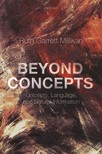
Millikan's Unicepts and Unitrackers

An underpinning theory of Hodges' model must help us make sense of what is happening within the care domains, between the domains, and possibly say something about what may be significant relation[s]-ships that are diametric. Arriving at threshold concepts I wondered in Hodges' model about there being compound threshold concepts. Consider, when 2-3 thresholds are (b)reached in one (the sciences) domain? Contrast this then, with 4-5 thresholds across care domains? There may also be care concepts applicable that are for example, person-centred: that is, patient, carer, 'management', or policy defined? These concepts while not threshold related per se, are nonetheless relevant.

I came across the work of Ruth G Millikan in London, several years ago as I followed 'epistemology' around the shop. It is time to pick this up and earlier work:

Millikan, Ruth Garrett. “Biosemantics.” The Journal of Philosophy 86, no. 6 (1989): 281–97. https://doi.org/10.2307/2027123

https://www.researchgate.net/publication/235734046_Biosemantics 

INTRODUCTION TO PART I

0.4 Unicepts and Unitrackers

'Neither the clusters in the world nor their properties are found at the sensory surfaces. The properties characterize distal objects and events. They are manifested in diverse and irregular ways through signs impinging on the sensory surfaces, energy patterns that are contingent on shifting intervening circumstances.' ...

'A unitracker is a mechanism or faculty for same-tracking something, for recognizing when incoming information concerns it, then linking and storing this information together as information about one and the same thing. Only then can it can be brought to bear together on inference and action. The link connecting stored information about the same thing together is a "unicept." The information is recognized, paradigmatically,by the initiation or strengthening of an intentional attitude of credence, which we tentatively model as a temporary or enduring connection between the unicept and unicepts for other things.'

'Both unicepts and unitrackers are particulars. You and I do not have any of the same unicepts or unitrackers. What we have in common is unicepts and unitrackers for many of the same things.' ...

'Unitrackers are same-trackers used for collecting knowledge about their targets.' pp.7-8.

Millikan, Ruth Garrett, Beyond Concepts: Unicepts, Language, and Natural Information (Oxford, 2017; online edn, Oxford Academic, 19 Oct. 2017), https://doi.org/10.1093/oso/9780198717195.001.0001, accessed 16 Feb. 2026.

Wednesday, February 04, 2026

vi Book: Bill Ross - 'Order and the Virtual'

'The Philosophy and Science of Deleuzian Cosmology'

Over time I have equated the center of Hodges' model with a nexus. Framing the whole model as a chaotic system, comprised of four domains, with two (or more?) Lorenz attractors, how do we make sense of what is going on? 

A previous post visited this too: Threshold Concepts: Reflection on chaos, complexity and AI 

Reading Order and the Virtual the new vocabulary, provides glimpses. The perspectives I'm adopting are no doubt naive and favour my context. If we freeze the situation from the center - the nexus the variables, parameters are frozen within their respective domains and tracks around the attractors. They tell us little (now), for obvious reasons, but (with AI and) acknowledging the social and political is a huge step forward (in healthcare).

'The word 'appetition' occurs not infrequently in Whitehead's work, though his own coining is 'prehension`. Both words convey essentially the same import. All individuals 'prehend' all others - the entire universe is expressed through the relations pertaining to any given individual therein.36 Prehension belongs cqually to the event as to the conscious decision. The 'nexus' or 'actual occasion' is the outcome of prior appetitive or prehensive enfolding for Whitehead as it is for Leibniz, and the aggregate of past prehensions shapes the future of the individual. The crucial refinement comes with the term 'negative prehension'. 

For Whitehead, accepting those same tenets that characterise Leibniz's metaphysics, the interconnection of all things and the tendency of systems to enfold elements from their total situation, negative prehension is a necessary corollary to positive appetition. It belongs to the 'principle of limitation' which Whitehead saw as a necessary supplement to Spinozist metaphysics, and which we shall encounter in some detail in following chapters.' 

It helps me, that Spinoza is heard here. 

'Instead of how is it that all things are interconnected, the question becomes, "Given that all things are interconnected, how is it that individuation is possible?'

Before recourse to Lorenz's butterflies, I saw 'oscillations', a constant swing from individual to other(s); then back again. 

`Every present state of a simple substance is a natural consequence of its preceding state, in such a way that its present is big with its future',37 (all p.47.)
While concerning a 'simple substance', is this a prelude to self-care and preventive health care?

I noted in pencil: In Hodges' model 'nexus' is framed as the now - that just was. Ross carries on to discuss 'the multiplicity of components in the nexus can enter explicit feeling as contrasts.' p.48.

Yes. 'The local and global are entwined' p.49; and now with the glocal too. Ross points out how Deleuze draws upon Simondon's treatment of the organic and inorganic within the same framework, p.50.

I've also been reminded about resolving some abbreviations:

https://hodges-model.blogspot.com/2025/07/axiomatic-simondon.html

Many thanks to Edinburgh University Press for my review copy.

More to follow here ...

Bill Ross (2024) Order and the Virtual: The Philosophy and Science of Deleuzian Cosmology. Edinburgh: Edinburgh University Press.
https://edinburghuniversitypress.com/book-order-and-the-virtual.html

Saturday, October 18, 2025

Just imagine ... caseloads, payloads and careloads

Just imagine ... no, not like that - really imagine!

You are in a situation. Unsurprisingly, let's say it's in health, or social care. We find ourselves in a care or nursing home, on a ward, or in the individual's home, even if the patient does not currently recognise it as such.

The patient is mobile. That is, and isn't a problem.

Physically, apart from thoughts about a chest, or urine infection, yes they are mobile, but they're also confused - disoriented.

We are concerned about their safety. 

Noisy, increasingly agitated, they are making it clear they want to leave.

Their carer, family, or staff are trying to limit the patient / resident's access to the exits, be that the front, or back door, the spare room, their room, or main entrance. They are not in agreement about where they need to be. Persuasion and distraction aren't working either. They appear to lack the level of mental capacity required to decide for themselves what needs to happen.

It is one thing to have this assessment of the situation running through one's mind; but quite another to 'pick up' a care concept mentally and carry it over the care (knowledge) domains of Hodges' model.

Hodges' Health Career - Care Domains - Model
Try it for yourself ...

Have a think about the following care concepts: mobility, capacity, consent, confusion, mobility, liberty, a locked-door while spouse/partner goes shopping, and safeguarding

As we engage in critical thinking, these concepts have a literal payload. They carry varying degrees of informational value, salience that helps us prioritise, what else do we need to factor in, what help is needed, and when; how do we  decide what to do?

As a concept is evaluated against Hodges' model, it changes. It is as if it morphs subtely, or starkly as other concepts, by association, are brought into play.

This process is influenced in so many ways; our training to date, our prior experience, biases and cultural baggage we might also carry, who else is present (this is of course potentially both a positive and negative), past and current role-models, our (team's) preparedness - what to do if .., teamwork, access to leadership (who is 'duty'?), and our confidence in them (Oh no!). And, them in us.*

Vitally, there is the small matter of our understanding, attititude and response to the person in-front of us. 

The delivery of healthcare is often stressed as emotional labour. Whether we use Hodges' model or not, perhaps the labour, the physical and psychological work involved, is experienced through carrying and feeling the careload. A reason too for supervision.

*Do seek help - advice if needed.

Further reading [ please contact me if needed - h2cmng AT yahoo.co.uk ]:

Jones, P. (2025), A Generic Model and Conceptual Framework to Prime Curiosity Across Health and Social Care Disciplines to Facilitate Lifelong Learning. Journal of Evaluation in Clinical Practice, 31: e70252. https://doi.org/10.1111/jep.70252

Jones, P. (2025). A Conceptual Mapping Exercise of Deprivation of Liberty Safeguards in Residential & Community Care Using Hodges' Model and Threshold Concepts. Journal of Evaluation in Clinical Practice, 31: e70085. https://doi.org/10.1111/jep.70085

Wednesday, August 27, 2025

Nursing models of care: "There is another"!

It seems Star Wars forums continue to debate the meaning of Yoda's response to Obi-Wan that "There is another". 

The lack of practice-based debate in nursing and health education about 'nursing theory' and 'models of care, confirms that these academia sagas did indeed take place in a galaxy far, far away.

There is, as ever, positive and negative news too. The bibliography in the sidebar keeps growing. I'm hoping for news of additions dropping into the inbox before the end of the year. Not just prospective papers I know about (yes, there is another prospect!), but other work. In a way the latter is even more special. As these sporadics reveal that there are research heroes out there, on their own path and journey of discovery. Finding Hodges' model, they have applied it to their respective field.

Yesterday, searching for 'Activities of Daily Living' (first published in 1980) while writing the DASH post, on BMJ Careers I came across:

'What models do nurses use to guide their care?'

Is that 'models' plural?

Perhaps the response to the question says something about:
  • nurse academia;
  • how our medical colleagues view nursing;
  • and more importantly - their understanding of nursing, the nursing profession, ongoing aspirations and relevance to self , health and social care in the 21st century?
In January, frustrated at the effort that is getting published (a shared experience then) and lack of attention to theory I posted:
The literature trail for Hodges' model is not voluminous, but it is there:
  • as a model of care, conceptual framework;
  • person-centredness;
  • integrated and holistic care;
  • holistic bandwidth
  • SDGs
  • life chances, health career, prevention, life-style and literacies
  • socio-technical approach
  • global health;
  • reflection and reflective practice;
  • critical thinking
  • mind-mapping;
  • concepts, conceptual spaces, threshold concepts
- with much more to do, even in the above.

Please, call this a gentle nudge. Thank you.

Image: http://www.quickmeme.com/

Friday, August 22, 2025

Paper - (finally!) "A generic model and conceptual framework to prime curiosity across health and social care ..."

 It has been over a decade but at last the second* paper has been published in Journal of Evaluation in Clinical Practice:

Jones, P. (2025), A Generic Model and Conceptual Framework to Prime Curiosity Across Health and Social Care Disciplines to Facilitate Lifelong Learning. Journal of Evaluation in Clinical Practice, 31: e70252. https://doi.org/10.1111/jep.70252

ABSTRACT 

Rationale: The Corona virus pandemic highlighted the importance in continuity of the physical and emotional labour across all care sectors. Synergy between healthcare in hospitals, and community services must be allied with social care; and be central to integrated and efficient policy and service delivery. Services were found wanting in the pandemic and in recurring winter crises. The politics of funding for care delivered in rest and nursing homes remains contested, awaiting long‐promised governmental action. The workforce is recognised as dedicated, skilled, compassionate and yet under‐valued and under‐paid; managers face ongoing recruitment challenges, with a national shortage of staff, and high turnover of personnel. A National Care Service is awaited in England and Wales. 

Aims and Objectives: This study explores the ongoing care crisis, using the educational lens of threshold concepts, projected, analysed and synthesised of a generic conceptual framework, known as Hodges' model. Readers will understand Hodges' model and threshold concepts being equipped to explain both. 

Methods: The study is descriptive and uses a conceptual mapping approach supported by discussion and literature. Additional resources and avenues for ongoing study are also provided. 

Conclusion: In conclusion, Hodges' model is a pragmatic, practice‐based tool, that can support and sustain curiosity for workforce learning and development. 

Acknowledgements I would like to thank Messrs Mark Bird and Matthew Graham and the journal's reviewers for comments on drafts of this study; and acknowledge the effort of Dr Michael T. Flanagan in creating the informative threshold concepts resource (referred to above). 


https://onlinelibrary.wiley.com/share/author/IRPNBR2KHJNYJK8XUAW6?target=10.1111/jep.70252

*This paper was originally the first of a two-part work. Feedback from reviewers suggested the papers be standalone. United now, in one journal.

Many thanks to the reviewers, editor, editorial and publications team at JECP.

This paper has been added to bibliography in the blog's sidebar.

Friday, August 01, 2025

Paper: "A generic model and conceptual framework to prime curiosity across health and social care disciplines to facilitate lifelong learning"

 What seems a long time ago now (a decade!) I started writing a paper on:

  • Threshold concepts
  • Deprivation of Liberty Safeguards (DoLS)
  • and Hodges' model

This ended up as a two part work, which after review ended up as two separate papers:

One appeared in April:

Jones, P. (2025). A Conceptual Mapping Exercise of Deprivation of Liberty Safeguards in Residential & Community Care Using Hodges' Model and Threshold Concepts. Journal of Evaluation in Clinical Practice, 31: e70085. https://doi.org/10.1111/jep.70085

The other should be published soon - same journal. I appreciate the editor's patience and team's support:

"A generic model and conceptual framework to prime curiosity across health and social care disciplines to facilitate lifelong learning"

Unfortunately, I've no funds to pay for open access. I will bear this in mind, as I resurrect another project - with two versions of 13,000 and 6,000 words. This is on (and began during) COVID-19, society, information and technology.

Monday, April 21, 2025

Biblio - addition: Conceptual Mapping Exercise of DoLS in Residential & Community Care Using Hodges' Model and Threshold Concepts


After a great many years of on-off effort, radical revisions - from one to two papers - part 1 and part 2; and then finally two standalone papers, I received news this morning from ORCID and Wiley of online publication.

News of the second paper (part 1 - to me) is still to follow.

Many thanks to the individuals who read earlier drafts, the editor and team of JECP.

It is a real delight to add an item to the blog's bibliography in the sidebar.

Apologies in advance, the paper is not open access, I cannot personally cover the fees. Happy to assist with an earlier draft.


Once again, if you can add to the bibliography, or are interested in using Hodges' model please let me know. Or as several researchers have done: 'Just get on with it!'. Learning post-publication of a citation for Hodges' model, is a welcome surprise too.


Jones, P. (2025), A Conceptual Mapping Exercise of Deprivation of Liberty Safeguards in Residential & Community Care Using Hodges' Model and Threshold Concepts. Journal of Evaluation in Clinical Practice, 31: e70085. https://doi.org/10.1111/jep.70085

Wednesday, March 19, 2025

News on two papers: Deprivation of Liberty Safeguards & Threshold Concepts

 - plus of course Hodges' model


While I could find out (here on W2tQ!?), I can't remember exactly when I started a writing project about threshold concepts, deprivation of liberty safeguards in the context of residential care and nursing homes. It was at least 2013, and may date back to 2011. Well, whenever it was: what a palaver! 

One paper, rejected, the advice was to split the work and create two. The two papers were then also rejected. My writing is always off-piste as it were, on-off too; and then ironically COVID-19 may have helped too? Afterwards, I started to pick it up again - the same title but parts 1 & 2. I never heard from one journal, so quickly moved on. Each time, the work improved thanks to two reviewers and their feedback. All the time my thought about Hodges' model has itself changed: I like to think progressed. With further revision, I finally had two standalone papers.


The important thing is the news received this week: Re. ...
'"A Conceptual Mapping Exercise of Deprivation of Liberty Safeguards in Residential & Community Care using Hodges’ Model and Threshold Concepts". I am pleased to be able to tell you that has been accepted for publication in Journal of Evaluation in Clinical Practice.'
A further paper (part 1 originally) same journal, to be referenced in the above, needs some minor revisions.

I am worried about another paper, with a similar history, that I can now turn my attention to (this itself speaks volumes!). I can see I need to alter the emphasis, balance of Hodges' model, diagrams, psychological therapies and case formulation. A co-author would help, but of course everyone's busy.

So if you're writing and struggling: do keep going!

Sunday, March 02, 2025

Alliance for Responsible Citizenship

Last month on two occasions, I came across the Alliance for Responsible Citizenship (which is a registered company)


In the Sunday Times, "Philippa Stroud: ‘Everyone’s moaning — I think humanity can sort things out’":

https://www.thetimes.com/uk/politics/article/philippa-stroud-alliance-responsible-citizenship-km8z26b8b

and Financial Times "'Part megachurch, part political rally: inside London’s ‘rightwing Davos’".

https://www.ft.com/content/7ff1614c-38a2-4b5c-81d3-80cea1196dad 

Apparently, a right wing, conservative movement with a three-day conference, one commentary suggested it has struggled to define itself, which is understandable given the ongoing (increasing?) prompts for its creation.

You recognise early on in your nursing career and not just as a student (pre-Project 2000 UK), but as a Nursing Assistant that character is a key element in your professional development. By the time you qualify, you more accurately see that without a doubt it is your formative education that is a critical factor. That and your 'home' circumstances - and not necessarily the two-parents good, one bad formulation. This is why with students excluded from school, society is taking a wrong turn. There is obviously a problem but what is the 'correct' approach?

An 'alliance' already suggests a given level of organisation. By definition 'grassroots movements' must struggle to establish and retain their identity.

This is a project Hodges' model can help address - with a balanced but not necessarily a neutral output.


Individual
|
      INTERPERSONAL    :     SCIENCES               
HUMANISTIC  --------------------------------------  MECHANISTIC      
 SOCIOLOGY  :    POLITICAL 
|
Group

identity
personality
attitude aptitude
character
faith
individual beliefs
religious engagement
courage
hope
threshold concepts
my destiny
well-being
trust


future
physical thresholds 
waste
climate change
circular economy
AI
truth - information disorder
science
technology
PAST - work - FUTURE
our future destiny -
(what does the clock say?)
future generations?

grassroots social movement
arts
family
community
culture - diversity
social - cultural identity
society - support
social change
social capital
social contract
social values
our shared destiny
our children's children
welfare - living wage
employment - leisure
quality of life

power
political systems
past policy UK: 'Troubled Families'
economics
organisations, institutions
corporations
political (manifest!
colonialism ) destiny
policy
systems
political engagement
health of leaders
trust
international law - justice
control of fraud, corruption, crime
human rights
political thresholds


Monday, February 10, 2025

Book review: Handbook on the Ethics of AI #2

Handbook on the Ethics of AI

Well, I am sold. So, encouraging again to read 'reflect -ion' on the first page and throughout chapter 1:

'... why the very idea of AI gives rise to (or should give rise to) ethical reflection.' (p.21), and I'm sure the book as a whole.

Most readers may pass this by, but to me this matters. Ethics scholars however will see how important and conjoint reflection is to deliberation and argumentation of ethics. Especially, as noted in post #1 the five part division of the text Foundations and Context; Responsibilities; Rights; Politics and Power; and Thinking Otherwise. 

Tables break up and inform the text. I like the way for many tables the source is: Author's own elaboration.
Given the subject matter, yes, the authors have the literature but they are also formulating their chosen theme against the present, near future, socio-political scenarios and much more. So, reflection - this should be expected. With Hodges' model I'm often asked why are those concepts placed in that particular domain? Perhaps that is a question for general artificial intelligence? Subjectivity is a key challenge, and its effective communication.

If I say, chapter 1 is a great primer on What Is This Thing Called the Ethics of AI and What Calls for It? I'd sell the book short, the whole text fulfills this purpose. The definitions and responses to What is A.I. are very helpful, taking into account ancient to more recent history. I've a book in a box by David Chalmers (sorry Prof.) - one day - which helps here discussing intelligence and consciousness.

I'm primed to pick up on 'gaps' (Theory-Practice) and in human experience they are inevitably legion. The responsibility gap (and meaningfulness!) c/o Sven Nyholm is a place to return to, to debate why A.I. raises such a broad range of ethical issues. Patiency is never far away. Here, the patient is stark: in  moral agents and moral patients (p.20 and 89). This blog is littered with posts on Drupal, which to date I have never mastered. I remember sitting in DrupalCon presentations, in the midst very skilled professional coders. A member of the community stood at the podium recounting their lived experience of impostor syndrome. In November with a presentation of my own, I had my own encounter. Well into reading this book, it really did help. The conclusion of chapter 1 contrasts the frequent need for a big-picture overview and reflection on more specific issues. That's quite fitting for me.

I am biased in the encouraging kernels I find: as seek them I do. Yes, as chapter 2 AI Ethics before Frankenstein begins: 'there remains work to be done in charting the long-range conceptual development of  AI in the history of political thought.' (p.27, my emphasis). And much more I hope. Chapter 2 combines literature, myth and I enjoyed the discussion on techne, Prometheus, Hobbes, the interdisciplinary bridge of techno-politics and articulating the mechanistic in our lives. Focussed recently on thresholds and threshold concepts in revising two papers: Hunt writes, 'Frankenstein is a "threshold" text for "modern political science fiction" (p.31). 

This  resonated - especially 'for its prediction that the nascent Enlightenment-era sciences of chemistry, anatomy, and electricity could be used to artificially make a human being' (p.31). The exploration of bad education and bad governance through Shelley and social history is other-worldly in itself. Hunt's conclusion which includes 'Wollstonecraft was the pivotal figure in the process of refracting ideas of AI from Hobbes to Shelley, ...' left me wondering about the refactoring of code. 

Chapter 3, Smith's Faith, Tech, and Ethics of AI brings more reflect -ion with the bonus for me of Descartes. On faith, the human situation is also repeatedly stressed. Delving into creation too, this is detailed on forms of theology - Augustine, Bede, for example, and philosophy Bacon, Hume, Kant and their role in diminishing the influence of religious thought and epistemology (p.39). How long a push was that? Surely it is ongoing - in some quarters? Medieval thought is discussed, and I recall this broad period also being regarded as misunderstood [Medieval Philosophy - Bryan Magee & Anthony Kenny (1987)] . 

On a personal level, I've always placed belief in the intra- interpersonal domain of Hodges' model. In psychosis, depression, anxiety, phobias in short mental health, beliefs can be disrupted, and influenced of course when all is well. Religion I have framed at the individual and socio-political level. Clinically, it is the individual patient's beliefs, if they follow a particular religion that we also need to be cognizant of as health personnel. Machine, or human; object or being as Smith asks:

SELF / INDIVIDUAL  -  OBJECT / THING
|
      INTERPERSONAL    :     SCIENCES               
HUMANISTIC  --------------------------------------  MECHANISTIC      
 SOCIOLOGY  :    POLITICAL 
|
GROUP

the human -

the machine -


- can become machine

- can become human


socio-


-political

There is depth of discussion too: in AI and Power; a Christian response to AI ethics. This handbook is not just for quick reference. There is indeed redemption (p.43) to be found:

'It is easier to cover a blemish than examine why it resulted in the first place: genetics, diet, stress, or lack of self-care.'

I argue for Hodges' model as a tool to identify, (re)present, and relate the determinants of health: all of them. The points and paragraphs on theology, mind, body and self are well worth revisiting.

Johnson's chapter 4, What are Responsible AI researchers really arguing about? provides support for my ongoing belief in the value of sociotechnical theories and approaches, and another book on enactivism. Given the ethics of the global south (and technological/electronic colonialism) more could perhaps be made of LMIC, but the point is made in Table 4.1 (Examples of functionalist evaluations of AI models, p.52). Constructivism 2.2 is a rich seam for me. Table 4.2 touches on medical diagnosis and socio-technical. Johnson notes that in seeking answers to AI ethics problems, scientists see constructivist approaches and '.. constructivism as a metaethic, holding a rich space for more research into pluralistic AI-Alignment', (p.53). And, the potential for much more. This is suggested (for me) in reference to the need for a holistic view of AI model's genesis, and 'two sides of one coin' - dichotomy, polarity, oppositions, binary reductions ... ? 

Johnson's conclusion is an indirect thumbs up (cue Arnie style - of course) to Hodges' model as a project. Conceptual frameworks can indeed:
'... offer unique perspectives on the methods commonly employed and to understand and mitigate the risks and dangers of AI.' (p.62).
If ethics gets 'technical' then the book's full title is well-earned. Two case studies demonstrate functionalist and constructivist debates in responsible AI. I don't remember Capt. Kirk et al. stating to a malign alien 'intelligence' "The trophy doesn't fit in the suitcase because it's too large (small)," (p.58). The writer's put other solutions to the characters lips. Spock, however, would find the discussion here on 'Artificial General Intelligence, 4E Cognition and Enactivism' - "Fascinating!"

Much more to follow ...

Handbook on the Ethics of Artificial Intelligence. David J. Gunkel (ed.). Cheltenham, UK: Edward Elgar Publishing Ltd. ISBN: 978 1 80392 671 1245
https://www.e-elgar.com/shop/gbp/handbook-on-the-ethics-of-artificial-intelligence-9781803926711.html


Related previous posts: 'general + AI'

Tuesday, January 28, 2025

Sticky Categories and Their Negative Consequences c/o Mikulak et al.

Category - Theory and Practice

Hodges' model -
A model for care in whatever situation, care environment*.

 
Individual
|
      INTERPERSONAL    :     SCIENCES               
HUMANISTIC  --------------------------------------  MECHANISTIC      
 SOCIOLOGY  :    POLITICAL 
|
Group
'I'
Me
My name is . . .
I am a person.
I am an individual.

Even if I don't thank you,
there may be someone out
there who thanks you for
acknowledging, confirming,
sustaining, preserving and
respecting my identity.

Even if I don't ask you
for your name please share
it with me, when you feel
 the time is right.

Together ...

[Abstract] "‘Behaviours that challenge others’ are attributed to 20% of people with learning disabilities. These behaviours are not a diagnosis, it is something people are labelled with. We conducted qualitative interviews with social care staff in the UK within four models of care: independent supported living, residential nursing home, Shared Lives, and living with family and attending a day opportunities centre*. We examine how the category of ‘behaviours that challenge others’ is produced, applied, and contested in adult social care settings. We demonstrate its stickiness and discuss its stigmatising consequences. How behaviours are understood, felt, and talked about matters for the support people with learning disabilities receive and maps onto their consequent inclusion or exclusion from society. We point out the harms the category carries for people who receive it and argue that it should be abandoned." p.110.


"Labeling theory suggests that labels lead to stigma, through changing how a group is perceived by others and supporting stratification (Haft et al. 2023). According to Link and Phelan (2001: 383), stigma ‘exists when elements of labeling, stereotyping, separating, status loss, and discrimination co-occur in a power situation that allows these processes to unfold’ (emphasis added). The acceptance of categories as valid and important differences is described by the labeling element of stigma (Link and Phelan 2001). Here, we attend to how this ‘labeling’ aspect of stigma interacts with its other mechanisms in the category of ‘behaviours that challenge others’." p.112.


"Emotions are not private, rather, they ‘circulate between bodies and signs’ producing meanings and creating ‘the surfaces or boundaries of bodies and worlds’ (Ahmed 2004b: 117); thus, affect is always distributed (Wetherell 2015). We propose the category—and the labeling process behind it—should be understood within an ableist (Campbell 2009) distribution of affect and politics of emotion; one that subordinates the experiences of people with learning disabilities through establishing the ‘truth’ of the reading as external and mediated through the emotions of people without learning disabilities. ‘Behaviours that challenge others’ (and synonyms of the category) are inherently relational but also reflect and reproduce existing power imbalances. We suggest their stickiness rehearses and reinforces the ableist politics of emotion that positions people with learning disabilities as ‘less human’ (Goodley 2021) and at times as monstrous. The category is a product of this politics, one that repeats its rehearsed, sticky associations, making the reading of the proximity of people with learning disabilities in the present a result of histories marked by dehumanization. The method of categorizing people through labels also makes them more susceptible to what McClimens has described as ‘reauthoring’, with collective histories ‘presented in a way that condones or even justifies their current situation’ (2007: 259)." p.113.


Mikulak, Magdalena, Sara Ryan, Elizabeth Tilley, Susan Ledger, Lisa Davidson, Pam Bebbigton, and Dawn Wiltshire. 2024. “Sticky Categories and Their Negative Consequences: People with Learning Disabilities and ‘Behaviours that Challenge Others’.” Scandinavian Journal of Disability Research 26(1): 110–123.
DOI: https://doi. org/10.16993/sjdr.1069 (with my emphasis)

I have cited Mikulak et al. in 1/2 papers submitted yesterday after revision on: threshold concepts, deprivation of liberty, residential care and Hodges' model.

Saturday, November 30, 2024

"Integrated - care": What's in a word, or two?

This blog post was sat in 'drafts' since 28/01/2007 (yes, I know what that suggests). It concerns an issue, or more properly a theoretical and experiential aspiration in health AND social care that should in truth have provoked many papers for Hodges' model by now.

In the almost 18 years since, I wonder about the total number of papers devoted to this subject, the service's delivery, policy, outcomes, reviews and reports on integrated care? In nursing theory, philosophy and the start of many 'learned papers', it is customary to begin with a definition of terms. What happens when we divide 'integrated care' and first treat integrated and care separately? Does this aid our understanding? Do we divide and conquer? Is there a difference in results? Conceptual analysis would see us do both, and conduct a literature search.

In practice, (and clinical - especially) we often use words in rather lackadaisical way. Not surprising really, after all we've got a job to do! When pronouncements are made regards health and social policy I hear it as good intentions. I also reach for my soap box. It is often hyperbole, rhetoric. The same applies to the related idea and ideal(?) of holistic care, and person-centredness. I'm biased, of course, but I believe that Hodges' model can help to scope, and define these idealised features of health and social care (and education). As noted, people don't have the luxury of time to stop and deliberate on the precise meaning of the language they routinely use. As noted, at the end of the day - if it gets the job done then that's sound.

In a poll of words that are both much used and the meaning taken for granted integrated must be near the top for several reasons:
  • its seniority: it has been around for decades.
  • its scope across sectors and day-to-day life.
  • our dependence on its fulfillment.
N-Gram suggests some possible insights into integrated and related forms of care:


https://books.google.com/ngrams/graph?content=integrated+care,holistic+care,person-centered+care&year_start=1800&year_end=2022&corpus=en&smoothing=3 
[Trying to embed, results in 1/3 white space at the bottom?]

It seems that integrated care [IC] has been a standing agenda item in health and social care media, education, the workforce, conference, exhibition and policy for several decades. Perhaps, things have calmed somewhat? So either IC is either very important, complex, a hard thing in practice or maybe it's all of these and more besides? IC is a undeniably a compound concept. Is this a cop-out though? You declare something 'compound' then sit back - job-done? I've suggested the same of threshold concepts in health (and probably other contexts?). Time will tell. In the meantime I have reflected on 'integrated care' across the domains of Hodges' model:
self
|
INTERPERSONAL : SCIENCES              
humanistic ------------------------------- mechanistic
SOCIOLOGY : POLITICAL   
|
other
INTEGRATION OF:
PRACTITIONER; Team; service; org... Philosophy*
assessments
threshold for acceptance into service
(referral criteria)
patient experience & engagement
health education / literacies programmes
spiritual
research involvement

INTEGRATION OF:
health record (e- or paper)
location - team base
care disciplines
geographical area
referral sources
assessments - tools/scales
data and statistics
research involvement


INTEGRATION OF:
HEALTH & SOCIAL CARE
public engagement
hospital 
carer (parent/guardian) experience
community services
social care - NHS
family experience
public engagement in research
Patient / Public Community Advocacy
Treat demand :: Support prevention


INTEGRATION OF:
funding
leadership / management
accountability - complaints
(not the same thing!)
outcome measures
ILLNESS - PREVENTION / education
self-care <> planetary care - 
Sustainability
assisted dying! palliative care!
Public - Private - Voluntary Sectors
Provider :: Purchaser [Systems]
All-Party Parliamentary Groups^


*ethics, values.
^One aspect of so-called 'joined-up government'.

Saturday, July 06, 2024

Take II? Fit for Government . . ?

As a community nurse, driving is obviously pretty essential to your being able to work. I have come across non-driving community nurses (earlier this year) but they are still few(?). As a boy going to work with my father you could see how dependent he and workmates were upon a string of vans, cars and be able to drive both being on the 'right-side' of the law and his health. It was always an 'event' a new van, fitting out with racks, shelves, nooks, hooks and crannies for all sorts.*

Then as a community nurse older adults you come across individuals who still have their driving license, still have their car on the drive / front, and still have the car keys. Perhaps family have suggested to mum, dad, brother, sister, aunt: "Look, isn't it time to call it a day and give up driving?" Ouch! There's a crash - in itself.

Re-working the two-part draft paper on deprivation of liberty safeguarding, threshold concepts, Hodges' model within residential care, some thresholds are difficult, challenging to call. But some are safety critical, and perhaps need a more 'proactive' stance, without giving way to ageism. Is it the local community's job - the public's job to proffer a diagnosis: and what about persons on the world stage? Diagnosis by social media?

I quickly admired those people who, though reticent, gave up the literal fast-lane. Inevitably you wonder how you will react when the time comes. Will you have the humility, the goodness of grace to hand over the keys? To call it a day. With an ageing population, I've warned the children when driving to expect the unexpected. Cars going the wrong way. It was a struggle for my father: but safety as it so often does - did the trick - with the impetus of physical illness.

Sometimes, at work, after a family trying, and a fracas, when they've tried to hide / remove the car keys, suddenly a near-miss has upped-the-ratchet. Neighbours have seen the 'driver' reversing out into the road, with numerous car horns announcing the event. Then perhaps you are intercepted outside, a call comes to the day center (the transport is also going), the community team, or the GP's surgery (the neighbours have helped with medication).

I've had to speak to GPs for them to visit, meeting them on occasion. Do GPs - family physicians still have the same gravitas today?

This is a care transition: what can be a difficult one. A helpful point (diplomatic argument) that often gets through is the matter of car insurance and the status of the existing policy?

Does a political leader carry insurance?

It is difficult for all, a person's human rights, choices, freedom; their life story, former career perhaps, their health career - most definitely.

With events in the USA and the Democrat Party, and seeing the cover of The Economist I had to TAKE II.

Individual
|
      INTERPERSONAL    :     SCIENCES                   
HUMANISTIC  --------------------------------------  MECHANISTIC      
 SOCIOLOGY  :    POLITICAL 
|
Group

cognitive state

memory

insight

Fitness for Office:
Mentally & Physically
Legally
The Economist


safety of Others

community - duty of care -
safeguarding
 (however realised)

This is global problem that is set to increase and not just for reasons of health.

Ack. The Economist

Owen, D. (2009) In Sickness and in Power: Illnesses in Heads of Government during the Last 100 Years, London: Methuen Ltd. ISBN: 978-0-413-77689-1

Listen also ... BBC Radio 4 Moral Maze 

'The Morality of Stepping Down'

Previously:

*I suspect he's still driving around somewhere. x

Sunday, March 10, 2024

Publication list - Peter Jones

Previously, I used to maintain a publications list, one that runs from the year 'dot' (ego eh!). The bibliography in the blog's sidebar serves this purpose, also being (much) enriched by other papers that use/cite Hodges' model. 

I decided to revisit the exercise. Successful at interview late in 2019, for a part-time (variable hours) tutoring role, no teaching opportunities followed as COVID intervened.

Invited now to f/w an updated CV and covering letter, I realise that apart from several recent papers I did not include a 'comprehensive' list - as I'm sure is the custom in academe; no doubt listings with many more entries. Here's the list:

Publications by Peter Jones (#1-4 software; #37 website; #40 this blog)

  1. 1982 CAPA: COMPUTER AIDED PATIENT ASSESSMENT, Sinclair ZX81, advertised in Nursing Mirror (see below) provided on audio cassette tape.
  2. 1983 THE NURSING PROCESS – Computer Aided Learning program, BBC Micro, published by Open Software Limited (OSL)
  3. 1984 HAEM. Blood Groups Computer Aided Learning program, BBC Micro – (OSL). (see below)
  4. c.1989 SHADES OF GREY, Computer Aided Learning program, BBC Micro. Simulation of nuclear weapons, Based on Fanchi, J. Local effects of nuclear weapons, BYTE, Volume 11. Issue 13. Dec., pp. 143–155. Computer Aided Learning program, BBC Micro, published by Open Software Limited. (see below).
  5. Jones, P. (1986) Computing in Nursing NEWS. Computerised Patient Assessment. Nursing Times. 85: 5. Sep 3-9;82(36):63-5. PMID: 3532039 (Describes 'CAPA', a BBC microcomputer program for student nurses.)
  6. Jones P. 1988 Thunderbirds are Go? (Impact of technology in society, disasters, macro-engineering). Popular Computing Weekly.
  7. Jones, P. 1989 Modems are Cheap, it's the phone bills that hurt. Popular Computing Weekly.
  8. Jones, P. (1989) Computers in Nursing NEWS. Creating a Program. Nursing Times. Feb 1-7;85(5):66-8. PMID: 2648342 (Describes 'HAEM', a BBC microcomputer program for student nurses on blood and blood groups.)
  9. Jones, P. (1989) Information Technology is Good For You! (Effects of information technology) IT in Nursing, BCS-Nurs. Specialist Group. 1,1
  10. Jones, P. (1990) Creating a Community Mental Health IS (Creation of a community mental health resource centre - a multidisciplinary research project). IT in Nursing and Paper at BCS NSG Conference. 2,4
  11. Jones, P., Beckingham, D. (1991) The Ins and Outs of a small mental health Information System. Healthcare Computing 91 Conference Paper.
  12. Jones, P. (1992) Nursing: All in the mind and machine? (Models of nursing and computing). British Computer Society -Nursing Specialist Group Conference Paper
  13. Jones, P., Beckingham, D. (1992) Community Mental Health: IT in the Buffer Zone. Healthcare Computing 92 Conference (Poster).
  14. Jones, P. (1993) Computerised Models of Nursing. (Data types in nursing - opportunities and problems). Healthcare Computing 93 Conference Paper.
  15. Jones, P. (1993) Using a Semantic Network to Represent Nursing Terminology (project for B.A. (Joint Hons. Computing / Philosophy). Supervisor J Kirby - Medical Informatics Group. University of Manchester). BCS-NSG Conference Paper.
  16. Jones, P. (1993) Nursing: All in the mind (and machine?). IT in Nursing, 5,4.
  17. Jones, P. (1994) An Enthusiast's View of CAL. (Problems in production of CAL - Simulation effects of Nuclear Weapons - conversion of GWBASIC to BBC BASIC from BYTE - with original author's permission - J Fanchi). IT in Nursing. 6,2.
  18. Jones, P. (1994) IT with Records in Mind (Mental Health CPA and Record types - idealised, cognitive, CBR, Distributed), IT in Nursing. 6,4.
  19. Jones, P. (1996) Humans, Information, and Science, Journal of Advanced Nursing, 24(3),591-598.
  20. Jones, P. (1996) An overarching theory of health communication? Health Informatics Journal,2,1,28-34.
  21. Jones, P. (1996) Nursing Technology and Elephants - Part 1: Technology as a beast of burden. IT in Nursing. 8,1,4-6.
  22. Jones, P. (1996) Nursing Technology and Elephants - Part 2: Technology as a serpent. IT in Nursing. 8,2,5-7.
  23. Jones, P. (1996) Nursing Technology and Elephants - Part 3: Technology rope to save humanity and health care, IT in Nursing. 8,3,5-7.
  24. Jones, P. (1997) Providing Mental Health Care: Getting A Purchase On Information. IT in Nursing. 9,3.
  25. Jones, P. (1997) IT: The ubiquitous Research Tool (The use of IT in research - to access; transform; transcribe and disseminate information). IT in Nursing. 9,4.
  26. Jones, P. (1999) Visualization in Nursing: Workshop report, IT in Nursing, 11.1.
  27. Jones, P. (1999) It's time to master the latest tools and Hodges' Health Career Model, IT in Nursing, 11.2.
  28. Jones, P. (2004) Viewpoint: Can informatics and holistic multidisciplinary care be harmonised? British Journal of Healthcare Computing & Information Management, 21, 6, 17-18.
  29. Jones, P. (2004) The Four Care Domains: Situations Worthy of Research. Conference: Building & Bridging Community Networks: Knowledge, Innovation & Diversity through Communication, Brighton, UK.
  30. 2005. Bursary Award Poster: Introduction and Scope of H2CM. HC2005: Harrogate. With thanks to the BCS Health Informatics Forum and my manager(s).
  31. 2005. Mental health and geography: questions and issues for a mental health trust organised using Hodges' four care domains GEOMED 2005. Cambridge – Poster.
  32. Jones, P. (2008) Exploring Serres’ Atlas, Hodges’ Knowledge Domains and the Fusion of Informatics and Cultural Horizons, IN Kidd, T., Chen, I. (Eds.) Social Information Technology Connecting Society and Cultural Issues, Idea Group Publishing, Inc. Chap. 7, pp. 96-109.
  33. Jones, P. (2009) Socio-Technical Structures, the Scope of Informatics and Hodges’ model, IN, Staudinger, R., Ostermann, H., Bettina Staudinger, B. (Eds.), Handbook of Research in Nursing Informatics and Socio-Technical Structures, Idea Group Publishing, Inc. Chap. 11, pp. 160-174.
  34. Jones, P. (2012). Exploring several dimensions of local, global and glocal using the generic conceptual framework Hodges's model. The Journal Of Community Informatics. 8(3). Retrieved from https://openjournals.uwaterloo.ca/index.php/JoCI/article/view/3034
  35. Doyle, M., Jones, P. (2013). Hodges’ Health Career Model and its role and potential application in forensic mental health nursing. Journal of Psychiatric and Mental Health Nursing. 20, 7, 631-640. http://onlinelibrary.wiley.com/doi/10.1111/j.1365-2850.2012.01961.x/abstract
  36. Jones P. (2014) Using a conceptual framework to explore the dimensions of recovery and their relationship to service user choice and self-determination. International Journal of Person Centered Medicine. Vol 3, No 4, (2013) pp.305-311.
  37. 1998-2015 Website devoted to Hodges' model p-jones.demon.co.uk Now on web.archive.org:  https://web.archive.org/web/19990501185433/http://www.p-jones.demon.co.uk/index.htm
  38. Jones P. Exploring the relationship of threshold concepts and Hodges’ model of care from the individual to populations and global health. Rev Cuid. 2017; 8(3): 1697-720. http://dx.doi.org/10.15649/cuidarte.v8i3.464
  39. Jones P, Wirnitzer K. Hodges’ model: the Sustainable Development Goals and public health – universal health coverage demands a universal framework. BMJ Nutrition, Prevention & Health 2022;0:e000254. doi:10.1136/bmjnph-2021-000254
  40. 2006- Ongoing This blog - Welcome to the QUAD.

Saturday, March 09, 2024

10th Biennial Threshold Concepts Conference: July 2-4, 2025

Save the date!

As a scholar who is active in Threshold Concepts, you may be interested to know that the biennial conference on Threshold Concepts will be held at the University of British Columbia in Vancouver, BC, Canada on July 2-4, 2025. More information on the call for proposals and conference logistics will be available in the late spring. But for now, follow us on X (formerly Twitter) @ThresholdConcep and join our Linkedin group (Threshold Concepts Conference 2025) to get the most up to date information.

Conference Invitation

Dear Colleagues,

As you may know, the biennial conference on Threshold Concepts will be held at the University of British Columbia in Vancouver, BC, Canada on July 2-4, 2025. As a scholar who has been active with Threshold Concepts in the last few years, we hope that you will consider submitting a proposal and attending the conference. The call for proposals will be open October 15 – December 20, 2024. 

Please check out the conference information on our website (https://thresholdconcepts.home.blog/) and reach out if you have any questions.

All the best,

Julie
Email: julie.rattray AT durham.ac.uk
Prof. Julie Rattray
Professor of Higher Education and Director of EDI at School of Education
Chair of Durham Disabled Staff Network
Durham University
Confluence Building
Stockton Road
Durham
DH1 3LE


Thursday, February 15, 2024

Questions in eclipse

 Last Friday 9th I had a Zoom chat for 30 mins, regards Hodges' model with faculty in the USA.

We touched upon:

  • background to Hodges' model
  • courses taught across the water and interests
  • overlaps, inc. person-centered care - socio-technical
  • informatics & literacies
  • maths/logic

As an outcome it was suggested I forward some questions I'm currently of Hodges' model. Questions that for me, are challenging, put me in the dark, and may not even be valid?

Going through my draft notes I picked out 20, beginning with the working title:

Hodges’ Model as a mathematical object and relational ontology:
category theory or category mistake?

  1. Can it be argued there is what amounts to a care locus - that can 'locate' person-centredness?

  2. Can the model's domains be seen as functions?

  3. Are the domains placeholders?

  4. Is there a case to test, and if logical implement co-domains (e.g. parity of esteem)?

  5. Are there other 'structures' in Hodges' model,  for example L-shaped forms, that is relations that involve three domains and (seemingly) omit one?

  6. Are there practical - case studies - that can be associated with such structures?

  7. Can Hodges' model be considered as a single conceptual space (Gärdenfors), or a series of four? (blog posts)

  8. Can Hodges' model be used to identify and apply threshold concepts (Meyer & Land)? (blog posts)

  9. Can we argue that the structure of Hodges’ model as defined by the axes extent, provides and invites inverse relations?

  10. Is Hodges' model as a structure only (a template) equivalent to an empty set (empty set as an initial object)?
  11. Is this a mathematical analogue (being neutral) to a practitioner's unconditional positive regard?

  12. Taking its axes and four (care/knowledge) domains can Hodges' model be reduced to a graph?

  13. If Hodges' model acknowledges/incorporates Cartesian duality, are there Cartesian products?

  14. In these Cartesian products are critical operations, e.g. relating to psychotropics - physical health; eating disorder - physical/mental health; complex emotional needs - policy (evidence-based care)?

  15. If the model is inverted, mirrored ... what follows: is the structure - function - consistency retained?

  16. Is Hodges' model 'closed' in comparison with Buzan's (open?) approach to mind-mapping?

  17. There is an 'equation of time': is there an 'equation of care'?

  18. Thought experiments: (semantic distance... cognitive linguistics)

    Which concept (INTERPERSONAL :: SCIENCES) is closer to the ‘INDIVIDUAL’ axes; which is closest to the ‘GROUP’ (SOCIOLOGY :: POLITICAL)?

    Which concept (SOCIOLOGY :: INTERPERSONAL) is closer to the HUMANISTIC axes; which is closest to the MECHANISTIC (SCIENCES :: POLITICAL)?

  19. Role of 'types' in Hodges' model - that is, patient / model as a whole as objects (with identity)?

  20. What significance can be gleaned given commonality between several mathematical terms, e.g. group, object, (co-)domain and Hodges' model?

I can no doubt structure - group these questions, and I've not picked out many concerned with Hodges' model as a set, or, as yet, those venturing into category theory. I am wondering, what the commutative law might tell us about holistic, integrated care, and parity of esteem when applied through Hodges' model? Also refining 3-4 case examples to explore and illustrate the same?

While it is maths that prompts this diversion, perhaps ultimately health care disciplines can determine its own formal approach that can produce its own context-sensitive rules, that straddle mathematics/logic and the humanities?

In initial emails, I'd noted the forthcoming eclipse across the USA. Checking, my interlocutor is just N of the path of totality (I wish!) for April's total eclipse. I'm enjoying the darkness here too.

https://science.nasa.gov/eclipses/future-eclipses/eclipse-2024/where-when/

#TotalEclipse2024 #SolarEclipse2024
