Hodges' Model: Welcome to the QUAD: Search results for continuity

Hodges' model is a conceptual framework to support reflection and critical thinking. Situated, the model can help integrate all disciplines (academic and professional). Amid news items, are posts that illustrate the scope and application of the model. A bibliography and A4 template are provided in the sidebar. Welcome to the QUAD ...

Showing posts sorted by date for query continuity. Sort by relevance Show all posts

Monday, October 05, 2026

The Lancet Series on the digital determinants of health: (What only three papers?)

Published: October 4, 2026

Executive summary

Digital technologies have become embedded within the systems and environments that shape health and wellbeing. They influence how people access information, communicate, learn, work, access health care, participate in society, and make decisions about their lives. Understanding and governing these determinants has therefore become a critical public health priority. This three-paper Series proposes a new approach for conceptualising and responding to the digital determinants of health, and sets a bold agenda for future research, practice, and governance.

https://www.thelancet.com/series-do/digital-determinants-of-health

My source: 'Unnecessary Services in Clinical Medicine & Public Health' group. 

Whether it is a journal, a clinic, community disciplinary team, a government committee, or an APPG - all-party parliamentary group, a university course (outside 'general studies') ... we are dealing with knowledge silos. Even more so, in the case of a journal series, special issue, or most conferences. 

There is always a case for expertise, in-depth perspectives and evidence-based understanding. Finding cures for cancer, diseases, the future of AI as relates to humanity's continuity are prime examples. When we speak of integrated care, if that care begins with education and self-care, then we need to consider all the determinants. Not only that, we need to conduct this investigative task concurrently with all the literacies. Otherwise, theory, practice, management, policy and ongoing research may struggle to cohere. Integration is essential, to facilitate sustainability, measurement and subsequent reporting. Hodges' model can assist.

Friday, September 18, 2026

Euclidean or Projective Care?

How many dimensions does a written - narrative record have?

Sketching out some ideas, I asked the question on Google and as usual an AI Overview response followed - snippet:
AI Overview

A physical written record has two primary spatial dimensions (length and breadth/width) as a flat document, or three dimensions (including thickness or depth/height) when considering its physical form or binding. [1, 2]

In archival and Records Continuum theory, a written record exists dynamically across four conceptual dimensions: [1, 2].

I put the question to the Records Management list with the above snippet and received several useful suggestions and sources. Perhaps I can share that at a future point? 

Acutely aware of not pursuing maths and category theory for its own sake, the query was driven by an attempt to look at Hodges' model in mathematical terms. Starting, rather obviously with the models structure and axes. When the model is assembled, as per many posts, the vertical axis:

INDIVIDUAL
|
GROUP

- shouts out the issue of parity and the distinction between mind and body. It does this at the individual and collective level. If we were to draw a silo, a cylinder springs to mind, and there are specific reasons for silos adopting this shape. Descartes gives us the perfect excuse, in the ongoing legacy. 

     Mathematical Visions

The question above came up from Joan L. Richards book 'Mathematical Visions' (c/o Lancaster Univ. library). Euclidean and the emergence of projective geometry is described. There is an interplay between 2D and 3D representation, that made me think about the health record and its dimensions. Not in a dataset sense (multi-dimensional), more generally and concretely(?). A patient's record on paper has physical dimensions (A4), there is a flow. An EHR has its virtual dimensions (discuss!). Abstractly the content is a time machine. At some point in a health encounter it is a literal 'history', the level of detail in accord with the context. The record might present the problem, premorbid situation, diagnosis, current state, observations and prognosis and much more.

I can revisit this, Richards provides a series of figures. We progress from two distinct circles (my silos) through to examples with a discussion of continuity and projection that sees the circles touching, then intersecting. This is a radical axis.

Richards, Joan L. (1988), Mathematical Visions: The Pursuit of Geometry in Victorian England, Boston: Academic Press, ISBN0-12-587445

Book cover: Amazon.

Saturday, July 11, 2026

"Train midwives as nurses" - Ockenden

Re. Ockenden Report

Catching up on the newspapers, I noticed in the Times reporting of Ockenden calling for midwives to train as nurses first. Provoking debate about nurse education.

Within maternity services there are problems with continuity of care and skills in dealing with complex cases:

'Maternal Deaths 

60. The Review examined 27 maternal deaths that occurred between 2006-2024. Five cases fell outside of the Terms of Reference of the Review. Of the 22 remaining cases, reviewers identified failures in care that may have or substantially impacted on the outcome in six deaths. 

61. The profile of maternal deaths at NUH over this period broadly aligned with the known demographics and causes as identified by MBRRACE. 11 of the deaths occurred to women living in the most deprived areas of the city and 14 occurred amongst women who were not white British.

62. The common failures reviewers identified that might prevent future maternal deaths included: listening to women and families and acting promptly on concerns; continuity of care particularly for those with additional social/medical complexities; robust clinical governance to ensure timely information sharing across organisations and prompt access to imaging for women presenting with concerning neurological symptoms.' xiv

AI Overview (Ecosia) suggests that although direct entry to midwifery has always been possible(?), the English National Board created the pathway some 39 years ago.

The Ockenden Report describes how in combination health systems, culture, leadership and training can contribute to compassion fatigue (p.313).

When you look at Hodges' model and our languages, a great many challenges for curricula, training and education programmes can be found. The most powerful of what can be progressive, or threats are invariably mechanistic:

  • shorten
  • bypass
  • shortcut
  • cutting corners
  • short-circuit

Nursing must always move forward, continuous professional development is built on this principle. In the late 70s and 1980s post-registered qualifications were held in high esteem. Especially midwifery, paediatrics, health visiting, emergency and intensive care. 

Clearly, decision and policymakers can underestimate the value of basic nurse training. Having an idea since childhood is brilliant, but at interview saying you're compassionate and want to make a difference will soon be tested. Sometimes as a student rather bluntly, as with a first placement in forensic nursing. I wonder how many students have been lost there? I'm sure the majority will cope, manage, enjoy and prosper, but I've seen the student peers who miss these cohort members on subsequent learning experiences. What preparation is employed?

Basic nurse training, is just that. Demonstrating competence in communication, awareness of basic needs and how these are expressed behaviourally. What interpersonal skills and knowledge are needed. As highlighted before, the director of nurse education worried about those of us who worked as nursing assistants risked being trained in poor care. Not recognising 'bad practice', a 'poor attitude', not using observation and most important of all listening: to what is said and unsaid. When I started I remember thinking about not responding - as individually programmed to do so, through a reflex action. That was a worry back then. 

While the news in the Ockenden Report is bleak. The depth of the report (for me) is manifest in identification of not only socioeconomic factors, but sociotechnical too (with five mentions) and the critical interplay of seeing (and hearing!) the individual amid the collective:

'2. Fetal monitoring

Rather than reflecting simple failures of individual interpretation, growing evidence suggests that intrapartum fetal monitoring is best understood as a complex sociotechnical practice, shaped by system design, workload, team dynamics, guideline variability and organisational culture.119 Continuous CTG itself has well-recognised limitations, including poor specificity for predicting long-term neonatal outcomes and substantial inter- and intra-observer variation in interpretation.5 Reviews of intrapartum care are therefore unavoidably influenced by retrospective bias, with greater apparent clarity afforded by knowledge of the outcome than was available to clinicians at the time. 

However, despite this, a sociotechnical understanding does not negate the importance of examining individual cases in which intrapartum monitoring was demonstrably substandard. National inquiries and confidential reviews repeatedly describe cases involving sustained failure to recognise pathological fetal heart-rate patterns, delayed escalation despite repeated triggers, and missed opportunities for timely intervention. 2,3,120,121 These cases cannot be explained solely by the inherent limitations of CTG or by hindsight bias.' p.143.

It is quite shocking to hear this conclusion: the need to train as a nurse first. Counterarguments: where is the evidence(?!) - have followed. But then if you undervalue and miss the fundamentals (see Hodges' model!) then individuals, families, communities, students, practitioners, services and systems suffer.

Previously: 'maternity' : 'report' : 'safety'

Tuesday, June 16, 2026

vi Book: 'Complexity in Health Care - A Paradigm Shift for Clinical Practice'

The rest of the book is practice-based which is a strength. Chapter 18 has three clinical illustrations, were reflection and self-reflection is brought to fore. Especially so, as it pointed out that the 'clinical situation/encounter' introduces its own 'vagaries', or noise which can impact the 'quality of the bond between clinician and patient'. Rapport is the key. 

I was still missing 'complexity' and its dynamics, but I'm sure of the following:

If this was discussed - could be represented then the book would be theory-laden and I and other would-be readers would not be able to understand.

I still think Hodges' model can help, and in chapter 19 picked out 'manifold' (p.113), as if doing so, manifests something more esoteric. There is something here, the author noting the need to shift from individual to group perspectives. So, yes I think we can do more than embrace 'complexity' (p.114).

On page 116 there is discussion of the sometimes sudden path to recovery, 'probably common but often not comprehended'. Please pardon the naivety, but I scribbled 'hidden in complexity, what would (say) the three(?) equations be?'. For a book published in 2023 'artificial intelligence' is not indexed. This might be one area that AI could assist, given the progress in formal mathematics (but see below p.183!)? Algorithm is mentioned throughout the book. Further reading here, informed me that engaging with a reading group on 'Philosophical Counselling' is worthwhile. It is!

Part IX had me wondering if the debate about typical and complex cases, there is a slight of perspective going on? You can end up with paradoxes in terms of an individual's needs, criteria, risk, 'need for admission'. Which I must think about! Chapter 20 has three further reading texts on abductive reasoning. There's an appeal(?) on page 129 for an appropriate treatment model, well that is my take. Collaborative care and stepped care models are suggested. But with acknowledgement that:

'In truth, all models currently available may involve a defect in continuity within or between systems'. p.129.

I beg to differ. A role of Hodges' model is to help frame aspects of care through time, to facilitate and assure continuity.

Part X tackles the required precision in assessment, hence recourse to mathematics and statistics. The next two chapters may be useful for early career researchers and yet looking over our shoulders what is ai offering here? In Case 1 I was impressed by the suggestion of a health record that is over 70 years old. Not impossible of course, but I thought of the Lloyd George envelopes, their hospital equivalents, other paper sources and inevitable scanning this would entail here in the UK? Of interest to research is the creation and validation of complexity profiling inventories (tools) not just that, but their self-assessment form of delivery. And, yes in summary chapter 24:

'We are still left with the challenge of rating the patients' severely compromised health situations where "health" includes social, emotional, and financial well-being.' p.143.

'How do you factor this interpersonal situation into your complexity equation?' p.144.

Yes, how indeed? 

The realities of research of dealt with - funding for the development of tools a problem universally. The references here concern biopsychosocial complexity. Chapter 25 describes abstraction, and hiding detail, which is of great interest here. DSM-5 criteria for major depressive disorder are listed (DSM-6 may be released in 2029?). 

In chapter 25 the authors are once stymied by 'how to include (integrate? PJ) four dimensions, three time periods,and assorted assessment items in a single assessment.' 

As noted the four domains are here again (p.151): medical, psychological, social and care delivery and on page 153, introducing chapter 26, limitations of complexity assessment tools. Parity as in 'parity of esteem' is not indexed and I don't recall having read this, but this is well represented in later deliberations on variables #2. You will find psychosis, but not in depth or severity.

 In 'Creation of a New Model for Clinical Practice' (Chapter 31) identity is stressed, as a prompt to encompass those variables that contribute to preserving the person - what is humanistic. Allied with manifold, identity is a 'coi' for me, concept of interest - for this same reason. On page 172: the authors observe they 'are left with the question of whether there are acceptably accurate clinical models that are simpler and more straightforward than ours? We believe the answer is no!'. I believe there is a way, and a model to help 'keep the life in clinical work' - not take it out. There is a sense that Chapter 32 seeks what I was looking for above: as they explore random variable and 'sample spaces' descriptively - over a page.

Ah! 'Artificial intelligence' is found in text p.183. I'm surprised an editor, proofreader aloud the following sentence to go unchallenged?

'But, as will be discussed, these computer techniques have their limitations based on their lack of flexibility.' 

I was genuinely surprised to read this. Plus, again on ai on page 185: 'Making inferences is not reliably their domain.' I think I would look more at the human-ai interface. And the status of ai within psychiatry as opposed to medicine, but that is also another (parity - divide) debate. Things really are complex now on so many fronts: ethics especially.

Perhaps I am looking for the cookbook formula as introduced for chapter 35 clinical judgement. The further reading is combined with critical thinking. More detail on the empirical-collaborative method is welcome. When I read 'illustrated' I take this literally. Again I can disagree twice on page 220. I know Hodges' model is not validated, but it can - with practice(?) - do this light (simple) or heavy (complex) lifting. 

The warning about dogma needs to be repeated regularly. It is rather like the need for nurses to revisit their profession, role and work as relates to the law. Is Hodges' model an over-valued idea? Am I guilty of thinking I'm an expert? A problem with that view is that any assumed expertise is stretched across the whole model. So if anything there is a shallowness, but this means that I see my particular scope of practice, as other colleagues / professions see theirs. Here in the UK of late, this seems to have become rather blurred. 

In closing with this and achieving a "real-life" understanding of a case, with synthesis - path analysis diagram, the author's underline the value of their book which I have enjoyed and informed my preparation for WCCS26 (more to follow there). The authors can perhaps be reassured that all practitioners have a means to achieve their paradigm shift as described here - with added value and values.

There is a missed word: "of the situation ['with'?] him" on page 114. And revision needed re. text beginning with 'his boyish Paul McCartney "mop-top" ... on page 214. Spelling error on 216 'retu(r)ning'. 

Thanks again to Daniela and colleagues at SpringerNature for the review copy.

Steven A. Frankel, Steven D. Thurber, James A. Bourgeois (2023) Complexity in Health Care: A Paradigm Shift for Clinical Practice. Cham. Switzerland: Springer. ISBN: 978303114948.

Saturday, May 09, 2026

v WCCS26: World Conference on Complex Systems 20-22nd April

Day 2 Tuesday 21st April (Revisiting) Keynote Speaker: Abderrazak El Albani - 
Emergence of Intercellular Cooperation: At the Origins of Eukaryotic Complexity
Session Chair: Khawla Tadist

This keynote was fasacinating. As I begin this post on the 100th birthday of Sir David Attenborough, who would have us all see life in the broadest terms, value life and diverse habits, and Earth as our collective and shared home.

Abderrazak El Albani explained the search for LUCA the last universal common ancestor - 3.8 billion years ago. Many dates in the emergence story of humanity, have been progressively pushed back. The first fire, art, languages, our co-habitation and intimate relationships with Neanderthals.

In healthcare, as a practitioner you have to be aware of your scope of practice. At WCCS, scale (as in iv) was ever present across research in complexity, and complex systems. Not just physical size nano-to-mega but temporal too, as we journeyed billions of years. Several of the slides are presented here:

https://www.synchrotron-soleil.fr/en/news/discovery-oldest-macroscopic-planktonic-eukaryotes-contribution-nanoscopium-beamline (with a reference).

There is a video (French): https://www.youtube.com/watch?v=bh3t26cU7xc

I asked a question, which may have been psychological preparation for own presentation to follow. Listening, I could see how the work Abderrazak El Albani and his team are doing, could be readily translated to the search for life on Mars. There has been a 'routine' interchange of planetary material between Earth and Mars over the aeons. Fitting surely that the sedimentary rocks sought lie in  A key lesson, is that light helps us see, but not all lights are equal. Light sources brighter than the sun become incredible scientific instruments. The longevity of the dinosaurs was highlighted, at least 140 million years. There is no comparison with homo sapiens then, even as those dates have been pushed further back in time. Time defeated me as I tried to make the observation that even the dinosaurs did not make it to their first galactic birthday (c.250 million years - and what a carousel). I like the thought (slide) of 'Earth as Memory'. 

What really counted was the expressed concern about what is happening now: in the Anthropocene.

The second keynote:
Nigel Gilbert - Policy in a Complex World: Towards Complexity-Aware Policymaking
Session Chair: Ali Idri 

Was helpful to me, as the dated conundrum of benefits realisation from our technologies, and evidence-based policy still leaves a gap (for me) within the POLITICAL care/knowledge domain of Hodges' model. The illustration/graphic elements of Prof. Gilbert's slides were a brilliant complement to the content:

Prof. Nigel Gilbert - WCCS26 21st April

I wonder if within policy the constant in the equation is continuity and as a quantity it is an unknown? This seems to the case in health policy, across successive governments. You may (also) find this chart informative: https://www.cecan.ac.uk/news/the-visual-representation-of-complexity/

Perhaps, a key factor in complexity is the fact that nothing stays the same, so continuity is nuanced? Michael Quinn Patton's book Developmental Evaluation was noted re. learning while doing. Now I wish I'd held on to Qualitative Research & Evaluation Methods (4th ed.). The discussion of 'obesity system map' and 'whole systems analysis' was appreciated here.*

Since Marrakech and WCCS, I've noticed acknowledgement in the literature that 'research' is currently flooded with AI tools. I'm sure PRSM - Participatory System Mapper is a welcome addition, (as noted in iv) tools to facilitate participation are much needed:

Collaborative Creativity

The Participatory System Mapper (PRSM) is an app that makes it easy to draw networks (or 'maps') of systems, working together collaboratively.'

I will definitely check this resource out; and CECAN. After Prof. Gilbert, the next Track included my contribution, which I will return to. Rather distracted, I have a somewhat blurred slide, with: 'The global tensor of educational research is' then headed 'Learning poverty. Being unable to read and understand a simple text; with points 1-4.'. I'm not sure which presentation this was, but zeroed in on the literacy theme, and the word tensor. Another slide refers to '6. Topological substitution for Success'. I think it is (writing this is helping recall!):

Harvey Spencer Sánchez-Restrepo, Jorge Louçã, Martha Belén Carmona-Soto and Sofialeticia Morales-Garza
Topological Patterns of Academic Success: Insights from Complex Network Analysis

'Always Label Your Axes' - Zazzle.

Before that there was another model, as the next keynote speaker: Chris Bauch demonstrated during the conference wearing a t-shirt:

Critical Transitions in Coupled Human-and-Natural Systems and their Early Warning Signals
Session Chair: Mohamed Essaaidi  

Previously: 'nexus'


*Jones P, Wirnitzer K. Hodges’ model: the Sustainable Development Goals and public health – universal health coverage demands a universal framework. BMJ Nutrition, Prevention & Health 2022;5: doi:10.1136/bmjnph-2021-000254

Wirnitzer, KC. et al. (2025) Toward a roadmap for addressing today's health dilemma – The 101-statement consensus report. Frontiers in Nutrition. Volume 12.
https://frontiersin.org/journals/nutrition/articles/10.3389/fnut.2025.1676080 DOI:10.3389/fnut.2025.1676080

S. Bettiol, P. Jones, H. A. Onyedikachi, and W. G. Kernohan, (2026) Bridging Gaps in Oral Health Frameworks: Mapping With Hodges' Health Career - Care Domains - Model, Journal of Public Health Dentistry. 1–14, https://doi.org/10.1111/jphd.70034

Thursday, April 23, 2026

Picking up sticks: when axes matter ii

This past week at WCCS26, I've put Hodges' model itself on the work-, or more properly the inspection bench. Now, referring back to the - 'Our broken sticks' c/o Roger Lewin "Complexity: life at the edge of chaos" post, perhaps a theatre table is required. That is, as I try to examine the model, take it apart, have a look at the bits - as far as they are. And, what about the question posed in the above post?

'If we take the axes of Hodges' model, and break them at twenty-five points, I wonder what we end-up (or start) with?'

If there are twenty-six sticks, well, amongst other things - we've made quite a mess. But, there's more going on.

There may be some kind of idealised symmetry, or is it equality between the necessary, or projected length of the I-G axis. That is, as it extends for the INTERPERSONAL and SOCIOLOGICAL domains. But is there equivalence, in a default sense, for the SCIENCE and POLITICAL domains? Or am I (once again) overthinking? If medicine, health and by implication social care are bio-psycho-social, then surely we have a structural problem? Not only that, but we see a boundary, partition ... axis - in action. In Hodges' model the axes have two parts, two sides, so they are in effect composite. If the bio-psycho-social model is true, in whatever senses we wish to declare, derive or pursue in research (the literature, logic, practice, political expediency, or realism ...), then the group axis is incomplete. 

Hodges' model: Structure and Content - Axes and Domains

Is this literally why health care systems are so difficult to design, develop, establish and sustain? Think about that too, please. Is this why we as individuals rely on a functioning (caring) society and political systems? Is this why health care systems can suddenly be faced with collapse, as geopolitics has revealed. Vulnerability, becomes more than an individual characteristic and experience; when nations are dependent upon others for their funding, organisation, logistics, personnel, continuity and more. As a result, many understandably want to break with this socio-political and coloanial legacy.

Is there something in the sentence above in italics, that we can actually utilise to help define the foundation of Hodges' model? Again, not wanting to sound grandiose, but is there an axiom hidden in there? Even as 'health' is the inevitable election issue. The irony of this! Even if the politics of health and health in politics is not so much hidden as often denied. History reveals the influence of triage on the battlefield on the emergence of medicine and surgery. The future is here now. There is a political fight to follow for health in all its manifest forms. So here is another post to return to.

Wednesday, January 21, 2026

v Book: Bill Ross - 'Order and the Virtual'

'The Philosophy and Science of Deleuzian Cosmology'

Systemists will find much here: 'principle of least action', 'principle of least resistance', equilibrium, open / closed systems, and entropy. A useful question is posed: 'Is complexity increasing? Is that average complexity across the universe; or the complexity of the most complex object? Deleuzes's Difference and Repetition is quoted:

'The values of implication are centres of envelopment. These centres  are not the intensive individuating factors themselves, but they are their representatives within a complex whole in the process of explication. ...' (p.255-6)'

Reading this I immediately thought of Bohm, who followed shortly after (still in Chapter 1!). In chapter 1, 'Chaos' could be read as Cosmos, hence the term rolling them together - chaosmos. This is the tract from which existence and becoming arise (re-reading). Deleuze's awareness of physics and quantum theory and its influence on his work is discussed, with chapter 2 providing continuity reaching to Leibniz (and 'The Calculating God'), also contributing is 'the complete concept', 'principle of sufficient reason', 'intensive individuating factors' and 'principle of identity of indiscernibles', for example. Even while the context is metaphysics (and it is not!), (for me) this seemingly presages a comprehensive health assessment:

'The necessity in question is the necessary inclusion of all predicates pertaining to an individual in the complete concept of that individual.' p.24.

A reason to look up Lautman's philosophy is that it - 

'... entails a dialectic; a dialectic comprised of the movement of Ideas. While a given theory may achieve the desired tractability of the paradoxical element in question, this can only be the provisional resolution of the problem. This does not imply that the paradoxical element is in itself resolved; it retains its disruptive powers, its `remainder` within the explanatory framework, which will itself once again redistribute, redeploy, in an inevitable encounter with the next explanatory framework. In this sense (a sense which Deleuze embellishes), the 'problem' and the 'solution' are profoundly different in kind to question and answer. Whereas an answer might be understood to put a question to rest, the solution cannot resolve the problem finally.'


Plato's perpetual questioning wins the day and night (that is 24 hour care). This is why, for me Hodges' model is powerful - "Nursing: Be the difference"^ - and more relevant than ever:

INDIVIDUAL
|
 INTERPERSONAL    :     SCIENCES               
HUMANISTIC --------------------------------------  MECHANISTIC      
SOCIOLOGY  :   POLITICAL 
|
GROUP

Self-Knowledge/Care
Literacies
Reasoning*

KNOWLEDGE - FACTS ...
Self-Knowledge for
Self-care
Dialectic*
Guided discovery
Perpetual questioning

Education
Government provision
Access for all
Voice(s): being heard*


Ross explains that Deleuze is not limited to the realm of mathematics: 

and: 'By Ideas, we do not mean models whose mathematical entities would only be copies, but in the true Platonic Idea sense of the term, the structural schemas acccording to which effective theories are organised.'

Is the 'paradoxical agent' at work here, now a digitalized homonculus ready to preside acting as a superior dialectic that runs over the stream of conciousness? Hodges' model is a conceptual framework and ever-ready (we hope) aide-mémoire:

'Problems are always dialectical; the dialectic has no other sense, nor do problems have any other sense. What is mathematical (or physical, biological, psychical or sociological) are the solutions' (DR, 179).' (p.43).

In Hodges' model, the solutions are fixed in time, for what is (usually) an ongoing situation and context. Certain results in mathematics may be fixed, appear as a standing wave, but the flux, dyanamic remains. And, with it noise that is incessant and increasingly political.

This is a challenging, but rewarding read. 

^Have constant regard for representation, creation, being, becoming and how this affects and impacts (the) becoming.

Many thanks to Edinburgh University Press for my review copy.

More to follow here ...

Bill Ross (2024) Order and the Virtual: The Philosophy and Science of Deleuzian Cosmology. Edinburgh: Edinburgh University Press.
https://edinburghuniversitypress.com/book-order-and-the-virtual.html

Monday, January 19, 2026

iv Book: Bill Ross - 'Order and the Virtual'

'The Philosophy and Science of Deleuzian Cosmology'

Systemists will find much here: 'principle of least action', 'principle of least resistance', equilibrium, open / closed systems, and entropy. A useful question is posed: 'Is complexity increasing? Is that average complexity across the universe; or the complexity of the most complex object? Deleuzes's Difference and Repetition is quoted:

'The values of implication are centres of envelopment. These centres  are not the intensive individuating factors themselves, but they are their representatives within a complex whole in the process of explication. ...' (p.255-6)'

Reading this I immediately thought of Bohm, who followed shortly after (still in Chapter 1!). In chapter 1, 'Chaos' could be read as Cosmos, hence the term rolling them together - chaosmos. This is the tract from which existence and becoming arise (re-reading). Deleuze's awareness of physics and quantum theory and its influence on his work is discussed, with chapter 2 providing continuity reaching to Leibniz (and 'The Calculating God'), also contributing is 'the complete concept', 'principle of sufficient reason', 'intensive individuating factors' and 'principle of identity of indiscernibles', for example. Even while the context is metaphysics (and it is not!), (for me) this seemingly presages a comprehensive health assessment:

'The necessity in question is the necessary inclusion of all predicates pertaining to an individual in the complete concept of that individual.' p.24.

There are several 'completes' to be unwound, and so better understood. Ross provides a key. This isn't a book to read and pass-on to a student, second-hand bookshop. It really deserves re-reading, mandatory here - to get hold of the ideas and interplay of Deleuze, Ross's understanding and it must be said interpretation, that also calls upon Dan Smith's Essays on Deleuze, (EUP) and directly Leibniz's work. 

'The complete concept idea of predication is furnished to map faithfully onto these principles concerning the nature of things.' p.26.

The expanse of thought and literature from across the channel, 'French Theory' has long tempted, teased and taunted (not-quite as severely as mathematics!). At least here you can get a sense of the traffic in thought and ideas. Deleuze is difficult (in-/compossibilities, kuklos exothen ...), until you relate: becoming over being, difference over identity, and creation over representation. Order and the Virtual helps in this task. Delueze is 'embedded' in the mechanics of complexity, and mathematics, but Deleuze and Ross can see - across - to the humanities (virtual and actual). 

'Lastly, while mathematical concepts are frequently adopted to illuminate Deleuze's argument, they should not be taken as metaphorically representative of processes in the world; this would be to ignore the broadside and extended attack on representation as a mode of thinking as such which occupies so much of Difference and Repetition. Rather, they serve as a particularly direct example of the differential processes to which all phenomena - natural, social, psychological are subject. In an unambiguous sense, it is eminently possible for problems prompting a mathematical response to express themselves in altogether different domains - natural, social, etc. The problem is, so to speak, a common root of all domains.' p.39.

Still grappling, I noted integration, actualization, parity of esteem, maths - the linear and non-linear. It seems Deleuze was challenged by the question of integration. Leibniz's contribution of the calculus is acknowledged. History and even the present remain preoccupied with finding boxes. Ross explains how for Deleuze, we should not discount turbulent phenomena that cannot be simply integrated, written off as random disorder.

If we associate complication, with implication and explication, do we invite two-fold (as a minimal - keyhole) 'surgery': (re-)constructive and destructive? Thank you Mr Ross. I see now, how the (infinity →) continuum will not be exhausted. Exploring axioms for Hodges' model, and what is axiomatic, I must check Albert Lautman's model of dynamic structuration, especially when set (against / with?) the problematic mode:

'The two modes relate to each other dialectically - a period of exploration followed by the resulting period of axiomatisation. Deleuze recognises both modes and their respective utility, but for his philosophy the problematic mode is by far the more important.' p.41.

Do our boxes still have a purpose? To tame the situation - at hand/mind/virtual?

More to follow here ...

Bill Ross (2024) Order and the Virtual: The Philosophy and Science of Deleuzian Cosmology. Edinburgh: Edinburgh University Press. 
https://edinburghuniversitypress.com/book-order-and-the-virtual.html

Tuesday, January 13, 2026

iii Book: Bill Ross - 'Order and the Virtual'

'The Philosophy and Science of Deleuzian Cosmology'

My book 'reviews' are unconventional in that they are not journal fare (format and quality-wise...); the book, or my reading of it - invariably refers to Hodges' model. I could argue that is not my fault, but a quality, something built in to the model. Anyway, what of the physical book itself?

The cover image is a marvel: Stone Quartet 1 by Patrick Haughton. 
[ Did someone say 'quartet'!* 😉]

Cover design by www.paulsmithdesign.com

Typeset in 10.5/13 Sabon, the fonts and styling through the book is clear, and easy to read (without regard to the technical content). The paper is thick, the quality contributing to a high contrast. 

The contents:

Abbreviations
Preface by Robin Durie and David Webb
1. Chaos
2. Entropy and the Complete Concept in Leibniz and Deleuze
3. Order
4. Order as Complexity
5. Sufficient Reason as Dissymmetry and the Evolutionary Paradigm

Conclusion
Notes
Bibliography
Index

The EUP website only lists four chapters for Order and the Virtual, but the book clearly has five. The conclusion is similarly omitted online: running from pp.175-181, I wish I'd written it.

That nursing and healthcare practice are bound up in philosophical considerations, values and ethics is fairly obvious. Care dilemmas would arise, calling for a multidisciplinary approach, and cross-disciplinary advice. Through this book, Bill Ross keeps highlighting for me, the way that once the uniform is donned, or the clock denotes an inbetweenness '0900-1700' for community staff, philosophy goes on the back-burner. The heat of the issue, and first rule of first-aid is felt, but it is not the primary concern. There is an international group of scholars for philosophy in nursing (and journal), but practitioners have, by definition - a job to do. If time is chaos and complexity (or appears as), then in health it is continuity, avoiding disruption and more often trying to 'heal' it.

Although Hodges' model presents as a symmetry; it is anything but. If we wish to symmetry-break, Hodges' model may assist. The flux and dynamics of care [insert your context] means that Hodges' model constantly changes its shape, form. Not as an objective statement, but an interpretation. Bill Ross's discussion on Nietzchean chaos and the superior principle of sufficient reason, demands and rewards a close reading (as does the whole text). Whether it is chaos, equilibrium, law and possibility cognitive - conceptual spaces invite ergodic (a cyclic) exploration. The mix of Deleuze and Leibniz's system makes for complex ideas, one probably needs to swim in. The book's first chapters are deep, technical but also inviting. There are encouraging links to psychotherapeutic thought, in the philosophy of difference, and how this is recognised, and change negotiated.

The scale is cosmological, with a section on ergodicity; and (inevitably) time, as per the quotation (p.10):

'Everything which happens and everything which appears is correlated with orders of differences: differences of level, temperature, pressure, tension, potential, difference of intensity. Carnot's principle says this in one way, Curie's principle in another, Gilles Deleuze (DR, 222)' (DR - Difference and Repetition).
There is a ponderous sense when assessment is routinized: assessment must be comprehensive. Do: tick all the boxes. Don't miss anything! How many levels of assessment should there be? If you want this number of assessments, what should I leave out? It is fascinating how we can frame time, not just 'set' against the axes of  Hodges' model, but a product of lifestyle, bio-physics, and even bio-psycho-social-politics. Is back to Earth - back to the individual? Not now. Contrast chronological and pathological time and not just for humanity. Ross follows Deleuze, Poincare, Neitzche and others in the long-term diagnosis of the universe, no less. A heat-death: the anti-fever. Now there's the collective, while in mental health, a diagnosis (or two ...) is still (often) contested, at least on twitter/X.

'The distinction for me is that metaphysics lives in that plane above where the concepts are not tied specifically to one field, but remain free to mobilise the salient questions as they play out among several fields.' p.15.

I don't think this just applies to metaphysics, but the extent (now) to which problems (clinical and generally) are multi- inter- and transdisciplinary (Ross acknowledges the pragmatic). Otherwise, with each step across a disciplinary boundary, our concepts lose their meaning, and the ergodic action (the around and around, back and forth ... our models and frameworks) is more akin to a drunken random-walk.

More to follow ...

Bill Ross (2024) Order and the Virtual: The Philosophy and Science of Deleuzian Cosmology. Edinburgh: Edinburgh University Press. 
https://edinburghuniversitypress.com/book-order-and-the-virtual.html

*And is that the fifth domain floating above?

The preface is titled 'Playing Cortázarian Hopscotch':
https://en.wikipedia.org/wiki/Hopscotch_(Cort%C3%A1zar_novel)

There is also a brief  'Series Editor's Preface'

Monday, September 22, 2025

A paper of special note: 'The Relational Care Framework ...'

Doing a search on 'person-centered care' the following paper was listed. It is useful too in contrasting personhood, and selfhood in relation to dementia, through 'The Relational Care Framework'

Abstract

We argue that contemporary conceptualizations of “persons” have failed to achieve the moral goals of “person-centred care” (PCC, a model of dementia care developed by Tom Kitwood) and that they are detrimental to those receiving care, their families, and practitioners of care. We draw a distinction between personhood and selfhood, pointing out that continuity or maintenance of the latter is what is really at stake in dementia care. We then demonstrate how our conceptualization, which is one that privileges the lived experiences of people with dementia, and understands selfhood as formed relationally in connection with carers and the care environment, best captures Kitwood’s original idea. This conceptualization is also flexible enough to be applicable to the practice of caring for people at different stages of their dementia. Application of this conceptualization into PCC will best promote the well-being of people with dementia, while also encouraging respect and dignity in the care environment.


Matthew Tieu, Steve Matthews, The Relational Care Framework: Promoting Continuity or Maintenance of Selfhood in Person-Centered Care, The Journal of Medicine and Philosophy: A Forum for Bioethics and Philosophy of Medicine, Volume 49, Issue 1, February 2024, 85–101, https://doi.org/10.1093/jmp/jhad044


The authors may find Hodges' model of relevance.

See also: 'subject' : 'object' : 'relational' : 'objective' : 'subjective' : 'personhood' : 'self' : 'identity'

Friday, August 22, 2025

Paper - (finally!) "A generic model and conceptual framework to prime curiosity across health and social care ..."

 It has been over a decade but at last the second* paper has been published in Journal of Evaluation in Clinical Practice:

Jones, P. (2025), A Generic Model and Conceptual Framework to Prime Curiosity Across Health and Social Care Disciplines to Facilitate Lifelong Learning. Journal of Evaluation in Clinical Practice, 31: e70252. https://doi.org/10.1111/jep.70252

ABSTRACT 

Rationale: The Corona virus pandemic highlighted the importance in continuity of the physical and emotional labour across all care sectors. Synergy between healthcare in hospitals, and community services must be allied with social care; and be central to integrated and efficient policy and service delivery. Services were found wanting in the pandemic and in recurring winter crises. The politics of funding for care delivered in rest and nursing homes remains contested, awaiting long‐promised governmental action. The workforce is recognised as dedicated, skilled, compassionate and yet under‐valued and under‐paid; managers face ongoing recruitment challenges, with a national shortage of staff, and high turnover of personnel. A National Care Service is awaited in England and Wales. 

Aims and Objectives: This study explores the ongoing care crisis, using the educational lens of threshold concepts, projected, analysed and synthesised of a generic conceptual framework, known as Hodges' model. Readers will understand Hodges' model and threshold concepts being equipped to explain both. 

Methods: The study is descriptive and uses a conceptual mapping approach supported by discussion and literature. Additional resources and avenues for ongoing study are also provided. 

Conclusion: In conclusion, Hodges' model is a pragmatic, practice‐based tool, that can support and sustain curiosity for workforce learning and development. 

Acknowledgements I would like to thank Messrs Mark Bird and Matthew Graham and the journal's reviewers for comments on drafts of this study; and acknowledge the effort of Dr Michael T. Flanagan in creating the informative threshold concepts resource (referred to above). 


https://onlinelibrary.wiley.com/share/author/IRPNBR2KHJNYJK8XUAW6?target=10.1111/jep.70252

*This paper was originally the first of a two-part work. Feedback from reviewers suggested the papers be standalone. United now, in one journal.

Many thanks to the reviewers, editor, editorial and publications team at JECP.

This paper has been added to bibliography in the blog's sidebar.

Friday, July 11, 2025

'Thinking outside the box ...' iii by Amber Javis

Third response to a blog post by Amber Jarvis on The Mental Elf:

Thinking outside the box: alternatives to standard inpatient mental health care

Amber's post considers a study by:

Griffiths, J. L., Baldwin, H., Vasikaran, J., Jarvis, R., Pillutla, R., Saunders, K. R., … & Johnson, S. (2025). Alternative approaches to standard inpatient mental health care: development of a typology of service models. International Journal of Mental Health Systems, 19(1), 1-13: https://pubmed.ncbi.nlm.nih.gov/40247283/

A Community Psychiatric Nurse since 1985, on first contact patients were often upset initially at the prospect of a visit. Not the fact it was a nurse, but a psychiatric, 'mental' nurse. If the patient was OK about it, their family may have had qualms. Discretion was always exercised, essential in terms of maintaining confidentialty. Not infrequently, as a team we had a conflict of interest. A colleague already had a client a few doors down; or they lived around the corner. Socio-politically, there was never an issue back then with shop fronts, but homelessness has a long history of course. I've worked in intermediate support, visiting someone 2-3 times in a day. That continuity helps, in contrast to the experience of older adults in social care. It could be that the potential stigma elicited by intensive home care is now attenuated by:
  • The public's increased awareness mental health & illness;
  • The fragmentation of neighbourliness means people really aren't interested?
In the conclusion on Griffith's et al's study Amber notes:

'The authors’ classification of alternative service models could help planners and commissioners understand ‘the whole range of options’ when deciding which improvements to prioritise and invest in.

However, future studies should investigate the implementation challenges surrounding these alternative models – that is, what might make certain models easier or more difficult to introduce? Research investigating their effectiveness in practice is also required – are there particular models that are better suited to certain individuals, at particular times? As the authors put it: “what works best for whom, when and how”!'

The government in England has launched a trial regards people who are sick, and their work status:

'GP surgeries in England can offer advice to patients on getting back to work, including career coaching or exercise classes, as part of a pilot project to reduce the number of people who are signed off work sick.

The aim is to help people return to the workplace more quickly to reduce the length of time they need fit notes - better known as sick notes.

These are issued by health professionals if a patient is unwell or cannot work for more than seven days.

A total of £1.5m is being made available to 15 regions in England, and will be shared between GP practices in these areas to hire coaches or occupational therapists to support patients in their return to work.'

Hugh Pym, Health editor: https://www.bbc.co.uk/news/articles/cwyx880d1w8o 

Individual
|
      INTERPERSONAL    :     SCIENCES               
HUMANISTIC  --------------------------------------  MECHANISTIC      
 SOCIOLOGY  :    POLITICAL 
|
Group
Career coaching
Exercise classes
Counselling
Reduce time spent 'ill - sick - off-work'
Motivation - Mindset

FIT - SICK:
physically only of course!
Seven days
What can't I do?
What can I do?


Social Prescribing
Occupational Therapists
Physiotherapist
Support workers
Horticultural groups
Local history


FIT NOTES - SICK NOTES
£1.5m across 15 regions
Policy
Welfare budget
Behavioural Economics
Integrated Care & Social Policy


Given the rise of mental health related provblems in the population, some might argue that increased awareness of, and education about mental illnesses is part of the problem. But this isn't literacy then?

With the standing of the mental health nursing curriculum called into question, policymakers have some serious decisions to make. Social prescribers and care navigators are not the only people preoccupied with signposting. Griffith et al. write:

'Inpatient care is also costly; even though only 3% of people in England accessing mental health care in 2018/19 received inpatient mental health care, National Health Service (NHS) trusts in England still invest more in inpatient than community services [].'
Hodges' model: Axes & Domains

You can appreciate just how far away prevention and a health literate population truly are. Budgets will have to be re-directed. Now that is 'care-ordination'.

Griffith et al. and Amber's response, calls care that is simultaneous person-centred and service-centred. 

In Hodges' model it is as if the vertical axis, is turned and the 'individual' aligned with the humanistic (person-centred) and group - the mechanistic (service-centred) axis. This gives us self-care, individualised healthcare, personalised medicine through to population health.


Griffith does not venture into literacy and education (not their study's purpose, of course); but using Hodges' model, we can see two critical related issues. In addition to reducing the time a person is physically, and mentally indisposed, unwell, ill, sick ...
  1. We need to improve the lot of children excluded from school;
  2. Seriously address the determinants of health socio-politically.


Friday, July 04, 2025

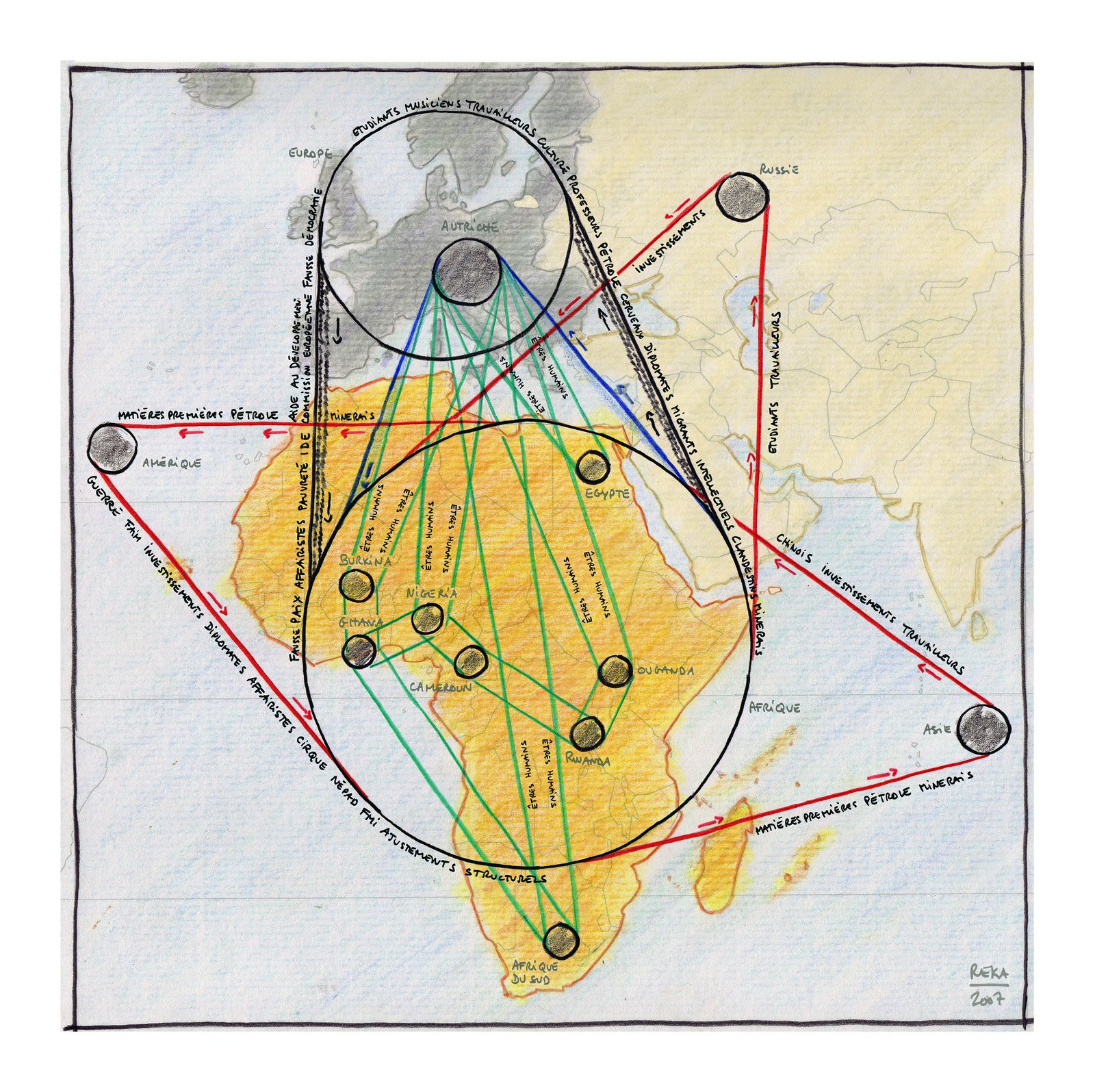
Diagrams - AMO/OMA at Prada Foundation Venice

"There is no such thing as an innocent map, observes Philippe Rekacewicz in his catalogue essay that accompanies Diagrams, a new exhibition at the Prada Foundation in Venice.

A renowned cartographer, the Paris-born Rekacewicz is well aware of his medium's capacity to transform narratives for good and ill. His own work includes maps that illustrate the deaths of migrants as they bid for new lives in Europe. "A map," Rekacewicz continues, "is above all a social and political act - and therefore inherently subjective."' p.5.

Individual
|
      INTERPERSONAL    :     SCIENCES               
HUMANISTIC  --------------------------------------  MECHANISTIC      
 SOCIOLOGY  :    POLITICAL 
|
Group
Am I Free?

My history ...
Philippe Rekacewicz / The African big wheel, 2007
The wheel symbolizes permanence and continuity in the context of a profoundly unequal exchange, drawing, color pencil and ink, exhibition copy.
Courtesy Philippe Rekacewicz
(Image credit: Philippe Rekacewicz)

SOCIETY

... is our history ...

Freedom

National & International Law

Justice


'Other pictures are equally revealing for what they conceal. Consider the diagram entitled "Universal commercial history", a visual analysis drawn up by the Scottish engineer William Playfair in 1805 which traces the rise and fall of global wealth since 1500 BC against what he terms "Remarkable Events Relative to Commerce". Playfair, who is said to have invented the pie chart, includes moments such as "Rome founded" "Mahomet's Flight" and "America discovered". He never mentions slavery.

With such a broad-brush approach, lacunae are inevitable. It is a shame that the work of Viennese social scientist Otto Neurath - who, along with his wife Marie and colleague Gerd Arntz, invented the Isotype (International System of Typographic Picture Education) - is not on show. Based on pictograms, Neurath's Isotypes are an lmportant forerunner to the digital vernacular (from emojis to icons) so familiar to us today. Nor does the exhibition include maps of the devastation of Gaza since October 2023, such as those made by investigative research agency Forensic Architecture, which are proving among the most critical diagrams of our time.' p.5.

Philippe Rekacewicz - https://www.grida.no/resources/10988

My source:
Rachel Spence. Hidden truths in the best laid plans. Diagrams | What charts, maps and graphics can - and can't - tell us. Collecting, FTWeekend. 26-27 April 2025. p.5. 
With many thanks acknowledging length of quotation.

Image source:
https://www.wallpaper.com/architecture/oma-amo-diagrams-prada-foundation-venice

See also: 'icon' : 'symbols' : 'diagram' : 'map' : 'Forensic Architecture'

Archived listing Links II Sciences - inc. 'Diagrams' & 'Visualization I' and 'II': 

Thursday, February 20, 2025

Book review: #5 - Handbook on the Ethics of AI

If there is an overall theme to the book it is - rather inevitably -   anthropomorphism. Some argue it is consequential in nature due to the risks we are running. Sandry's chapter 10 Anthropomorphism and its Discontents begins by highlighting duality, dichotomies, and  oppositions that instantly come into effect in this emerging  theoretical, practical and policy field. If a term anthropomorphic can be 'loaded' this one carries extra baggage: history, religion, natural, aesthetic, philosophy, physical, existential. The dual issue of making a machine that looks human; versus, machines that could deceive humans (used remotely today and in situ in the future?) is considered. In our interacting with AI Tech, I found intention (and attention) of specific interest. Sandry seeks definitions, starting with dictionaries, the discussion is helpful across arts too. The reader is left well briefed and technically too: intrinsic and extrinsic forms, the role of the intentional stance, 3-factors. ...

Health is not a primary focus of the book. The index does not list health, medicine, nursing, at least not where they may be expected. The index is comprehensive but I wonder if it could be improved. Care is suggested through social robotics (p.147). Design figures again, anthropomorphically of course (p.147). Specific attention to ethics and Taking Care With Language are given (sections 6-7). I scribbled! again about care for tech - in the material, energy, and production 'costs' in an ecological sense. SUVs annoy me (sorry!) are they all necessary? On language, I thought back to McDermott D (1985) Artificial Intelligence Meets Natural Stupidity, In MIND DESIGN, Haugeland J (Ed), MIT Press, London, p.144-145:


Balance in subjectivity and objectivity of stances and resulting content / conclusions can be difficult to achieve and represent. The latter section prompts respond to frustration with the term anthropomorphism. I found myself in a couple's lounge, as a community mental health nurse, acutely aware of the role of proxies in dementia care; as Sandry described Paula Sweeney's 'fictional dualism' (8, 150). Hodges' model fits well here too, regards anxiety. To socialbots, I added carebots. There seems potential in sociomorphing.

As noted previously, reflection and relation-al points litter the text. In Jecker's chapter 11 A Relational Approach to Moral Standing for Robots and AI this is more explicit. Jecker refers to care of others - as animals too. In computer science and seeking to retain a socio-technical perspective, I've seen potential in capability and maturity frameworks. Section 2 provides some discussion of the former. One of the first words I looked up in the index was isomorphic. It wasn't listed but I found reference to it on page 157: '... a community of robots psychologically isomorphic to to human beings that share our psychology ...'. Maths is a focus here, even though I must try to utilise AI to aid my learning and understanding. This is - must be an outcome of reading HEoAI.

The section on (self-)counsciousness is engaging and not limited (again) to machine intelligence. Subjectivity arises again. I wrote a note re. the precautionary principle, my 'prompt' the ethical principle. A gift was dicovered in 3. A CONCEPTUAL REFLECTION and within 3.2 Relational Ethics, preceded by the potential of Kant, utilitarian and vurtue ethics. While not wishing to virtue signal I've long speculated on how other cultures could inform nursing theory and models of care. Jecker incorporates the African philosophy of ubuntu in relational ethics. Student's would enjoy this, especially as Jecker (Source: Author) provides tables laying out the ethical approaches and robot & AI capabilities. This can also encompass older adults and care contexts with social robots. Nussbaum's capabilities applied to human development is also adopted here - another useful reminder:

(And, once again I recall Nussbaum's talk on Aristotle.) In post #4 I wrote of the rubbish scene in the film A.I. Artificial Intelligence, but it's here (p.166) that I wrote the note. There is so much I'm skimming over - believe it not.

The conclusion in mentioning a hybrid future consisting of both humanistic and mechanistic agents appears to find an additional theoretical and practical ally in Hodges' model?


Chapter 12 by Navas is AI Ethics, Aesthetics, Art and Artistry visits the history and philosophy of this subject too, esp. from 1700s. With Žižek and Deleuze there is much prepatory reading for would-be undergrads - and general readers keen to have an awareness of contemporary issues. There is quite a triad here - disassembled - across several sections. I have quoted from the volume many times, but p.179 concerns empathy: 
'Empathy challenges the ongoing optimization of technology, because it takes time to exercise it. A person needs time to think about whatever issue, situation, thing, or person they may empathize with. In other words, empathy is essential for humans to understand and figure their relation to others and their surroundings. Empathy, if practiced reflexively, can lead to critical thinking. which may not lead to clear results but the activity may and often does end in "wasted" time if framed under the drive for efficiency, which is clearly something Al is designed to achieve. And lastly, empathy, because it has been foundational to art, is also part of art's long-term resistance against capitalism's exponential dependence on speed of production. At the core of AI ethics, then, we find speed of production and consumption coming in conflict with human existence itself. Humans are proving to be inefficient actors in the very system they built for their own benefit, which obsessively demands faster cultural activity from people, which (to be blunt) translates to an unapologetic and incessant desire for profit.' pp.179-180.
Section 6 on creativity AND speed is fascinating, especially as human-machine (brain) interfaces develop apace. Concerned as I am with what is a metacognitive tool, 8 Metacreativity formed the conclusion of chapter 12. The notes refer to generative coding which has come up in various webinars.

Silent Running: Film
Briefly, chapter 13 covers AI and the Environment. It is amazing (or not) how in a few sentences your mind can be changed? From "Really!" upon reading 'species culling', to this being explained in the crown-of-thorns starfish (hence COTSbot) and the toll on coral in Queensland. There are robots-for-ecology. I smiled returning to Silent Running's Dewey, Huey, and Louie becoming reality. Facinating point in: what is collective must be recognised in terms of causation. Appropriatly, PEAS is an acronym: probalistic weather event attribution studies are a reality in conjunction with remote sensing and tracking.

Drones are also developing apace, and applied robotics - tree-climbing. Less reassuring (adding to nature's precarity?) are artificial insects to undertake pollination; more positively reducing the impact of chemical and toxic spills. Simulation for training is well established in medicine and nursing; section 2.3 addresses this were PEAS form super-ensembles of data (I like that). PEAS can also have a role in determining an evidence-base and demonstrating it is hoped provenance for that evidence in the movement of populations, for example, climate refugees. In conflicts, human rights and justice, forensic architecture is of course well established: Forensic Architecture (Care Forensics?)

The summative nature in closing chapter 13 is a helpful approach which I will possibly try to duplicate.

Socio-technical approaches are found in chapter 14 Uses and Abuses of AI Ethics by Frank & Klincewicz. Understandably, boundaries play a large role, as you would expect in deliberating value and values, moral patients and agents. The Collingridge dilemma is discussed, regards putting in place controls for a technology while it is still in development, otherwise control may be lost (p.213). Diversity, a story of the moment - closes out this chapter. There is a 'nice' continuity across chapters to
15 The (Un)bearable Whiteness of AI Ethics by Syed Mustafa Ali et al. (the first note highlights the format is a dialogue). The (colonial) politics of north-SOUTH are duly noted and Africa (section 4). Section 8 points to technological (and health) colonialism. I take as a positive that the 'hyphen' also has a place (S.10).

The Savage Mind

Again related, as per the book's structured parts, chapter 16 Ethics beyond Ethics: AI, Power, and Colonialism by Kim prompts the reader to revisit the concepts of 'other', alterity even if 'understood'. I pencilled 'Savage Mind' here. Machines are posited as the colonial other. There will be a repeated argument as in response to humankind's going back to the moon (to stay) and on to Mars. We should sort Earth out first. So too for inclusion and the machines. What about the people who are excluded, disenfranchised and increasingly so? I wondered (previously) if (even) more could be made a transparency? Noting the word subaltern, it appears this has suddenly been attributed to Ukraine? On disability and ableism reminded also of radio history and 'Does He Take Sugar?'

The statement: 'Machines are perceived as distant - temporally, spatially, or socially - and different from human culture.' p.234. Is, so true.

INDIVIDUAL
|
      INTERPERSONAL    :     SCIENCES               
HUMANISTIC  --------------------------------------  MECHANISTIC      
 SOCIOLOGY  :    POLITICAL 
|
GROUP
cognitive - conceptual
'spaces'
distance:
time, space
human cultures
societies
difference


'Binary-opposition' and the need to think outside of this is acknowledged. And as if (perhaps) to stress both distance and proximity, I wrote 'mobius' in the margin (p.238). Hutchings (2015) sounds a valuable reference: 'Ethical Encounters - Encountering Ethics'. The books I've read contribute to evidence to revalidate my nurse registration. I realise I've sold-myself short in listing the book's titles. Although not discussed here the remaining chapters are excellent critical reading at a time when diversity, equality and inclusion policies are being rolled-back and undone. I will highlight these:

  • 17 Disabling AI: Biases and Values Embedded in Artificial Intelligence (quoted in 'Do you fit the description?')
  • 18 The AI Imaginary: AI, Ethics and Communication
  • 19 Feminist Ethics and AI: A Subfield of Feminist Philosophy of Technology
  • 20 Buddhism and the Ethics of Artificial Intelligence
  • 21 Queering the Ethics of AI

In chapter 16 'Ethics beyond Ethics...' just before the conclusion I will carry forward a sentence -
'Forming an identity requires that "I identify something or someone beyond me" - with one or more categories persons, non-human others, acts, ideals, values, or social systems' (p.243).
- and the points following, and end there.

Many thanks to David J. Gunkel (Editor), the many contributors, and Edward Elgar Publishing Ltd for my copy. I have greatly enjoyed and learned much from reading this book.

Handbook on the Ethics of Artificial Intelligence. David J. Gunkel (ed.). Cheltenham, UK: Edward Elgar Publishing Ltd. ISBN: 978 1 80392 671 1245
https://www.e-elgar.com/shop/gbp/handbook-on-the-ethics-of-artificial-intelligence-9781803926711.html


Images:
Silent Running 
https://cdna.artstation.com/p/assets/images/images/016/839/904/large/david-eagan-screenshot001.jpg?1553673214
The Savage Mind
https://en.wikipedia.org/wiki/File:The_Savage_Mind_(first_edition).jpg

Related previous posts: 'general + AI'

*That early streak of competitiveness was clearly educated out of me.