Hodges' Model: Welcome to the QUAD: Search results for ideas

Hodges' model is a conceptual framework to support reflection and critical thinking. Situated, the model can help integrate all disciplines (academic and professional). Amid news items, are posts that illustrate the scope and application of the model. A bibliography and A4 template are provided in the sidebar. Welcome to the QUAD ...

Showing posts sorted by relevance for query ideas. Sort by date Show all posts

Sunday, May 05, 2019

Innovations: From Myths To Reality (Revisiting - Berkun, 2007)


Even though Brexit may have normalised hoarding, temporarily(?) at an economic level, I've been sorting some books to 'go' because of  'new' arrivals. Here then are some further reflections on Hodges' model as an innovation in response to Scott Berkun's 2007 title. As you can see there are many overlaps between Berkun's myths of innovation, which in the book are each given a chapter:

Myth #1: The Myth of the Epiphany

The creation of Hodges' model by Brian Hodges in the mid-1980s might be likened to an epiphany of sorts. I didn't ask that particular question when we met in 1998. It was however, more accurately a solution to the forthcoming challenge of Project 2000 and the revolution in the nurse education from schools of nursing to university based, undergraduate courses of study.


This educational, theory and practice-based focus is evident in the four purposes for the model's creation:
  1. Person-centred - holistic care;
  2. To bridge the theory - practice gap;
  3. To facilitate reflection and reflective practice;
  4. To support curriculum development.
If we are talking 'myths' too, how many of these issues were at the model's creation in the mid-1980s what we would term legacy issues now?

Myth #2: We Understand the History of Innovation

If the rise of ideas and the existence of 'fads' suggests that innovations wax and wane - falling out of fashion then - yes. There is a history. I'm assuming that the emphasis on models and theory development in nursing is past its 'golden age'? Whether we understand innovation in the healthcare, medicine, nursing, other disciplines is another question; especially socio-technically. I will return to this at #4.

Myth #3: There is a Method For Innovation

In healthcare there is a method: it is, the method (and methodology of) research that provides evidence for practice and hopefully policy.

(There's brainstorming too of course - for which h2cm is the gift.)

Myth #4: People Love New Ideas

New starters and students in many lines of work are usually made aware of their potential and status (wanted or not) as 'change agents'. Student nurses should be torch-bearers of new ideas that are evidence-based. Whatever our age as lifelong learners we should always be open to new ideas, especially with the advantages that experience brings to the work and testbench of ideas. Constructive criticism should help - by definition - to construct.

So often though, there is marked resistance to ideas whatever 'age' they are. The ongoing mantras are "We've always done it this way!"; or "This is quicker! Tried and tested!" ...

For the past decade (at least) the UK economy has been plagued by a productivity crunch. This is also affecting health care. Myths 1-4 can also be considered under the heading of 'progress'. How much do we understand 'progress'? An examination must reveal productivity and innovation as fundamental elements.

Myth #5: The Lone Inventor

As I may have mentioned before when we were taught Hodges' model (1987-1988 Manchester Polytechnical College - MMU) as students and informed that we must apply h2cm in a marked case study/assignment there were some mutterings. Students often contribute to the development and testing of countless theories and models.

Brian did not publish much on the model beyond a book chapter. In this sense there is a lone inventor and a lone champion drawing an immense number of additional sources (here since 2006 for example).

Myth #6: Good Ideas Are Hard to Find

Ideas are not hard to find. For Hodges' model this is quite ironic. Ironic because, of course, the model provides a net to help 'capture' not just good ideas - but a brainstorm full of them.

There's something even more important though:

Hodges' model can help us find ideas not as 'good' or 'bad' in the first instance, but to test the ideas across contexts to see how an idea might perform. Only then is an idea 'good' and suitable for purpose (see #9).

Myth #7: Your Boss Knows More About Innovation Than You

The defences of ritualised practice and accepted (ideas) practice are well established ...
  • Not invented here!
  • Not created - owned by me!
  • Who is Hodges?
Social media constantly espouses on 'true' leadership and how power is exercised and distributed (if at all), but for many leaders power is a factor and the pedigree of the ideas and strategies that are deployed is a political football.

Myth #8: The Best Ideas Win

The videotape recording standards is a regular lesson here. The best ideas often do not win.

Sometimes building something is not enough ... or is it?

Whatever the 'truth' here - I still believe there is a great resource in this model.

Is h2cm a compound instrument?
Is h2cm an implicit holistic theory?
Is h2cm a series of conceptual spaces?
Is h2cm all of these ... ?

I also believe the challenge of individual and population health has a long-tail as a legacy problem.

Whether h2cm 'wins' or not - its relevance for the problems and solutions of the 21st and 22nd centuries grows each day ...

Myth #9: Problems and Solutions

Management and organisational gurus often extol the virtue of 360 degree vision. Hodges' model can encourage this as there are several dimensions and dichotomies 'embedded' within. Of particular note in myth 9 is objective versus subjective qualities - and what counts as good or bad (to follow).

A key in healthcare is that 'the' problem is not ours.

It is 'ours' - if factors impose upon clinical decision making are a distraction 
- such as economics.

Identifying what the problem is - requires that we validate and integrate several sources of information: the referrer, the person - patient/client with the problem and what can be observed and investigated.

In healthcare again there is a need for co-production and Hodges' model can play a role in this. Sometimes the 'solution' may not be what is expected when a patient's choices are taken into account.  Hodges' model can work to the patient's strengths and the situation. The model can be used explicitly or implicitly to help assure the working out of the problems and the solution. A by-product of this is that we are prompted in consequence to ask questions and act on an individual's health and other literacies. What becomes evident given the challenges of productivity, demographics, public engagement is a gap in our understanding were co-production is concerned.

Myth #10: Innovation is Always Good

Berkun highlights how some innovations are not always good. H2cm may be challenging in terms of fears of 'runaway' reflection or navel-gazing. Could h2cm lend itself to a mechanistic response to problems. Is that a robot I can hear?

Could h2cm be a gift to those who wish to deskill the health and social workforce?

From models of care and theories of nursing to checklist A, B, C & D?

Use of the model on paper is one thing, but what of e-based forms of application? How can we assure accessibility to the model? Can we make an e-reflective workbench a reality for our students?

As noted in #9 the need for research to innovate in co-production, collaborative, person-centred care within developed and developing health care systems remains marked.

Scott Berkun (2007) The Myths of Innovation, CA: O'Reilly.

Monday, November 16, 2026

Book: 'Sleeping Beauties: Why Good Ideas Go Dormant and How They Wake Up' - Hodges' model!

 Byrne guides us on a captivating quest to understand how we come to remember forgotten ideas, inventions and technologies. With striking dexterity and range, he explores how advocates reawakened Bach's compositions and Vermeer's paintings after one and two centuries of slumber; how technological advances rekindled theories of continental drift and black holes; how accidents resuscitated hand-washing and genetics; and how war renewed interest in the submarine and The Great Gatsby . . . He is acutely aware that there is no surefire formula for making ideas last or bringing them back to life. What he presents is far more valuable: a deeply researched, stimulating inspection of how the marketplace of ideas shifts, and what steps we can take to shift it. Sleeping Beauties belongs on the bookshelf of anyone who cares about creativity or culture

Adam Grant, New York Times

 
individual
|
INTERPERSONAL
: SCIENCES             
HUMANISTIC ------------------------------------------------ MECHANISTIC
SOCIOLOGY : POLITICAL   
|
group
Sleeping Beauties: Why Good Ideas Go Dormant 
and How They Wake Up


silos 

ideas

science

construction

arts

technology

synergy

disciplines

interdisciplinary

multidisciplinary

 transdisciplinary

'web' as 
art/science/health 
gallery?


Society

Therapeutics: 'Talking Heads'

power

meritocracy 


My source: Foyles, Waterstones .and this morning BBC Radio 4 Start the Week, 16th November 2026:
https://www.bbc.co.uk/programmes/m00349wk

Previously: 'ideas' : 'science' : 'bias' : 'time'

David Byrne. Sleeping Beauties: Why Good Ideas Go Dormant and How They Wake Up. Canongate.

Sunday, January 22, 2023

Philosophy in Pubs - Liverpool Weds 25th Jan 7.30pm

Subscribed to Philosophy in Pubs for many years, I've posted to the list also in the distant past, but I've never attended a meeting. This past week I noticed a message about a new subgroup - Young Philosophers - in Liverpool from Mike (phone numbers removed). Below, I've posted some of the online chat:

On Saturday, 14 January 2023 at 14:38:50 GMT, <info AT philosophyinpubs.co.uk> wrote:
Hi everybody,
 
Its Mike from the Keith's PIP and the young philosophers group.
I am currently re-launching the latter as a new PIP group at
Thomas Rigby's in town
(23-25 Dale St, Liverpool L2 2EZ)
 
The first meeting of the Philosophy group will be
Wednesday evening the 25th January at 7.30pm.
Please come along, all welcome, all ages.
 
If you need anymore  information, please email me (email below) or call me on ...
 
Thanks
Mike Green.
michaelljohngreen AT gmail.com 

This piqued my interest, given my love of Liverpool (born in Walton) and the question of at what age can younger people - children be introduced to Hodges' model?

I replied expressing interest in the possibility of contributing, once the group is established, or as a 'starter for 10', seeking critique as to what sense young philosophers would make of the model.

Responding with an introduction to Hodges' model, and expression of interest, Paul and Rob replied as per below, to which I've tried to add some clarification.

Rob's thoughts are very helpful. The upshot is, I'm looking f/w to a full day in Liverpool this Wednesday, meeting Mike, Paul, Rob and possibly others before the meeting starts at 7.30pm.

Paul's message (intended for me):

info AT philosophyinpubs.co.uk
Sunday, 15 January 2023 at 13:00:12 GMT
Subject:
Re: New PIP group!

Hi Mike, Peter

Yes, you seem to be part of quite a sizeable group of people on our general members/mailing list that have not gotten round to attending one of the groups yet. But that's okay, absolutely no need for apologies, your interest is appreciated anyway.

I've had a quick glance at your attachments; found what I read very interesting and would like to know more. I don't think I've heard of the Hodges' model, or at least not in relation to what we generally practice (Community of Enquiry method).

It's great that you would like to contribute or provide a session regarding the Hodges' model, but I'm not sure if doing that would fit well with this particular opening meeting of a new PIP group. Having said that, I could be very mistaken, and an introduction in the manner you mention, might be a great way to get people thinking and herald a fruitful meeting. The meeting is due to start at 7.30pm - (meetings usually take one and a half to two hours), but if you like I could meet you there half an hour earlier. Let me know.

We have something called the Enquiry Development Series (EDS) running at the moment. It's a monthly Online event which is run for PIP members and others to learn/refresh their undertanding and practices. You would be most welcome to attend.

Best regards,

Paul ...

PS: I have cc'd some members of the EDS in with this reply.

From Rob:

On 2023-01-16 12:44, fappyhealing02 AT yahoo.co.uk wrote:

Hi Everyone,

From my very limited reading on Hodge's model. It seems to be concerned with very similar issues to those of PIPs and the CofE community, which is an expression of prior analysis, critique and reflection coming from people like Dewey, Postman, Freire, Lipman and so on. I have a basic grasp of the model as a conceptual framework and a means to better care and understanding across society. What I don't seem to have picked up so much is a more fully developed methodology rooted in practice and realisation of these ideas.

This leads me wonder whether this model/framework is mainly conceptual, with limited  methodological guidance towards how the ideas in the framework are to be expressed and realised. PIPs is at the stage where it has a very successful methodology which realises and expresses in practice the ideas that Hodge points to, along with the philosophy of education eluded to earlier and various other frameworks such as the Paul and Elder model of critical thinking.

So, we have the history and philosophical education from Socrates onwards, the comes a distillation of these ideas into a framework or model, which is where we find Piaget, Bloom, Paul and Elder, along with Hodge and others. These models then have to be cashed out in practice. At this point, we are now thinking about methodology, there is of course connection, influence and overlap with the history, philosophy and subsequent frameworks. Methodologies vary from being barely formed to being well formed and robust. I would say PIPs and CofE have a well formed and somewhat robust methodological practice. It has been well tested and critiqued for over 40 years in different countries, communities and contexts. It has stood the test of time with a good pedigree. Matt Lipman was a key figure in developing a methodology out of his research into philosophy of education and various frameworks/models. However the methodology he produced to deliver in practice was something of a prototype rather than the more fully formed, finished article. Through time and careful reflection people like R Sutcliffe and Karin Muris took Lipman's methods improved and polished them into the practice we see and use 40 years later. This is of course still developing along democratic and dialogic lines.

In the case of Edward De Bonno, Paul and Elder, Illich and Dewey we find some powerful insights, some partially formed models and some fully formed models but not that much guidance on how to implement these ideas. Yes, they provide some ideas and pointers on how to go about the realisation of these things in practice but methodology on the whole is pretty sparse. I guess it's a case of focussing on a specific group of concerns comes at the cost of other concerns, though, I don't want to take this too far and slip into zero-sum thinking. Anyway, based on limited understandings I'd provisionally put Hodge in this category of well formed model, limited methodology in terms of the nuts and bolts of how to best realise the model in practice.

Questions I'm left with:

Is the distinction between model and methodology a significant and useful one here - why? Yes/No, because...?

Given our current point of development and understanding, by doing what we do, are we already cashing out a good deal of the key ideas in Hodge's model?

Could we just clarify what Hodge's model is a model of?

Do I need some help in understanding Hodge better in terms of both 'model' and 'methodology'?

This isn't to say we should not draw inspiration and ideas or take time to explore and experiment with Hodge's model, just that I need to be clearer about what it is, what it's trying to do, how it is going to do it. Once more secure with this, I feel I'd be in a better position to make more competent judgements and recommendations about its uses and benefits.

Best wishes,

Rob

My reply:

Subject: Re: New PIP group!

Thanks for the messages - just caught up I think...

I wondered originally Mike - about your young philosopher's group and once established asking the group the questions that Rob has posed and responded to.

I'm seeking critique, not proposing that Hodges' model is adopted by PIP.

The questions posed by the model - might gainfully exercise younger minds, and provide me with some pointers - which I would make clear (from ethics / consent perspective).

I greatly appreciate Rob's thoughts*.

A question I have educationally is from what age (literacy level) which Hodges' model #h2cm might be taught (discovered?).

I'd be pleased to come through on the 25th Mike and Paul, arriving a bit earlier.

I'll get to Liverpool early a.m. train and make a day of it.

As per Rob, I'm still asking these questions of the model and enjoying the journey ... so, briefly in response:

There is no methodology associated with the model, it is 'agnostic' (whatever that means).

The model is situated - so clinically, the way the model is used is influenced by the patient, client, carer, student, manager ...

The model can provide a relational ontology - it incorporates several polarities, dichotomies, oppositions and instrumentally can facilitate dialectic engagement.

It can be applied (imho) for a variety of research and philosophical stances, standpoints - Qual , Quant, Mixed-methods ... all the -isms?

As you will no doubt appreciate, in education and health care (especially) we need *evidence-based* interventions.

In seeking possible theoretical underpinnings for #h2cm think (as Rob suggests) of the model as a giant conceptual corpus (drawing from Tim Berners-Lee's giant global graph).

The axes of the model represent the (conceptual) holistic bandwidth of the situation.

The model can wax and wane as per the context (scale, scope). In a reductive sense I see the four (care) knowledge domains as four 'conceptual spaces' (Gärdenfors).

h2cm can also find a 'home' in the semantic web and in education - the idea of 'threshold concepts' (Meyer and Land).

There is another tool, but this calls for a logician - if not a totally erroneous idea?

[ Note diametric oppositions in the model: e.g.
  • public understanding of science;
  • the extent of visualization in the humanities;
  • mental health (the self) and the State (politics, law) current Psycho-Economic crisis. ]
*ROB - and all - I'd be pleased to post your thoughts / response on the blog, if this is appropriate with links and text on PIPs.

I hope this helps and look f/w to next week - thanks for your interest too.

Best to all.

Peter
====

Clearly not the last word. Look f/w to Wednesday and learning more.

Monday, June 20, 2011

Article 10 of the European Convention on Human Rights: receive and impart information and ideas

Article 10 of the European Convention on Human Rights provides the right to freedom of expression, subject to certain restrictions that are "in accordance with law" and "necessary in a democratic society". This right includes the freedom to hold opinions, and to receive and impart information and ideas.

“ Article 10 – Freedom of expression 1. Everyone has the right to freedom of expression. This right shall include freedom to hold opinions and to receive and impart information and ideas without interference by public authority and regardless of frontiers. This article shall not prevent States from requiring the licensing of broadcasting, television or cinema enterprises.
2. The exercise of these freedoms, since it carries with it duties and responsibilities, may be subject to such formalities, conditions, restrictions or penalties as are prescribed by law and are necessary in a democratic society, in the interests of national security, territorial integrity or public safety, for the prevention of disorder or crime, for the protection of health or morals, for the protection of the reputation or rights of others, for preventing the disclosure of information received in confidence, or for maintaining the authority and impartiality of the judiciary.

”
Well there is clearly one -

purpose


Political

- in blogging. Many small voices can make a difference.

It is sobering to realise the responsibility; the responsibility that pertains not only when we receive, but also impart information and ideas. Hodges' model can be concerned with both.

Care is needed when ideas have political weight and a health impact; even though when in the guise of public (mental) health such information and ideas apparently lack inertia. You have to wonder about striking the balance. Forget physics - it's the masses that suffer here.

physic(s)
sick society

For how many decades have the health professions given the government(s) advice on alcohol?

For how long has the negative influence of advertising on children been questioned?

Always the balance.
So hard to find - like Political balls.

My source (and emphasis): Wikipedia
http://en.wikipedia.org/wiki/Article_10_of_the_European_Convention_on_Human_Rights

Saturday, September 14, 2024

Hardy (1940) A Mathematician's Apology


In Liverpool I came across G.H. Hardy's short book A Mathematician's Apology. At £2.00 - a pristine bargain and a  marvellous read, especially the latter sections.

From being taught and applying Hodges' model in a case study in 1987 through to online work since 1998; I have to ask myself. Do I need to write:

'A Nurse's Apology'?

Aware of Hardy in the history of mathematics, and having read his apology, I'm no Hardy. My antics are a lesson in addition, but this is more 'Laurel and Hardy' - with apologies to comic genius of course. 


By their nature professions seek to maintain, and assure their continuity. A professional body can point to a definable body of theory, practice (curricula), that carries social and political status, if not patronage. There is national agreement that the NHS needs reform; radical reform no-less. The new Labour government is drawing lines to negotiate with the BMA, other professional bodies and unions. Specificity, specialisation is key. In healthcare people have suggested to me that Hodges' model invites genericism. Any suggestion of genericism is to be shunned. There seems an almost allergic reaction such is the threat to professional identity; unless, of course, you are a 'General Nurse', or General Practitioner - GP family doctor). Even Hardy warns:
"'GENERALITY' is an ambiguous and rather dangerous word, and we must be careful not to allow it to dominate our discussion too much." p.105.

This also applies to the quality and solidity of professional agencies and bodies whose role is to provide governance and set standards. The Nursing & Midwifery Council has stumbled? Life and death is made up of details AND big pictures. How do you provide for - balance both? Curricula are another concern. Is the future of mental health nursing guaranteed as a profession? 

https://hodges-model.blogspot.com/2016/08/future-of-mental-health-nurse-training.html

The instrumental potential of Hodges' model is obvious. It invites a checkbox approach. One-to-one clinical encounters and interactions reduced to a tick-box exercise. This reduces any sense of specialist knowledge, training and education needed to assess, plan, deliver and evaluate high quality, effective, sustainable healthcare.

'THE second quality which I demanded in a significant idea was depth, and this is still more difficult to define. It has something to do with difficulty; the deeper? ideas are usually the harder to grasp: but it is not at all the same.' p.109.

Hardy's thoughts (and no doubt similarly expressed by other mathematicians and logicians) can be 'found' in Hodges' model; with an addition. Depth and difficulty rests on the uniqueness of  the 'one'. 

Here, Hardy is comparing between 'real mathematics' and chess:

'A chess problem also has unexpectedness, and a certain economy ; it is essential that the moves should be surprising, and that every piece on the board should play its part. But the aesthetic effect is cumulative. It is essential also (unless the problem is too simple to be really amusing) that the key-move should be followed by a good many variations, each requiring its own individual answer. 'If P-B5 then Kt-R6; if .... then if .... then ...., ....' - the effect would be spoilt if there were not a good many different replies. All this is quite genuine mathematics, and has its merits; but it is just that 'proof by enumeration of cases'  (and of cases which do not, at bottom, differ at all profoundly*) which a real mathematician tends to despise.' p.114.

*I believe it is now regarded as a merit in a problem that there should be many variations of the same type. (footnote)

While Kings, and Queens et al. undoubtedly have their own unique personalities, in healthcare effective clinicians make a concerted effort not to merely enumerate cases. The professional emphasis is (idealistically, professionally, purely and in application to) person-centredness; with the compassion, complexity, cussedness, and (sometimes literal) complications this brings. From 1-1 interaction, the clinical encounter, the therapeutic relationship, and alliance are the reason for practitioners achieving and sustaining intra- and interpersonal communication skills. Our attitudes towards knowledge, what is thoughts affects what we feel individually and collectively. Science should be neutral. It might be concluded that this question is for the philosophers and ethicists to wrestle with. In healthcare ethics are central: 'Do no harm'. Whether the practitioner, theorist, manager, policy maker is a nurse, scientist or mathematician such questions impact upon the person. As they are social, cultural and political. Revisiting Bronowski's Ascent of Man, this question arose in Archive on 4.

'It seems that mathematical ideas are arranged somehow in strata, the ideas in each stratum being linked by a complex of relations both among themselves and with those above and below. The lower the stratum, the deeper (and in general the more difficult) the idea.' p.110.

(my emphasis)

individual
|
INTERPERSONAL : SCIENCES
humanistic ------------------------------- mechanistic
SOCIOLOGY : POLITICAL
|
group

logical & mathematical reasoning
depth of reasoning (memory)
mathematical aptitude
intelligence(s)
pure maths
identity

vector
relations
mathematics
logic
depth of analysis, complexity
Cricket!
pure - applied maths
"1" problem per visit

patient - health practitioner 
relationship
Watching cricket - conversation

reports - outcomes
enumeration of cases


Back-tracking to page 104, Hardy:

'The relations revealed by the proof should be such as connect many different mathematical ideas.'

Our proof is person-centredness, placing the person at the center (in this case - of Hodges' model). The proof can be quantitative and qualitive. There are a great many ideas at work. Critically, the ideas that might be called upon (even improvised) are not all health-related, but can extend beyond to encompass the four care (knowledge) domains of Hodges' model. In healthcare as in Hardy's life the spiritual is encountered. So, the determinants of health are ALL available to us - as required. Well not available as a resource might be, they are available in the hope they will be seen as factors. Hardy would approve I think of the direction of travel, not just as a vector, but a model of multidimensional vectors - reaching for relations.

Hardy, G.H. (1940) A Mathematician's Apology, Cambridge: Canto.
https://www.cambridge.org/core/books/mathematicians-apology/B90D81A8E28674119781863988A3E11B

Monday, August 27, 2007

INTERPERSONAL links: Holistic Bliss or Tristram Shandy ... III

The INTERPERSONAL domain links are to my mind (no pun intended) fairly obvious, at least that first row complements the SCIENCES top row opposite.

Basically, who needs a talking therapy and who needs a drug therapy?

The two uppermost care domains are intended to represent the INDIVIDUAL axis, so just as the SCIENCES [ANATOMY & PHYS] domain covers physical care; so the INTERPERSONAL domain encompasses emotional and mental health care.

Hodges' model is comprised of four care domains, but it is these two [INTERPERSONAL : SCIENCES] applied to the individual that even today we struggle to balance in theory and practice.

A key factor in Brian Hodges' early nursing career (and mine) has been the role of institutions, organisations and the formal policies and structures they represent. This can be depicted as:

EMOTIONAL HEALTH : PHYSICAL HEALTH (both 'individual')
OTHERS family, society : INSTITUTIONS (both 'group')

As to the INTERPERSONAL links themselves - I arrived at mental health through reading a psychology text on Wundt and introspection, then James..... PSYCHOLOGY being of central importance in this domain has two listings, with MENTAL HEALTH and closely related THERAPIES also sharing the top row. I may swap these around: PSYCH-OLOGY as a cognitive science should be placed rightmost, while MENTAL HEALTH and THERAPIES should be further to the left being more 'humanistic'. What do you think?

Do the sciences have to be corralled in the SCIENCES domain? I think I remember Bryan Magee and John Searle in conversation noting that many disciplines with science in their title are probably not sciences - in that upper right hand quadrant sense. Maybe it is just that -

cognitive science : "SCIENCE" (physics, biology, chemistry)
social science : political science

- are still running wild out there, untamed and as yet unbroken? Cognitive science has however, clearly come of age and the 21st century will undoubtedly be the century of the brain when anatomy, physiology and genetics are linked to thought and individual (and even social) behaviour.

Already the content here highlights cognition (thought). The inclusion of other link categories in this upper-left set can be explained with recourse to cogitation. After PSYCHOLOGY, PHILOSOPHY (with ETHICS) is the rather obvious 'ology'.

For better or for worse our culture is driven more by IDEAS and ideology than philosophy. Call it the informal philosophical engine that drives CREATIVITY.

COMMUNICATION lies at the heart of all things human-e. Given the millennia that the patient-physician relationship has been around, you might expect it to be perfected by now. Well health and social care workers and the public they serve are still trying to reach empathic nirvana (although that may be to take communication a bit too far).

Hodges' model has a role to play supporting reflection for all.

IDEAS, COMMUNICATION lead us to belief and a central component in psychological therapies. Belief is also a thread can be used by one individual to lead others positively or to subvert other individual's capacity to think critically. It is in this INTERPERSONAL domain that good and evil are so proximal they create heat, fanned by a culturally driven winds of history and media from the South. Be-life indeed. Here then - THEOLOGY is purposefully placed with TRANSDISCIPLINARITY. If it is to serve humanity Religion must be bound and integrated into the corpus of knowledge and that includes reconciliation with the SCIENCES. We cannot deny myth and yet myth cannot deny evidence - a debate that will go on......

The economic emphasis placed
currently on creativity is quite remarkable, not just at a national level (cue ramble...). Cities recognise that their future development, sustainability and very survival depends on the generation and flow of ideas. Some things do not change. In myth a special place has been reserved for the isolated thinker, the one individual who takes themselves away for weeks-months, to be touched by the spiritual realm, to return to the community delivering insight, creative sustenance. Now creative individuals are needed more than ever. The isolation is virtual, the community potentially global. The energies of individuals are directed at solving problems concerning more mundane matters of cost, risk, flexibility and growth. Those creative outputs are distilled through team work and although they are then diluted they remain invaluable - such is the scale of the problems to be solved. Just as the great rivers that feed our cities have their sources - often remote and isolated in the high mountains, so ideas and creativity begin with one individual. That flow of personal knowledge now finally enters the ocean of KNOWLEDGE MANAGEMENT - EXPERT SYSTEMS (decision support systems).

I have a little mantra that I share with students. It's not perfect as there is much overlap; but I figure that what
aptitude is to engineering so attitude is to caring.

HEALTH PROTECTION and PROMOTION, SELF CARE are all about attitude.
Of course, money in the form of departmental budgets (those institutions do matter) and family income can make a huge difference, but if the right attitudes are not present then you may as well - "go fish!".

In light of the above STUDY SKILLS and EDUCATION and TRAINING speak for themselves - on this occasion at least. One of the original purposes of Hodges' model was to facilitate reflective practice
(more to follow). We are familiar with the mechanical tools in use everyday to the extent they are taken for granted. Now the focus of training is more likely on the software tools that translate IDEAS into art, artefacts and conceptual frameworks.... ;-) These graphical and design tools must be learnt and the HUMAN-COMPUTER INTERFACE and its ACCESSIBILITY 'quotient' can prove to be either a brick wall or a leg-up for the individual user (even if networked or a collaborative tool - see SOCIOLOGY links).

If the SOCIAL domain reflects the worlds of the others, then the last INTERPERSONAL row REST & RECREATION reflects something of me and my family.

"Next!" - the SOCIOLOGY domain links....

Thursday, September 11, 2014

Technologies for Development: Project - founding ideas

Reading the website of this project I noticed that their founding ideas can be mapped to Hodges' model. As depicted below some are pretty obvious, notably the POLITICAL domain and the SOCIOLOGICAL.

Their first founding idea is placed in the interpersonal domain. This is very subjective exercise - literally playing with words - but here I am prioritizing individual cognitive access above physical access. I am thinking of individual participants and how a person even as part of cohorts, communities and groups can be marginalised. Mental health, also 'found' in this domain is a key example. As Nanotechnologies for Development state the first idea also focuses on countries - the group. So maybe I am wrong, if there is a wrong when using models - idealisations - in this way?

Staying with the group, access and participation are also a crucial matter of human rights - education, health information, health and social care, employment, freedoms, and security - freedom from violence, unlawful imprisonment...

These founding ideas clearly denote underpinning values, note in-particular the way risks and benefits are included at the individual and the group level.

In the SCIENCES domain from the beginning acknowledges time, process, project management. Nanotechnology needs to be understood in terms of the environments we inhabit. Not just us, now; but grandchildren... too. Not just the physical environment, but that embodied under and within this other divide: skin.

Within the mechanistic domains how will consultation about benefits and risks be negotiated and communicated to the humanistic domains?

How will the individual - group : community - commercial enterprise and innovation be squared?
 
This individual-group distinction is becoming ever more significant - of which more to follow.

individual
INTERPERSONAL : SCIENCES
humanistic ------------------------------------------- mechanistic
SOCIOLOGY : POLITICAL
group
The first founding idea of this project is that developing countries should not be denied participation in advanced modern technologies.The third core idea is that such developments entail risks and benefits that need to be addressed from the beginning.
The second that they should do that in their own culturally-specific ways. Our approach rejects any a priori distinction between traditional and modern technologies, but rather seeks innovative ways to connect indigenous and globalized knowledge and practices.
The fourth founding idea is that choices about those benefits and risks need to be made in a democratic way.

Source: Technologies for Development: Project Founding ideas

Wednesday, July 30, 2025

Book: 'Health and Health Care Inequities' iv

Fittingly, chapter 4 brings us to Political Power and Policy Advocacy. In Hodges' model you can both have your cake; and gratefully receive the cake you're given. This is the health in politics and the health in politics (as, for example, revealed in the health status of political leaders).


As a framework structure, the axes of Hodges' model initially give rise to four symmetric domains (spaces). There is an invitation to begin where you choose. Chapter four reveals some truths, as the 'nexus' - center of the model is mobile (unlike many citizens!) as the 2x2 rendition below suggests, if not illustrates. Borras takes us through health politics, political participation and representation, unequal power and politics, and policy change approaches with illustrative cases.

In an institution (like the NHS), bureaucracy, aka an organisation, the workforce are often acutely aware of policy and procedure. It is like the Force. It permeates everything - the meetings - and yet is remote. Borras seek to shed light on unequal resources and policy influence. Again Borras's literature informed discussion and argument, includes some historical gems, such as Lasswell (1958).

Individual
|
      INTERPERSONAL    :     SCIENCES               
HUMANISTIC  --------------------------------------  MECHANISTIC      
 SOCIOLOGY  :    POLITICAL 
|
Group


Political Power and
Policy Advocacy


In chapter 5 on evidence and ideas, discussion of Katherine Smith's 'under 'Six Travelling Ideas' is an excellent resource, with several references including:

Smith, Katherine E (2013) Institutional filters : the translation and re-circulation of ideas about health inequalities within policy. Policy and Politics, 41 (1). pp. 81-100. ISSN 0305-5736 (https://doi.org/10.1332/030557312X655413).

I love the image of ideas as and on a journey, some successful, others fractured, weak, re-contextualised, even non-journeys (falling - 'dead from the press' - I suppose?). At least the journey of Hodges' model is ongoing. A baton for our times. As I wrote in post i, chapter 5 tackles 'evidence' (there's a post or two). It does so in relation to information, ideology, and interests:

If you've read many posts on W2tQ, you may see: I've a chip on my shoulder. Evidence for the safety, benefits, theoretical underpinning ... of Hodges' model is still to be realised. To the satisfaction, that is: of course to the powers that be. Speaking of which: the axial (for me) subtitles arise again in chapter 6; capitalism-imperialism-colonialism-racism nexus (p.87).

To demonstrate the utility of Hodges' model, this is significant.

Please feel free to search for these terms - capitalism-imperialism-colonialism-racism in the search bar above.

I've been interested in drama since playing the part of Francis Nurse in Miller's The Crucible. It took some 50 years to go from armchair to treading the boards again. I played Ken, supported by his wife, trying to run a post office, amid a chaotic and injurious IT system. An 8-9 minute sketch which was part of a Living Newspaper. Interested in writing - as previous posts may reveal, I also keep trying get to the theatre. With the themes of chapter 6, Liberation was thought provoking.

Mind-Body, Private-Public, Socialist-Conservative, Borras adds the global health North-South schism. A prompt for suggesting a brief glossary is expropriation and exploitation^ (p.88). Four stages of capitalism too. This chapter - A critical political economy approach is essential reading for me (and you!?) - a path to a critical care economy (self-care to planetary health).

^There is a note #3 about these on page 99.

See also: Post i : Post ii : Post iii : Post v (to follow)

Merelman, R. M. (1981). Harold D. Lasswell’s Political World: Weak Tea for Hard Times. British Journal of Political Science, 11(4), 471–497. http://www.jstor.org/stable/193766

Arnel M. Borras. (2025) Health and Health Care Inequities - A Critical Political Economy Perspective. Fernwood Publishing.

Liberation image: The Agency
https://theagency.co.uk/news/cast-announced-for-ntombizodwa-nyonis-liberation-at-royal-exchange/

Thursday, October 19, 2017

Paper: Wang and Nickerson (2017). A literature review on individual creativity support systems

Hodges' model can lay claim to being a creativity support system [CSS]. While I do not have evidence, the model presents a diversity of stimuli in its structure and the care - knowledge - domains. It follows then that from the outset it is a motivational primer on both affective and achievement counts. Immediately, there is the motivation provided by the blank space, viewed as one or four conceptual spaces to find an initial starting concept. Affective as users gravitate towards their chosen reflective and creative journey, and achievement priming as having a goal that is prompted by professional, interpersonal and educational goals. If there is a case of 'creativity block' then perhaps a group approach can be adopted? Hodges' model then becomes a collaborative creativity support system. With Hodges' model and no doubt the proposed CSSs the collaborative agents add their own affective and achievement priming, whether student-student; patient-student (supervised); or mentor-student.

With the important caveat that the studies identified do not include healthcare but many papers are general. The authors provoke many questions: "Creativity support systems, like other information systems, are most effective when they instantiate underlying theories..." (p.140). I have already posed this question - which is (as ever) compound. As per the review's general domain papers, is there an underlying theory for all of Hodges' model; or is there a need for a theory per care domain?

"The literature on individual creativity support systems has drawn from theories about design, human computer interaction, information systems, and creativity.. " (p.140). 
If 'design' can be complex, what of 'care design'? That is what we are about. This in turn impacts upon the other sources of theory above.

There is much to draw upon in Wang and Nickerson (2017) but finally on page 145:
"the authors did a survey to verify the notion that creative self-efficacy, individual knowledge and IT support affect individual creativity through mediating variables: individual absorptive capacity, exploration and exploitation." 
Creativity must contribute to literacy, Wang and Nickerson allude to a relationship, referring to self-efficacy above. This is what we are seeking in health literacy and self-care. An ability to explore and exploit available resources being a sign of autonomy and efficacy.

Table 3
A framework for designing individual creativity support systems.


Aspects Components Features to Support the Component
Motivation
Motivational
priming
Affective priming
Achievement priming
Creative Process
Process
completeness
Process control 
Modules to support each step in a complete
creative process
Allowing iteration and selection of steps
Divergent
thinking

Stimuli

Long term
memory

Working
memory

Creativity
techniques
Providing different levels of stimuli,
Providing stimuli dynamically
External long term memory, such as knowledge
base and case library;
Facilitating search
Supporting association,
Visualisation,
Random combination
Facilitating the use of creativity techniques;
Computational creativity techniques
Convergent
thinking 
Comprehension
Decision 
 Labelling, classification, simulation
Criteria based comparison, Decision support


Table 4
The steps in a complete creative process.

Process Stage The Divergent Step The Convergent Step
Problem finding
Formulating problem presentations in various ways
Selecting the best ways to present the problem
Information finding
Collecting potentially relevant information
Selecting the most relevant information
Idea finding
Generating many ideas
Selecting the best ideas
Solution finding
Improving the selected ideas
Selecting the improved ideas and integrating them into a solution


Reference:
Wang, K., & Nickerson, J. (2017). A literature review on individual creativity support systems. Computers In Human Behavior, 74, 139-151. (tables p.145). http://dx.doi.org/10.1016/j.chb.2017.04.035

Saturday, May 02, 2009

Drum Beat Network: Development Policy Ideas and Critique

To: Academics and other Researchers in The Drum Beat Network
From: Warren Feek - Executive Director - The Communication Initiative

Development Policy Ideas and Critique

Dear Peter

Many best wishes. Never has consideration, analysis and debate of Development policies been more important. We would welcome your Development policy ideas, analysis and thoughts being shared through The CI's policy process [with and supported by The BBC WST].

There is a coming opportunity to give your Development policy ideas wide circulation. We will be doing a theme issue of The Drum Beat e-magazine [subscriber base of 44,000 in development action and thinking) in mid-May based on the blog submissions to the Policy section on The CI site.

That policy site is receiving increasing access and engagement from amongst the 2,700,000 individual user sessions over past 12 months on The CI portal.

A significant and growing percentage of the CI network and user base are policy makers and funders and their support staff.

It would be excellent if you are able to blog - we encourage a substantive op-ed style (my link) - on an interest to you within the overall theme for this blogging process - namely issues of development policy. There are more details at http://www.comminit.com/en/node/286565/bbc

To participate, simply send me your blog [op-ed] contribution in whatever form you wish and we will consider and process it for possible featuring both on the policy blogging site and in the mid-May Drum Beat.

We would also welcome your comments on the present blogs that have commenced this process and can be seen at http://www.comminit.com/en/development_policy

So, if you want to join this blogging process - in the Op-Ed style we have adopted - on development policy issues and themes as featured through Policy tab at top of all pages on site - www.comminit.com - then please check out the guidance notes at
http://www.comminit.com/en/node/286565/bbc and email me your contributions - wfeek AT comminit.com

It would be great to have your reflections in this policy mix. Please do send your contribution.

(edited for length) ...

Thanks - Warren
--------------------
Hi Warren, Thank you for this news and invitation. A very interesting and worthy project all the more so with the use of op-ed style. I'll see what I can do - perhaps using the h2cm matrix ... Good luck! PJ

Sunday, October 11, 2009

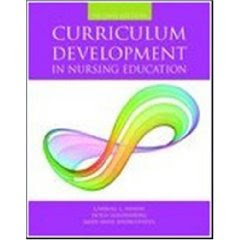
Book review: Curriculum Development In Nursing Education (2nd. Edition)

It is high time I reviewed a book on nursing so when I came across Curriculum Development In Nursing Education by Carroll L. Iwasiw, Dolly Goldenberg and Mary-Anne Andrusyszyn, I was really pleased to receive a review copy. While I am not a full-time academic I learned a little about curriculum development on the PG Cert. Ed. course. As for all qualified nurses I take the mentoring role seriously, enjoy it immensely and of course we are all life long learners. The other benefit comes from curriculum planning being one of the original purposes for Hodges' model.

https://www.jblearning.com/catalog/productdetails/9781284143584
To begin the book is a very comprehensive and yet accessible introduction to this subject. The language is clear and not technical, the print is also clear (and large - for an ageing readership!) the format is modern. The book is well referenced overall, leaving me with several leads to follow-up. Although grounded in and with case studies based on hypothetical North American institutions the scenarios, questions and critque are easy to appreciate and relate to, whether you are faculty, nurse (student), or other stakeholder. Iwasiw et al. stress how curriculum development (CD) is ongoing, recursive and the limitations of a 2-D representation of the process on paper. A model is provided on pages 6-10 and in figure 1.1 with many very useful definitions.

The politics of educational settings and their activities are clear as Iwasiw and colleagues explain the 'sales pitch' for CD and the importance of interpersonal skills and foresight. CD the authors make clear is a non-trivial pursuit. It should be ongoing all the time with established curricula under review. At first I was surprised about the lack of mention of project management, specialist consultants are referred to and Gantt charts and project plans are discussed subsequently. The book starts and ends with the nursing and faculty shortage (which seems ironic from here).

In chapter 3 leadership is covered and the need for formal preparation of staff to manage CD.  Faculty development for CD features in the majority of chapters. The case studies engaged me throughout. Chapter 4 leads on to the organizational context of CD, with helpful introductions to change theories and their application. So we have Kotter's 8-Stage process; the Transtheoretical Model of Behaviour Change. Talk of leadership and organizations inevitably leads to the adminstration and management of CD and types of committees. Not exactly page-turning content, but essential to planning, collaboration and ongoing success. CD is viewed as a golden opportunity for change, so decision making and critical reading is emphasized, with several methods of ideas generation outlined in a table (wither Hodges' model?). There is a 2 year Gantt chart, despite my initial reservations about 'project management'. (I am still surprised and must address my impression that academia is largely untainted by external project management and consultancy speak?). Page 80 sees an explanation for the book's cover.

There is a crucial point made in programs and courses taught and how these can act as an assett or a constraint:

Knowledge from the physical, biological and psychological sciences, as well as from the arts and humanities, contributes significantly to the nursing knowledge and well-rounded graduates p.106.
I have always been interested in this word 'infrastructure'. The complexity of education and CD is revealed as the author's explore human resources, physical resources, resources to support teaching and learning. These headings do not do justice to the content here which is dealt with economically, but effectively. Moving to external contextual factors and I can see how Hodges' model is ideally suited to helping to frame CD. The authors also cover demographics, culture, health and health care, professional standards and trends, technology and information and the environment. There is a summary of the social, political and economic conditions and their impact and influence on CD p.115-16.

The section on Approaches to data gathering for CD, seemed familar, reminding me of Management Information System books of old. Here the contrast is between data gathering for CD and data collection for research. Perhaps the distinction here is less important if we are equally open to quantitative and qualitative methods and triangulated approaches p.116-17. Tables 6.3 & 6.4 over four and a half pages run through data, data sources and data gathering methods for internal and external contextual factors. The initial definitions are supported by a further collection (p.136-7) curriculum concepts, professional abilities, curriculum possibilities, curriculum limitations, administration and curriculum nucleus. Data collection is one thing, but it is in subsequent analysis, interpretation and synthesis that value is found. In response five processes are introduced:
  1. Examining and integrating contextual data - identifying patterns and trends
  2. Inferring curricula conceptions and professional abilities
  3. Proposing curriculum possibilities
  4. Deducing curriculum limitations
  5. Identifying administration issues
Although not stated in the text, I enjoyed reading about the over-riding, over-arching ideas that nurses should learn and apply. The fundamental ideas that shape how nurses relate to their clients, how they think and behave. How are these ideas to permeate and be promoted through the curriculum? In confirming the curriculum nucleus (and another bread and butter point for Hodges' model) has anything important been missed p.148?

Educational establishments are of course living entities. Continuity is essential and is attended to here in the Popularfield case study p.150-169. If things get heavy in the book then currculum philosophy is the focus of chapter 8, and considers the role of different audiences of curriculum outcome statements. Program models (p.201-09) leads (inevitably) to models of nursing - listing Orem, Leininger, Watson. The nitty-gritty of teaching and learning is discussed in contemporary organisational structures and course sequence patterns p.211. Table 9.1 provides an interesting matrix of core curriculum concepts. The table headings include:

health promotion : empowering interpersonal relationships : caring : social justice

Deliberating curriculum delivery requires selection of delivery application, program model, and organizational strategy and course sequencing pattern - all discussed across chapters 9-10. I've been wondering about 'process' across the humanistic-mechanistic divide and there are some lines that set me to thinking:
Process-orientated courses further integrative learning, de-emphasize specific content and reduce reliance on the lecture method p.243.
Of particular interest to me is designing individual classes with table 10.5 providing example of instructional events and teacher activities. Gagne, et al., may be a primary source, but the date of 1992 troubles me. It is undoubtedly difficult to encompass the whole range of instructional events and activities in 2-3 pages, but future editions would benefit from a revision of the 'state of technology' in the book as a whole.

Chapter 11 throws CD into a public light in planning curriculum improvement and making curriculum plans public. Discussion includes division of criteria along structural and process lines. The former - adherence and duration; the latter - quality of delivery and program of differentiation. Contractual agreements are raised between health care and community agencies, legal areas of concern and insurance. The human side of CD cannot be ignored looking at the existing work force - skills - and demands and requirements of a new curriculum. The phasing of the change to a new curriculum from an old needs to be handled sensitively is an issue well made in the text. New students must not feel they are missing out and being experimented upon, while students on existing programs feel they are missing out on what is 'new and shiny'. As noted faculty development remains a constant throughout the book.

Chapter 12 is an excursion through planning curriculum evaluation taking in outcomes, human and physical resources, learning climate and policies. Skills and means in judging curriculum quality, reporting results, and reflecting on the process are explored with further definitions supplied. Utilization-focussed evaluation is described - in which the focus is on the intended use by the intended users. Program evaluation is broken down into internal and external forms (p.281) and as if to give credence to the adage "All work and no play makes Jack (and Jill) dull people"... the benefits of CD for faculty are explored.

Typologies of Curriculum Evaluation Models are presented, a generational view 1st-4th, again with resort to a table. The 4th generation - the post-late 1970s is described as holistic and inclusive. RCAR stands out Relevance-Congruence-Adequacy-Reasonableness and other examples. I thought about learning management systems here and was surprised that there is no tie-in, or mention in the index as a reporting resource. Planning evaluation of curriculum components also touched on philosophical aspects.

Chapter 13 on Flexible Delivery of Nursing Education Curricula is central to my interest and criticism of the book if there is one. Distance education and flexible delivery are differentiated. Guidance at a distance is stressed not technology (p.315). There may be be too much reliance on 2-way communications between tutor and student, and the important thing for me to remember here is the focus is on CD (academic responsibility, obligations, affirmation), not teaching methods, multimedia and instructional technology. That said, the problem of instructional technology models and their integration into curricula appears to be a key challenge: [ previous discussion on http://it.coe.uga.edu/itforum/ ] Tied to this as the authors state are the politics of schools of nursing who are obliged to follow the strategic plans of their institutions. There is reference here to an online critical care nursing course p.318. Plus integrating pedagogy and technology with Blackboard Learning System, Moodle, Desire2Learn and Knowledge Hub, so this book is far from a technology-software desert. Virtual reality is in the index.

Surprisingly or highlighting how enclosed (institutionalized) CD is, 'open source' is not considered. Too risky perhaps? Nevertheless, this is a surprising omission from the index (unless I have missed it in the text?). There are some marvellous open source projects in education, and surely some of these touch on curriculum development, especially in the developing world? Drupal the content management system (and many other open source tools) is increasingly being adopted. Libraries are deploying Drupal on the 'front desk'. The closing chapter 14 draws attention once again to the nursing and nursing faculty shortages and related politics. This really is an important message with global implications for the future of local training of nurses, job readiness, the refocus of existing nurse curricula, subsequent migration and standards within the profession. In summary:
  • I enjoyed reading CDiNE.
  • Learned a great deal about this important subject.
  • It is accessible and readable.
  • I have many leads - references to follow up.
  • The book is a comprehensive in its treatment of CD in nursing education.
  • The many definitions are informative.
  • The tables are a great signposting and summary resource.
  • The book encourages further reading and study - and actual engagement
    in the CD process.
If the book has a problem for me there is not enough on technology AND information - as a lever for change and source of metrics. My impression admittedly from one book is how untainted academia is by project management and an information (consultancy?) driven ethos. This is just an impression and I am biased as this blog demonstrates. I do believe that in discussing CD (p.195-99) that while the Web is clearly mentioned, more could be made of learning management systems. I would have thought that 'systems' to a organization of any sort, would be viewed across operational, tactical and operational levels. Where is the management dashboard here? If it is an issue of maturity this could be stated. I thought these may feature in a more integrated way, also being used as a data gathering resource. To the author's credit the book is nicely balanced as an introductory source.

Recent students have highlighted that they do not cite (unless the work is historical) references older than four years. The references here that relate to technology are for me quite dated and should be revisited and considered afresh. Recent literature suggests that the days of the university are numbered. Whether you take this seriously or not the position of instructional technology, the web, scholarship and future of academic publishing - the smoke under the door - should at least merit examination. Otherwise - from my external locale - this a very comprehensive, informed and accessible account of CD in nursing education that continues and must continue to build on previous editions. Meanwhile thanks to this good book - I must also re-visit Boyer's model of scholarship.

Acknowledgement: Thanks to Clare McMillan, Marketing Specialist and Jones & Bartlett International for the review copy.

Ref:
Carroll L. Iwasiw, Dolly Goldenberg abd Mary-Anne Andrusyszyn, (2009) Curriculum Development In Nursing Education (2nd edition), Jones and Bartlett Publishers.
(My) additional image:
Möbius Strip As Quotient Space

Wednesday, November 25, 2015

Nursing the Research Councils

It seems incredible the way the years have flown by since 2006, the year this blog started. So many changes personal, technical, learning ... along the way.

That year I attended a research grants event in Bath, UK. An Ideas Factory organised by one of the research councils. Writing about the fraught, hard, emotionally demanding and yet very rewarding experience it struck me back then how duplication between organisations could creep in.

All those acronyms! There was in a way a lot of support for Hodges' model, with the disciplinary divides in evidence. Whether it's a 'market' view, policy or other perspective it seems innovation, serendipity, creativity and interdisciplinary progress (that might also become transdisciplinary?) might be assisted by some 'slack resource' in the system. Some opportunities, avenues for cross-fertilization of ideas to occur. Sometimes this is done deliberately, such as the Ideas Factory.

Now with austerity ongoing, UK research has been reviewed:


I hope that some capacity for mixing things up will remain.

Sunday, October 28, 2012

Open access: everyone has the right to knowledge

SOURCE: The Conversation

By Alessandro Demaio, University of Copenhagen; Bertil Dorch, University of Copenhagen, and Fred Hersch, University of Sydney

This week, we celebrate open access week – an event aimed at bringing attention to this rapidly emerging form of scientific publication and its ethical imperatives.

Traditionally, knowledge breakthroughs and scientific discoveries are shared through publication in academic journals. Peer-reviewed and highly competitive, careers are made and broken on the number and impact of these publications.

With the complex, long-standing hierarchy of journal ranking, scientific publishing is big business. From a distance, one might assume that scientific publications aim to maximise the dissemination of ideas, break down barriers to science and make knowledge accessible to the masses – but this is not actually the case.

The publication process

When a scientist, whether in the field, the laboratory or the hospital, makes a discovery, she puts her ideas into an academic paper and submits it to a journal. The journal’s editors decide whether it’s relevant to the scope of the publication, and if it is, they (usually) send it on to a small group of the researcher’s peers.

These are other specialists in the field who will read and give feedback on the paper. If they think the work is worthwhile, and they have no changes to suggest (which is seldom), then the paper will be published in a future issue of that journal.

At this point, no one has paid for anything. The authors don’t pay to submit the article, the journal doesn’t pay for the scientists’ work and the peer reviewers are voluntary. Even the editors are often unpaid, unless they can integrate this service into their professional work.

Journals seek remuneration through subscriptions or once-off access fees by the user – often in the order of US$30 per paper. Those of us lucky enough to have an affiliation to a university, or live in Denmark where the government spends many millions on subscriptions for the entire population can access scientific knowledge free of charge.

Open access

Open access publication differs in one very important way from “traditional” academic publishing. Instead of the individual paying to access an article, or buying a subscription, researchers pay for the publication of their work, often out of their research funds.

In the order of US$1,000-$2,500 per publication, this article processing fee is payable when and if the paper is accepted – and it’s routinely waived for researchers from low and middle-income nations.
This means that while the editorial and peer review process are the same as above, access to the published work is free forever and available openly (hence, open access) online.

The traditional publishing paradigm can be regressive and exclusive. Think for a moment how it works: I am a researcher, I do research in developing countries. What if I was to go there; take the time, resources, ideas or even blood samples from thousands of local people; take the information back to my university; access all the scientific knowledge I need in order to develop the work; and then publish my findings in journals for which there’s an access fee of one week’s wages for the people involved in my study.

Sure I might be able to send them a copy, but for the vast majority of people in that community, science remains out of reach. Now, these study participants may also have no internet access for open access sourcing, but many now do and at least the barrier to knowledge is not put up by the scientific community itself.

Similarly, in high-income nations, it’s still the wealthy, the highly educated or those at higher-education institutions who have greatest access to the vast majority of published science. How is this just?

And what happens when we add an additional layer of ethical consideration: that these researchers and their work is often is paid for by society, by taxpayers, through public funding. How can we then justify publishing it in academic media inaccessible to the vast majority who paid for it?

We can’t just blame researchers or the research community for this – and we’re not saying that because we’re researchers. Academic performance and assessment, in the large part, is determined by the amount and impact of one’s publications. The older “traditional” journals have greater histories and so researchers are almost coerced into publishing with these journals.

Some good news

The good news is that things are changing. In the first decade of the 21st century, we have seen an explosion in open access publications. During this time, we’ve observed a ten-fold increase in publications (almost 200,000 at 2011) and more than a six-fold increase in the number of open access journals, to almost 5,000.

Things are clearly moving in the right direction, but this impressive number still accounts for only around 20% of all publishing.

Simultaneously, global leaders have acknowledged the ethical dilemmas of our current system and backed open access. The European Union, for example, is currently piloting a project to encourage all EU-funded research to place their results in an open-access repository or publish them in open access journals.

And some nations, including the United Kingdom, Denmark and Australia, are either planning or implementing policies making publication of publicly-funded research in open access journals mandatory.

The call for change is being echoed by the academic community, which is asking for greater open access and the removal of economic barriers to science.

Research should be about furthering knowledge for all. And there’s no reason why open access publication shouldn’t be routine.

There are also strong economic arguments for investing in a knowledge economy. We are confident that with enough support, we will see more nations, companies and organisations mandating open access publication – a move that’s likely to bring social and economic benefits.

And who knows, maybe we’ll also begin to see the “traditional” academic journals change their business model and one day make knowledge open to all.

Dr Alessandro Demaio is PhD Fellow in Global Health with the Copenhagen School of Global Health at the University of Copenhagen. In addition, he is a Director of the Global Steering Committee for the Young Professional Chronic Disease Network and NCD Action. For The Conversation, Alessandro expresses his own views only.
Bertil F. Dorch is currently senior executive adviser to the university librarian at Copenhagen University Library Services (part of The Royal Library, Denmark), and have previously been Head of Center for Research Support Services as well as a research scientist at University of Copenhagen (The Niels Bohr Institute), within the field of astrophysics.
Fred Hersch does not work for, consult to, own shares in or receive funding from any company or organisation that would benefit from this article, and has no relevant affiliations.


This article was originally published at The Conversation. Read the original article.

Saturday, February 25, 2023

Call for Papers (ii) Community Development and Preventative Care With Older People: New Values and Approaches

 I drafted this with (i) but didn't want to distract from the call and journal itself.

 With three working titles in a 250 word abstract in response to:

"How can prevention in social care be better conceptualised?" - 

I am open here (as ever) to expressions of interest towards collaboration. Support (help) would be invaluable, whether advice/co-author - to develop ideas on Hodges' model as a mathematical object(?). Even if this includes telling me to stop the barking and leave the tree alone. That point aside, the reading and videos are a challenge, but really enjoyable too.

In reading the call, Quaternary prevention will be added to:

"While applied in the context of complex social problems, discourses of prevention are most coherent and established in the realm of public health (e.g., tertiary, secondary, and primary prevention). As Rapoport highlighted in the 1960s, however, translating the unified view of prevention associated with public health into social welfare is inherently problematic. This remains the case. Preventative social care and support necessarily operate in complex and dynamic systems, generally where knowledge of causation and the consequences are unclear, and an imaginative application of care needs and contexts is required."

The result will be abstract. With “'re-imagine' social care" taken literally. 

Since there are quinary industries ( 'ours' no less), is there, should there be - quinary prevention? I think so, and this - and several legacy issues encountered in my career and ongoing today (also accentuated in the future?) will form the basis of discussion. Early days, but also need to decide upon the manuscript type:

  • Article: a paper containing original research results that has not been published elsewhere. Articles shall have a maximum length of 6,000 words (the word count limit includes title, abstract, tables, figures, and references list). During a potential revisions stage, after peer-review, authors can extend the article length to a maximum of 8,000 words to better address the reviewers and editors’ comments.
  • Commentary: an opinion piece providing a critical evaluation of a published article or topic of interest to the readership of the journal. Letters to the Editor and replies should be submitted as Commentaries. Commentaries shall have a maximum length of 2,000 words (the word count limit includes title, abstract, tables, figures, and references list).
  • Review: a paper which comprehensively sums up the current state of research on a particular topic. Reviews shall have a maximum length of 6,000 words (the word count limit includes title, abstract, tables, figures, and references list). During a potential revisions stage, after peer-review, authors can extend the article length to a maximum of 8,000 words to better address the reviewers and editors’ comments.

The completed draft may not be 'finished' by July, but the exercise will help develop ideas to further understanding and awareness of Hodges' model. I'm almost too close to Hodges' model and I can't discuss ideas on a daily - work basis. The other impediment, is standing on my foot, pressing me against the walls (whichever domain) is the fact that models of/for care, and nursing theory have little currency these days. Finally, having explained I have no funding, encouragement to write is appreciated. This effort is also informed by threads on (and off) the Spirit of 1848 ListServer.