Hodges' Model: Welcome to the QUAD: Search results for logic

Hodges' model is a conceptual framework to support reflection and critical thinking. Situated, the model can help integrate all disciplines (academic and professional). Amid news items, are posts that illustrate the scope and application of the model. A bibliography and A4 template are provided in the sidebar. Welcome to the QUAD ...

Showing posts sorted by date for query logic. Sort by relevance Show all posts

Wednesday, September 23, 2026

'Compositionality' - Journal

'Compositionality is a diamond open-access journal for research using compositional ideas, most notably of a category-theoretic origin, in any discipline. Compositionality describes and quantifies how complex things can be assembled out of simpler parts. Topics may concern foundational structures, an organizing principle, or a powerful tool. Example areas include but are not limited to: mathematics, computation, logic, physics, chemistry, engineering, linguistics, and cognition.

Compositionality is free of cost for both readers and authors (diamond open access). You can find our editorial policies here. Our first issue was published, under ISSN 2631-4444, in December 2019.'

Continued ... 

Tuesday, August 25, 2026

Medicine - Mathematics & History

'We now come to the input of mathematics into medical history, and to the related questions of arithmetic and quantification, ratio and proportion, geometrical argument and diagrams, and probability. Mathematics (consisting in arithmetic, geometry, astrology and music) had an established place in the quadrivium of the medieval arts course; its application to medicine is demonstrated in such textbooks as the Articella, which include treatises on weights and measures, and in studies of proportion and ratio such as those of the medieval Oxford calculators which Italian doctors among others caused to be revived at the beginning of our period. In the sixteenth century, it was a vigorously debated subject; there is a well-documented discussion of the certainty of mathematics, concerning its status in respect to the logical adequacy of its proofs, in which some natural philosophers and doctors (notably Cardano) take part. It will come therefore as no surprise that it was prescribed for doctors by most Renaissance pedagogical writers;  this prescription is often specifically linked to Galen's geometrical (axiomatic) method whose operations are the constitution of objects from elements, the comparison of existing objects and their reduction into their constitutive elements.

Associated with mathematics are diagrams, that is, abstract quantified spatial representations. There is a modern debate about the contribution of technical innovations in illustration in the Renaissance (most notably perspective) to the scientific revolution: this is only relevant here insofar as some participants in this debate argue for the importance of diagrammatic symbolisation of mental abstractions above those, like perspective, which are still representations of the real world, and see the former as a step on the path to full algebraic notation of geometry. Not all Renaissance thinkers were persuaded of their usefulness: Argenterio describes the diagrams of Manardo and Akakia reproduced below as 'vain and false tables and figures'; but I shall argue here that they were related to the uptake of doctors from the arts course insofar as well-known logical diagrams reproduced above (4.3:3) were adapted by them for their own purposes.' pp.171-172.

Maclean, Ian. 2002. Chapter 5, Beyond logic: geometry, proportion, quantity. In Logic, Signs, and Nature in the Renaissance: The Case of Learned Medicine. Cambridge/New York: Cambridge University Press.

Related to ongoing reading, Maclean provides two (among several) historical illustrations (with apologies for the quality) on pp.174-175, the first is from the Wellcome Collection:

Dubois, Jacques, 1478-1555 (Boe͏̈, Jacques, Bois, J. d., Boë, J., del, Boë, J., Del Boë, J., DelBoe͏̈, J., . . . Sylvius/de Bois). (1548). Methodus sex librorum galeni in differentiis et causis morborum et symptomatum in tabellas sex ordine suo conjecta paulo fusius ne brevitas obscura lectorem remoretur & fallat. de signis omnibus medicis, hoc est salubribus, insalubribus, & neutris, commentarius / ... per jacobum sylvium ..Paris: Retrieved from https://www.proquest.com/books/methodus-sex-librorum-galeni-differentiis-et/docview/2090356749/se-2

Jacobus Sylvius, 1539

Which Maclean then translates / interprets (p.174):

Maclean. Figure 5.1, p.174.

'Manardo goes further, and causes and symptoms adapts the square of contraries to represent not only all the possible combinations of temperaments (combinations of cold and hot and wet and dry are cleverly excluded) but also inserts a mediate point to represent the absolutely temperate body: see fig. 5.2.
This adaptation of the square of contraries (which has precedents in the medieval period) shows the appropriation for their own use by doctors of the logical instruments at their disposal.

As we have seen, it is a feature of medical thinking to take into account many circumstantiae or variables, and, over time, the numbers of variables taken into consideration increases.' p.174-175.

Figure 5.2 Giovanni Manardo, p.175.

individual
|
INTERPERSONAL
: SCIENCES             
humanistic ------------------------------- mechanistic
SOCIOLOGY : POLITICAL   
|
group

quality

logic

quantity
past - present - future
diagrams

symptoms - signs


subjective

objective

Previously: 'medicine' : 'history' : 'diagram'

Wednesday, June 10, 2026

v Book: 'Complexity in Health Care - A Paradigm Shift for Clinical Practice'

Chapter 11 held promise in the title 'Formalising the Clinical Field'.

If anyone is interested, formalisation is what I would like to focus upon - using Hodges' model - over the next several years (taking nothing for granted). If truth be told, I'd be stressed as if (true) formalisation was discovered here, I may find this is beyond me, but this is the course I have chosen.

There was nothing new, the 'clinical illustrations' continued. The reading is worthwhile, in trying to define complexity, or what constitutes a 'complex case', hence 'Each new entry expands the complexity and gravity of the case, moving it beyond "plain vanilla" of a single medical or socially based condition'. I was reminded here of the user personas used in developing online communities. And in health the way personalised detail gets lost as personal details - emotional content gets lost (necessarily) as data is aggregated. The chapter revists the definition of clinical complexity.

'So, how does this information fit with our tentative understanding of clinical complexity as "the potential for progress toward health recovery in the context of a particular set of diagnoses and available treatments" (Kathol et al. 2018)? The phrase "particular set of diagnoses" could be replaced by "clinical challenges?" After all, where do you fit cultural considerations or family disjunctions here? Neither are diagnoses per se. Both have typically been relegated to the periphery of diagnostic considerations. Instead, they are elements in a loose matrix of clinical influencers.' p.76. [My emphasis].
Well, Hodges' model provides an ideal place for cultural considerations and family disjunctions. But replacing 'particular set of diagnoses' with 'clinical challenges' will be met with a challenge itself. This serves my purpose in advocating for Hodges' model, if challenges across the model's four care/knowledge domains can be seen as 'clinical'.

Identity morphism

Part VI on Subjectivity and Intersubjectivity is an important lesson to look; then look again - beyond the (basic!) subjective-objective dichotomy. You want patients - clients to recover quickly. The clinical illustrations are helpfully carried forward, as per the longevity their being 'complex' portends. The fact that in a clinical conference, social aspects are barely mentioned is one rationale for use of Hodges' model in practice. What has not been discussed? For 'Seth' a case formulation is raised, (I sketched a 'simple'  triangle) and the limited conceptual scope acknowledged above (p.80). Reading, I did wonder what a new edition might look like given developments in the USA? Would it make a difference? There a question about to categorise one client. And I scribbled 'identity' in the summary for the subjectivity between client and clinician.

I've always liked archaic terms^ and here cussedness springs to mind as the authors seem compelled to return to the issue of a definition for complexity. You could say - they can't put it to bed! 'Lifestyle' is not indexed. But it is clear that the adopted lifestyle of many clients also compounds, contributes to the clinically complex presentation. Case, condition, set of sign/symptoms, state of affairs, situation - all may be simple or complex. On page 87 regards Mark: 'The management challenge of this situation is evident. The situation itself is not medically complex. However, managing it is.'

When I read the aforementioned formalisation (chapter 11), I thought logic might follow, a specific illustration? Abduction is a teaser introducing chapter 14. It is chapter 15 that inference including abduction is usefully discussed:

'Abduction goes further than obtaining general and specific logical conclusions. Abduction seeks explanations beyond logic. The clinician listens to the utterances of a patient and integrates word meanings and word referents with other gathered data. The clinician abductively decodes information and concocts potential explanations for the words of the patient that fit with aggregated clinical findings. This rational processing results in what the clinician considers the best explanation for the information at hand. However, other explanations remain as viable until and unless eliminated by subsequent data. The clinician using abductive reasoning always maintains an openness to changing explanations and an intention to expunge unsatisfactory conclusions as accumulating data dictate [1].' p.96.

The author's empirical-collaborative (E-C) approach spans the book. They might find that Hodges' model as a conceptual framework can seamlessly fit with E-C. A reference on Bayesian Statistics. Lee PM (2013), plus further reading is listed.

There is a spelling mistake p.73; 'contacted a disease'?

One more post to follow ... may add here also.

Thanks again to Daniela and colleagues at SpringerNature for the review copy. 

Steven A. Frankel, Steven D. Thurber, James A. Bourgeois (2023) Complexity in Health Care: A Paradigm Shift for Clinical Practice. Cham. Switzerland: Springer. ISBN: 978303114948. 

Image:
https://krossovochkin.com/posts/2020_04_26_category_theory/ 
 
^Which is ok, I'm a grandad now. 

Sunday, May 31, 2026

iv Book: 'Complexity in Health Care - A Paradigm Shift for Clinical Practice'

After a first mention on page 23, it is chapter 6 that discusses "awe" - the chapter's title. I wrote (in light pencil!) 'It keeps you going'. This is deeper than job satisfaction, but in healthcare is a contributing factor. And different again to (clinical) intution (with many mentions), which recurs, despite (or due to) its subjective nature.

Within its 3.5 pages you will find 'interpersonal awe', Piaget's 'accomodation', the neuroscience of awe, and humility. From a physiological and experiences with short-sightedness and vision, I have applied the concept of accommodation over the years. All this, quite rightly, places emphasis upon the therapeutic relationship. Even since the book's publication in 2023, this relationship has grown in importance.

'The sense of awe is an emotional reaction to events characterized as "vast" or to experienced stimuli outside the domain of the usual and prototypical. A sense of "awe" is often described by scientists who peer through telescopes (immensity) or who observe the uniqueness and expansiveness of the microscopic world. A similar emotional reaction can ocur with respect to the overwhelming experience of the clinician processing the complexity of intertwined variables experienced with a patient. When interpersonal awe occurs, it potentially opens the mind of the clinician to enhanced information gathering, cognitive processing, and empathic understanding.' p.49.

I often feel obliged to apologise that the spiritual does not have a concrete home in Hodges' model. Personally, it is INTRA- and interpersonal. Our religious beliefs, and committments were they apply. Unfortunately, the spiritual is often expressed politically: 'shock and awe'(?). Socially, the spiritual is manifest in the world's religions, our cultures and upbringing, recognition of others - in our communities, the media, ability to 'see' beauty, experience empathy, rapport and shared emotions. On twitter I've often written -

(SPIRITUAL [Intra- Interpersonal; Sciences; Political; Sociology] )

So, Hodges' model is embedded within - should be viewed as surrounded by the spiritual. 

Chapter 7, 'Clinical Decision-Making' utilises the thought of Daniel Kahneman. I like the use of ratiocinations here. I do try to bear in mind the 'traps' afforded by Hodges' model. To be clear, it is not the only clinical cognitive tool I have used. For some reason, against ratiocinations I scribbled 'running the axes, or the corridors of care'. Formal training brought to mind training to assure the marking of student's work (if still needed!), and mentoring student nurses. Case-based learning features here, and in the conclusion: CBL 'will be the central element of this book and will involve actual patients with pronounced biopsychosocial complexities.' p.56. How I wish there was an extra reference (a #16) here: clinical decision-making is fundamentally political; both reflectively and reflexively.

Part V then begins (p.59) on further technical considerations with chapter 8 Introduction to Clinical Complexity. A shift is flagged from a linear, logical-based approach to mix of logic and clinical content. At two pages I did hope for more: biological complexity and resolution left me hungry for more. There is however a key learning point on p.62, re. resolution; that of suffering. Connected to this and a well made point is priorities and what is clinically important and any contrast for the clinical team and the patient.

In a BASIC program from the 1980s on the 'Nursing Process' (essentially p.11 in the book, and somewhere on W2tQ?) I'd included a woman, medical ward with chest pain, who was agitated and couldn't explain herself that well. It wasn't delerium, but we eventually found out she was alone at home and worried about a cat. Attention and listening are not in the index, but should be in all clinical texts. An essential ingredient in the aforementioned reflective/reflexive aspect of interpersonal exchange. In the summary for C8 it was good to read of constellations. Our forebears joined the stars to provide meaning and explanation for what was life, being and experience for them, who had passed, and who was to follow. Without that political domain, the meaning is incomplete, may be repeatedly mistaken. How impoverished [we are / are we] as a result?

 Chapter 9 starts to present the clinical model, with clinical illustrations - case examples. The focus here is underrepresented factors. There is always an issue about granularity in how much data/information is needed for a comprehensive assessment/evaluation. A paragraph considers The problem of simplication. A question is raised:

'How can a clinician think of all the contributing factors on the spur of the moment, the point at which many if not most clinical decisions are made? Our guess is that your response, as a reader, may be to wipe your brow and decide to return to "treatment as usual." reverting to comfortable algorithms.' p.67.

This 'treatment as usual' is surely institutional in origin? Back to the 'political' again. Well I can think of a way to frame, apprehend all the contributing factors and on the spur of the moment. Healthcare is inherently situated. Healthcare professionals need to proceed with care, especially with constant reference to statistics and algorithms. Hodges' model can provide an anchorage, a safe harbour even if the visit is fleeting. These harbour fees, or dues, service charges are negligible.

 In Chapter 10 brings the complexcity of the clinical "field", once more through a case illustration, a woman with chronic schizophrenia, complexity based on clinical diagnosis. The process of diagnosis (and a medical matter) is largely a matter of data reduction, a means to simplify, and provide an avenue to aggregate and group. There is a history lesson in the development of hospitals, even as in the UK bed numbers have seen whole scale reductions. Interestingly (for further study), of course, diagnosis is also a way to abstract away details. The problem is that although this makes the unknown a known, it is binding when it comes to complexity. It ties down a flux, a dynamic that doesn't just want to be free it is constantly changing and may also achieve a more ordered state. The authors try to get to grips with this, they highlight housing, employment, comorbidity and how these may prevent recovery. All this as they seek to define complexity in clinical terms. No easy task: itself part of the problem.

In the summary for chapter 10 it was encouraging to see the cultural aspects for the person and group emphasised, plus how identical demographic factors can still result in disimilar prognoses, hence the importance to 'see' the person and their respective 'self-management'. 

More to follow ...

^Jones P. (2014) Using a conceptual framework to explore the dimensions of recovery and their relationship to service user choice and self-determination. International Journal of Person Centered Medicine. Vol 3, No 4, (2013) pp.305-311. 

Steven A. Frankel, Steven D. Thurber, James A. Bourgeois (2023) Complexity in Health Care: A Paradigm Shift for Clinical Practice. Cham. Switzerland: Springer. ISBN: 978303114948.

Monday, May 18, 2026

CfP: Nonsense in Language and Thought

CFP: Nonsense in Language and Thought

Guest editor: 
Krystian Bogucki (Polish Academy of Sciences)

Deadline for submissions: 
the 31st of July 2026 

Description:

Studia Semiotyczne (Semiotic Studies) invites submissions for a special issue of the journal. Papers should be written in English and prepared for blind review. 

An interest in nonsense was a hallmark of the early analytic philosophy. Bertrand Russell (1908) thought that a theory of nonsense could help us avoid some daunting paradoxes in logic. Ludwig Wittgenstein (1922, 1953) and Rudolf Carnap (1931) recognised nonsense as a fundamental concept for philosophical criticism. They claimed that much of philosophical discourse is defective in the most fundamental way: it is neither true nor false, it does not consist of thoughts and propositions ? it is nonsense. According to the early Wittgenstein, philosophers want to describe the nature of the world, thought, language and ethics, but they unwittingly fall into nonsense. The Tractatus was supposed to free us from this troublesome position by presenting a perspicuous notation. On the other hand, the later Wittgenstein claimed that we should compare deceptive philosophical images with our ordinary ways of thinking and speaking in order to avoid nonsense. Philosophical problems arise when language goes on holiday, so we must always remember the everyday use of concepts. For Carnap, propositions should be reducible to sense data and constructed according to the rules of logical syntax in order to be meaningful. 

Later, the topic of nonsense was discussed by Alfred Ayer, Gilbert Ryle, Willard V. O. Quine, Arthur Prior, Richard Routley and Georg H. von Wright, among others. Since the late 1970s, however, the interest in nonsense has faded. Only recently, some important works have been published. The first important stimulus came from foundational works on theories of nonsense (Cappelen 2012, 2013; Camp 2004; Glock 2015; Magidor 2009, 2013). The second source of the revival of interest in nonsense was Wittgenstein scholarship on the austere and substantial conceptions of nonsense (Conant 2001; Diamond 1995, 2005; Glock 2004; Hacker 2003; Moore 2003; Sullivan 2003). Some works also examined the relation of nonsense to other phenomena (Gotham 2017, Keller and Keller 2021, Shaw 2015, Sorensen 2003). 

The important questions to be addressed in the forthcoming volume are (to name but a few):

  • What are the sources of nonsense? 
  • Are some parts of philosophical and non-philosophical discourse nonsense?
  • What is the relation between nonsense and figurative speech?
  • Is it at all possible to be wrong whether our own thoughts are meaningful? 

We hope that the special issue of Studia Semiotyczne will further strengthen and deepen the scholarly interest in nonsense. 

Possible topics include, but are not limited to:

Theories of nonsense
Nonsense and logical syntax
Nonsense and category mistakes
Nonsense and figurative speech (e.g. metaphor, metonymy)

Nonsense and fiction
History of the concept of nonsense (in particular Wittgenstein's and the Vienna Circle's views on nonsense)
Nonsense and understanding
Nonsense and illusions of sense
Nonsense and quantification
Nonsense and linguistics
Nonsense and ineffability
Nonsense, knowledge-how and knowledge-that
Logics of nonsense

Nonsense and semantic paradoxes
How to diagnose philosophical nonsense?
Metaphilosophical and methodological issues concerning nonsense
In order to submit the paper one is kindly asked to submit the manuscript by sending it to:
krystian.bogucki AT ifispan.edu.pl and studiasemiotyczne AT pts.edu.pl 

All submitted papers will be double-blind peer-reviewed.

My source (and emphasis):
Philos-L "The Liverpool List" is run by the Department of Philosophy, University of Liverpool 
https://www.liverpool.ac.uk/philosophy/philos-l/

Sunday, May 17, 2026

Wittgenstein's - Tractatus

Apparently, Wittgenstein walked away from philosophy after publication of the Tractatus. He thought he had solved the problems of philosophy, logic and reality.

In trying to ‘see’ Hodges’ model, in mathematical terms, there may be lessons in Wittegenstein’s approach, both in content and style. Of course, as a non-mathematician, I probably should leave well-alone; and stick to nursing. But that is the problem: from 1987-88 there is a need for a different perspective, even if this is a personal challenge. As with many ‘reviews’ here, we can look at Wittengenstein’s work, reflect upon it, and consider how it relates to the purposes, structures and content of Hodges’ model.

The Tractatus’s first line then, offers a warm welcome.

‘The world is everything that is the case.’ [I]

Making the decision to become a nurse and enrolling as a student makes you an educational and workforce demographic case.

Once a student in the university lecture theatre, you hopefully whether consciously, or not are exposed to the theory – practice gap; as you yearn to be on your first placement. Now it you who is seeking ‘cases’. As we live, and statistics roll and tally, the question of caseness (and categories) is key, one that is carried around even if not always active, recognised as such.

As noted in the previous post, we can for Hodges’ model (and other models, frameworks it must be said) think of ‘case’ as a, or the situation. 

A mathematical approach to Hodges’ model involves looking at things, concepts, people as objects. This includes patients and carers. In terms of a project worthy of pursuing in nursing and other disciplines involved in healthcare, this mathematization presents a non-trivial challenge. A fully-deserved response would be: 'What have you done to the aptitude for care and caring attitude? You've cancelled - subtracted it!' Humour aside:

'In order to know an object, I must know not its external but all its internal qualities.' [2.01231] 

Is this equivalent to us getting to know our patient / client and their socio-political context? 

‘The way in which objects hang together in the atomic fact is the structure of the atomic fact.’ [2.032] 

It is a help that Wittgenstein points to structure (crumbs of understanding are welcome here, as incremental steps). In formulating Hodges’ model we first identify the axes. It is the axes that then provide a space, four domains in total, to frame the objects that we decide; or, as the situation dictates, what concepts are placed in the domains of Hodges' model.

There is a successive series that follows, combining place, space and logic: ‘The proposition determines a place in logical space: the existence of this logical place is guaranteed by the existence of the constituent parts alone, by the existence of the significant proposition.’ [3.4]

‘The propositional sign and the logical coordinates : that is the logical place.’ [3.41]

‘The geometrical and the logical place agree in that each is the possibility of an existence.’ [3.411]

‘Although a proposition may only determine one place in logical space, the whole logical space must already be given by it.
(Otherwise denial, the logical sum, the logical product. etc., would always introduce new elements -in co-ordination.) 
(The logical scaffolding round the picture determines the logical space. The proposition reaches through the whole logical space.)' [3.42]

While Wittgenstein came to view ‘the picture theory of meaning’ as incorrect, as a conceptual framework and diagrammatic resource Hodges’ model is closely tied to this form of representation.

Of course, the logic at work here, is far from mathematical, but there is surely a logic.

'Formal concepts cannot, like proper concepts, be presented by a function.' [4.126]

'There is therefore really a sense in which in philosophy we can talk of a non-psychological I.
The I occurs in philosophy through the fact that the "world is my world'".
The philosophical I is not the man, not the human body or the human soul of which psychology treats, but the metaphysical subject, the limit - not a part of the world.' [5.641] 

'Although the spots in our picture are geometrical figures, geometry can obviously say nothing about their actual form and position. But the network is purely geometrical, and all its properties can be given a priori.

Laws, like the law of causation, etc., treat of the network and not of what the network describes.' [6.35]

There is much more in this work, and much that remains a challenge. Many commentators have written and said in interviews that the Tractatus rewards re-reading and some sentences stay with you for life (The Great Philosophers BBC TV). 

I'm still seeking mine.

https://www.gutenberg.org/files/5740/5740-pdf.pdf

Thursday, April 23, 2026

Picking up sticks: when axes matter ii

This past week at WCCS26, I've put Hodges' model itself on the work-, or more properly the inspection bench. Now, referring back to the - 'Our broken sticks' c/o Roger Lewin "Complexity: life at the edge of chaos" post, perhaps a theatre table is required. That is, as I try to examine the model, take it apart, have a look at the bits - as far as they are. And, what about the question posed in the above post?

'If we take the axes of Hodges' model, and break them at twenty-five points, I wonder what we end-up (or start) with?'

If there are twenty-six sticks, well, amongst other things - we've made quite a mess. But, there's more going on.

There may be some kind of idealised symmetry, or is it equality between the necessary, or projected length of the I-G axis. That is, as it extends for the INTERPERSONAL and SOCIOLOGICAL domains. But is there equivalence, in a default sense, for the SCIENCE and POLITICAL domains? Or am I (once again) overthinking? If medicine, health and by implication social care are bio-psycho-social, then surely we have a structural problem? Not only that, but we see a boundary, partition ... axis - in action. In Hodges' model the axes have two parts, two sides, so they are in effect composite. If the bio-psycho-social model is true, in whatever senses we wish to declare, derive or pursue in research (the literature, logic, practice, political expediency, or realism ...), then the group axis is incomplete. 

Hodges' model: Structure and Content - Axes and Domains

Is this literally why health care systems are so difficult to design, develop, establish and sustain? Think about that too, please. Is this why we as individuals rely on a functioning (caring) society and political systems? Is this why health care systems can suddenly be faced with collapse, as geopolitics has revealed. Vulnerability, becomes more than an individual characteristic and experience; when nations are dependent upon others for their funding, organisation, logistics, personnel, continuity and more. As a result, many understandably want to break with this socio-political and coloanial legacy.

Is there something in the sentence above in italics, that we can actually utilise to help define the foundation of Hodges' model? Again, not wanting to sound grandiose, but is there an axiom hidden in there? Even as 'health' is the inevitable election issue. The irony of this! Even if the politics of health and health in politics is not so much hidden as often denied. History reveals the influence of triage on the battlefield on the emergence of medicine and surgery. The future is here now. There is a political fight to follow for health in all its manifest forms. So here is another post to return to.

Wednesday, April 15, 2026

Book: 'Logic on the Track of Social Change'

When I walked into Lancaster Univ. library in February, I had no idea I was being followed.

From the maths shelves, the lights switching on as you progress, I decided to walk across to the more familiar realm of sociology. Looking for something, it was nice to see the parity in lighting, even as my struggle for mathematical enlightenment continues.

Logic on the Track of Social Change    

I do use the e-library, and other e-resources, but sometimes real shelves and varying levels of mustiness (remember the 'new acquisitions' - fewer these days?) invite a bit of serendipity. Suddenly, over my shoulders, the stranger,  pointed (with four arms of course). Was it my shadow? Or, was it my unconscious that 'read': LOGIC and TRACK and SOCIAL CHANGE, on the spine of -

David Braybrooke, Bryson Brown & Peter K. Schotch (eds.), Logic on the Track of Social Change, Oxford University Press. 1995?

In the early decades of health informatics, there was much talk - and still is(?) - of  'languages for health', even languages for nursing. Coding and classification systems were constantly developing, as posted here, but while physical diagnoses were the driver, the psychosocial dimensions of person - patienthood proved more nebulous. DSM is still subject much debate.

 Chapter 8 in Braybrook et al. is brilliant: A Rules-Analysis, Following Foucault, of the Birth of Clinical Medicine.

I've been in situations when surgery is suggested for an older person, and family, friends wonder is this really necessary? This chapter literally brings the history home, and not only that, but the emergence of the hospital system, versus care at home, in the community. The social determinants of health have been ever-present. This is essential reading for students, with the history of ICD, and the history of medicine. There are insights too into public attitudes and expectations to health services and provision here in the UK and in France.

For me, and Hodges' model, the significance of Braybrook, Brown, Schotch and Byrne is that it precedes:

Sallach, D.L. Categorical Social Science: Theory, Methodology and Design. September 2012
Conference: Fourth World Congress on Social Simulation. Taipei, Taiwan.
https://www2.econ.iastate.edu/tesfatsi/Sallach2012CategoricalSoSci4.WCSS-SS.pdf

And so, I do need my own secondhand copy of  Logic on the Track of Social Change. More to follow (indeed)! ... and help still welcome and needed.
 

Sunday, April 05, 2026

Complexity science as a frame; or, a frame for complexity science?

In reading for WCCS later this month, I wonder if Braithwaite et al. (open access) may have found Hodges' model useful in addressing both the learning objectives and questions they raise in their chapter; and as a response to the recommendations?

Braithwaite J, Ellis LA, Churruca K, et al. Complexity Science as a Frame for Understanding the Management and Delivery of High Quality and Safer Care. 2020 Dec 15. In: Donaldson L, Ricciardi W, Sheridan S, et al., editors. Textbook of Patient Safety and Clinical Risk Management [Internet]. Cham (CH): Springer; 2021. Chapter 27. Available from: https://www.ncbi.nlm.nih.gov/books/NBK585611/ doi: 10.1007/978-3-030-59403-9_27

' Learning Objectives and Questions Covered in the Chapter

  • How does a linear view of improvement contrast with a complexity science approach? 
  • The complexity frame makes it harder to manage and deliver high quality and safer care — does it therefore need to be rejected in favour of simpler improvement models?
  • What examples can be brought to bear to show how studies in the complexity frame can lead to good outcomes and positive change?'

'In addition, in homing in on any part of a CAS, we can discern elements of both selfsimilarity and local nuances. Self-similarity can manifest fractally, at different scales (e.g., features of the culture of the organisation at the team level approximate to that of the culture of the department, and then division, and then the whole organisation) or laterally (e.g., one department looks comparable structurally to another). It might seem paradoxical, but healthcare levels or departments, despite being self-similar in some respects, also each operate as unique entities. There are always localised contextual, cultural and structural distinctions. Such local nuances occur as the result of the particular configurations of agents (e.g., nurses, doctors, quality managers, patients) following their internalised rules and shared mental models (e.g., put the patients first, project a good reputation to the outside world, prioritise safety) in that unique setting.' pp.378-379.

'Bringing clinicians from different departments together with the patient as the focus, provided a deeper understanding of other’s roles and barriers, helped create a shared mental model, and fostered a whole-of-system approach to the care for patients with this condition.' p.382.

[CAS - Complex Adaptive System]
 

'Recommendations

1. Sensitise those with responsibility for leading, managing, improving or researching care settings to a systems view. 
2. Train sufficient staff in the tools of complexity: FRAM, network analyses, system dynamics modelling, process mapping, and the like. 
3. Approach quality and safety and risk management activities with a knowledge of complexity science, sense-making, and non-linearity rather than as a set of linear problems amenable to simplistic causal change logic. 
4. Consider how our studies, borrowing from complexity theory, have resisted simplifying the challenges, but have nevertheless made progress in understanding care systems and their improvement.' p.389.

 [FRAM - Functional Resonance Analysis Method]

 I will include this in my presentation, duly cited:

 'Complexity science as a frame: or, frame for complexity science?'

Tuesday, March 03, 2026

Thoughts ii re. 2026 Lancaster Philosophy of Psychiatry Work in Progress Workshop

For me, applying Hodges' model I tend to place philosophy and psychiatry (mind, thought, belief, truth, intention ...) within the humanistic part of the model. So, Ewa Grzeszczak and - Philosophy of psychiatry and the methodology of social ontology - stood out. This is helpful as Homeostatic Property Clusters (HPC) are a useful structure, spanning bio-mathematics. As suggested previously with 'equality', we can place the philosophical non-trivial question of kinds at the centre of Hodges' model and proceed (if possible?) from there.

The requirement for a holistic, integrative and pluralistic framework is there in literature. A statement supported by Alessandra Civani's talk: 'What kind of concept is ‘incongruence’? I located a paper:

Enactive psychiatry - A pragmatic and pluralistic approach to mental health and disease

- (and now have a copy c/o and thanks to Alessandra) and am grateful to being pointed to de Haan:

An Enactive Approach to Psychiatry

 I will (must) return to these papers. Earlier on Hodges' model, I'd opined (as on 'X') how the -

  • medical
  • biomedical
  • bio-psycho-social models - are insufficient in the 21st century.

There was a thematic feel to the presentations with Anna Golova - Self-illness ambiguity without a self-illness distinction - following nicely. The styling on the slides was an added bonus. I located an informative (co-authored) paper by Golova:

‘Is it me or my illness?’: self-illness ambiguity as a useful conceptual lens for psychiatry'

Part of the power of Hodges' model derives not so much from its duality; as its dual axes. The two axes can encompass and handle the relatedness between/within reductionism, holist perspectives, the self and otherness, illness and health (well-being).

An hours break brought us to an event which was very well attended, clearly open to the public:

6-7pm Prof Miriam Solomon – Royal Institute of Philosophy talk ‘Stigma as an actant in the history of psychiatry’

In setting out the talk's structure I liked Prof. Solomon's reference to the common, implicit "grime" theory of the dynamic of stigma, and "punching down" as a strategy for managing stigma. 'Grime' made me think of sense of smell, the grime in my father's work van, a diesel. Now so many memories are evoked with the merest whiff. More positively, the patina of physical and mental life also came to mind. You would - might think stigma has been dealt with by now, but of course we are socio-politically far from it.

There is a related podcast from 2025, which also covers Prof. Solomon's early studies. A previous paper was also noted in the slides:

Solomon, M. (2025). The Elusiveness of Hermeneutic Injustice in Psychiatric Categorizations. Social Epistemology, 39(2), 166–177. https://doi.org/10.1080/02691728.2024.2400068
 
Discussion of the DSM inevitably followed (and in the above podcast). In questions the 'reality' of severe mental illness, and suggestion of the acute challenge of managing the negative symptoms of psychoses.
 
Prof. Solomon's conclusion was well worth waiting for, including:
Stigma as an "actant" (cf. Bruno Latour's concept of an agent: causal role without intention)... DSM - ICD...
 
If stigma disappeared tomorrow, the DSM would not have the same categories. 
 
Stigma (more specifically, its management) is shaping the conceptual space, with both scientific and moral consequences.

[Added 4th March...] On Friday - Sam Fellowes, took on, or has taken on - the non-trivial issue of - Modelling psychiatric diagnoses when self-diagnosing - how does this work? Complexity was acknowledged on the first slide, with self-diagnosis, and modelling, set against the Duhem-Quine thesis. 

This technical aspect is welcome and no doubt essential given the socio-technical nature of diagnosis, touching as it does the public (society), primary care, psychiatry, service user groups, policymakers, informatics, and HM Treasury, amongst several 'stakeholders'. With the impact of the internet and social media, much (if not all?) of the vocabulary of mental health professionals has been co-opted and re-framed(?) by patient / service-user groups? It does not, for example, appear that the agency behind the DSM will be able to claim it back. Autism and ADHD were also discussed and debated. I located a previous chapter by Sam (pay-wall):

Fellowes S. Self-Diagnosis in Psychiatry and the Distribution of Social Resources. Royal Institute of Philosophy Supplement. 2023;94:55-76. doi:10.1017/S1358246123000218
 
This really is a thicket of thorns, it spreads as and wherever you go.
 
The welfare bill is such that there should have been government Ministers in attendance. I have responded on behalf of clients to PIP assessments. Agencies have invited me to interview for 'Disability Assessor' roles. Not only is this a complex web, but several logics obtain: a perverse temporal logic operates, binary logic and a fixed mindset can develop so that some (vulnerable!?) individuals can get stuck. Perhaps, a social imperative steps in and disrupts, life chances: their being a NEET ('a young person who is no longer in the education system and who is not working or being trained for work'. Ecosia) is better for someone else? 
 
To unpick, make sense of this, you need a foundational universal model.
 
There is a (co-authored) paper from Giulia Russo, who presented - Epistemic and political role of experience: https://philpapers.org/rec/RUSTPO-112 from which:
'As it is widely known, epistemic injustice was introduced by Fricker (2007) to unveil power relations that have negative consequences on people as epistemic agents. She distinguished in particular two different kinds of epistemic injustice: testimonial and hermeneutical. The first kind occurs when a person (usually in a disadvantaged and oppressed role within the epistemic relation) is damaged as a knower because, as the name suggests, their testimony is overlooked, dismissed or invalidated. The second kind of epistemic injustice occurs when a person is deprived of the epistemic resources to even explain or articulate their experience of distress, or of systemic oppression. In connection to this, the concepts of neurodivergence and neurodiversity come from the political and social arena, and are born explicitly to contrast dominant pathologizing narratives in psychiatry.'
In seeking some 'test' cases to try to model relationally, Hodges' model suggests at least four - without letting the care / knowledge domains wag-the-dog. Giulia's talk was very helpful, ranging across forms of epistemic injustice (addressed by others too), identity, neurodivergence, lived experience, self-, counter- and collective narratives with references. A great resource.
 
Frank Denning, reminded me of an important phenomena, in Using Stebbing’s Directional Analysis to Evaluate ‘Mentalizing’. Talking therapies, or more properly referral to talking therapies often presents several criteria that would-be subjects must 'pass'. An ability to mentalize, can represent one. This is understanable, for effectiveness, efficiency, efficacy ... it is to be found in the manual. But, in terms of power relations, gate keeping in various forms is a literal (virtual) key to service access. Hodges' model is no different (sigh!). At what age can people start to use Hodges' model? What mentalization is involved to cognitively engage in use of Hodges' model? 
 
I struggled to obtain a copy of Stebbing's original work from 1930, but see how closely tied the work is to physics. An Internet Archive copy is poor quality. The search will continue, as I suspect there are links to Bill Ross's text on Deleuzian cosmology. It is marvellous that work from 1930 resonates today. There is: 

Janssen-Lauret, F. (Accepted/In press). Directional Analysis in Susan Stebbing’s Philosophy of Physics. In S. Chapman (Ed.), Susan Stebbing on Logic and Analysis Springer Nature. 
https://pure.manchester.ac.uk/ws/portalfiles/portal/338653274/Directional_Analysis_in_Susan_Stebbing_s_Philosophy_of_Physics_Final_.pdf

Gloria Ayob - Flourishing as mental health - was encouraging. 'TASK 1:EQUATION' a slide was titled, including emotional disorder is meta-evaluative; there are negative and positive poles, plus isomorphism between unpleasantness-pleasantness and disorder-health. I think my stomach was protesting I should have paid more attention. There is a blog post by Gloria: https://blog.oup.com/2024/12/the-concept-of-emotional-disorder/

After lunch Richard Hassall - Hermeneutical Injustice and Damaged Intellectual Self-Trust in Psychiatric Service Users, a reminder of the time and effort that needs to be put into public and patient involvement and engagement in mental health service (when this is desired). References included J.L. Austin and J.S. Bruner. A paper:

Hassall R. Sense-making and hermeneutical injustice following a psychiatric diagnosis. J Eval Clin Pract. 2024 Aug;30(5):848-854. doi: 10.1111/jep.13971. Epub 2024 Feb 20. PMID: 38375925.
https://onlinelibrary.wiley.com/doi/10.1111/jep.13971 

Scoping reviews are more common it seems: Lara Calabrese - Exploring epistemic injustice in dementia care: a scoping review and a qualitative study, plus paper [with QR code on the slide]:

Calabrese L, Brigiano M, Quartarone M, Chirico I, Trolese S, Lambiase F, Forte L, Annini A, Bortolotti L, Chattat R. I'm still here and my opinion matters: a scoping review on the experience of epistemic injustice among people living with dementia. Curr Psychol. 2025 Dec 17;45(1):s12144-025-08519-y. doi: 10.1007/s12144-025-08519-y. PMID: 41445984; PMCID: PMC7618523.
 
The paper's title here brought to mind the radio programme "Does He Take Sugar?" Questions followed regards the studies methods. Since leaving I wondered if there has been an evaluation of Dementia Friendly Communities? Are there dots to usefully joined there?
 
The final talk was delivered (with gusto - pepped me up anyway) by Jacob Barlow - Epistemic borders: experts, communities, communication. Jacob's interest in pragmatism was apparent. I look forward to reading future work, and note Liverpool 2025: ‘Problems with Pragmatism in the Philosophy of Psychiatry’.

All in all, a stimulating and enjoyable event.

Thursday, December 11, 2025

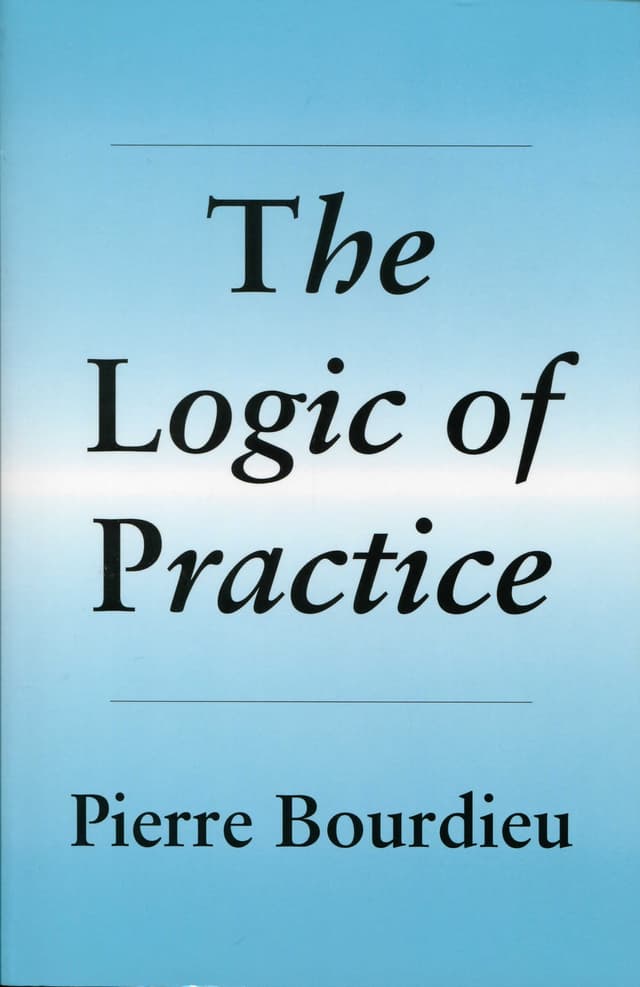
Bourdieu: systems, axes, maps, practical logics

I have checked these quotes and am fairly sure they are accurate. The first, I feel, improves with re-reading, and presents a clearing at the end? 

The clearing could be a template, and as per the second it may be old; but retains its practical function.

'Intellectualism is inscribed in the fact of introducing into the object the intellectual relation to the object, of substituting the observer's relation to practice for the practical relation to practice. Anthropologists would be able to escape from all their metaphysical questioning about the ontological status or even the 'site' of culture only if they were to objectify their relation to the object, that of the outsider who has to procure a substitute for practical mastery in the form of an objectified model. Genealogies and other models are to the social orientation which makes possible the relation of immediate immanence to the familiar world, as a map, an abstract mode of all possible routes, is to the practical sense of space, a "system of axes linked unalterably to our bodies, which we carry about with us wherever we go", as Poincaré put it.' p.34.
The Logic of Practice
'The logical [kinship] relations he constructs are to 'practical' relations - practical because continuously practised, kept up and cultivated - as the geometrical space of a map, a representation of all possible routes for all possible subjects, is to the network of pathways that are really maintained and used, 'beaten tracks' that are really practicable for a particular agent. The family tree, a spatial diagram that can be taken in at a glance, uno intuitu and scanned indifferently in any direction from any point, causes the complete network of kinship relations over several generations to exist in the mode of temporal existence which is that of theoretical objects, that is, tota simul, as a totality in simultaneity. It puts on the same footing official relationships, which, for lack of regular maintenance, tend to become what they are for the genealogist, that is, theoretical relationships, like abandoned roads on an old map; and practical relationships which really function because they fulfil practical functions.' p.35.


My source:
Bourdieu, P. (1990). The Logic of Practice. Stanford University Press. https://doi.org/10.1515/9781503621749 [and image source].

Bourdieu, Pierre, "The Logic of Practice (1990)" (1990). eTextbooks for Students. 875.
https://stars.library.ucf.edu/etextbooks/875

See also: https://hodges-model.blogspot.com/search?q=bourdieu

Tuesday, December 09, 2025

In search of socio-political logics

'The logic of appropriateness refers to actions which members of an institution take to conform to its norms. For example, a head of state will perform ceremonial duties because it is an official obligation. By contrast, the logic of consequences denotes behaviour directed at achieving an individual goal such as promotion or re-election.' p.87.

individual
|
INTERPERSONAL : SCIENCES
humanistic -------------------------------------------  mechanistic
SOCIOLOGY : POLITICAL
|
group-population


'Institutions are far more than the theatre within which the political drama unfolds; they also shape the script (Peters, 1999). This emphasis within the institutional framework on the symbolic or ritual aspect of political behaviour contrasts with the view of politicians and bureaucrats as rational, instrumental actors who define their own goals independently of the organization they represent.' p.87.


'Further, institutions bring forth activity which takes place simply because it is expected, not because it has any deeper political motive. When a legislative committee holds hearings on a topic, it may be more concerned to be seen to be doing its job than to probe the topic itself. Much political action is best understood by reference to this 
logic of appropriateness rather than a logic of consequences. For instance, when a president visits an area devastated by floods, he is not necessarily seeking to direct relief operations or to achieve any purpose other than to be seen to be performing his duty of showing concern. In itself, the tour achieves the goal of meeting expectations arising from the actor's institutional position. "Don't just do something, stand there", said Ronald Reagan, a president with a fine grasp of the logic of appropriateness.' pp.86-87.


See also: 'drama' : 'bridges'

Hague, R., & Harrop, M. (2007). Comparative Government and Politics (7th ed.). New York, NY: Palgrave Macmillan.

Peters, B. Guy. (1999). Institutional theory in political science: the new institutionalism. London: Pinter.

Sunday, October 26, 2025

'Politics as a science' ...

'The science of politics is the oldest of the social sciences but still perhaps the most dependent: it derives much of its methodology from statistics (the science of the state turned into the science of numerical data), from economics and from sociology and it steals much of its substance from anthropology, from history and from law. Yet there is little doubt about the core of the subject: it focuses on the ways in which decisions are taken by men acting within territorially or functionally defined networks and constellations of organizations. And the hallmark of the discipline is 'its systematic analysis', whether couched in verbal and literary terms or in the formalized language of statistics or of mathematical logic.' Preface vii
Hayward R. Alker, Karl W. Deutsch, Antoine H. Stoetzel (eds.), Mathematical Approaches to Politics, Amsterdam, Elsevier, 1973, pp. 475.

Saturday, October 04, 2025

Argumentation - Journal: Informal Logic

Early evening (UK) yesterday, I joined a further webinar on argumentation. Through the speaker, and discussion, I was led to a journal

INFORMAL LOGIC

It is in informal logic that I see a role for Hodges' model. The model's structure providing a universal foundation of knowledge domains to be applied in practice. The bonus of this journal, is its being open access, a search revealed the following paper:

Mark Weinstein. Towards a Research Agenda for Informal Logic and Critical Thinking. XII.3, Fall 1990.
https://ojs.uwindsor.ca/index.php/informal_logic/article/view/2609

'This paper recommends that the recent concern with informal logic and critical thinking be redirected from its general philosophical focus and towards a greater appreciation of the particulars of practice in the various domains of human understanding. The redirection recommended is prompted by the central role that critical thinking and informal logic can be seen to play in meaningful educational reform, especially at the undergraduate level.' 

'Critical thinking, similarly, should be redirected from concerns typical of philosophers and towards issues and approaches more representative of critical thinking both within and across the wide range of disciplines represented by the course of undergraduate studies.' p.121.

'The sense that there is an internal relationship between arguments, argumentation and domains of knowledge persists despite attempts to show relevant and useful notions of critical thinking that are generally available for instruction and neutral in respect of the disciplines. The resolution of the issues generated by these competing views, requires that reflective practitioners of the disciplines, students of the history of ideas, methodologists and specialists in teaching increasingly engage in the task of generating and organizing the data upon which an informed and adequate notion of critical thinking across the disciplines must be based.' p.125.

I believe that the structure of Hodges' model provides a basis for Weinstein's ordinary argumentation and stylized argumentation.

For me (at present) ordinary argumentation, is 'open' argumentation. That is, without differentiation in (using) Hodges' model. I might (well, I would) have Hodges' model in mind, but choose not to apply it. As per the paper, stylized argumentation is using Hodges' model and doing so in a multidisciplinary manner - within my discipline. 

The problem and challenge for nurses and other health professionals is the need, if:

  • person/patient-centred;
  • integrated;
  • and holistic - having regard for parity of esteem (mind - body)

- not to stray, extend the disciplinary scope, while working within one's professional scope.

In highly effective multidiscioplinary teams that touch on being transdisciplinary (hybrid?), can experienced team members have insight into the stylized argumentation of their colleagues?

Ack. ​Argumentation network of the AMERICAS - https://www.argnet.org/ethics-of-arg.html

Previously: 'critical thinking'

Sunday, August 03, 2025

The compact: a knowledge project

Some things don't change . . .

 'Doctor Faustus'

'FAUSTUS discovered in his study.7

     FAUSTUS. Settle thy studies, Faustus, and begin
     To sound the depth of that thou wilt profess:
     Having commenc’d, be a divine in shew,
     Yet level at the end of every art,
     And live and die in Aristotle’s works.
     Sweet Analytics, ’tis thou8 hast ravish’d me!
     Bene disserere est finis logices.
     Is, to dispute well, logic’s chiefest end?
     Affords this art no greater miracle?
     Then read no more; thou hast attain’d that9 end:
     A greater subject fitteth Faustus’ wit:
     Bid Economy10 farewell, and11 Galen come,
     Seeing, Ubi desinit philosophus, ibi incipit medicus:
     Be a physician, Faustus; heap up gold,
     And be eterniz’d for some wondrous cure:
     Summum bonum medicinae sanitas,
     The end of physic is our body’s health.
     Why, Faustus, hast thou not attain’d that end?
     Is not thy common talk found aphorisms?
     Are not thy bills hung up as monuments,
     Whereby whole cities have escap’d the plague,
     And thousand desperate maladies been eas’d?
     Yet art thou still but Faustus, and a man.
        ...'

THE TRAGICAL HISTORY OF DOCTOR FAUSTUS
By Christopher Marlowe
From The Quarto of 1604
Edited by The Rev. Alexander Dyce


'AI' - Humanity's Faustian compact?

#individual #collective #power #safety #governance #ethics #morality

Saturday, June 14, 2025

Call for Papers: Compassionate Futures for Collective Well-Being

Despite an academic affiliation, without any (part-time) tutoring hours this past year, it may be difficult to avoid article processing fees (APCs). A shame as I believe that Hodges' model can address this call (below) in a somewhat novel manner. 
If anyone is interested in exploring a writing project framed around Hodges' model and employing a relational - diagrammatic approach please let me know.
The exercise would be greatly enhanced by:
  1. Engaging with one of more academics, adept in formal methods (maths, logic..?) and keen to apply their talents within the social sciences - humanities.
  2. And, exploring the possibility of working with early career researchers, including from developing nations, independent and 'late career'(!) scholars would also be very welcome.

Previously:

Jones, P. (2004) Viewpoint: Can informatics and holistic multidisciplinary care be harmonised? British Journal of Healthcare Computing & Information Management, 21, 6, 17-18.

Jones, P. (2004) The Four Care Domains: Situations Worthy of Research. Conference: Building & Bridging Community Networks: Knowledge, Innovation & Diversity through Communication, Brighton, UK.

Jones, P. (2008) Exploring Serres’ Atlas, Hodges’ Knowledge Domains and the Fusion of Informatics and Cultural Horizons, IN Kidd, T., Chen, I. (Eds.) Social Information Technology Connecting Society and Cultural Issues, Idea Group Publishing, Inc. Chap. 7, pp. 96-109.

Jones, P. (2009) Socio-Technical Structures, the Scope of Informatics and Hodges’ model, IN, Staudinger, R., Ostermann, H., Bettina Staudinger, B. (Eds.), Handbook of Research in Nursing Informatics and Socio-Technical Structures, Idea Group Publishing, Inc. Chap. 11, pp. 160-174.

Compassionate Futures for Collective Well-Being

Academic Editors: Karin Hannes (KU Leuven) and Natalia Martini (KU Leuven)

Deadline for Abstracts: 15 September 2025
Deadline for Articles: 30 January 2026

Social Inclusion, peer-reviewed journal indexed in the Social Sciences Citation Index (Web of Science; Impact Factor: 1.4) and Scopus (CiteScore: 3.5), welcomes new and exciting research papers for its upcoming issue "Compassionate Futures for Collective Well-Being," edited by Karin Hannes (KU Leuven) and Natalia Martini (KU Leuven).

In an increasingly unequal world, the concept of “compassionate futures” offers a new paradigm to address the pressing challenges of social inclusion. Compassionate futures recognize vulnerability, interdependency, and mutual responsibility as fundamental features of social relations, and emphasize care and empathy as fundamental principles in designing socio-cultural, economic, and political systems where the collective well-being of diverse actors, human and other-than-human, can flourish.

We encourage contributions that engage in an interdisciplinary dialogue among scholars, practitioners, and policymakers about what it means to create a caring society in the face of persistent inequalities. In addition, we welcome papers that demonstrate where and how humans take up the responsibility to conceptualize compassionate futures from a multi-species perspective, as well as those that focus on what hinders or supports the idea and the project of compassionate futures. We accept theoretical papers presenting frameworks on compassionate futures, prospective policy analyses, cases featuring the use of futures studies and co-creative approaches that promote compassion and care as central principles in re-imagining the future, and reflection papers focusing on global cooperation for fostering compassionate futures. Authors should connect to the general idea of how humans could or should relate to other agents with whom they share the planet or illustrate how the new narratives they developed support collective well-being.

Authors interested in submitting a paper to this issue are encouraged to read the full call for papers here:

https://www.cogitatiopress.com/socialinclusion/pages/view/nextissues#CompassionateFutures

Abstracts welcome until 15 September 2025.

Kindest regards,

Mariana
Mariana Pires
Social Inclusion
Cogitatio Press
1070-129 Lisbon 
Portugal
New issues (open access):
Public Participation Amidst Hostility: When the Uninvited Shape Matters of Collective Concern
https://www.cogitatiopress.com/socialinclusion/issue/view/419

Violence, Hate Speech, and Gender Bias: Challenges to an Inclusive Digital Environment
https://www.cogitatiopress.com/socialinclusion/issue/view/415

My source: https://www.jiscmail.ac.uk/cgi-bin/webadmin?A0=COMPLEXITY-PRIMARY-CARE

Friday, May 16, 2025

RCN Congress 2025 Liverpool i

... the twists and folds of debates

Repeating myself (again) but worthwhile I think(?), the past week brought my second RCN Congress. If you are new student nurse, international (Std) nurse, or nursing support worker and not engaged with a professional body, or union; do try to get involved. Don't leave it as long as I have (I joined a union as a nursing assistant). By way of a small excuse, listening this week it seems I am not the only one to leave it 'late'. Based in Liverpool (again after 2019) means there's a torrent of potential content. So where am I/We? By their nature all the debates are worthy. I have picked a few:

Discussion - Celebrating a nursing career

You can read above the main focus for the discussion. For me it prompted the following (no doubt - familiar)  reflections ...

The number of potential careers in health and social care is amazing:

Not only what the NHS (for training, education) can 'offer', but within that the number of nursing roles and specialities. The discussion inevitably drew the 'longevity' card. Students do pick on the temperature of their chosen community of practice. They recognise when they are surrounded (not literally!) by colleagues who have careers numbered in the several decades. But like a card the side that presents the occupational safe harbour from the threat posed by artificial intelligence, is countered by the seemingly relentless pressures imposed on nursing staff. The debates also revealed the pressure and negative impact of 'lived' work experiences for students and newly qualified nurses. I remember in the late 1970s early 1980s student nurses being counted as 'staff'. Have we really not progressed? I wrote 'offer' above because many students cannot get jobs once they have qualified. Not the best start to a shiny career. Having to fold, as they qualify.

Speaking of "career", can we please twist that? There is a great deal of talk - soul searching - about how on earth the (so-called) health service truly transforms itself to be health promoting and preventive. In the NHS's history perhaps there was a window of opportunity to begin in the late 1960s. Not so much a 'moonshot' as a healthshot. Now with the demographics that potential is being lost, unless this is positive way that AI can make up the shortfall? Alternately, nursing can utilise the health career, as in Hodges' model which are invariably impacted by an individual's life chances. As such there may be signs and signatures in the person's familial background? We can imagine a timeline composed of Hodges' model as 2x2 frames through a person's life, even prior to their conception and their legacy. 

More to follow . . .

Previously: 'RCN' : 'nursing' : 'power'

Please pardon the 'gambling' analogies, but we are literally asking students to gamble with their careers, financial status and well-being (life chances - no less). Should they be lost to the service, you can't blame young people. They know the logic of care, also known as demographics. They can do the maths? So who is it who can't do basic arithmetic?

Tuesday, February 25, 2025

So, I can proceed, fall flat on my face - [ concepts-maths iii/iii ]

- and utilise the inevitable!

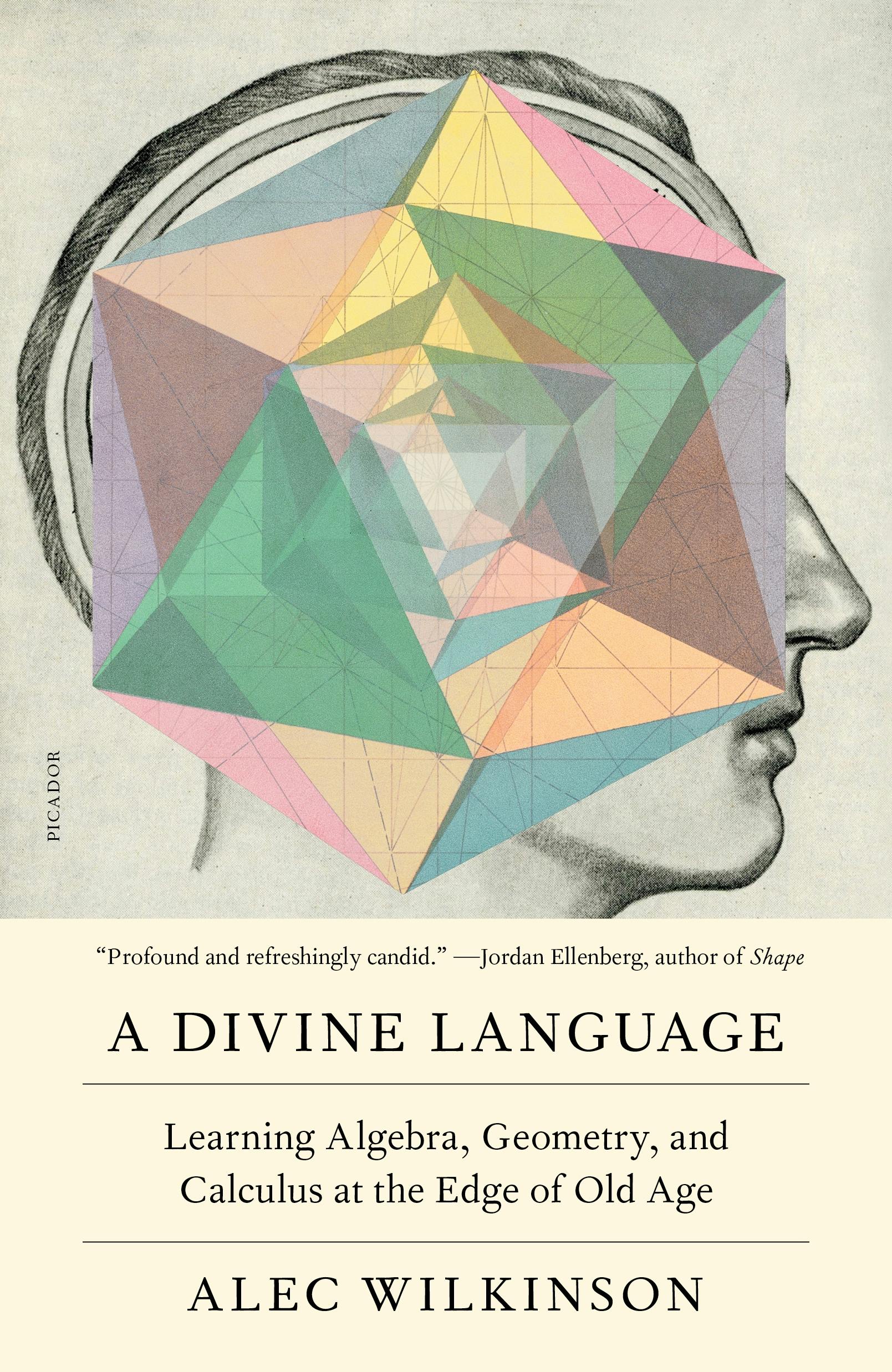
'Decades after struggling to understand math as a boy, Alec Wilkinson decides to embark on a journey to learn it as a middle-aged man. What begins as a personal challenge—and it's challenging—soon transforms into something greater than a belabored effort to learn math. Despite his incompetence, Wilkinson encounters a universe of unexpected mysteries in his pursuit of mathematical knowledge and quickly becomes fascinated; soon, his exercise in personal growth (and torture) morphs into an intellectually expansive exploration.' 
https://us.macmillan.com/books/9781250168580/adivinelanguage/


A Divine Language

As observed many times in the literature and here on W2tQ writing about Hodges' model, healthcare - medicine and nursing are both a science and art. Hodges' model is an invitation to the arts in liberal form, with an emphasis on practice: social sciences, humanities, physical sciences and even mathematics. 

There is now quite a bank of posts on W2tQ tagged art/arts and more specifically prints. I still plan to attend a workshop on printing. As ever, in my head, my mind's eye - I've an amazing, brilliant .. (!?) arts project, just waiting to be released. A true collage of the care concepts.

If Hodges' model is 'simple' in its basic form, then it is clearly possible for other people to create their own artistic impressions, interpretation of Hodges' model. My effort would of course be unique, as would theirs. There could be a competition and I end-up missing out. Not even short-listed for a prize; a victm of familiarity perhaps? 

Quite 'naturally' in a way, or at least by way of childhood experiences, a need for therapy and validation; I have also arrived at a belief that there is a mathematical project here (Oh, for goodness sake! Is there no end to this?). 

As posted before, like Alec Wilkinson I am no mathematician. Embarrased, shamed to a husk at school on many occasions, I encountered math teachers who must have empathised. Well, that's one way to explain the appreciation of maths I have always felt. Or more accurately, a love of knowledge; of which maths and logic are a part? Since I can hardly understand, I am more in love with the idea of maths, than mathematics itself. I have always been in awe of maths and people who 'get it', even if that is only  mastery of the high school mathematics curriculum.

Convinced that there is more to Hodges' model than meets the eye, I have thought of following Wilkinson - who tries to be systematic - to underpin a book - back into the nightmare lands of my youth. Should I retake GCSE maths? 'There be dragons', without a doubt. The heat can be recalled, like it was yesterday. This isn't just a dragon, it is a chimera. At times it wants to be a friend, providing familiar terms, domain, set, and group. Wilkinson's quest is structured and seeks a reasoned and disciplined approach. Why am I bothering? I have a choice surely? Nursing, health, global health can all collectively furnish many items of epistemological fruit. No need for calculative flagellation. Through Hodges' model you can productively span the disciplinary bridges once again: call in - sociology, economics, policy and more. How many Königsberg bridges do you need?

While the artist in me, might waste time. In pointing to Hodges' model as a potential mathematical object, this little seed might fall on fertile and (much) more capable ground(?), as Wilkinson describes:

'Mathematics might be the only creative pursuit in which inevitability figures. Other artists might be defeated by a task beyond their capabilities, but they do not live with knowing that sooner or later, if their work is consequential, someone will do what they haven't been able to do. Mathematicians work within a discipline in which, so long as their suppositions are correct, there is always a precise and irrefutable answer, even if they can't find it.' p.135.

I can hope for this at least.

Alec Wilkinson. (2022) A Divine Language. Learning Algebra, Geometry, and Calculus at the Edge of Old Age. New York: Farrar, Straus and Giroux. https://us.macmillan.com/books/9781250168580/adivinelanguage/

Previously: How 'divine' is the language of care?

n.b. At some point I will go though all the posts and unpublish/delete items that add little to the core.

Saturday, February 22, 2025

6º CONGRESSO INTERNACIONAL DA SPF - CONVITE À SUBMISSÃO DE RESUMOS/CALL for PAPERS

6º CONGRESSO INTERNACIONAL DA SOCIEDADE PORTUGUESA DE FILOSOFIA

CONVITE À SUBMISSÃO DE RESUMOS

A Sociedade Portuguesa de Filosofia, em colaboração com o Centro de Filosofia da Universidade de Lisboa, organiza o seu 6º Congresso Internacional, que decorrerá na Faculdade de Letras da mesma universidade, de 1 a 3 de setembro de 2025.

O Congresso é aberto à participação de todos os interessados em apresentar e discutir a sua investigação em qualquer domínio e metodologia dos estudos filosóficos. As propostas serão avaliadas anonimamente por membros de um amplo painel de especialistas.

ORADORES CONVIDADOS

Genia Schonbaumsfeld (Universidade de Southampton)
João Carlos Salles (Universidade Federal da Bahia)
Luísa Couto Soares (Universidade do Porto)
Olga Pombo (Universidade de Lisboa)
Viriato Soromenho-Marques (Universidade de Lisboa)

LÍNGUAS DO CONGRESSO: Português, Inglês, Francês e Espanhol

VALORES DA INSCRIÇÃO:

Participantes: € 80,00
Sócios da SPF: € 50,00
Estudantes (licenciatura, mestrado ou doutoramento): € 40,00
Estudantes sócios da SPF: 30€

DATA LIMITE para a submissão de propostas de comunicação: 1 de Abril de 2025

COMISSÃO CIENTÍFICA:

Álvaro Balsas (Universidade Católica Portuguesa, Braga)
André Barata (Universidade da Beira Interior)
António Pedro Mesquita (Universidade de Lisboa)
Célia Teixeira (Universidade Federal do Rio de Janeiro)
David Yates (Universidade de Lisboa)
Diogo Ferrer (Universidade de Coimbra)
Gil Santos (Universidade de Lisboa)
Irene Borges Duarte (Universidade de Évora)
João Cardoso Rosas (Universidade do Minho)
João Constâncio (Universidade Nova de Lisboa)
José Meirinhos (Universidade do Porto)
Magda Costa Carvalho (Universidade dos Açores)
Nuno Venturinha (Universidade Nova de Lisboa)
Pedro Galvão (Universidade de Lisboa)

EMAIL DO CONGRESSO: 6congressospf  AT gmail.com

INSTRUÇÕES PARA SUBMISSÃO DE RESUMOS E MAIS INFORMAÇÕES

Consulte a página do congresso no site da SPF: www.spfil.pt/6congresso

__________________________________________________________

ENGLISH

6th INTERNATIONAL CONGRESS OF PHILOSOPHY

CALL FOR ABSTRACTS

The Portuguese Philosophical Society, in partnership with the Centre of Philosophy of the University of Lisbon are organizing the 6th International Congress of Philosophy, to be held at the University’s Faculty of Letters on 1 to 3 September 2025.

The Congress welcomes all researchers interested in presenting and discussing their research in all domains of philosophical studies and according to all philosophical methodologies. Abstracts submitted will be anonymously refereed by members of a large panel of experts.

INVITED SPEAKERS:

Genia Schonbaumsfeld (University of Southampton)
João Carlos Salles (Universidade Federal da Bahia)
Luísa Couto Soares (Universidade do Porto)
Olga Pombo (Universidade de Lisboa)
Viriato Soromenho-Marques (Universidade de Lisboa)

CONGRESS LANGUAGES: Portuguese, English, French and Spanish

CONGRESS SECTIONS

Each proposal must indicate that it intends to be associated with one and only one of the following sections:

Teaching Philosophy (PE)
Epistemology / Philosophy of Knowledge (ET)
Aesthetics and Philosophy of Art (ES)
Ethics and Bioethics (EB)
African Philosophy (AF)
Philosophy of Science (SF)
Philosophy of History (FH)
Philosophy of Language (FL)
Philosophy of Mathematics (FMA)
Philosophy of Mind (FME)
Philosophy of Nature and Environment (FN)
Philosophy of Religion (FR)
Philosophy of Law (FD)
Philosophy and Gender (FG)
Phenomenology (FE)
Luso-Brazilian Philosophy (FB)
Political Philosophy (PF)
History of Ancient and Medieval Philosophy (HA)
History of Modern Philosophy (HM)
Logic (LO)
Metaphysics and Ontology (MO)

FEES:

Participants: € 80,00
SPF Associates: € 50,00
Students (Bac, MA or PhD): € 40,00
Student SPF Associates: 30€

DEADLINE for submitting proposals: ­­­­­­1st April 2025

SCIENTIFIC COMITTEE:

Álvaro Balsas (Universidade Católica Portuguesa, Braga)
André Barata (Universidade da Beira Interior)
António Pedro Mesquita (Universidade de Lisboa)
Célia Teixeira ((Universidade Federal do Rio de Janeiro)
David Yates (Universidade de Lisboa)
Diogo Ferrer (Universidade de Coimbra)
Gil Santos (Universidade de Lisboa)
Irene Borges Duarte (Universidade de Évora)
João Cardoso Rosas (Universidade do Minho)
João Constâncio (Universidade Nova de Lisboa)
José Meirinhos (Universidade do Porto)
Magda Costa Carvalho (Universidade dos Açores)
Nuno Venturinha (Universidade Nova de Lisboa)
Pedro Galvão (Universidade de Lisboa)

CONGRESS EMAIL: 6congressospf AT gmail.com

HOW TO SUBMIT ABSTRACTS AND FURTHER INFORMATION on the congress page at the SPF site: www.spfil.pt/6congresso

My source:


E-mail: iestudosfilosoficos AT gmail.com