Hodges' Model: Welcome to the QUAD: Search results for long term

Hodges' model is a conceptual framework to support reflection and critical thinking. Situated, the model can help integrate all disciplines (academic and professional). Amid news items, are posts that illustrate the scope and application of the model. A bibliography and A4 template are provided in the sidebar. Welcome to the QUAD ...

Showing posts sorted by relevance for query long term. Sort by date Show all posts

Monday, September 16, 2024

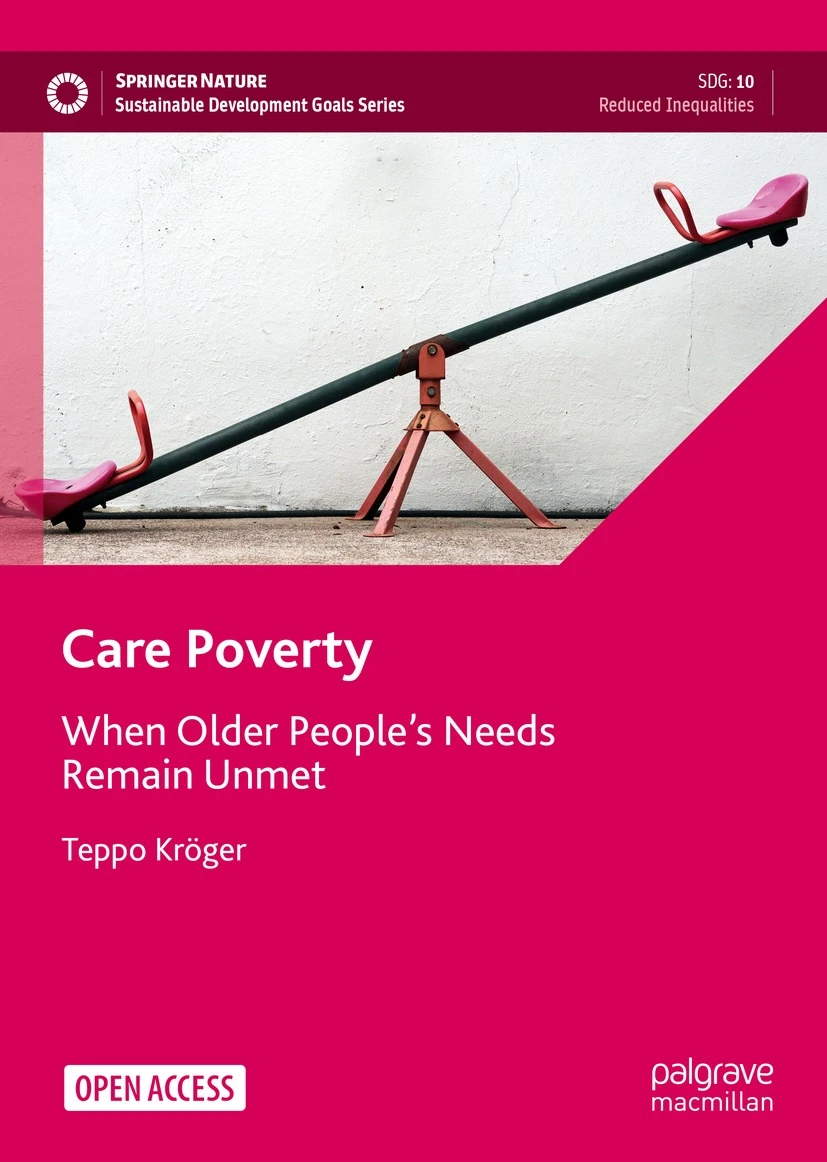
Book: Care Poverty - When Older People’s Needs Remain Unmet

CARE POVERTY
'This open access book turns the research attention of social policy scholars and long-term care researchers from comparative descriptions of care systems, focusing mostly on expenditures and volumes of long-term care services, to outcomes, and in particular to the question whether older people really receive the support that they need. Without knowledge about which needs and which social groups are currently inadequately covered, it is impossible to guide policy development.

The book puts forward a novel theoretical framework to guide future research work and public discussion on the issue of unmet long-term care needs, by broadening the current discussion so that inadequate care is seen in its societal and policy contexts, taking structural issues and policy designs into account. Kröger outlines three different domains of care poverty (personal care poverty, practical care poverty and socio-emotional care poverty) and differentiates between main methods how unmet needs are measured.' [my emphasis]

In psychiatry and psychiatric nursing, a person may be assessed to display poverty of thought, ideas or speech. As an exercise it may be useful to invert the rendering below in Hodges' model, and  consider Kröger's forms of poverty and possibly others that arise from your critique, reflections and life experience to date. Clearly, another book to add to the list!
 
individual
|
INTERPERSONAL : SCIENCES
humanistic ------------------------------- mechanistic
SOCIOLOGY : POLITICAL
|
group

CARE


CARE

CARE

POVERTY


Previously on W2tQ - (unmet) 'needs'

Kröger, T. (2022) Care Poverty - When Older People’s Needs Remain Unmet. Cham: Palgrave Macmillanhttps://link.springer.com/book/10.1007/978-3-030-97243-1#about-this-book

Will check on a related title too.

Thursday, July 29, 2021

Review: iii Fundamentals of Person-Centred Healthcare Practice


Previously, I recognised the many links throughout the book and on p.54 there are five relating to professional standards. These reflect the book's international scope and multidisciplinary relevance. Those on page 54 do work and support the text. One of them I was presented not with the expected page and missed the outcome of the 'click'. I wasn't going to re-type but found the page through the site's menu. Some links are long, as I found, whether permalinks [usually shorter] or fallback search text might improve link-longevity I'm not sure.

As a reassurance the contrast issue black-text-on-dark-green is limited to one figure.

The book is well referenced with an additional reading list. I've been made aware through plagiarism detectors (one paper) which - it appears - have 'read' an introductory section to Hodges' model as self-plagiarism. I wondered if in comprising a community of practice the references here maybe somewhat insular. I've no analysis to support this and the same no doubt may apply to other to emergent ideas, including threshold concepts. You have to start somewhere. At fear of contradiction there are many theories called upon and referenced.

Students may find the more attention to the position and specificity of references useful p.75 "we cannot not communicate." How times, chapters (8 - Communicating and Relating Effectively), theory, practice and management are challenged. The art of  'sympathetic presencing' working on the phone triaging acute community mental health referrals, 'Being kind and warm'.

For a text on person-centredness the book is imho mental illness-health light, but then as noted what is the book about? Am I suggesting that such books should attend to disciplinary equality? That said if there is a test for parity of esteem here, what do you conclude from one dedicated chapter? I was surprised, but is there a dilemma here? Beside 'Trust in self and others' I made a note, 'intuition'. Is person-centredness and being person-centred taken for granted within mental health practice? Research suggests not. 

Reading the table of contents you will find:

Chapter 18: Being person-centred in the acute hospital setting
Chapter 19: Person-Centred Rehabilitation
Chapter 20: Being person-centred in community and ambulatory services
Chapter 21: Experiencing person-centredness in long-term care
Chapter 22: Being person-centred in mental health services
Chapter 23: Person-centred support for people with learning disabilities
Chapter 24: Being Person-centred in Maternity Services
Chapter 25: Being person-centred in children’s services
Chapter 26: Being person-centred when working with people living with long-term conditions
Chapter 27: Palliative and end of life care services

I had a sense that the chapters were not sufficiently differentiated despite the titles. This may say more about my reading and the (editor's achieved) coherence of the book overall. Perhaps also for me, person-centredness is realised in-situ with personalised details. Not just vignettes (which are used) but the detailed intra- interpersonal, social, physical, political and spiritual choreography that is person-centred care: whether or not there is engagement (a dance).

Dementia is represented but the context appears to be residential care. You will find challenging / courageous conversations, but not challenging behaviour in situations that test interpersonal skills and person-centredness especially for staff, students, carers and families (dementia in general hospitals - despite numerous initiatives). Trauma has its place in the mental health chapter (and in current literature), but again the challenge of psychoses, anorexia are missed opportunities to reveal the potential and delivery of the Person-Centered Practice Framework.

Since the book's publication with its stress on the welfare and well-being of staff and educators too, the need to make explicit the politics in health is even more extreme. The need to protect the title of 'nurse'; mis-information generally and relating to COVID. Person-centred decision making and shared decision making are described as systems. Perhaps this misses the nuances of a health care professional, the team and family working with a person were they are making an unwise decision (pp.83-92). Another chapter indicates the need and utility of disciplinary bridges:

Chapter 17: Socio-political context in Person-centred Practice

 
individual - PERSON - patient
|
INTERPERSONAL : SCIENCES
humanistic ----------------------------------------------- mechanistic
SOCIOLOGY : POLITICAL
|
family - group - population
MIND :: Parity -

 - of esteem :: BODY

Culture
Child - Parent - Guardian
FAMILY


SOCIO -
 Refugees Homeless
title of 'nurse'*
mis-information

Organisational culture?

- POLITICAL

One more to follow with many thanks to the publisher for the review copy.

Review i

Review ii

Review iv

Fundamentals of Person-Centred Healthcare Practice,  McCormack, B., McCance, T., Bulley, C., Brown, D., McMillan, A, Martin,S. (Eds.). ISBN: 978-1-119-53308-5 February 2021 Wiley-Blackwell.

* https://twitter.com/hashtag/ProtectNurse?src=hashtag_click
 

Wednesday, July 20, 2022

Reflecting on The Times Education Commission 2022

"At the Apple headquarters in Cupertino, California, Susan Prescott, vice-president of enterprise and education marketing, argued that economic prosperity depended on human ingenuity. “Creativity doesn’t mean ‘Have a music and an arts class’. Creativity means across disciplines, how can you bring in ways for kids to engage in the material differently? How do you bring in opportunities for kids to reflect their learning in new ways? How do you use it to get a different, broader view rather than the fact-based stuff?" p.58. (with my emphasis and below)

Included in the 12-point plan for education:

1 A British Baccalaureate

It would offer broader academic and vocational qualifications at 18, with parity in funding per pupil in both routes, and a slimmed-down set of exams at 16 to bring out the best in every child.

2 ‘Electives premium’

This should be offered for all schools to be spent on activities including drama, music, dance and sport and a National Citizen Service experience for every pupil, with volunteering and outdoor pursuits expeditions to ensure that the co-curricular activities enjoyed by the most advantaged become available to all.

3 New cadre of Career Academies

These would be elite technical and vocational sixth forms with close links to industry, mirroring the academic sixth forms that are being established and a new focus on creativity and entrepreneurialism in education to unleash the economic potential of Britain.

4 Significant boost to early years funding

The extra funding should be targeted at the most vulnerable. A unique pupil number would be given to every child from birth, to level the playing field before they get to school. Every primary school should have a library.

5 Army of undergraduate tutors

The students would earn credit towards their degrees by helping pupils who fall behind to catch up.

6 Making the most of tech

A laptop or tablet for every child, greater use of artificial intelligence in schools, colleges and universities to personalise learning, reduce teacher workload and prepare young people better for future employment.

7 Wellbeing at the heart of education

A counsellor should be placed in every school and an annual wellbeing survey of pupils carried out to encourage schools to actively build resilience rather than just support students once problems have arisen.

8 Bring out the best in teaching

The profession’s status and appeal would be increased with better career development, revalidation every five years and a new category of consultant teachers, promoted within the classroom, as well as a new teaching apprenticeship.

9 A reformed Ofsted

Ofsted should work collaboratively with schools to secure sustained improvement, rather than operating through fear, and a new “school report card” with a wider range of metrics including wellbeing, school culture, inclusion and attendance to unleash the potential of schools.

10 Better training

Teachers should be trained to identify children who have special educational needs, a greater focus should be placed on inclusion and a duty put on schools to remain accountable for the pupils they exclude to draw out the talent in every child.

11 New university campuses

New campuses should be created in 50 higher education “cold spots”, including satellite wings in further education colleges. In addition, pay and conditions in the FE sector should be improved and a transferrable credit system between universities and colleges created to boost stalled British productivity.

12 A 15-year strategy for education

The strategy should be drawn up in consultation with business leaders, scientists, local mayors, civic leaders and cultural figures, putting education above short-term party politics and bringing out the best in our schools, colleges and universities.

Obviously idealised but mapped here to Hodges' model the long-term - policy, strategic, funding, resource and workforce emphasis is apparent.

INDIVIDUAL
|
 INTERPERSONAL    :     SCIENCES               
HUMANISTIC --------------------------------------  MECHANISTIC      
SOCIOLOGY  :   POLITICAL 
|
GROUP

7 Wellbeing at the heart of education

reflection
critical thinking,
communication
and creativity


2 ‘Electives premium’
(outdoors) ...

6 Making the most of tech

7 Wellbeing at the heart of education


2 ‘Electives premium’
(drama, music, dance) ...


1 A British Baccalaureate

2 ‘Electives premium’
(National Citizen Service experience)

3 New cadre of Career Academies

4 Significant boost to early years funding

5 Army of undergraduate tutors

8 Bring out the best in teaching

9 A reformed Ofsted

10 Better training

11 New university campuses

12 A 15-year strategy for education


What, if anything, is missing?

With its recommendations, the Commission is not intended to be prescriptive, specifying educational methods, methodologies and resources. But the aims and mapping above, point to the need to link education and health as per #7 Wellbeing at the heart of education. 

There is surely an avenue here - via the sustainable development goals, which the UK must also 'achieve'. Consider the following too:

"The system doesn’t measure creativity; it measures what you can remember of other people’s facts.” p.11.

"A British Baccalaureate at 18, an equally rigorous but broader qualification than A-levels with academic and vocational options under the same umbrella. Pupils studying for the academic Diploma Programme would take six subjects — three major, three minor — covering humanities and sciences as well as units on critical thinking, communication and creativity. Those on the Career-related Programme would combine learning (which could include BTecs or a T-level) with work experience. There would be the option for students to “mix and match” elements of both programmes to create the qualification that best suited them. All pupils would do an extended project, community service and some literacy and numeracy through to 18. Digital skills would be woven through the whole curriculum." p.95.

What is missing is understandably the aforementioned tools to facilitate creativity, but let state this as follows and join the dots with wellbeing.

  • We need to respect, support and encourage students to be and become curators of their lifelong learning and life chances. 
  • The reference p.11 to students being measured on what they can "remember of other people’s facts" is a key statement. As a curator, students should be the marshal of their own 'memory palace' pushing the boundaries, their envelope as the lifelong learning (constant test-pilot) of what we hope is a long career - and not just while in 'work'.
  • In the above mapping, we can see what is recognised in 'wellbeing'. Pupils need a foundation, they need the confidence and self-esteem to explore, express and explain any difficulties commensurate with their unique situation and identity. The importance of security (nationally, locally and personally) as the basis to address the social determinants of health are essential to integrate short and long-term policy aims and objectives, individual and collective success.

This is identified in the findings:

"Lee Elliot Major, a professor of social mobility at the University of Exeter, said there were 'bold and compelling reform' in the commission’s findings.

He welcomed the adoption of his recommendations for undergraduate tutors to help poorer pupils, adding: 'We need to consider radical reset to ensure that the education system fulfils the potential of all children.'”

https://www.thetimes.co.uk/article/times-education-commission-report-welcomed-by-tony-blair-john-major-qwc3b7ktx


The Times Education Commission 2022, 

https://www.thetimes.co.uk/society/education/education-commission

'Health career' - 'life chances'

Tuesday, October 07, 2025

Short Placement Award for Research Collaboration (SPARC) (Cohort 12)

Dear CHAIN member,

We would like to draw your attention to the following funding opportunity offered by NIHR. Please pass on the information as appropriate. Thank you.

‘Short Placement Award for Research Collaboration (SPARC) (Cohort 12)

This award offers a unique opportunity to design and undertake a short, bespoke placement within a part of the NIHR. Tailored to your individual research training needs and background, the award aims to enhance your research career, skills, and professional network.

What are the priority themes for an NIHR SPARC?

  • Multiple Long Term Conditions - Morbidity (MLTC-M)
The NIHR SPARC welcomes applications centred around making connections important to your research and work, that may spark innovative new ways of working across MLTC research.
  • Links to industry and the commercial sectors
One of the aims of the NIHR is to increase the number of researchers equipped with the skills to work at the interfaces between:
  • academia
  • the NHS
  • wider health, public health and social care
  • industry
We work with a diverse range of industry sectors. The NIHR SPARC welcomes applications that undertake placements in other parts of the organisation that have developed partnerships and collaborations with industry partners. This opportunity should develop your skills and experience to have a successful working relationship with industry (including the life-sciences, med-tech, SMEs and the food industry) and encourage entrepreneurship.

Please note applicants wishing to plan and undertake placements that meet their own research training and career development needs will continue to be encouraged and welcomed; however for Cohort 12 of the NIHR SPARC we are particularly encouraging applicants to consider placements in the two areas outlined above.

Closing date: 20 November 2025 at 1:00 pm'

Find out more at: https://www.nihr.ac.uk/funding/short-placement-award-research-collaboration-sparc-cohort-12/2025334?source=chainmail

Kind regards,

Wendy Zhou
CHAIN Manager


If you wish to publicise information on the CHAIN Network please email your request to: enquiries AT chain-network.org.uk


CHAIN - Contact, Help, Advice and Information Network – is an online international network for people working in health and social care. For more information on CHAIN and joining the network please visit website: www.chain-network.org.uk


Follow CHAIN on X: @CHAIN_Network ; Connect with CHAIN on LinkedIn


See also: 'long term' : 'academia' : 'interfaces' : 'industry' : 'social care'

Friday, February 05, 2010

RCN UK 2010 General Election 6 priorities - framed in Hodges' model

Previously [Please sign up: NURSING COUNTS ]

The RCN's 6 priorities hit the POLITICAL sweet-spot. In the table below I have related each of the priorities to a care domain of Hodges' model with a rationale that follows:


Give nurses time to train
Protect the Nation's health
Improve care for those with
long term conditions

Standing up for staff who speak out
Safer staffing levels
Sustain health care investment

Timeout from the clinical arena for training is always a political issue. It is also at the behest of the individual. This includes individual practitioners and their managers.

The public's health (and mental health) is of course grounded in the group, but is initially framed by evidence, knowledge and preventive medicine.

Long term conditions may impact the quality of life of the individual concerned, but the effect on carers and the social ripples are also profound.

The Demand - Supply equation in health care may be reduced to raw, mechanical numbers, but they quickly become the political football of investment statistics.

So many false economies in stretching the more expensive resources when it comes to staff AND patient (carer) safety. Skill mix and staffing levels are vital for job satisfaction, service development, quality and safe outcomes.

Motivation and intent may be concepts exercised by individuals, but the political environment must support nurses who speak out for high standards of care, safety, the public good.

Friday, February 23, 2024

Do we need to / can we 'cancel' Mental Health Nursing / Psychiatric Nursing?

Ever since August 15th 1977 (and prior to starting in the NHS), I've been acutely aware of the politics of my chosen career choice. Once again this explains my focus here since April 2006 and prior...

Make no mistake, starting as a Nursing Assistant at Winwick hospital, a Victorian asylum then two months later entering Warrington School of Nursing was a test. Quickly, you were preoccupied with trying to innovate and move beyond task oriented care, ritualised practice, trying to escape (the irony) from custodial care - despite the clink of keys (even on non-secure wards/clinical areas).

The quality of debate on Twi/X regards psychiatry is saddening.

The structure and domains of Hodges' model have been applied to the following editorial:

Wand, T. (2024), We have to cancel psychiatric nursing and forge a new way forward. Int J Mental Health Nurs. https://doi.org/10.1111/inm.13301


Individual
   |
      INTERPERSONAL    :     SCIENCES               
HUMANISTIC  --------------------------------------  MECHANISTIC      
 SOCIOLOGY  :   POLITICAL 
|
Group
MIND
Evidence-base?           neuro-

Person - identity

Yes, how do we conceptualise ...

"Mental health nurse" (Long-term)
"Psychiatric Nurse" (Crisis)

What's in a Title:
REGISTERED Nurse
Mental illness nurse

ENOUGH!
Let's Fully integrate MIND-BODY!

You/We must manage legacy

Recognition of emotional intelligence, rapport-empathy; people who want to 'help' others

Lived experience:
Care in Community

Contrast with 'pastoral care'? Counselling - pre-'therapist'?

RMN, RNMH ..
1. Subservient to Medicine?* Use of power, pharmacology, beds - 'controlled' environment, place of safety, restraint, loss of freedoms ..
2. Therapeutic agents - therapist? (Never truly realised: Psychology - scope of practice, Banding, Career pathways).
Conscientious objection. 

VALUE - VALUES
Diagnosis here?
 Respond to distress ? - OR 
BODY
-biogenic         Evidence-base?

Iatrogenesis

DEFINE^: 'sustainable' in terms of:
individual - population
NHS
Professions
Demographics (time-scales)
Environment
Economic
Ethics - Human Rights
Curricula
medical model
bio-psycho-social model
...
[ ^Research ]

Modalities of care - student experience/placement has changed

Nurse education - curricula

What would a properly funded NHS/Mental health services 'look' like?
 
Models  of care

DEBATE ongoing:
Anti-psychiatry

PSYCHIATRIC DIAGNOSIS
biomarkers, genetics, neurological explanations - pathologising,
safety of anti-psychotics,
long-term use ...

Demographics - workforce scope
Diagnosis here?
Where - psycho-SOCIALLY has policy been thus far?

Wither humanism?
Therapeutic relationship -
human connection

Social history:
Creation of asylums to standardise care for the insane

Anti-psychiatry:
Psychiatry as MECHANISTIC social control

Role of language, history, expections, social justice, law-public safety ...
 (can you 'cancel' here?)

Lived experience, family, carers, peer support workers

"Lifestyle Medicine"
(Map the 6 pillars to Hodges' model)

Social prescribing (research?)

Attitudes, Stigma, Social media

Sense-making, 'Faith' 1:Pop.

Social care, community resources

Integrated & Person-centred care

Other models of MH care/services

 - mechanistically assess risk? 

Formal distinction (break):
MH Nursing <-> Trad. Psychiatric family?

POLICY:
Community care set in aspic,
NHS also: funding £££££?
Innovation in POLICY?

No slack resource - HOW to shift to prevention/education

Sustainable health care

What crises are you (health professions) responding to?

Determinants of health: 
social, commercial, economic, social, political, education ...

Mental Health Law: inc. Consent, MH Capacity
(now also a 'football'?)

UNHCHR - Mental Health: ‘Mental health, human rights and legislation’ (World Health Organization and the United Nations, 2023)

Former: RCP Reports on CPNs*
National Reports:
Suicides, Homicides, Forensic, Prisons

Change [Progress!]: predicated upon research & evidence,
not 'rebellion' as befits
a profession - Duty of care?

Once you start to apply Hodges' model then additional content often presents itself. For example, (12th March) apart from people employed in tax and undertakers how many professions, would admit to a value system that aims for, seeks making the collective enterprise redundant? A utopic appeal no doubt, and this would for a population demand that the socio-political foundation (ills!) for our individual lives are finally addressed. What are referred to as the determinants of health. It is a sign of the times that trying to do a search on this, 'redundancy' / redundant is taken as related to the state of being employed, not an ideal.

If this sounds like pie-in-the-sky, consider the birth of social medicine - the NHS. Consider too the future of the NHS and we arrive at sustainable health care systems?

National Confidential Inquiry into Suicide and Safety in Mental Health
The University of Manchester - https://sites.manchester.ac.uk/ncish/

Homicide in England and Wales: year ending March 2023 -
https://www.ons.gov.uk/peoplepopulationandcommunity/crimeandjustice/articles/homicideinenglandandwales/yearendingmarch2023

Monday, February 17, 2025

Harnessing the Power of Artificial Intelligence to Improve Outcomes for Patients with for Long-Term Health Conditions

 Dear Colleagues and Friends,

We are organising a Special Session: Harnessing the Power of Artificial Intelligence to Improve Outcomes for Patients with for Long-Term Health Conditions

(https://aiih.cc/lthc/) in the International Conference on AI in Healthcare (AIiH), 8-10 September 2025, Jesus College, University of Cambridge.

We would like to accept both full length papers (12 pages plus references) and short abstracts (up to 5 pages including references) for special sessions. Submission guideline can be found here, including paper templates in both Word and LaTeX: https://aiih.cc/paper-submission/

The accepted full papers and abstracts will be published in the Springer LNCS volumes.

Full Paper submission deadline:            Friday 11 April 2025

Abstract submission deadline:               Monday 30 June 2024

We are looking forward to meeting you.

Best wishes

Shang-Ming Zhou

Professor in e-Health | Faculty of Health | University of Plymouth | PL4 8AA | UK.

Email :  shangming.zhou AT plymouth.ac.uk; smzhou AT ieee.org

https://www.plymouth.ac.uk/staff/shang-ming-zhou

https://www.plymouth.ac.uk/research/centre-for-health-technology

Wednesday, January 27, 2010

ERCIM News No. 80 Special Theme: "Digital Preservation"

Dear ERCIM News Reader,
ERCIM News No. 80 has just been published at http://ercim-news.ercim.eu/
Special Theme: "Digital Preservation"
- coordinated by Ingeborg Solvberg, Norwegian University of Science and Technology; and Andreas Rauber, Vienna Technical University
- featuring a keynote by Pat Manson, Head of Unit "Cultural Heritage & Technology Enhanced Learning"; European Commission Information Society and Media Directorate-General
Next issue: April 2010 - Special Theme:
"Computational Science/ Scientific Computing: Modelling and Simulation for Research and Industry"
(see call for articles)
Thank you for your interest in ERCIM News.
Feel free to forward this message to others who might be interested.

Best regards,
Peter Kunz

This issue includes:

  • The CARA Approach for Long-Term Preservation and Exploitation of Medical Images and Reports by Hanan Bouzid, et al..
  • Designing a Trusted Distributed Long-Term Archive for Health Records by Frej Drejhammar
  • Providing Web Accessibility for the Visually Impaired by Barbara Leporini, et al..
  • ICASE Project: New Challenges in Computer-Based Assessment by Thibaud Latour and Sandrine Sarre.


ERCIM News

is published quarterly by ERCIM, the European Research Consortium for Informatics and Mathematics.
The printed edition will reach about 10,000 readers.
This email alert reaches over 5,000 subscribers.


Advertising in ERCIM News
By advertising in the ERCIM News printed edition, your company or institution will be able to speak to a highly qualified audience: You can reach over 10,000 researchers, scientists and decision makers in the field of information and communication technologies.
For rates and conditions, see http://ercim-news.ercim.eu/advertise


About ERCIM
ERCIM - the European Research Consortium for Informatics and Mathematics - aims to foster collaborative work within the European research community and to increase co-operation with European industry. Leading research institutes from twenty European countries are members of ERCIM. ERCIM is the European host of W3C.
http://www.ercim.eu/

Thursday, October 19, 2017

Paper: Wang and Nickerson (2017). A literature review on individual creativity support systems

Hodges' model can lay claim to being a creativity support system [CSS]. While I do not have evidence, the model presents a diversity of stimuli in its structure and the care - knowledge - domains. It follows then that from the outset it is a motivational primer on both affective and achievement counts. Immediately, there is the motivation provided by the blank space, viewed as one or four conceptual spaces to find an initial starting concept. Affective as users gravitate towards their chosen reflective and creative journey, and achievement priming as having a goal that is prompted by professional, interpersonal and educational goals. If there is a case of 'creativity block' then perhaps a group approach can be adopted? Hodges' model then becomes a collaborative creativity support system. With Hodges' model and no doubt the proposed CSSs the collaborative agents add their own affective and achievement priming, whether student-student; patient-student (supervised); or mentor-student.

With the important caveat that the studies identified do not include healthcare but many papers are general. The authors provoke many questions: "Creativity support systems, like other information systems, are most effective when they instantiate underlying theories..." (p.140). I have already posed this question - which is (as ever) compound. As per the review's general domain papers, is there an underlying theory for all of Hodges' model; or is there a need for a theory per care domain?

"The literature on individual creativity support systems has drawn from theories about design, human computer interaction, information systems, and creativity.. " (p.140). 
If 'design' can be complex, what of 'care design'? That is what we are about. This in turn impacts upon the other sources of theory above.

There is much to draw upon in Wang and Nickerson (2017) but finally on page 145:
"the authors did a survey to verify the notion that creative self-efficacy, individual knowledge and IT support affect individual creativity through mediating variables: individual absorptive capacity, exploration and exploitation." 
Creativity must contribute to literacy, Wang and Nickerson allude to a relationship, referring to self-efficacy above. This is what we are seeking in health literacy and self-care. An ability to explore and exploit available resources being a sign of autonomy and efficacy.

Table 3
A framework for designing individual creativity support systems.


Aspects Components Features to Support the Component
Motivation
Motivational
priming
Affective priming
Achievement priming
Creative Process
Process
completeness
Process control 
Modules to support each step in a complete
creative process
Allowing iteration and selection of steps
Divergent
thinking

Stimuli

Long term
memory

Working
memory

Creativity
techniques
Providing different levels of stimuli,
Providing stimuli dynamically
External long term memory, such as knowledge
base and case library;
Facilitating search
Supporting association,
Visualization,
Random combination
Facilitating the use of creativity techniques;
Computational creativity techniques
Convergent
thinking 
Comprehension
Decision 
 Labeling, classification, simulation
Criteria based comparison, Decision support


Table 4
The steps in a complete creative process.

Process Stage The Divergent Step The Convergent Step
Problem finding
Formulating problem presentations in various ways
Selecting the best ways to present the problem
Information finding
Collecting potentially relevant information
Selecting the most relevant information
Idea finding
Generating many ideas
Selecting the best ideas
Solution finding
Improving the selected ideas
Selecting the improved ideas and integrating them into a solution


Reference:
Wang, K., & Nickerson, J. (2017). A literature review on individual creativity support systems. Computers In Human Behavior, 74, 139-151. (tables p.145).
http://dx.doi.org/10.1016/j.chb.2017.04.035

Thursday, February 20, 2025

Book review: #5 - Handbook on the Ethics of AI

Handbook on the Ethics of AI
If there is an overall theme to the book it is - rather inevitably -   anthropomorphism. Some argue it is consequential in nature due to the risks we are running. Sandry's chapter 10 Anthropomorphism and its Discontents begins by highlighting duality, dichotomies, and  oppositions that instantly come into effect in this emerging  theoretical, practical and policy field. If a term anthropomorphic can be 'loaded' this one carries extra baggage: history, religion, natural, aesthetic, philosophy, physical, existential. The dual issue of making a machine that looks human; versus, machines that could deceive humans (used remotely today and in situ in the future?) is considered. In our interacting with AI Tech, I found intention (and attention) of specific interest. Sandry seeks definitions, starting with dictionaries, the discussion is helpful across arts too. The reader is left well briefed and technically too: intrinsic and extrinsic forms, the role of the intentional stance, 3-factors. ...

Health is not a primary focus of the book. The index does not list healthmedicinenursing, at least not where they may be expected. The index is comprehensive but I wonder if it could be improved. Care is suggested through social robotics (p.147). Design figures again, anthropomorphically of course (p.147). Specific attention to ethics and Taking Care With Language are given (sections 6-7). I scribbled! again about care for tech - in the material, energy, and production 'costs' in an ecological sense. SUVs annoy me (sorry!) are they all necessary? On language, I thought back to McDermott D (1985) Artificial Intelligence Meets Natural Stupidity, In MIND DESIGN, Haugeland J (Ed), MIT Press, London, p.144-145:


Balance in subjectivity and objectivity of stances and resulting content / conclusions can be difficult to achieve and represent. The latter section prompts respond to frustration with the term anthropomorphism. I found myself in a couple's lounge, as a community mental health nurse, acutely aware of the role of proxies in dementia care; as Sandry described Paula Sweeney's 'fictional dualism' (8, 150). Hodges' model fits well here too, regards anxiety. To socialbots, I added carebots. There seems potential in sociomorphing.

As noted previously, reflection and relation-al points litter the text. In Jecker's chapter 11 A Relational Approach to Moral Standing for Robots and AI this is more explicit. Jecker refers to care of others - as animals too. In computer science and seeking to retain a socio-technical perspective, I've seen potential in capability and maturity frameworks. Section 2 provides some discussion of the former. One of the first words I looked up in the index was isomorphic. It wasn't listed but I found reference to it on page 157: '... a community of robots psychologically isomorphic to to human beings that share our psychology ...'. Maths is a focus here, even though I must try to utilise AI to aid my learning and understanding. This is - must be an outcome of reading HEoAI.

The section on (self-)counsciousness is engaging and not limited (again) to machine intelligence. Subjectivity arises again. I wrote a note re. the precautionary principle, my 'prompt' the ethical principle. A gift was dicovered in 3. A CONCEPTUAL REFLECTION and within 3.2 Relational Ethics, preceded by the potential of Kant, utilitarian and vurtue ethics. While not wishing to virtue signal I've long speculated on how other cultures could inform nursing theory and models of care. Jecker incorporates the African philosophy of ubuntu in relational ethics. Student's would enjoy this, especially as Jecker (Source: Author) provides tables laying out the ethical approaches and robot & AI capabilities. This can also encompass older adults and care contexts with social robots. Nussbaum's capabilities applied to human development is also adopted here - another useful reminder:

(And, once again I recall Nussbaum's talk on Aristotle.) In post #4 I wrote of the rubbish scene in the film A.I. Artificial Intelligence, but it's here (p.166) that I wrote the note. There is so much I'm skimming over - believe it not.

The conclusion in mentioning a hybrid future consisting of both humanistic and mechanistic agents appears to find an additional theoretical and practical ally in Hodges' model?


Chapter 12 by Navas is AI Ethics, Aesthetics, Art and Artistry visits the history and philosophy of this subject too, esp. from 1700s. With Žižek and Deleuze there is much prepatory reading for would-be undergrads - and general readers keen to have an awareness of contemporary issues. There is quite a triad here - disassembled - across several sections. I have quoted from the volume many times, but p.179 concerns empathy: 
'Empathy challenges the ongoing optimization of technology, because it takes time to exercise it. A person needs time to think about whatever issue, situation, thing, or person they may empathize with. In other words, empathy is essential for humans to understand and figure their relation to others and their surroundings. Empathy, if practiced reflexively, can lead to critical thinking. which may not lead to clear results but the activity may and often does end in "wasted" time if framed under the drive for efficiency, which is clearly something Al is designed to achieve. And lastly, empathy, because it has been foundational to art, is also part of art's long-term resistance against capitalism's exponential dependence on speed of production. At the core of AI ethics, then, we find speed of production and consumption coming in conflict with human existence itself. Humans are proving to be inefficient actors in the very system they built for their own benefit, which obsessively demands faster cultural activity from people, which (to be blunt) translates to an unapologetic and incessant desire for profit.' pp.179-180.
Section 6 on creativity AND speed is fascinating, especially as human-machine (brain) interfaces develop apace. Concerned as I am with what is a metacognitive tool, 8 Metacreativity formed the conclusion of chapter 12. The notes refer to generative coding which has come up in various webinars.

Silent Running: Film
Briefly, chapter 13 covers AI and the Environment. It is amazing (or not) how in a few sentences your mind can be changed? From "Really!" upon reading 'species culling', to this being explained in the crown-of-thorns starfish (hence COTSbot) and the toll on coral in Queensland. There are robots-for-ecology. I smiled returning to Silent Running's Dewey, Huey, and Louie becoming reality. Facinating point in: what is collective must be recognised in terms of causation. Appropriatly, PEAS is an acronym: probalistic weather event attribution studies are a reality in conjunction with remote sensing and tracking.

Drones are also developing apace, and applied robotics - tree-climbing. Less reassuring (adding to nature's precarity?) are artificial insects to undertake pollination; more positively reducing the impact of chemical and toxic spills. Simulation for training is well established in medicine and nursing; section 2.3 addresses this were PEAS form super-ensembles of data (I like that). PEAS can also have a role in determining an evidence-base and demonstrating it is hoped provenance for that evidence in the movement of populations, for example, climate refugees. In conflicts, human rights and justice, forensic architecture is of course well established: Forensic Architecture (Care Forensics?)

The summative nature in closing chapter 13 is a helpful approach which I will possibly try to duplicate.

Socio-technical approaches are found in chapter 14 Uses and Abuses of AI Ethics by Frank & Klincewicz. Understandably, boundaries play a large role, as you would expect in deliberating value and values, moral patients and agents. The Collingridge dilemma is discussed, regards putting in place controls for a technology while it is still in development, otherwise control may be lost (p.213). Diversity, a story of the moment - closes out this chapter. There is a 'nice' continuity across chapters to
15 The (Un)bearable Whiteness of AI Ethics by Syed Mustafa Ali et al. (the first note highlights the format is a dialogue). The (colonial) politics of north-SOUTH are duly noted and Africa (section 4). Section 8 points to technological (and health) colonialism. I take as a positive that the 'hyphen' also has a place (S.10).

The Savage Mind

Again related, as per the book's structured parts, chapter 16 Ethics beyond Ethics: AI, Power, and Colonialism by Kim prompts the reader to revisit the concepts of 'other', alterity even if 'understood'. I pencilled 'Savage Mind' here. Machines are posited as the colonial other. There will be a repeated argument as in response to humankind's going back to the moon (to stay) and on to Mars. We should sort Earth out first. So too for inclusion and the machines. What about the people who are excluded, disenfranchised and increasingly so? I wondered (previously) if (even) more could be made a transparency? Noting the word subaltern, it appears this has suddenly been attributed to Ukraine? On disability and ableism reminded also of radio history and 'Does He Take Sugar?'

The statement: 'Machines are perceived as distant - temporally, spatially, or socially - and different from human culture.' p.234. Is, so true.

INDIVIDUAL
|
      INTERPERSONAL    :     SCIENCES               
HUMANISTIC  --------------------------------------  MECHANISTIC      
 SOCIOLOGY  :    POLITICAL 
|
GROUP
cognitive - conceptual
'spaces'
distance:
time, space
human cultures
societies
difference


'Binary-opposition' and the need to think outside of this is acknowledged. And as if (perhaps) to stress both distance and proximity, I wrote 'mobius' in the margin (p.238). Hutchings (2015) sounds a valuable reference: 'Ethical Encounters - Encountering Ethics'. The books I've read contribute to evidence to revalidate my nurse registration. I realise I've sold-myself short in listing the book's titles. Although not discussed here the remaining chapters are excellent critical reading at a time when diversity, equality and inclusion policies are being rolled-back and undone. I will highlight these:

  • 17 Disabling AI: Biases and Values Embedded in Artificial Intelligence (quoted in 'Do you fit the description?')
  • 18 The AI Imaginary: AI, Ethics and Communication
  • 19 Feminist Ethics and AI: A Subfield of Feminist Philosophy of Technology
  • 20 Buddhism and the Ethics of Artificial Intelligence
  • 21 Queering the Ethics of AI

In chapter 16 'Ethics beyond Ethics...' just before the conclusion I will carry forward a sentence -
'Forming an identity requires that "I identify something or someone beyond me" - with one or more categories persons, non-human others, acts, ideals, values, or social systems' (p.243).
- and the points following, and end there.

Many thanks to David J. Gunkel (Editor), the many contributors, and Edward Elgar Publishing Ltd for my copy. I have greatly enjoyed and learned much from reading this book.

Handbook on the Ethics of Artificial Intelligence. David J. Gunkel (ed.). Cheltenham, UK: Edward Elgar Publishing Ltd. ISBN: 978 1 80392 671 1245
https://www.e-elgar.com/shop/gbp/handbook-on-the-ethics-of-artificial-intelligence-9781803926711.html


Images:
Silent Running 
https://cdna.artstation.com/p/assets/images/images/016/839/904/large/david-eagan-screenshot001.jpg?1553673214
The Savage Mind
https://en.wikipedia.org/wiki/File:The_Savage_Mind_(first_edition).jpg

Related previous posts: 'general + AI'

*That early streak of competitiveness was clearly educated out of me.

Tuesday, October 16, 2012

Self-care: The Long Answer (Ack. HSJ)

Here is another item from the HSJ:

"There is often a Berlin Wall between formal and informal caring environments both in the NHS and in social care," he says [Alex Fox, Shared Lives Plus]. He argues that patient care needs to be de-institutionalised.
"If we are going to get anything from all the effort and heartache that has gone in to the NHS reforms, CCGs need to take a holistic view of a person, like good GPs do, and understand that a range of factors go in to someone's health and wellbeing and it is finding models that fit personalised and self-care."
Helen Mooney, (2012). The Long Answer, Health Service Journal supplement (Long term conditions). 28 June. p.1.


Staying with the vertical axis of Hodges' model there is something beyond the delineation of INDIVIDUAL and GROUP (POPULATION) that this axis performs. It bisects the horizon of external reality that is frequently differentiated into what is HUMANISTIC and what is often described as MECHANISTIC. If not these terms then the humanities and the sciences.

From a mental health perspective and taking the above reference to 'institution' literally we can reflect upon how the Victorians sought to standardise provision of care for the mentally ill with the asylums. This was a scientific and political solution to an interpersonal and social problem. Institutions continue to be disempowering, in physical and psychological care. In a way this Victorian solution is still ongoing. On the journey from institution, to community, to home, to self... there is still a long way to go.

The system created to the mechanistic right within the model was custodial. As far as society was concerned the people there were forgotten. A community within a community was re-created. The person, the individual was lost and we are still trying to find them. Progress has been made and can be mapped across Hodges' model. As one example how has the student nurse's learning experience changed over the decades?

That INDIVIDUAL-GROUP axis, the red line in the figure is the Berlin Wall that we are still trying to tear down.

There is another view on this which I'll save for the future.

Thursday, January 31, 2019

6th Health and Justice Summit: safety with continuity i

Whilst I am using Hodges' model (h2cm) to 
reflect on the 1st day of this event no 
endorsement should be inferred...

My exposure to forensic - prison nursing is trivial in contrast to the emotions, policy, issues, contention and hence importance that just the word 'prison' provokes. This statement can can be summarised in one point that was made this afternoon. That is, how any duty of care to prisoners must be balanced with the public's perception* of what should and should not be done. The word important is a moot one when the the aim is to stress the risk of being forgotten. Prison health is surely in danger of being lost within the Russian doll of mental health. Mental health that was (still is?) also the Cinderella service of health care? I refer to history in celebration since while there was mention of pressure of staff, long shifts, not feeling valued, heightened risk there was no shroud waving. Attending today was refreshing in the expressed passion, pride and enthusiasm that I heard; even while some of slides showing older and newer prison interiors and rooms - cells - were sobering (as they are supposed to be*).

My forensic experience is limited to time as a student nurse, making numbers up, on Ward 17 at Winwick. Visiting a medium secure unit to liaise and 'communicate' about the National Programme for IT and co-writing a paper on the Hodges' model in forensic settings. I have long wondered about the model being used educationally with groups in primary care, looking at stress and vulnerability, resilience, staying well ... and perhaps more selectively with this population. A strength here is the model's use: explicit - explained and shared or used implicitly guiding the 'teacher' or (more properly?) facilitator. We invest in 'life story' interventions for people with dementia. What about the 'life stories' of prisoners? It not the matter of their life story, but their lack of understanding of that story? What tools are there to help make sense of their 'health career' the life chances encountered and experienced in their lives?

https://equallywell.co.uk/
The keynotes this morning emphasised the facts and figures of the physical health of prisoners with severe mental illnesses [SMI] and the work of Equally Well. Amid many health problems the focus is upon obesity and smoking cessation.

Dr Alan Cohen from Equally Well, reported on surveys and analysis of national QOF data comparing the prevalence of people with SMI in ten long-term conditions. As per the summit website: “The physical health of those with a severe mental illness is held up as one of the last significant health inequalities. This presentation will explore some of the data that underpins that inequality. This will describe how it can be used to enhance services, through the development of a national learning network. Equally Well.”

There are plans for an evaluation phase of the work and other audits. Dr Cohen almost had me ask a question, with regards to some people having three health problems across least and most deprived populations. How can this be explained?

The second keynote c/o Stephen Watkins confirmed (for me) the history of mental health beds (below) and how ongoing studies and graphs can illustrate processes across prisons. How long do prisoners have to wait for mental health transfer and remission? Diagnoses, across gender, ethnicity and outcomes were also presented.

Stephen Watkins NHS Benchmarking

Stephen Watkins NHS Benchmarking

I will post soon on the workshops I attended. As is often found with satellite sessions the choice is difficult at times.

Tomorrow I must ask someone about 'social care' input. I have had cause to liaise with palliative care and local hospices recently, dementia and cancers. A question concerning a very literal form of 'in-reach' was asked for me. With four people to follow up with tomorrow, great organisation and day 2 to follow it will be a 'breeze' getting out of bed - even if that breeze is chilly...


individual
|
INTERPERSONAL : SCIENCES
humanistic ----------------------------------------------- mechanistic
SOCIOLOGY : POLITICAL
|
group


primary care
:::
Society: SOCIAL (care): Family interface ::::::
:::

Prison Health
--------------  INTERFACE -------------
Prison Service


individual
|
INTERPERSONAL : SCIENCES
humanistic ----------------------------------------------- mechanistic
SOCIOLOGY : POLITICAL
|
group

personal autonomy


OPEN door
CLOSED door
Mechanistic: 'Lock' 'Up'
Ability to step on the grass


Family involement
(What do they know?)


prison experience
in-validates the 'person'
narrows - restrains - autonomy


Reflective exercises: define 'continuity' as per Hodges' model?

What is the bandwidth of autonomy across the domains of Hodges' model?

Contrast the return to society of prisoners and service veterans?


Wednesday, November 06, 2024

Dear Doctor, I have a list . . .

It seems reasonable to suggest that my trips to see the GP as a child:

"What's the problem Mrs Jones?"
"It's Peter, he's not eating!"
"Well, does he seem ill? ... Is he lying down all the time?"
"No, he's running around all day"
"Well he sounds OK but let's check" ... ... ...
"Say arr!"
 (That's to me - not you reader!)
"Argh!"
"Mmm.. ok, ok. ... What does he eat?"
"Tomato soup, chips, chicken, beans on toast, raw carrot, boiled egg."
"Oh! And jam butties!"
"Well he's of slim build, no doubt underweight, but he's fine. Keep the jam butties rolling, and I suspect he'll keep running around."
- were in the days pre-one-problem-per-visit to the surgery. Even now I wonder is this an urban (rural) myth. But then it rears itself with a comment by family, or overheard. The 1960s and 1970s were a different time, a different age. We always saw the same doctor. Continuity mattered then. Thankfully, I was not a regular 'visitor', or the more derogatory term frequent flyer.

individual
|
INTERPERSONAL : SCIENCES
humanistic ------------------------------- mechanistic
SOCIOLOGY : POLITICAL
|
group

Ever since starting in the NHS as a nursing assistant, you became aware of the anxiety provoked by many patients when it is their turn to see the doctor. Being asked to bring the patient and any relative(s) through. It often entailed a walk.


I remember one instance their being 12 professionals. Learners can soon increase numbers and restrictions were imposed. Voices were raised. Patients did see the doctor separately.

Back in 1980s, I became a CMHN (CPN) in 1985, I used to encourage patient's to prepare, to make notes of points - questions they wanted to ask. I framed it as their time, their opportunity. A learning opportunity too.

Of course, humour always needs to be used carefully, but on occasion we would joke about walking into the meeting with a list.*


In case of long-term mental illness families are also greatly involved. Sometimes a case review would take place in the patient's home. If it's care in the community, delivered by the community team then surely the administration can be organised in support? 

At times, I would offer to assist and the team were always responsive. This role of advocacy has changed, transformed over the decades, but it is still there. As a nurse you listen for the voice: but have to be ready to 'pick this up' on another's behalf. Ready 

*Lists: Long a tool for safety and situational awareness.