Hodges' Model: Welcome to the QUAD: Search results for maths

Hodges' model is a conceptual framework to support reflection and critical thinking. Situated, the model can help integrate all disciplines (academic and professional). Amid news items, are posts that illustrate the scope and application of the model. A bibliography and A4 template are provided in the sidebar. Welcome to the QUAD ...

Showing posts sorted by date for query maths. Sort by relevance Show all posts

Saturday, November 07, 2026

Order theory - in Hodges' model?

Continuing to try and see Hodges' model as a mathematical object (yes, I clearly don't know), I'm revising the past (N) summer's draft. Rather embarrassingly, shared with a couple of people. In my defence it is a vanity project, a personal indulgence, to deal with the 'trauma' of my maths education and inadequacy as a child. So the draft is a brain dump, trying to use the literature in near darkness. The hope is there is a project here for others more skilled and versed in mathematics than I, who can ask the questions.

Many years ago I posted about binary classifiers, that is for human learning - not just machine. There was a post about a child's toy. I thought that Hodges' model was like a Sober toy; a flat one.

The basis of triage, is order. Fail in this you are not doing triage. This drives the categories of 'reason for referral', 'main problem'. It is not long until that main problem becomes: 'Patient's problem', 'Initially assessed'.

nLab suggests at least that order is deserving of attention:

Order theory, the study of orders, is one of the main branches of mathematics, but it often gets short shrift.

Friday, October 30, 2026

Hausdorff property - c/o Reid & Szendroi

individual
|
INTERPERSONAL
: SCIENCES             
HUMANISTIC ------------------------------------------------ MECHANISTIC
SOCIOLOGY : POLITICAL   
|
group


Miles Reid,  Balázs Szendrői (2005) Geometry and Topology. Cambridge: Cambridge University Press. fig 7.2a p.110.

Previously: 'maths' : 'relational'

Friday, September 18, 2026

Euclidean or Projective Care?

How many dimensions does a written - narrative record have?

Sketching out some ideas, I asked the question on Google and as usual an AI Overview response followed - snippet:
AI Overview

A physical written record has two primary spatial dimensions (length and breadth/width) as a flat document, or three dimensions (including thickness or depth/height) when considering its physical form or binding. [1, 2]

In archival and Records Continuum theory, a written record exists dynamically across four conceptual dimensions: [1, 2].

I put the question to the Records Management list with the above snippet and received several useful suggestions and sources. Perhaps I can share that at a future point? 

Acutely aware of not pursuing maths and category theory for its own sake, the query was driven by an attempt to look at Hodges' model in mathematical terms. Starting, rather obviously with the models structure and axes. When the model is assembled, as per many posts, the vertical axis:

INDIVIDUAL
|
GROUP

- shouts out the issue of parity and the distinction between mind and body. It does this at the individual and collective level. If we were to draw a silo, a cylinder springs to mind, and there are specific reasons for silos adopting this shape. Descartes gives us the perfect excuse, in the ongoing legacy. 

     Mathematical Visions

The question above came up from Joan L. Richards book 'Mathematical Visions' (c/o Lancaster Univ. library). Euclidean and the emergence of projective geometry is described. There is an interplay between 2D and 3D representation, that made me think about the health record and its dimensions. Not in a dataset sense (multi-dimensional), more generally and concretely(?). A patient's record on paper has physical dimensions (A4), there is a flow. An EHR has its virtual dimensions (discuss!). Abstractly the content is a time machine. At some point in a health encounter it is a literal 'history', the level of detail in accord with the context. The record might present the problem, premorbid situation, diagnosis, current state, observations and prognosis and much more.

I can revisit this, Richards provides a series of figures. We progress from two distinct circles (my silos) through to examples with a discussion of continuity and projection that sees the circles touching, then intersecting. This is a radical axis.

Richards, Joan L. (1988), Mathematical Visions: The Pursuit of Geometry in Victorian England, Boston: Academic Press, ISBN0-12-587445

Book cover: Amazon.

Saturday, June 20, 2026

ii Thoughts re. Ecosia's AI Chat 'answer'

The previous post has been updated, to the prompt is added:

 'Please provide sources and references.

[If you are new here, and too Hodges' model please see the bibliography in the sidebar.] 

A 'human' reading (still) makes me wonder if the 'answer' is what I want to hear (as a user)? Is it worrying that the first provides a 'Conclusion' the latest does not. The table is helpful as I believe that Hodges' model has a role across research (and political!) -isms through methodologies and methods. The model can also encompass ('eat'!) aspects of scale, or level.

The reply still gives me quadraphonic joy (if read out-loud). Not only are the domains recognised, but the LLM/agent ai takes the intrapersonal / interpersonal in its stride (from the blog?). Subjects related to each of the domains are given in brackets. 

There is of course a bias (several) in the prompt, as the care domains were never intended to be comparable. It is positive that each domain is seen as having its own specific scope and function. Over twenty years notes were started on a paper on Hodges' model and its role/function in helping to define 'scope of practice'. Significantly, in the UK the rise of associate positions across disciplines has provoked much debate, vitriol (on X and union and lobbying) and soul searching in certain professional groups. Given the increasing importance of the global health and social care workforce this trend is reflected globally. A situation set to be extended with uncertainties and tensions exacerbated by artificial intelligence in practice.

Before 'explaining' the asymmetries (in points 1-4) it seems the domains are complementary (for all their differences), and provide a holistic underpinning for the model as a whole (my reading).

1. Scope and Focus 

Interesting, how the science and sociology domains are described as broad. Perhaps I am underestimating the depth/density of sociology, after all folk theory is found there? Unfortunately, we can also add a myriad of conspiracy theories? Sociology can also lay claim to quite a few constructions of its own. Including aesthetics as a bridge to architecture and design(?).

On 'X', Hodges' model has been described negatively as inviting / fostering generalism. So, this is a bad thing? Is it not strange then that your Advanced Nurse Practitioner, Consultant doctors (all specialities) and students cross-curricula can all use Hodges' model? The fact that my own responses were never engaged has helped train my thought. Here the relevance of the model to students and continued professional development is made through generalizable knowledge.

The response to the political domain is supportive, acknowledging resource allocation and the distinction between individual and collective (see for example):

S. Bettiol, P. Jones, H. A. Onyedikachi, and W. G. Kernohan, (2026) Bridging Gaps in Oral Health Frameworks: Mapping With Hodges' Health Career - Care Domains - Model, Journal of Public Health Dentistry. 1–14, https://doi.org/10.1111/jphd.70034.  

I've seen tweets today regards IQ reductions in younger people. This is one reason for support of the top-left mental domain being designated as 'Intrapersonal – Interpersonal'. Our interpersonal skills and awareness are surely dependent upon our achieving a given level of inner mental life? Encouraging to see how subjectivity and objectivity is assigned too. Although, I think I'm in an echo chamber!

2. Epistemological Differences

In arguing for a model of health and social care that goes beyond:

  • medical model;
  • bio-medical model;
  • bio-psycho-social model.

Reading 1-2 from the perspective of the Intrapersonal – Interpersonal domain you see how limiting this is, if an individual in a mental health/illness/mental capacity context can only point to sciences and sociological domains. Indeed, they may be relying guardians and advocates as they are unable to does this and raise the political matter of their rights. Without the POLITICAL domain (or as a result of it - neglect, structural racism) there is no law enshrining independent advocacy...

3. Practical Application in Care

To care is to act. Think about triage and emergency response.

Now in the 21st century 'care' must include self-care, health and social care, and (delayed or not you decide?) planetary care.

This necessitates a change of mindset at an individual and collective level. Consider the literacies that (again) young people must master to be effective, productive and happy citizens tomorrow?

So the following is a gift (in my eyes): 

"This means the intrapersonal-interpersonal domain is not just another 'content area' but a lens through which all other domains are experienced and integrated."

4. Hierarchy of Integration

'While the domains are conceptually equal in Hodges’ model' ..

This is interesting in itself.

[There does seem a emphasis upon the Intrapersonal – Interpersonal domain in this answer?]

This is quite a step, as the idea of a nexus and integration are picked up; and pointing to what are the determinants of health:

'For example:

  • A scientific understanding of depression (e.g., serotonin levels) must be interpreted through the intrapersonal experience of the individual.
  • A sociological analysis of healthcare disparities must be understood through the political structures that enable or inhibit change.
  • A political decision about resource allocation must be filtered through intrapersonal values and priorities.'

I'm pleased I did this, as long as I'm not being trapped in an epistemological cocoon: otherwise known as a circle. Apart from a few occasions, I have not used AI/LLMs, perhaps it is time to explore more? I'd like to preserve my naivety, especially were maths is concerned. I'm not sure of what baggage I may pick up and lack the knowledge to interpret?

Previous post:  https://hodges-model.blogspot.com/2026/06/h2cm-domains-symmetry.html

Saturday, May 30, 2026

iii Book: 'Complexity in Health Care - A Paradigm Shift for Clinical Practice'


In reading this book and others on W2tQ, I must make the following points:

  * my need to remember the purely USA context (I have never worked there);
  * my healthcare, nursing, informatics experience is NHS-based;
  * this review (and others) is motivated by the project here - Hodges' model;
  * as a result, I will be quoting heavily, there is much to bring to your attention.

As noted in post (i) there is much to whet the appetite, a paradigm shift, 'comprehensive, collaborative, and integrated care' (p.11) certainly have become popular topics in the medical literature. Not only that but 'interpersonal and intersubjective treatment models' too (p.12).


The role of 'Case Managers' is highlighted, plus the Case Management Society of America, which is committed to:

  •  Improved Consumer Health Outcomes
  •  Professional Diversity, Equity, and Inclusion
  •  Cultural Competency and Humility
  •  Advocacy for the Health Consumer
  •  Integrity and Ethical Principles
  •  Promoting Health Equity
  •  Educating Case Managers Across the Care Continuum
  •  Evidence-based Quality Care
  •  Holistic, Compassionate Care
  •  Fostering Communication and Collaboration
  •  Advancing Research, Innovation, and Use of Technology
  •  Fiscal Accountability [ https://cmsa.org/about/ ]

Whether the USA influences global trends in the structure and form of healthcare is another post, but there is a UK Case Management Society too: https://www.cmsuk.org. I can see a fit here [UK] with the development in recent decades on social prescribing. A different role, of course but part of a complex jig-saw.

As expected definitions are provided: 

'Roger Kathol has eloquently defined "health complexity" as "the interference with the achievement of expected or desired health and cost outcomes, due to the interaction of biological, psychological, social and health systems factors when patients are exposed to standard care delivered by their doctors" [1].' p.10. 

Roger G. Kathol, Rachel L. Andrew, Michelle Squire, Peter J. Dehnel (2018) The Integrated Case Management Manual: Value-Based Assistance to Complex Medical and Behavioral Health Patients. 2nd ed. Basel: Springer.

I can see where this definition comes from, but for me, it does not sit right. The problem when there is 'interference' is the assignment of responsibility and consequence that blame can follow. We've seen this, and in mental health too), with the recover model^. Some of the terms here may be completely innocuous politically speaking (which is the author's intent of course), but they can also be 'weighted'. Hence they can become concrete terms of judgement. Think about it: achievement, expected, desired, cost (and) outcomes, standard care, delivered (by doctors)? Or, am I over-thinking again.

In the margin I pencilled/drew:

individual
|
INTERPERSONAL : SCIENCES
humanistic ------------------------------- mechanistic
SOCIOLOGY : POLITICAL
|
group
Standard - 
 
care

Other -

factors


As ever, the individual patient is our focus. The individual is supported (literally) by the social and political (infra-)structures that act as a scaffold, safety-net for most.

Time flies, I can't believe it was 2007 I posted 

Plush HQ foyer, shame about the mannequins!

I had this notion of life-size cardboard cutouts representing the average people who use a given health service provider (local, or not so local these days?). The data will be there in statistical annual reports. I'd noticed the displays - analogue and digital that greeted visitors at a local NHS Trust HQ. This would be the book's 'routine patients' who receive standard care. 

Chapter 3 introduces 'variables' which again is brief, but imporant as variables recur throughout the book. The 'Clinical Field' is first outlined, as in:

  • Sources of clinically relevant factors;
  • Dynamic factors;
  • and: Variables representing contributions from practitioner(s).

Abstract variables are differentiated from those that are concrete. It's reassuring to read there is no true simplicity within the clinical field, and the author's goal is to 'unpack complexity so it remains as true to life as possible, not just manageable conceptually.' p.18.

Frankel et al. are primed to go beyond this. Maths, as in statistical procedures are one tool. Chapter 4 adds to this with a theoretical model to guide clinical understanding of patients with biopsychosocial complexities, the foundations of our paradigm shift. p.23.

If you have an understanding of Hodges' model you can picture my response to this. But, staying grounded, the whole book and paradigm shift represents a form of scientific "emergence". It is frustrating that literature searches fail to pick out Hodges' model. 

Frustrating too as reading of "awe", also on page 23, I have experienced this many times (over say 1977 - 2019 ...). So, I held on to my dummy (pacifier!?) and read on ...  

Chapter 4 Technical Considerations is one the longest and contributes all of Part III. Here you can read about science, measurement, statistics, empirical, operational definitions, intelligence, reliability. I often see a chapter, book section as a useful primer for students and the same applies here; with inter-judge realiability, validity, control, null hypothesis, statistical methods and much more. Reference to mathematics (axiomatic too) had me hoping for more. I picked out Structural Equation Modelling:
 'We would also like to suggest that following the steps involved in "structural equation modeling" (path analysis) is a good way of conceptualizing and reasoning about complex clinical variables altogether. For example, constructing a clinical model informally (intuitively, loosely from data) and thinking about (diagramming) how the variables involved may moderate and mediate each other can be a useful activity for clarifying the nature and requirements of a complicated clinica1 situation. 
 
 In simplest terms, an independent variable is the causal or influential variable that impacts and effects the dependent variable. A moderating variable is a dichotomy, and refers to two comparison groups (e.g., male/female; passed/fail; religious/nonreligious; tall/short; high versus low socioeconomic status) that display significantly different degrees of magnitude on a correlated relationship. For example, the relationship between a specific treatment for a medical disorder and treatment outcomes may be moderated by socioeconomic differences. The treatment outcome relationship may be stronger and more positive for individuals with elevated socioeconomic standing who therefore have better support systems and access to medical professionals, and fewer economic stressors.' p.36.
I think from this the authors might be sympathetic to giving 'life' to the POLITICAL domain and Hodges' model; after all it lives in people's daily experience - acknowledged or not. The book's structure works thus far: Chapter 5 Nature-Nurture (n.b. no escape!)  and the Epigenome. The structure - flow - works, as at just over four pages, it begs further reading (beyond the listed references). I still have my copy of:

Fritjof Capra and Pier Luigi Luisi (2014) The Systems View of Life - A Unifying Vision. Cambridge: Cambridge University Press.
 
With the epigenome being added to the 'patient complexity equation' in chapter 5, I wondered whether this was predictable, a promise, or a tease?

individual
|
INTERPERSONAL : SCIENCES
humanistic ------------------------------- mechanistic
SOCIOLOGY : POLITICAL
|
group
nature?
 
NATURE?

NURTURE?

nurture?

 
Previously: 'complex' : 'nature' : 'mental health' : 'person(-centred)'

More to follow ...

^Jones P. (2014) Using a conceptual framework to explore the dimensions of recovery and their relationship to service user choice and self-determination. International Journal of Person Centered Medicine. Vol 3, No 4, (2013) pp.305-311. 

Steven A. Frankel, Steven D. Thurber, James A. Bourgeois (2023) Complexity in Health Care: A Paradigm Shift for Clinical Practice. Cham. Switzerland: Springer. ISBN: 978303114948.

Sunday, May 24, 2026

Glossaries - calques, standards and what is, or can be canonical?

Post Marrakech and WCCS26 I'm still contemplating on matters 'complex' and 'complexity', across complex systems and complex care. We humans (and this one in-particular) have a penchant for compunding complexity, adding complications. Our languages are a case in point. 

As the conference demonstrated mathematical is central to the discovery of chaotic and complex systems. Maths itself preempted the discovery of the Lorenz System, and the Mandelbrot Set.

Efforts to look at Hodges' model mathematically has resulted in a small draft comparative glossary (4-5 terms). In addition to the history of chemistry and its adaptation of mathematical symbols, I soon came across complex numbers, complex dynamics, complex mathematics (don't worry I know my limits). But, symplectic geometry! What is that?

Apparently, 'The term "symplectic" is a calque of "complex" introduced by Hermann Weyl in 1939.'
(https://en.wikipedia.org/wiki/Symplectic).

So, over decades of ward meetings, reviews, care plans it was symplectic patients, symplectic care and situations all the time? Where am I heading with this? Probably nowhere in particular. There's still the risk of a meeting c/o gravity with the floor. I've been fascinated with the way words such as design and architecture are conjoined and added to things that do not qualify, at least from the purists perspective. This is joy of languages, they change constantly. 

Familiar with 'standard' in the clinical and informatics sense; 'canonical (form)' has come up within maths. It occurs in health too:

Graham, M., Winter, A. K., Ferrari, M., Grenfell, B., Moss, W. J., Azman, A. S., Metcalf, C. J. E., & Lessler, J. (2019). Measles and the canonical path to elimination. Science, 364(6440), 584–587. https://www.jstor.org/stable/26649426 

Sepehri, A. (2015). A Critique of Grossman’s Canonical Model of Health Capital. International Journal of Health Services, 45(4), 762–778. http://www.jstor.org/stable/45140527
Lee, H.-S., Paik, M. C., & Lee, J. H. (2009). Estimating a Multivariate Familial Correlation Using Joint Models for Canonical Correlations: Application to Memory Score Analysis from Familial Hispanic Alzheimer’s Disease Study. Biometrics, 65(2), 463–469. http://www.jstor.org/stable/25502307 
Voit, E. O. (2000). Canonical Modeling: Review of Concepts with Emphasis on Environmental Health. Environmental Health Perspectives, 108, 895–909. https://doi.org/10.2307/3454323 
 
Goddu, A. (1985). The Effect of Canonical Prohibitions on the Faculty of Medicine at the University of Paris in the Middle Ages. Medizinhistorisches Journal, 20(4), 342–362. http://www.jstor.org/stable/25803849
 In drawing up a glossary, and starting with a blank sheet (that is not Hodges' model) this is all worth consideration. Could Hodges' model find a place as a canonical form - even clinically?

Thursday, April 30, 2026

ii WCCS26: World Conference on Complex Systems 20-22nd April

Day 1

Plenary Talk: Reda Benkirane - Lost in Complexity: Welcome to the Real World

A first slide considered Abraham Maslow's book The Psychology of Science and his thought on the "law of the instrument". Maslow's hierarchy of needs is a key primer for new students to many disciplines, including nursing, and psychology. The purpose of Benikrane's focus on instruments concerns the emergence of civilisation and roles of agriculture, and war in the rise of community at several scales from village, to cities, states and nations. In terms of flow the slides highlighted the next speaker Peter Turchin's END TIMES, and two books by Johann Chapoutot, LES IRRESPONSABLES, and FREE TO OBEY.

In response to the slide with Einstein's -

"We cannot solve our problems with the same thinking we used when we created them":

- may I please class 'health - care' as a world? The thought that the medical, bio-medical, and bio-psycho-social encourages, sees enacted, and sustained a : is this fit for the problems of the 21st century. I like the slide's heading 'Beyond Complexity'. Such is the pace of change, which is labelled 'progress' that each one of us wakes up momentarily stupified and lost in complexity.

Keynote Speaker: Peter Turchin - The Great Holocene
Transformation: What Complexity Science Tells Us About The Evolution of Complex Societies

Turchin's keynote reminded me of Jared Diamond's book Guns, Germs and Steel. Reading GGS I realised there is more to 'axes' than I thought, especially from the individual to collective scales. It appears that whichever label - academia, research or education - you would like to apply, they all need a conceptual framework. Just as, individually, we all need a model of self, others and the world. This was a marvellous journey, through millennia of humanities' evolution, social, and political development, all realised through complexity. While attractors are to the fore, architecture and archaeology are regular distractors for me. Reading Holocene then had me hooked. 

A fellow delegate and speaker I dined with a few times encouraged me to read 'END TIMES'. I will seek it out later this year, (the next Hay-on-Wye visit?). Turchin is seeking to account for how human societies have reached their current state of organisation. The role of self-protection, seeking food, shelter, co-operation are all factors, with the emergence of religions, and agriculture. Several theories to date were covered [including, cultural multilevel selection, see Wilson et al. (2023)], plus a major project on cultural evolution: The Seshat: Global History Databank. For all the current loss and misery, conflict has paid a major role in cultural and political development. The prefix 'macro' features here. There was a social scale (people): FROM 10s - in foraging bands through TO 100,000,000s large nation-states. Mention of levels of scale, took me back to the work of Mario Bunge. The application of the Hertzsprung-Russell 'main sequence' (H-R) diagram is a great idea. I think Olaf Stapleton, author of Star Maker would have approved. 

This itself, for me, is reason enough to read Turchin. There is evolutionary biochemistry too, which is required in terms of a systems account. Is there a reflection of a main sequence construct between the SOCIOLOGICAL and SCIENCES domain of Hodges' model? 

 It is incredible the way new findings are regularly pushing even further the dates of human milestones stepping-stones. Perhaps we should always view progress in this way, and enjoy the 'moment'. There is still the puzzle of ultrasociality, and how to explain it? Turchin is seeking a mathematical history, with a journal Cliodynamics. There is another SF reference here, in Asimov's psychohistory in the Foundation books, but with less emphasis upon maths. This is encouraging for Hodges' model, and the inevitable transdisciplinary approach these questions demand.

More to follow ...

D.S. Wilson, G. Madhavan, M.J. Gelfand, S.C. Hayes, P.W.B. Atkins, & R.R. Colwell, Multilevel cultural evolution: From new theory to practical applications, Proc. Natl. Acad. Sci. U.S.A. 120 (16) e2218222120, https://doi.org/10.1073/pnas.2218222120 (2023).

Wednesday, April 15, 2026

Book: 'Logic on the Track of Social Change'

When I walked into Lancaster Univ. library in February, I had no idea I was being followed.

From the maths shelves, the lights switching on as you progress, I decided to walk across to the more familiar realm of sociology. Looking for something, it was nice to see the parity in lighting, even as my struggle for mathematical enlightenment continues.

Logic on the Track of Social Change    

I do use the e-library, and other e-resources, but sometimes real shelves and varying levels of mustiness (remember the 'new acquisitions' - fewer these days?) invite a bit of serendipity. Suddenly, over my shoulders, the stranger,  pointed (with four arms of course). Was it my shadow? Or, was it my unconscious that 'read': LOGIC and TRACK and SOCIAL CHANGE, on the spine of -

David Braybrooke, Bryson Brown & Peter K. Schotch (eds.), Logic on the Track of Social Change, Oxford University Press. 1995?

In the early decades of health informatics, there was much talk - and still is(?) - of  'languages for health', even languages for nursing. Coding and classification systems were constantly developing, as posted here, but while physical diagnoses were the driver, the psychosocial dimensions of person - patienthood proved more nebulous. DSM is still subject much debate.

 Chapter 8 in Braybrook et al. is brilliant: A Rules-Analysis, Following Foucault, of the Birth of Clinical Medicine.

I've been in situations when surgery is suggested for an older person, and family, friends wonder is this really necessary? This chapter literally brings the history home, and not only that, but the emergence of the hospital system, versus care at home, in the community. The social determinants of health have been ever-present. This is essential reading for students, with the history of ICD, and the history of medicine. There are insights too into public attitudes and expectations to health services and provision here in the UK and in France.

For me, and Hodges' model, the significance of Braybrook, Brown, Schotch and Byrne is that it precedes:

Sallach, D.L. Categorical Social Science: Theory, Methodology and Design. September 2012
Conference: Fourth World Congress on Social Simulation. Taipei, Taiwan.
https://www2.econ.iastate.edu/tesfatsi/Sallach2012CategoricalSoSci4.WCSS-SS.pdf

And so, I do need my own secondhand copy of  Logic on the Track of Social Change. More to follow (indeed)! ... and help still welcome and needed.
 

Monday, March 30, 2026

Lavoisier: Math - Chemistry; Quantity, Quality, Principle ...

The philosophy of science, can not avoid being viewed historically, which leads us to learn how mathematics literally took hold, from physics, to chemistry and biology. The application of mathematics to chemistry provides many and ongoing insights:

'Curiously enough, Kant’s own student, Jeremias Benjamin Richter (1762-1807), would only a few years later disprove his professor with his PhD dissertation On the use of the mathematical method in chemistry (Richter 1789). It laid the groundwork for stoichiometry as an algebraic approach to chemistry, including what was later called the ‘law of constant proportion’ that John Dalton used for his atomism on chemical grounds (Richter 1792-3, Dalton 1808). Moreover, at the time of Kant’s writing, experimental philosophy was taking over most of the centers of European research to become the mainstream methodology of modern science, which would later denounce the ideal of a priori knowledge in science as ‘mere’ metaphysics. Although some philosophers of mathematical physics still adhere to that ideal today, Kant was a late partisan in the struggle for the methodological priority of mathematics in the study of nature as it was exemplified by the old field of ‘rational mechanics’. Yet, his view on science became marginalized as much as his verdict on chemistry, that it would be alien to mathematics, was refuted.'

The pitfalls presented and Schummer's 2.4 A methodological suggestion for defining mathematical chemistry are helpful.

Joachim Schummer. Why Mathematical Chemistry Cannot Copy Mathematical Physics and How to Avoid the Imminent Epistemological Pitfalls. HYLE--International Journal for Philosophy of Chemistry, Vol. 18, No.1 (2012). pp. 71-89. https://www.hyle.org/journal/issues/18-1/schummer.htm

Maths is filled with tragedy, but the personal manifestation in my lack of ability, pales to insignificance to the many scientific and human tragedies history reveals. Consider Galois, and Lavoisier:

‘Only a moment to cut off that head and a hundred years may not give us another like it,’ lamented the 18th-century French mathematician Joseph Louis Lagrange. The head in question had belonged to the French aristocrat and chemist Antoine Laurent Lavoisier, who was executed at the hands of French revolutionaries on 8 May 1794. Lavoisier’s ideas changed the face of chemistry. He is best remembered for overthrowing the phlogiston theory, but perhaps his greater and more lasting achievement was to impose order on the language and symbolism that have shaped the thoughts of chemists.'

Paul Board, The Aristocrat who revolutionised chemistry, New Scientist. May 7, 1994 (Volume 142, Issue 1924). https://www.newscientist.com/article/mg14219243-300/

In an essay in the Charles Coulston Gillispie's essay in the history of scientific ideas, Chapter VI. The Rationalization of Matter, describes how Lavoisier sought to develop an algebraic approach:

'But what is most interesting is Lavoisier's mode of representing these results, so correct in quantity, so wrong in principle. In order to sec what he was about, one has to follow him into some detail. It is obvious, he writes, that acidification of a metal involves many variables-heat, concentration, chemical affinities, etc. each of which is a force acting with characteristic energy. Therefrom results a problem complex and difficult of solution: [my emphasis]

"Better to exhibit the state of the question in this respect, and in order to show at a glance the result of what happens in metallic solutions, I have constructed formulas of a sort, which could at first be taken for algebraic formulas, but which have not the same object, and do not derive from the same principles . . ."'

Gillispie, Charles Coulston. The Edge of Objectivity: An Essay in the History of Scientific Ideas. Princeton, N.J.: Princeton University Press, 1960.

Gillispie quotes at length to demonstrate Lavoisier's approach*. There is a more accessible (for me, here) source in -

Stefano Zambelli (2012). Chemical Kinetics, an Historical Introduction, Chemical Kinetics, Dr Vivek Patel (Ed.), ISBN: 978-953-51-0132-1, InTech, Available from: 
http://www.intechopen.com/books/chemicalkinetics/chemical-kinetics-an-historical-introduction

Please see page 6: 3. Chemical equilibrium conception: The law of mass action.

To close, there is reading and advice to be carried forward in:

Guillermo Restrepo & José L. Villaveces, "Mathematical Thinking in Chemistry". Special Issue: Chemistry and Mathematics, Part 1. HYLE--International Journal for Philosophy of Chemistry, Vol. 18, No.1 (2012). pp. 3-22. https://www.hyle.org/journal/issues/18-1/restrepo-villaveces.htm

Gillispie concludes his illustrated exploration of Lavoisier:

'Is this not the most tantalizing memoir in the history of chemistry, and in Lavoisier's the most appealing? Here alone, one gets a sense of modesty. He never claims for these expressions the dignity of algebra. "We are still very far from being able to introduce mathematical precision into chemistry, and I beg, therefore, that no one consider these formulas . . . as more than simple annotations, of which the object is to ease the labors of the mind." (But compare this disclaimer with what he says of algebra itself in the Method of Chemical Nomenclature: "Algebra is the analytical method par excellence: it was invented to facilitate the labors of the mind, to compress into a few lines what would take pages to discuss, and to lead, finally, in a more convenient prompt and certain manner to the solution of very complicated questions.")' p.245.

*in - Lavoisier, A.L. (1782). Considerations sur la dissolution des metaux dans les acides, Mémoires de l’Académie des sciences 1782, pp. 492-527, Available from http://www.lavoisier.cnrs.fr/ice/ice_book_detail-fr-text-lavosier-Lavoisier-49- 5.htm

Sunday, January 25, 2026

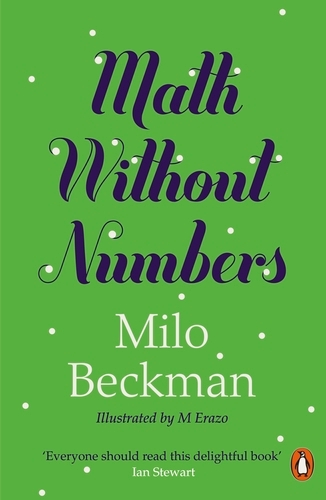
'Maths Without Numbers' by Milo Beckman

'Before you go tell your loved ones that you read a book about math and learned that a square is a circle, keep in mind: Context matters. A square is a circle, in topology. A square is most certainly not a circle in art or architecture, or in everyday conversation, or even in geometry, and if you try to ride a bike with square tires you won't get far.' pp.7-8.

'Like a line:

(Illustration - pen drawing of a line, a 'C' and an almost closed circle.)

A line can be bent almost into a circle, but to finish the job we'd need to click the ends together--not allowed. No matter how you manipulate a line, you'll always have those two special points on either end, where the shape just stops. You can't get rid of end-points. You can move them around and stretch them apart, but the two end-points are an unchanging feature of the shape.

For a similar reason, a figure-eight is a different shape too. There aren't any end-points, but there's still a special point in the middle where the lines cross, where there are four arms reaching out instead of the usual two at any other point. Stretch and squeeze all you want, you can't get rid of a crossing-point either. p.9.

Math Without Numbers
'The circle (aka S-one) and the infinite line (named R-one) are the only manifolds in the first dimension. To avoid end-points, you either have to loop back around or just go on and on forever. And don't forget: Because all the shapes in topology are stretchy, this also covers any closed-loop shape and any goes-on-forever shape. It doesn't have to be literally a circle or a straight line.' p.16.

The third dimension, dough-type manifolds, is pretty well understood at this point, though it took a hundred years and a million-dollar prize to get there, and we still don't have a totally neat and clean classification like the lower dimension. In dimensions five and up, topologists use a set of techniques called "surgery theory" to operate on manifolds and construct new ones.

That just leaves dimension four.

I wish I could tell you what's going on in dimension four. I'm not sure there's anyone who really knows. It's a weird boundary case: too many dimensions to do visually, but not enough to use sophisticated surgery tools. There are entire textbooks dedicated to what little we know about four-manifolds, and I couldn't make sense of anything past the opening pages. A professional topologist once told me she'd wanted to work on four-manifolds as an undergraduate but was advised to steer clear.' pp.23-24.

"Like a line" ... Yes. Take two that cross. Then the universes open up. 

Milo Beckman (2021) Math Without Numbers. London, Penguin Books. Illustrated by M. Erazo.

Previously: 'surgery'

Monday, January 19, 2026

iv Book: Bill Ross - 'Order and the Virtual'

'The Philosophy and Science of Deleuzian Cosmology'

Systemists will find much here: 'principle of least action', 'principle of least resistance', equilibrium, open / closed systems, and entropy. A useful question is posed: 'Is complexity increasing? Is that average complexity across the universe; or the complexity of the most complex object? Deleuzes's Difference and Repetition is quoted:

'The values of implication are centres of envelopment. These centres  are not the intensive individuating factors themselves, but they are their representatives within a complex whole in the process of explication. ...' (p.255-6)'

Reading this I immediately thought of Bohm, who followed shortly after (still in Chapter 1!). In chapter 1, 'Chaos' could be read as Cosmos, hence the term rolling them together - chaosmos. This is the tract from which existence and becoming arise (re-reading). Deleuze's awareness of physics and quantum theory and its influence on his work is discussed, with chapter 2 providing continuity reaching to Leibniz (and 'The Calculating God'), also contributing is 'the complete concept', 'principle of sufficient reason', 'intensive individuating factors' and 'principle of identity of indiscernibles', for example. Even while the context is metaphysics (and it is not!), (for me) this seemingly presages a comprehensive health assessment:

'The necessity in question is the necessary inclusion of all predicates pertaining to an individual in the complete concept of that individual.' p.24.

There are several 'completes' to be unwound, and so better understood. Ross provides a key. This isn't a book to read and pass-on to a student, second-hand bookshop. It really deserves re-reading, mandatory here - to get hold of the ideas and interplay of Deleuze, Ross's understanding and it must be said interpretation, that also calls upon Dan Smith's Essays on Deleuze, (EUP) and directly Leibniz's work. 

'The complete concept idea of predication is furnished to map faithfully onto these principles concerning the nature of things.' p.26.

The expanse of thought and literature from across the channel, 'French Theory' has long tempted, teased and taunted (not-quite as severely as mathematics!). At least here you can get a sense of the traffic in thought and ideas. Deleuze is difficult (in-/compossibilities, kuklos exothen ...), until you relate: becoming over being, difference over identity, and creation over representation. Order and the Virtual helps in this task. Delueze is 'embedded' in the mechanics of complexity, and mathematics, but Deleuze and Ross can see - across - to the humanities (virtual and actual). 

'Lastly, while mathematical concepts are frequently adopted to illuminate Deleuze's argument, they should not be taken as metaphorically representative of processes in the world; this would be to ignore the broadside and extended attack on representation as a mode of thinking as such which occupies so much of Difference and Repetition. Rather, they serve as a particularly direct example of the differential processes to which all phenomena - natural, social, psychological are subject. In an unambiguous sense, it is eminently possible for problems prompting a mathematical response to express themselves in altogether different domains - natural, social, etc. The problem is, so to speak, a common root of all domains.' p.39.

Still grappling, I noted integration, actualization, parity of esteem, maths - the linear and non-linear. It seems Deleuze was challenged by the question of integration. Leibniz's contribution of the calculus is acknowledged. History and even the present remain preoccupied with finding boxes. Ross explains how for Deleuze, we should not discount turbulent phenomena that cannot be simply integrated, written off as random disorder.

If we associate complication, with implication and explication, do we invite two-fold (as a minimal - keyhole) 'surgery': (re-)constructive and destructive? Thank you Mr Ross. I see now, how the (infinity →) continuum will not be exhausted. Exploring axioms for Hodges' model, and what is axiomatic, I must check Albert Lautman's model of dynamic structuration, especially when set (against / with?) the problematic mode:

'The two modes relate to each other dialectically - a period of exploration followed by the resulting period of axiomatisation. Deleuze recognises both modes and their respective utility, but for his philosophy the problematic mode is by far the more important.' p.41.

Do our boxes still have a purpose? To tame the situation - at hand/mind/virtual?

More to follow here ...

Bill Ross (2024) Order and the Virtual: The Philosophy and Science of Deleuzian Cosmology. Edinburgh: Edinburgh University Press. 
https://edinburghuniversitypress.com/book-order-and-the-virtual.html

Sunday, December 28, 2025

Feedback on Hodges' model in 'mathematical' terms

Through HIFA, I noticed an introduction by a new subscriber - Mr James Twahirwa; and noted a maths-oriented skillset:

'HIFA profile: James Twahirwa works on Research and data analysis in Rwanda. He is deeply interested in contributing to the global effort to improve health equity through reliable, accessible information. His background in statistics, data analysis, and research methods equips him to support evidence-based decision-making and strengthen health systems.

By email, I got in touch seeking an independent reading of the draft h2cm-maths paper (part 1).

Prior to this, Mr Twahirwa kindly made the following observations on Hodges' model which he is happy for me to post here:

==============

Dear Peter Jones 

I find your work interesting and really well-positioned.

Overall impression

Your work is intellectually ambitious and unusually well-positioned. You are attempting something that many disciplines struggle with: creating a unifying conceptual framework that can bridge practice, theory, and abstraction without collapsing into reductionism. The fact that Hodges’ model originates in nursing and has sustained relevance across decades already gives it credibility as a practice-informed epistemic structure, not just a diagram.

Your effort to reinterpret it through mathematics and category theory is especially interesting, because health economics often suffers from exactly the fragmentation your work seeks to address: disconnected models of behavior, outcomes, ethics, and systems.

1. The 2x2 structure aligns naturally with health systems thinking

Health economics constantly balances dualities such as:

  • Individual vs population
  • Clinical outcomes vs social value
  • Quantitative evidence vs lived experience
  • Efficiency vs equity

A 2x2 framework provides a powerful way to hold these tensions without collapsing them into a single metric. This is one reason cost-effectiveness frameworks often feel incomplete. Hodges’ model appears capable of holding multiple dimensions of value simultaneously.

2. Conceptual clarity over mathematical dominance

Health economics has increasingly recognized that mathematical rigor alone does not guarantee insight. Your attempt to treat Hodges’ model as a conceptual object rather than a predictive algorithm is aligned with modern critiques of over-formalization in economics and health policy.

Where your work could be strengthened

1. Clarify the “mathematical” claim carefully

From a health economist’s perspective, the risk is not that the model lacks mathematics, but that readers may misunderstand what kind of mathematics is being invoked.

You may want to explicitly distinguish between:

  • Mathematics as computation or formal proof
  • Mathematics as structural reasoning (relations, mappings, constraints)

Making this distinction early will help avoid criticism that the model is “not really mathematical,” while still defending its rigor.

2. Connect to applied decision-making

To attract health economists and policy researchers, it may help to show how Hodges’ model could:

  • Frame health technology assessment decisions
  • Structure evaluations of complex interventions
  • Support mixed-methods research designs

Even one concrete example (e.g., health service redesign, chronic disease management, or resource allocation) would strengthen its practical relevance.

3. Position the work in relation to existing frameworks

Your work resonates with, but is distinct from:

  • Systems thinking in health
  • Capability approach (Sen, Nussbaum)
  • Complex adaptive systems
  • Multi-criteria decision analysis

Explicitly stating how Hodges’ model complements or improves upon these will help readers locate it intellectually.

I hope this feedback may be of help

Happy festive season.

=================

Thank you Mr James Twahirwa. These comments are very helpful. You have identified the many strengths of Hodges' model and its uses. On the mathematics, you make many points for me to address and balance in terms of the overall intent and content of this 'project'.

Mr Twahirwa is now in possession of the draft paper. Any further thoughts are always welcome. While rather remote from clinical practice (a debate in itself) health economics is ultimately grounded in health services and health systems development. So this perspective provides a critical counterbalance to my clinical (business) as usual approach.

Point #1 is a primary motivating factor for this 'project'. I'm sure I can use structure as an anchor, while acknowledging that Hodges' model is a conceptual model, an idealisation. Additional feedback regards reasoning, decision making and Bayes also apply here:
[ ii Learn your lines and the hyperplanes will follow ].

In Point #2 I may be able to leverage research, drawing from #1:

'Mathematics as structural reasoning (relations, mappings, constraints)'.

Point #3 will be considered in-part through April's complexity conference; and revisiting former work on systems.

Both points #2 and #3 may find their home in a second paper (part 2), but this is fine, as it may support a step-wise workflow, and something akin to a logical progression(?).

As posted before any assistance greatly appreciated.

Sunday, November 30, 2025

Interesting ... 'Incidence structure(s)'

Unsurprising, in studying 'Hodges' model, I've been aware of Wilfrid Hodges and model theory for many years.


Now, trying to look at (Brian) Hodges' model using maths, I've wondered about possible connections with Wilfred Hodges' work.

Dr W. Hodges was listed in searches on lines, axes, and structure:
'Algebraists and geometers like to classify structures by the laws which they obey. A typical law for incidence structures reads:

"For any two different lines L and M, there is exactly one point which lies on both L and M."'
My imagination may be getting the better of me, but there seems something profound in the intersection of the model's two axes and the care - knowledge domains that are created (proposed - adopted..)?

So, is Hodges' model a form of 'incidence structure', or does it contain several incidence structures? 

Hodges, W. (1985). Truth in a Structure. Proceedings of the Aristotelian Society, 86, 135–151. http://www.jstor.org/stable/4545041

Monday, October 13, 2025

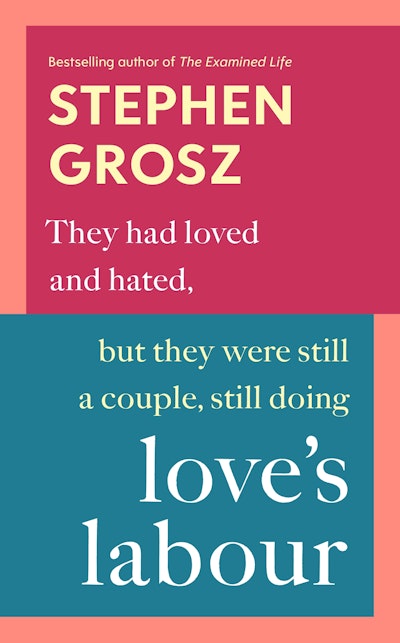
Book: Love's Labour by Stephen Grosz

They had loved and hated,
but they were still a couple, 
still doing love's labour ...

Luminous and necessary stories from the psychoanalyst's consulting room; on desire, heartbreak and learning how to love.

When it comes to love why do we find things so difficult? Drawing on over forty years of candid and surprising conversations with his patients, Stephen Grosz asks, what gets in the way of our falling in love? And what must we do to stay there? Penguin UK.
<>
'Ravi, a maths lecturer, is tormented by his wife Sonal's supposed infidelity, but won't look at the CCTV - even though that might reveal her to be innocent. This chapter has a sting in its tail when 19 years later Grosz is contacted by Sonal. She is dying of cancer and Ravi is cruelly neglecting her. Grosz feels that he missed a vital clue all those years ago, concerning Ravi's ingratitude and envy.

This moment of "failure" on Grosz's part forms an aspect of this small book's power. It shows that the psychoanalyst is not a machine, and the process is fallible. But it is also a testament to human complexity. When he hasn't understood the patient sufficiently, Grosz brings the case to his supervisor, and we, the reader, are witness to their exchange.' Life&Arts, FTWeekend.
Individual
|
      INTERPERSONAL    :     SCIENCES               
HUMANISTIC =========================  MECHANISTIC      
 SOCIOLOGY  :    POLITICAL 
|
My source: Kathy O'Shaughnessy. The hard work of seeing ourselves. Books, Life&Arts, FTWeekend, 27-28 September 2025, p.11.


Iamge: https://cdn2.penguin.com.au/covers/400/9780701188979.jpg

Wednesday, September 03, 2025

TEL us a story ... Hard, Soft and being Smart

Sorting papers I'd saved I came across -

David Mossley and Clare Saunders: A revolution in philosophy teaching? from the The Philosophy Magazine. 3rd quarter. 2013. pp. 40-45. 

Checking back, I see I posted and cited this item in 2013:


In the decade-plus since, how things have changed in tech, education and philosophy!

The story is ... that around this time I needed a new website and in the past I practised computer aided learning. Or should I say mCAL, microcomputer aided learning on the ZX81 and BBC Micro (related citations below). In 2013-2014, I started a PhD (as noted elsewhere) thinking I could recover and update some IT skills. Could I recapture the CAL days, by picking up TEL - technology enhanced learning? I stepped outside healthcare, and nursing specifically. I see now this was an error, but of course I still venture off-piste. The latest detour is even more extreme? On a personal - psychological level I'm visiting a subject maths - formal methods that simultaneously fills me with wonder (recognising its power and utility) and yet terrifies me with its complexity, made me feel sick at school, as a pre-teen and after.

My 'research question' was poorly formulated - which I did recognise. Two years were not wasted, far from it. The journey then was also driven by personal circumstances, married with events in 2007, 2010 and then 2015. 
 
Sticking with the current conference theme, I noticed a call for the 7th International Soft Computing and Engineering Applications Conference. Selected themes from track #4 include*:


Track 4: Soft Computing for Smart Sustainable World

Smart agriculture and aquaculture
Smart cities
Smart communication
Smart disaster monitoring and management
Smart earth system
Smart education
Smart elderly care
Smart environment and ecosystems
Smart governance
Smart healthcare
Smart homes and buildings
Smart learning
Smart living
Smart machines and robots
Smart materials and fabric
Smart medicine
Smart social services
Smart villages
Smart wearables and implants
 
 *Try searching this blog for the themes above.

Amid all the (understandable) emphasis on 'smart' we need to retain a place for the human. That's the challenge in simultaneously considering the hard and soft of today's and tomorrow's world.

Citations

1982 CAPA: COMPUTER AIDED PATIENT ASSESSMENT, Sinclair ZX81, advertised in Nursing Mirror (see below) provided on audio cassette tape.

1983 THE NURSING PROCESS – Computer Aided Learning program, BBC Micro, published by Open Software Limited (OSL)

1984 HAEM. Blood Groups Computer Aided Learning program, BBC Micro – (OSL).

1989 SHADES OF GREY, Computer Aided Learning program, BBC Micro. Simulation of nuclear weapons, Based on Fanchi, J. Local effects of nuclear weapons, BYTE, Volume 11. Issue 13. Dec., pp. 143–155. Computer Aided Learning program, BBC Micro, published by Open Software Limited..

Jones, P. (1986) Computing in Nursing NEWS. Computerised Patient Assessment. Nursing Times. 85: 5. Sep 3-9;82(36):63-5. PMID: 3532039 (Describes 'CAPA', a BBC microcomputer program for student nurses.)

Jones P. 1988 Thunderbirds are Go? (Impact of technology in society, disasters, macro-engineering). Popular Computing Weekly.

Jones, P. (1989) Computers in Nursing NEWS. Creating a Program. Nursing Times. Feb 1-7;85(5):66-8. PMID: 2648342 (Describes 'HAEM', a BBC microcomputer program for student nurses on blood and blood groups.)

Jones, P. (1989) Information Technology is Good For You! (Effects of information technology) IT in Nursing, BCS-Nurs. Specialist Group. 1,1

Jones, P. (1990) Creating a Community Mental Health IS (Creation of a community mental health resource centre - a multidisciplinary research project). IT in Nursing and Paper at BCS NSG Conference. 2,4.

Jones, P., & Beckingham, D. (1991) The Ins and Outs of a small mental health Information System. Healthcare Computing 91 Conference Paper.

Jones, P. (1992) Nursing: All in the mind and machine? (Models of nursing and computing). British Computer Society -Nursing Specialist Group Conference Paper

Monday, July 28, 2025

Book: ii 'Health and Health Care Inequities'

In the introduction to Health and Health Care Inequities - A Critical Political Economy Perspective, Borras concludes:

'This book aims to spark thoughutful conversation and collaboration by moving away from capitalism to improve society and health. Health is not just about nursing and medicine; it is integrally connected to economic, political, cultural, and institutional systems. Moreover, it encompasses philosophy and ethics. Capitalism's focus on individualism and competition harms people and the environment,making it all but impossible to achieve health equity. We must work together to envision and create a new world that ensures fairer and better health for all.' p.3.
This sets the tone for a short 163 page book, with a page of acknowledgements, (said) introduction pp.1-3, reference listing pp.136-153; 10 page index, and eight chapters:

Chapter 1: Social Determinants of Health Inequities
Chapter 2: Neoliberalism and Canada’s Housing Policies
Chapter 3: Neoliberalism and Canada’s Health Care System
Chapter 4: Political Power and Policy Advocacy
Chapter 5: The Role of Evidence and Ideas
Chapter 6: A Critical Political Economy Approach
Chapter 7: Searching for Socialism
Chapter 8: Mobilizing for Health Equity
Chapter 1 on 'Social Determinants' provides the first of many political points to underscore the effort with Hodges' model here. If income and poverty come second the preceding paragraphs on wages reveal the socialist stance stand of the author, and the acknowledged networks. Throughout the book the relational nature of determinants, inequality, inequity, protected characteristics, socio-economics and political struggle is raised. In the discussion on wages the importance of education is described in cross-cultural and gender-based terms. The book possibly turns on the sentence:
'To effectively address poverty, we need to unite those who are in poverty with individuals who have more economic stability but are still ulnerable within our capitalist system. These individuals are at risk of falling into poverty if they lose their jobs due to workplace closures or privatization. It is essential to acknowledge that certain groups experience higher poverty rates, but we should see them not as victims but as protagonists and capable workers facing unique but connected challenges.' p.7.
For the people who follow the news, the majority of 'us' are (even if only roughly) aware of the distribution of wealth across national and the global population: the injustice. The erosion and lack of union representation within many workforces, especially 'Big-tech'. The way utility enterprises have provided dividends for shareholders at the expense of ongoing investment in infrastructure, the quality of service provided to the public and even public safety. COVID (p.7), crystalised 'difference' for us all. I came to now substitute collective for 'group' in Hodges' model. Suddenly all those individuals, many working in health, were collectively vulnerable:

Individual
|
      INTERPERSONAL    :     SCIENCES               
HUMANISTIC  --------------------------------------  MECHANISTIC      
 SOCIOLOGY  :    POLITICAL 
|
Group
PSYCHOLOGICALLY
EXISTENTIALLY
BELIEFS
SCIENCE
PHYSICALLY
data, information, knowledge
SOCIALLY
CULTURALLY
SOCIAL MEDIA
wisdom, leadership, truth
LAW - POLICY
FREEDOM - CHOICE

Throughout the text, I like the concise coherence Borras demonstrates in the steps from wages, income and poverty to investigate the state of health inequities. Once again (from i) the context is Canada, but the lessons are for all - as globalisation should/must demand?  There is public health history too. As expected Canada's First Nation, Indigenous, and Nunavut populations are frequently referenced regards exclusion and disparity in health services access and provision. Under health inequities, after infant mortality and life expectancy there is a convention(?) adopted of several axes being identified. The first (p.9) is the class-health axis, then class-gender-health and others. No surprise I found the relational and organisational aspects of these 'constructs' very helpful. As I try to think of Hodges' model as a mathematical object I realise (through oft impromtu conversations^) that we don't have two 'axes' in Hodges' model. Still musing on this; and more to follow ...

Arnel M. Borras. (2025) Health and Health Care Inequities - A Critical Political Economy Perspective. Fernwood Publishing.

^A pure maths lecturer, Gower St Waterstones, London.

See also: Post i : Post iii : Post iv : Post v (to follow)