Hodges' Model: Welcome to the QUAD: Search results for mind

Hodges' model is a conceptual framework to support reflection and critical thinking. Situated, the model can help integrate all disciplines (academic and professional). Amid news items, are posts that illustrate the scope and application of the model. A bibliography and A4 template are provided in the sidebar. Welcome to the QUAD ...

Showing posts sorted by relevance for query mind. Sort by date Show all posts

Wednesday, May 16, 2007

News exclusive: Mind mapper is visited by guardian angel of Hodges' model

On the web I found an interesting comment item from the Educational Guardian 2006 by Philip Beadle "Mind maps: rubbish in theory, but handy in practice". Being an educational piece Mr Beadle is concerned with mind mapping in the context of children, although that's quite an age range in reality. As the title suggests, the piece as a whole does not rubbish mind mapping completely, but the start got my goat.... You see I thought of the first impressions and assumptions that people may form coming to Hodges' cognitive x-roads. Do they turn back or cross the divide?

Beadle apparently mind mapped the article and asks the reader if they notice a rise in quantity. I don't know if it's a typo, but quality should be the factor here. He made several points:

  • Mind-mapping is easy
  • Send people to search for coloured pencils
  • Sharpen them - and again - and again
  • DO NOT use a felt pen
These instructions are c/o the books by Tony Buzan the mind mapping guru. Beadle declares them wrong - and continues:
  • Draw something in the middle (right dead bang, no less) of the paper
  • Stay away from the sides - radiant thinkers need space
  • Draw six multicoloured lines from the centre and a picture at the end of each
  • Lines should be curly - no room for rulers in this realm
  • Write key words in UPPER and lower case and voilà! A basic mind map is born
I realise you can read, but suffice to add that Beadle explains the claims that are made for mind mapping and the issue of 'bad science'.

Hodges' model has a problem here. It is not scientific - not evidence based. Not for the last time I'll say that the website and this blog are a (faltering?) call for research.

In many subjects the concepts of locus and control is important, in psychology and therapy for example. In mind mapping what determines that initial centre-stage drawing? True it could be person-centred, situated and problem centred.

As described above, though the space (page) in mind mapping is blanc*, virginal, neutral and crucially - unstructured.

Actually, there's some grief and annoyance in store for the mind mapper coming to Hodges' model.

There they are coloured pencils in hand, tongue protruding seeking airborne creative inspiration...

And then, it happens "Sh-t! Who the hell has graffitied on my page!"

Then suddenly, a voice booms out from overhead:
"Greetings, mild-mannered mind-mapper. Here is an announcement: the centre of this page has been rendered a no-go-zone. It is now a hyper-dimensional nexus, the point of fusion between four disciplines, five even (how could I forget). It is Complexity and Chaos. You can venture as near as you wish. Now please do not fret; I have it on good authority that aesthetically many things look better slightly off-centre."
The point I want to make - is the central importance of:
  • Hodges' axes and knowledge domains - just where is the 'map'?
  • How these influence the locus of control and association
  • The concepts are already 'on' the page implicitly
  • The user makes them explicit (in mind-mapping the space is aconceptual)
There are other critical dependencies:
  • The knowledge, skills, attitudes and aptitudes of the user (are they a novice or expert#?)
  • Whether they are novice or expert, Hodges' model provides a common conceptual substrate
  • Finally (though I could go on!) quality in health and social care - and without - is the real issue. There are times when silence is golden...
There are many visualization (with apologies to those with voluminous datasets to swing) and mind mapping tools out there, but with the semantic web and Web 2.0-3.0... then Hodges' model will come of age....

Ack: *Michel Serres; #Benner, et al..

Thursday, August 13, 2020

Tony Buzan: Mind mapping - mental literacy

Tony Buzan, The Times, April 17 2019, p.57

There are a great many diagrammatic reasoning and argumentation tools available in various forms, paper concept maps and a variety of software. As noted previously on W2tQ ever since watching Tony Buzan's Use Your Head programmes on BBC TV in the 1970s I have been fascinated by the use of drawings to represent a situation, problem and solutions. I was primed to be hooked by Hodges' model in 1987-1988.

I've been sitting on this obituary for over a year. It was sad to hear of Mr Buzan's death and still quite young by today's standards at 76 years. I never managed to make contact with Mr Buzan, although I'm sure I tried, the inevitable email - undoubtedly well-lost.

Now, letting revisions 'relax' [the draft SDGs, public health and Hodges' model resubmission(?)] I'm looking at Drupal (again) and papers that address fundamental questions about h2cm; the axes, care domains.

As an influence I've an old pb copy of Use Your Head and a recently acquired hb copy of The Mind Map Book published by the BBC.

Some of the points of interest to me include:

BULL, B.L. and WITTROCK, M.C. (1973), IMAGERY IN THE LEARNING OF VERBAL DEFINITIONS. British Journal of Educational Psychology, 43: 289-293. doi:10.1111/j.2044-8279.1973.tb02269.x

Bull and Wittrock's study was on 9-10 year olds (p.84). I've often wondered about the age at which Hodges' model could be taught.  I'm sure there are other, 'current' sources but this is a start.

There is a refreshing cultural contrast between the three Eastern basic instructions:

'obey, 'cooperate' and 'diverge'.

While the mind mapping equivalents are the three A's:

'ACCEPT', 'APPLY' and 'ADAPT'. pp.92-93.

If "drawing boundaries on a Mind Map has obvious mnemonic advantages;" is this, to some degree, what the care (knowledge) domains of Hodges' model also achieve? p.103 (and p.149).

Some chapters I can directly 'translate', e.g. -

Chapter 13 - Organising your own ideas -

Self-reflection, Self-care -

- similarly Chapter 18 Self-Analysis

The Mind Map Book
(Ideas stand for 'concepts' the latter no specific entry in the index.).

Chapter 19 Problem-Solving actually refers to interpersonal problem-solving using Mind Maps.

Chapter 19 might be extended to case formulation and especially so chapter 21 Family study and story-telling. I'm thinking of the way in health, whether physical or mental health context there is a narrative to told and listened to, acknowledged and acted upon.

Chapter 22 Thinking and Chapter 23 on Teaching, perhaps has a current analogue in Threshold Concepts and for the former Conceptual Spaces - both chapters stress learning.

The meaning of 'deep' and 'surface' learning has perhaps changed today, but deep being intrinsically motivated still stands - and could be related to the Socratic form of dialogue for engagement. p.228.

On pages 229-232 Mr Buzan demonstrated how people with special education needs can also utilise Mind Mapping. Hodges' model was created, very much with this population in mind, and in the Political domain.

'Mind Maps' ™ Acknowledged.


Monday, July 02, 2007

Nursing Times and mind mapping: All my slides are packed, I'm ready to go...

This Saturday I leave for the Society for Philosophy and Technology Conference in Charleston, SC. Still awaiting news regards funding with £200 gratefully received thus far.

I'm really looking forward to this, not just being able to contribute, but listening to the other presentations. Must admit that after the weather here in the UK, warmer climes will be most welcome.

The past week's Nursing Times included a feature on mind mapping in research. I haven't checked the full paper, but in NT noticed two references to Buzan (1997 and 2003).

I'm keen to differentiate h2cm from mind mapping, even though of course there are a lot of similarities.

I wonder if Hodges' model gets a mention in the full paper? If not then of course other people realise h2cm isn't about mind mapping!

The reason why I ask (beyond the obvious) is that for many people models of nursing are old-hat. When were they really in fashion? The 80s...

When did Buzan's mind mapping arrive? I think 'Use your Head' aired on TV in the 70s, early 80s...? My Library thing includes books written by Buzan in the 80s and one or two from the 70s.

Maybe it really is time to move on?

So looking forward to the (relaunch of) semantic web Community too!

Saturday, July 29, 2017

No Body... No Mind...

Hodges' model: an open conceptual space for the naive beginner and expert alike...

individual
|
INTERPERSONAL : SCIENCES
humanistic --------------------------------------- mechanistic
SOCIOLOGY : POLITICAL
|
group
NO BODY...!?NO MIND...!?


"I also find it helpful to be both expert and naive. Following Shunryu Suzuki’s saying, “in the beginner’s mind there are many possibilities; in the expert’s mind there are few,” I find it helpful to approach each client with an attitude of “we don’t really know anything about this, let’s explore it together.” On the other hand, clients expect (and have a right to expect) some level of expertise and the fact as clinicians is we do have a body of knowledge which is valuable. By being both “expert and naive,” simultaneously teacher and student, we can model a kind of being-with-a-problem, which is most paradoxical but most essential: I (and you) are both healthy and ill, distressed and just fine." p.23.
Rosenbaum, R., & Shahar, Golan. (2012). Thoughts on Mrs. T: No Body, No Mind. Journal of Psychotherapy Integration, 22(1), 19-26.

Wednesday, October 07, 2026

Hodges' model: Is it a virus: or a universal vaccine?

The arrival of 'imposter syndrome' well-over a decade ago(?), from the speaker's podium was an interesting surprise. A case of lived experience, as I'd felt this in trying (and failing) to grapple with the ever-growing, morphing development stack of a software program. Long gone are the days of Sinclair and BBC BASIC. The mountain and learning cliff, was CMS content management system: Drupal. 

What contributed to that feeling back then? Well there was the people I was sat by and sharing time at various European DrupalCons. It was I who was the 'con'. A hobbyist, from pre-PC days. Seeing and hearing what they were creating and the great community. Fascinating also, to see web design fashions come-and-go.

I've written before about Hodges' model being an over-valued idea to me. As a mind-mapping meme it infected me decades ago. Is it a virus? If it is I clearly had no resistance, no immunity. I've always tried to acknowledge, reminded myself that the model is not the be-all-and-end-all.

While the specific mathematical is complex, it is worth trying to grasp some of the intent and meaning (even at the risk of exacerbating imposter reactions). Hestenes provides a paper (and several others):

'ABSTRACT. The discovery of Mathematical Viruses is announced here for the first
time. Such viruses are a serious threat to the general mental health of the mathematical
community. Several viruses inimical to the unity of mathematics are identified, and their
deleterious characteristics are described. A strong dose of geometric algebra and calculus
is the best medicine for both prevention and cure.'

Hestenes, D. (1992). Mathematical Viruses. In: Micali, A., Boudet, R., Helmstetter, J. (eds) Clifford Algebras and their Applications in Mathematical Physics. Fundamental Theories of Physics, vol 47. Springer, Dordrecht. https://doi.org/10.1007/978-94-015-8090-8_1

'The computer virus (CV) owes its name and perhaps its genesis to the biological virus
(BV). Like a BV, a CV cannot function by itself, but when attached to a host it replicates
repeatedly until it impairs the functioning of the host, sometimes to the point of disabling
the host altogether. ...

My purpose here is to call your attention to another kind of virus - one which can
infect the mind - the mind of anyone doing mathematics, from young student to professional
mathematician. As I believe this is the first published paper to explicitly identify
such viruses, I take the liberty of naming and describing them as follows: A mathematical
virus (MV) is a preconception about the structure, function or method of mathematics
which impairs one's ability to do mathematics. Just as a CV is program which impairs the
operating system of a computer, an MV is an idea which impairs the conceptualization of
mathematics in the mind. Indeed, as one definition of "virus," Webster gives "something that
corrupts the mind or soul." Since the identification and classification of MVs has only
just begun, it would be premature to attempt a more precise definition. The better course
is to examine some specific viruses to form a form empirical base for further study.
My first example is an easily recognized MV which is extremely virulent and as common
as the common cold. I call it the coordinate virus, designating it by MV/C to denote genesis
and type, and characterizing it as follows:' pp.1-2. (online copy)

Hestenes' biohistory is an interesting conceptual and interdisciplinary bridge. Another construct to add to our  collection. Is there a virus in the models deployed within medicine and healthcare to date? You know, the bed-round of the medical, biomedical, bio-psycho-social? The round were you don't need to count the number of beds, except in the event of a pandemic. Is the omission of the political, even as the socio-economic reality is now a constant point of reference a symptom of a centuries-long infection? 

For a long time now* the legacies that successive cohorts of students, and newly qualified professionals encounter have stood out. Another question is, just how far back in time do we need to travel to find can the origin of this situation? Was there an initial crisis involving the overt expression of 'power'? Can this be found the as the Hippocratic oath butted up - literally - against triage on the battlefield?

Now: Time won't tell (or will it?). Now that - is some virus.

Wednesday, November 20, 2024

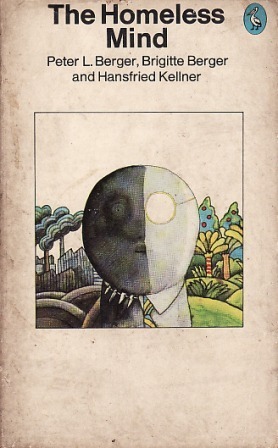
Hello? Is anyone there? 'The Homeless Mind'

individuality
|
INTERPERSONAL : SCIENCES              
humanistic ------------------------------- mechanistic
SOCIOLOGY : POLITICAL   
|
group

'Put differently, the componentiality of the cognitive style pertaining to technological production extends to identity. Again, a specific kind of double consciousness develops. In this case the dichotomy is between concrete identity and anonymous identity. The individual now becomes capable of experiencing himself in a double way: as a unique individual rich in concrete qualities and as an anonymous functionary. This dichotomization in the subjective experience of identity makes it possible for the individual to establish subjective distance vis-à-vis certain features of this identity.9 

For example, the individual will now experience that portion of his identity that contains his anonymization as a 'worker' as being 'less real' than his identity as a private person or family man. Since each portion of identity relates to specific roles, it now becomes possible for the individual to perform some of these roles 'tongue in cheek'. The componentiality of identity, as the componentiality of social relations, makes possible an 'engineering' practice. This time what is involved is the 'engineering' of one's own self. Those aspects of identity that a defined as 'more real' must be protected against threats coming from the 'less real' components of identity.' p.37-38.


Helpful reference to ideas of multi-relational synchronization and institutional vectors and how our mind's became homeless.

Also encouraging, even though 'historic', discussion on life plans and life planning.

'A basic presupposition is that life careers are not firmly fixed but are at least relatively open. Put simply the individual is faced with a number of alternative careers, especially in his " younger years, and therefore must make decisions about these available options. It is possible for the individual to imagine, himself as having different biographies. This possibility has both positive and negative consequences for the emotional economy of the individual. Positively, it may give him a feeling of frees dom to shape at least certain parts of his life. Negatively, it increases the likelihood of frustration regarding specific careers One is, after all, less likely to resign oneself to a particular situation if one believes that other situations are, in principle, possible.' p.67.
'Implicit in this scale of probabilities is a general 'sociology', on whatever level of theoretical sophistication. The individual has a `map of society' within which he can locate and project himself in terms of both past biographical recollection and future projects. The individual's life is perceived as a trajectory across this 'map'. There is also a large body of factual knowledge, most of which is 'weighted' in terms of the individual's life plans. Thus if a particular career appears to the individual as a realistically plausible project, he will have more factual knowledge about it than about a career in which he can participate only in pragmatically irrelevant fantasy. In other words, a good deal of background knowledge is related to 'anticipatory socialization'. p.68.
'However vaguely this may be defined, there is the underlying concept of life plan, both for the individuals and for the a family unit. This life plan is the totalization of all the relevant timetables, their grand sum and their integrative meaning In modern society, such life planning has become a value in itself. Its absence is commonly an occasion for reproach. The family unit thus operates as a life-planning workshop.' p.69.

'There is a general expectation of justice. It is expected that everyone in the relevant category - as, for example, those en-titled by law to a passport - will receive equal treatment. It is, of course, understood that certain persons may be excluded from this relevant category - for example, resident aliens or convicted criminals. It is also understood that the bureaucratic procedures may codify certain preferences, for example, in favour of diplomats or other people travelling on urgent government business. Once the categorial system has been established, however, the presumption of equality holds within each category. In the most general way, bureaucracy is expected to conform to the Roman principle suum cuique. An implication of this is that there will be no favouritism or any other intrusion of personal bias in the bureaucrat's handling of each client's case. The bureaucrat is expected to handle every case sine ira et studio. In other words, there is the general expectation that bureaucracy will operate impersonally and with 'affective neutrality'.2 These considerations bring us to an important point: unlike anything discussed in the preceding chapter, the cognitive style of bureaucracy contains a moral quality, not just as a limiting factor (after all, there are also moral assumptions about technological production - for example, that no one will be killed in the course of it), but as an intrinsic part of its own structure of consciousness. The source for this moral element is probably to be sought in the primary social location of bureaucracy in the political sphere.' pp.52-53.


Berger, P. L., Berger, B., & Kellner, H. (1973). The homeless mind: Modernization and consciousness. Penguin. 

Cover image: https://www.goodreads.com/book/show/3368465-the-homeless-mind

9 This is an amplification, by way of phenomenological description, of what Erving Goffman has called 'role distance'.

2 This term was coined by Talcott Parsons.

See also: 'homeless'

Monday, December 15, 2025

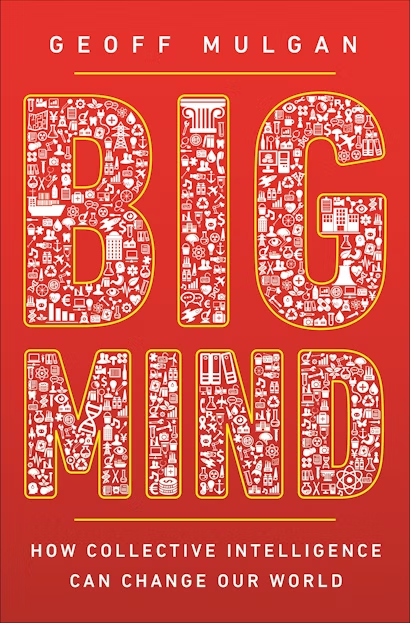
Q. Is Hodges' model Person OR University-centered? [ 'Big Mind' iii? ]

To date, I have not written a paper on Brian Hodges' original purpose for his model in curriculum development, design, planning and evaluation. Geoff Mulgan's book and referenced sources provide support, if not evidence, for the increasing relevance of Hodges' model.

The center of Hodges' model, the nexus, can be variously occupied by an individual student, researcher; a group, or team, or even an institution. Why not a university?

Since 1987-88, when I applied Hodges' model in a case study, I've acquired a broad understanding of the 'POLITICAL' domain in terms of institutions and organisations. Even if that learning is now 'archived':

https://web.archive.org/web/20150414073721/http://www.p-jones.demon.co.uk/linksIV.htm

In 'Big Mind', Chapter 14, The University as Collective Intelligence (pp.174-180) refers to 'third-loop learning' and a document from Nesta:

Geoff Mulgan, Oscar Townsley, and Adam Price, "The Challenge-Driven University: How Real-Life Problems Can Fuel Learning", Nesta, accessed April 28, 2017.
accessed 15/12/2025: https://media.nesta.org.uk/documents/the_challenge-driven_university.pdf 

'This paper focuses on one important strand of change: the rise of what we call ‘challenge-driven’ university models. These models develop students by putting them up against difficult problems and challenges for which there are no established answers.  Instead students to draw on many disciplines to solve them; they have to work in teams; and they have to collaborate with organisations outside higher education.

These models aren’t a replacement for the classic core of university education - mastering a discipline.   But they provide an important complement to this core, and they may be better suited to preparing young people for the needs of the world. They also re-emphasise one of the founding principles of some ancient universities: a focus on questions rather than answers as the key to deep learning.'

Within the Nesta document, Mulgan et al. list educational institutions who have succeeded, and are trying to effect change (with much editing):

US

The approach was pioneered by McMaster University Medical School in the late 1960s where in response to changing demands on the profession, the curriculum was changed so that students learned collaboratively, working on real-life cases in small groups. ...

... examples like High Tech High in the US, use project-based learning, centred on real-life problems, as the core curriculum for students.

Olin College of Engineering has quickly gained a reputation for being one of the most innovative institutions in the US since it opened in 1997.

Last year, the Ash Center for Democratic Governance and Innovation at the Harvard Kennedy school founded the ‘Urban Innovation Field Lab’, a project aiming to improve social conditions in cities in Massachusetts.

Canada

In Canada, the University of Waterloo uses a model of co-operative education, where students’ time is split between study and assessed work experience.

Europe 

Aalto University in Finland was created out of a merger between Technology, Economics and Art Universities in Helsinki and now runs four interdisciplinary ‘factories’ - Design, Health, Media and Service, where teams of academics and students work with companies and communities to develop new products that respond to demand from the real economy. 

The Norwegian University of Science and Technology in Trondheim has a similar approach. As part of their courses, students are required to join a ‘village’ (i.e. area of interest) of around 30 members which address questions such as ‘Biofuels - a solution or a problem?’, ‘Sustainable, affordable housing for all’, and ‘Portable technology and well-being’.

At Maastricht University (the second youngest university in the Netherlands), all teaching uses a problem-based learning model, and this has become one of the main attractions of the university. 

Twelve to fifteen students discuss problems in group sessions, with one student appointed to lead the discussion. The students are given complex problems from everyday professional practice which they brainstorm and research both together and separately. ...

UK 

Imperial College London and the Royal College of Art (RCA) are two particularly innovative higher education institutions. For the last ten years, Imperial has been running the Energy Futures Lab - a cross-discipline, issue-based department aimed at tackling global energy challenges. It was established to bring together disparate fields of study that are relevant to energy including engineering, environmental sciences, computer science, business, policy and mathematics. ...

Imperial and the Royal College of Art also run a Double Masters in Innovation Design Engineering (IDE) which is well known for producing some of the best talent in the field. Their flagship international module ‘GoGlobal’ takes students abroad for three week cross cultural, collaborative projects with academics and industry partners. ... The University of Lincoln has challenge-driven education at the core of its teaching.

Globally? South?

... 

Over the years I've reached out to a great many private and public bodies. 

MEMO TO: New College of Humanities and London Interdisciplinary School

I note the NESTA document is a 'draft'. I'd be pleased to help update and complete this work. Keen to frame Hodges' model not just in the context of problems, but strengths, weaknesses, risks, opportunities and more. When your model emerges from health, you quickly learn when it comes to problems that versatility and adaptability are essential. Always ready to cross disciplines - insofar as I understand them, borders and boundaries as required.

Previously:

https://hodges-model.blogspot.com/2025/07/big-mind.html

https://hodges-model.blogspot.com/2025/12/ii-big-mind-book.html

Geoff Mulgan (2017) Big Mind: How Collective Intelligence Can Change Our World, Princeton University Press.

Thursday, July 28, 2022

Seeds in 'architecture' iii

Prof. Younés describes 'three essential dualities': 

  • IMAGE and WORD 
  • TYPE and MODEL
  • IMITATION and INVENTION

IMAGE and WORD 

Nursing has its historical images, that are continually presented, the lamp, hands imbued with care and support and others. The attraction to Hodges' model was through its similarity to mind-mapping, but with offering an foundational structure for reflection and critique (learning). So image has been there from the start.

Younés writes: "Within the dialectic of the visible (objects apprehended by the senses) and the invisible (ideas or forms apprehended by the mind), the image acts as a symbol when it supports the visibility of an idea." ... "Forms can be seen as structural potentials ..." p.238.

Younés classifies images (p.241), or the artistically factual through three divisions:

  1. visual images (that would include icons and interface features)
  2. mental images
  3. verbal images (including metaphors and descriptions).

 "... the mind constructs a world within a world, and then reflects upon its own activity, as well as its own aesthetic appreciation of such activity."
I must stress the Younés context is architecture (and philosophy), but here extending to meaning I'm reminded of the way Hodges' model can span the arts and sciences, and original influences on why this model stood out for me through its facility for mind-mapping.

TYPE and MODEL 

 Here (p.242) Younés returns, not just to the origin, but the concept of origin through Form, the word and the type. Searching for universally shared purposes, within the permanences of human experience  this is health and social care too.

Taking in data, information, knowledge from assessment and other activities, this is usually contextualised - associated with a care domain. A return to the origin (nexus) of Hodges' model, the center is vital to retain balance and provide assurance in what we are doing, or not, and why.

"The architect imitates things as they have essential significance, but he or she does not copy any particular thing. This enables the layered transformation of natural models, without which the column would have always remained a tree. The form of the imitation is always different from that of the model. The roof is different from the forest's canopy. It is here that the pleasure of invention and the evaluation of the new enter, for it is within the recognized distance between the forest's canopy and the roof, that much of art occurs." p.244.
How times change in two decades. So many seek a roof, with architects having a recognized role in providing solutions post-natural disaster and political displacement of people. Not just homelessness, but homes that can cope, adjust to climate change. COVID has reminded us of the rejuvenating properties of nature, of the forest canopy, even that afforded by city centre gardens. 

We now see a roof not merely in physical terms, but social. As the night skies brighten we try to secure the canopy of the stars.

IMITATION and INVENTION 

Have we forgotten the contribution of positive role-models in learning? Imitation is the sincerest form of flattery and this throws up the constant educational dilemma of the theory - practice gap. Should we be exposed to practice without the guiding mentor represented in theory - that is also evidence-based?

There is an interesting exploration of SCOPE, DISCOURSE and NATURE: On Scope

"Thus a theory that is systemic aims at a certain level of completeness for it establishes the internal organization of architecture as a discipline, and it explains its external relations to other arts, to techniques, to social factors. Put differently, the interior individual realm concerns the intellectual freedom, the inner reflection of the architect-maker. The exterior individual pertains to the thoughts resulting from one architect reflecting upon another architect's work, as well as the individual architect's reflections on the suitability of her or his building to a context. The interior collective bears upon the conscious or unconscious content of culture which thrive within the images of of operative myths that inform architectural production. The exterior collective designates that commonly built sense regarding the suitability of architecture (decorum) within its milieu par excellence: the city. The above concerns the scope of an architectural theoretical system, on the urban, architectural, aesthetic, social, and practical levels." p.245-246.

INDIVIDUAL
|
 INTERPERSONAL    :     SCIENCES               
HUMANISTIC --------------------------------------  MECHANISTIC      
SOCIOLOGY  :   POLITICAL 
|
GROUP
interior individualexterior individual
interior collective
exterior collective


I started these three posts noting the addition of 'architecture' to titles, concepts, and 'stretching' disciplines. Also guilty here; in mitigation, I'm aware of how in the mid-late 1970s technical drawing as taught was to change radically in the digital wave.

Hodges' model provides a drawing board, with analogue and digital potential.

I will continue to draw upon the (inspirational) discipline of architecture, it informs and sustains thought, construction, meanings, language use, and effort here.

There is much more to glean from this paper, so I hope to revisit it in the future - with further annotations on my copy.

Over the years I have noted related items in the press (yes, I saved the following):

Designs for life: architecture in the disaster zone, FT Weekend.

and read - A Bed for the Night: Humanitarianism in Crisis

See also: 

Seeds in 'architecture' i 

Seeds in 'architecture' ii

Younés, Samir. “Constructing Architectural Theory.” Philosophy 78, no. 304 (2003): 233–53. http://www.jstor.org/stable/3752046.


Sunday, June 25, 2023

Design with People in Mind Books - The Seclusion Issue

Design with People in Mind
The Seclusion Issue


Design with People in Mind is the Design in Mental Health Network’s annual round up of the latest research evidence on therapeutic outcomes and the evidence for them relating to the built environment in mental health. In partnership with London Southbank University and Nottingham Trent, so far we’ve looked at a variety of issues, from nature to sound design to boundaries and borders. The latest issue is Seclusion, launched at this years conference and focusing on the evidence for and impact of the practice of seclusion units, how to use them if at all, and best practice in the field to maintain psychological as well as physical safety for service users and staff.


The link to the publication is: 

https://dimhn.org/wp-content/uploads/2023/06/1DWPIM_I8_250x210_24PP_AW_V02_HI_RES.pdf

It’s a member only resource, so you will need to register (free for individuals) before viewing.

Very best,

Hannah

Hannah Chamberlain
CEO
Design in Mental Health Network
m: 07811169609
www.dimhn.org


My source: https://twitter.com/DIMHN

See also:
ii Design with People in Mind

Saturday, August 12, 2017

Book: A Mind at Play

individual
|
INTERPERSONAL : SCIENCES
humanistic --------------------------------------- mechanistic
SOCIOLOGY : POLITICAL
|
group

I still have a collection of articles on information and information theory saved from old magazines, such as, PC World, Practical Computing, PC Magazine (British), PCW and Byte. I've some specific books too that might form a collection of sorts, once they gathered together and sorted. Maths helps, but you don't need a high level of math ability to grasp the basics. It is a fascinating field and now with quantum computing, AI ... the future isn't just beckoning we're caught in its tenacious gravity field - especially as we get older!

I still have the aspiration to write a follow-up to the paper below, combining information, health and complexity. Meanwhile this book looks good summer reading...

Jones, P. (1996) Humans, Information, and Science, Journal of Advanced Nursing, 24(3),591-598.


Image: Simon and Schuster = A Mind at Play

Wednesday, January 10, 2007

Hodges model: What is it? [2] It’s an interface...

A further response to the “What is Hodges' model?” question is that the model is an interface. We tend to think of the word interface as a modern invention, referring to an information solution or computer system aspect that conjures up hopes of qualities like ‘user-friendly’, ‘open’, ‘accessible’ and ‘uncluttered’.

2001 A Space Odyssey - Ape bone toolsOf course technology is not new, interfaces have been around for several millions of years, as realised in Clarke’s 2001. More recently, someone recognised the need for a H.H.I.: human-horse interface and reins were born (or emerged).

Just like the courage, patience and skill needed to manage horses, the same applies to sociotechnical interfaces realised in software (and hardware). If you don't listen and whisper and get it wrong, the rider could have the whip out, someone might be thrown and even if you do reach the finish line you’ll be chasing dust (even worse than that the dust may have settled!).

In the 1980s writing some (very BASIC) educational software (see, a,b,c below) on the Sinclair ZX81 and BBC microcomputer, this word interface even then demanded your attention. Interfaces present many challenges; they should be fit-for-purpose, safe! (health, air-traffic control...), logical, structured and organised (usually), also self-explanatory or self-describing if possible. In short intuitive and many would now also demand some 'intelligence'.

Those four perspectives from the house of ideas I mentioned the other day, that were combined into the ship or yacht's sails is a powerful analogy for another reason. It's an example of economy of effort – otherwise why bother? Bringing those four disciplines together folds space and time. We can start to relate items in one disciplinary domain (perspective) with others. Previously disparate disciplines are suddenly more accessible. (I'm not sure if that last line is a sentence, but never mind isn't accessibility a feature of interfaces?)

This is NOT just about creating an overview. In interface speak it can be fairly easy to create a quick and aesthetically pleasing 'front end'. If that's what is needed fair enough, but Hodges' model - while simplistic in appearance - is much deeper than that.

globe & compassWith reins in hand and sails trimmed our forebears shaped history, with a compass in mind the possibilities for travel are endless.


# TITLE PUBLICATION YEAR ISSUE WORDS
a) CAPA: COMPUTER AIDED PATIENT ASSESSMENT Sinclair ZX81, advertised in Nursing Mirror c.1982
b) THE NURSING PROCESS - CAL program BBC Micro published by Open Software Limited (OSL) 1983
c) HAEM (see 4 below) BBC Micro - (OSL) 1984
1 CAPA: Computerised Patient Assessment Nursing Times (BBC micro program - OSL) 1986 82, 36 1500
2 Thunderbirds are Go? (Impact of technology in society - disasters, macro-engineering) Popular Computing Weekly 1988 500
3 Modems are Cheap, it's the phone bills that hurt Popular Computing Weekly 1989 500
4 HAEM: Computer Aided Learning: Creating A Program (Described production of a BBC micro program on blood and blood groups) Nursing Times 1989 85,5 1500
5 Information Technology is Good For You!
(Effects of information technology)
IT in Nursing, BCS-Nurs. Specialist Grp. 1989 1,1 2000
6 Creating a Community Mental Health IS (Creation of a community mental health resource centre - a
multidisciplinary research project)
IT in Nursing and Paper at BCS NSG Conference 1990 2,4 2000
7 The Ins and Outs of a small mental health IS (et al.) as per 6 HC91 Conference Paper 1991 2000
8 Nursing: All in the mind (and machine?)
(Models of nursing and computing)
British Computer Society -Nursing Specialist Group Conference Paper 1992 2000
9 Community Mental Health: IT in the Buffer Zone
(co-author: David Beckingham)
Healthcare Computing 92 Conference (Poster) 1992 500
10 Computerised Models of Nursing
(Data types in nursing - opportunities and problems)
HC93
Conference Paper
1993 2000
11 Using a Semantic Network to Represent Nursing Terminology
(project for B.A. (Hons).
Supervisor J Kirby - Medical Informatics Group)
BCS-NSG
Conference Paper
1993 2000
12 Nursing: All in the mind (and machine?) IT in
Nursing
1993 5,4 2000
13 An Enthusiast's View of CAL
(Problems in production of CAL - Simulation effects of Nuclear
Weapons - conversion of GWBASIC to BBC BASIC from BYTE (with original author's permission - J Fanchi))
IT in
Nursing
1994 6,2 2000

Tuesday, October 01, 2024

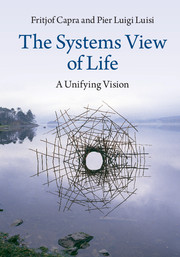
[iv] Book: The Systems View of Life - A Unifying Vision

The Systems View of Life -
A Unifying Vision


If you are about to start studying biology, Part 3 'A new conception of life'  is an excellent introduction to some broad and yet pivotal concepts. I haven't checked the 'current' curricula for biology or human biology, but I suspect there is content provided that may be missing? How are biology curricula characterised? If the 'subject' is comprehensively covered at school - college, there may still be value in the way in which they are presented in TSVoL. And, yes the book is a decade old. There's a step-wise development, that is coherent and fascinating.

The opening sentences to chapter 7, which asks 'What is Life?' :

'7.1 How to characterize the living

It is a common understanding that it is impossible to provide a scientific definition of life which is universally accepted. This stems from the fact that the background of scientists dealing with the question - biologists, chemists. computer scientists, philosophers, astro-biologists, engineers, theologians, social scientists, ecologists differs considerably from one another, depending on one's conceptual framework. In this book, we will not dwell so much on the question of a unique definition of life a single sentence catching all the various aspects of life - but rather, we will consider the more general question: what are the essential characteristics of a living system?' p.129.

- for some reason puts me in Plato's Cave? Maturana and Varela would (and do) have very broad shoulders by now. Autopoiesis is described with structure, systems (of course), self-maintenance, nonlocalization, coupling, and emergent properties. 'Life is a factory that makes itself from within'. p.132. Well that will do me. Even though we talk of political, social and psychological processes, I've always associated the SCIENCES domain of Hodges' model with processes. This includes whether the processes are biological, manufactured by human hand/intellect, such as, industrial working, project management and planning.

For life, initial descriptions concern the cell, DNA, RNA, cell walls and the cellular logic of life. Key is life's interaction with the environment. This is emphasised 7.2.4 and 7.4. I gained a lot of encouragement from:

'According to Maturana and Varela (1980, 1998), the organism interacts with the environment in a "cognitive" way whereby the organism "creates" its own environment and the environment permits the actualization of the organism.' p.134.

It is not just mind - but 'embodied mind'. The joy (for Hodges' model) continues with the impact of social autopoiesis in the social sciences.  

'While behaviour in the physical domain is governed by the "laws of nature,' behavior in the social domain is governed by rules generated in the social system itself.
Thus, two questions arise: is it meaningful to apply the concept of autopoiesis to these domains at all, and, if so, to which domain should it be applied?' pp.136-37.

It's almost like Descartes has taken on a quantum property. We don't know when life is physical (time, space, velocity) and when it is mental - cognitive? Contemplating life, death is never far behind (taxes p.419 if you're wondering). The ethics of death and dying are acknowledged in medical intervention (or not) and religious beliefs and edicts. Again the figures are helpful, illustrating the dynamic modes of an autopoietic unit: homeostasis, reproduction, and death of a cell (p.138). The trilogy of life then is also illustrated as environment, cognition, and autopoietic unit (p.142). When it comes to knowledge domains (social science & ecology) are clearly ubiquitous too.

Concepts of Modern Mathematics
Ian Stewart, 1975

It is Chapter 8 that delivers the biological goods. Beginning with a fascinating account of molecular, or prebiotic evolution, giving rise to biological structures and the interplay of soaps and lipids - "amphiphilic" substances, with molecules that contain a hydrophilic (water loving) head group, and long hydrophobic (water-hating) chains. Well illustrated too, box 8.1 describes 'Surfactants, lipids, and liposomes'. Self-organization, emergence are skillfully threaded together and with creativity - the generation of new forms. Unsurprisingly, Gaia is highlighted 8.3.3 and in a guest essay 'Daisyworld' by Stephen Harding of Schumacher College; which also reminded me of the 1970's BBC drama 'Edge of Darkness'. Maths has another turn in the text; a chiral one. Biomathematics is posited as a new mathematics frontier: here - the numerology of plant growth, the golden section (there's one primary context?), nature's spirals, and symmetry breaking. This helps my current return to maths (the struggle!) trying to get to grips with basic concepts. Ian Stewart is cited, later work than 1975's 'Concepts' I must seek out the 'Mathematics of Life' 2011/12.

Darwin, the resulting biological revolution, history, polymers, peptides and proteins plus DNA and RNA continue a suitably in-depth treatment of 'life' in chapter 9. The conclusion on Darwinism today and the status of genes in science and relation to our identity, being and the effect of chance and contingency is worth being reminded of. In mental illness - psychiatry and psychology a sometimes vitriolic debate continues.  Commercial realities are also apparent, the extent of their influence described: the race to map the human genome. In the text protein folding has advanced markedly since the book's original publication. Now new commercial pressures allied with artificial intelligence make you wonder how the author's would deal with this new 'content'? Exobiologists will enjoy chapter 10 as the focus is planetary: the origins of life on Earth. Useful, basic chemistry figures here - informational and functional (concentration). The notion of 'cognitive' is raised again - information carrying. 

While we are concerned for all life, chapter 11 takes in the human adventure, including the determinants of being human. 'Determinants' have taken on more import today. Chapter 12 in addressing 'Mind and consciousness' is helpful in the approach, the easy and hard problems of consciousness, types of consciousness, schools study. There is another guest essay. Chapters 13-15 deal with spirituality (inc. eco-literacy); life mind and society (I wonder if topology does have a role in the mental realm? (p.311). Chapter 15 is a gift for healthcare professionals - 'The systems view of health' with the question, 'What is health?'. Not to diminish this statement, but I will return to this subsequently; whether in the closing post for this 'review,' or afterwards. This completes part III of what is a great read.

Many thanks again to CUP for the paperback copy, much easier on the eyes. While this copy is new, I do make extensive use of secondhand books.

Fritjof Capra and Pier Luigi Luisi (2014) The Systems View of Life - A Unifying Vision. Cambridge: Cambridge University Press.

https://www.cambridge.org/gb/universitypress/subjects/life-sciences/genomics-bioinformatics-and-systems-biology/systems-view-life-unifying-vision?format=HB&isbn=9781107011366


Tuesday, November 03, 2009

h2cm: windows on the mind, body, society and State

h2cm is not just a window and handle on the mind and that of patients and carers.

Art for Saleh2cm can reflect (as per its original purposes):

  • health and social care policy;
  • the aspirations of local care communities and economies;
  • signs, symptoms - priorities;
  • care plans, actions and care pathways;
  • research objectives;
  • procedures;
  • ethical deliberations;
  • recovery, relapse prevention;
  • information requirements;
  • learning objectives;
  • and outcomes.
  • ...
HOW Hodges' model can achieve this...?

Now that IS the question that can really open the windows, whether you believe in four or five....


Image source: with thanks to - FineArtAmerica.com: and the artist of -
I Marry Your Mind to Lights Window, Stephen Lucas

Tuesday, January 29, 2008

Halos, clouds and living ontologies

Simon TemplarIt would be nice to be blessed with a halo, but I guess I'd rather be elliptically challenged than possessed of a slipped disc.

Halo-less, succor is found imagining the concept cloud that follows me around. Of course we all have one:

A dynamic cognitive-virtual creation that would be a wonder of the universe if it could be seen. Maybe this is why the WWW is such a marvel?

Life is a comic book really, we just don't see the thought bubbles. ...

As of Jan 2008 - this blog's side bar has a sandpit listing tools in which I would love to fully immerse myself. One of these is Protégé. Like so many pieces of this (my) care informatics jig-saw, this - the keystone? - is yet to be picked up.

It is heavy, a specialist tool; built for knowledge engineering not for care engineers.

After decades of excellent work by researchers in expert systems and decision support systems... knowledge management tools like Protégé are making knowledge engineering much more accessible. Web 2 (and Web 3...) is using the semantic web as a foundation and the term semantic web seems to capture the concept cloud (that might be) instantiated in Hodges' model.

I know the links pages may seem a links-fest or even a links-farm, but in LINKS I intra-INTERpersonal the presence of knowledge management is neither incidental or accidental. Conceptual tools and Protégé in particular might provide a means to help thread together:

  • caring and learning: the 4Ps and care participants
  • informatics
  • records
  • Hodges' model

When I set about creating the website in 1997 this is what I had in - and out of - mind. Already familiar with Buzan's mind-mapping, Hodges' model was and remains a living ontology. A tool to capture and freeze concepts and reasoning at selected critical intervals. This living dynamic vision was just what I needed, to blow the dust off Brian's model, sat there languishing on the shelf. Better a living ontology than a model sleeping in the recessed cloisters of the more mature student's memory. As far as Protégé is concerned though, I've yet to fully raise my right foot, never mind complete the first step (and listen into the literature) perhaps I may never.

Maybe for living ontologies this is where communities come in - so please look after your halo!

Image source: http://www.simon-templar.de/

Wednesday, February 15, 2023

c/o Joan Didion 1934-2021: "Let Me Tell You What I Mean"

"All I know about grammar is its infinite power. To shift the structure of a sentence alters the meaning of that sentence, as definitely and inflexibly as the position of a camera alters the meaning of the object photographed. Many people know about camera angles now, but not so many know about sentences. The arrangement of the words matters, and the arrangement you want can be found in the picture in your mind. The picture dictates the arrangement. The picture dictates whether this will be a sentence with or without clauses, a sentence that ends hard or a dyingfall sentence, long or short, active or passive. The picture tells you how to arrange the words and the arrangement of the words tells you, or tells me, what's going on in the picture. Nota bone:


It tells you.

You don't tell it."

 INDIVIDUAL
|
 INTERPERSONAL    :     SCIENCES               
HUMANISTIC --------------------------------------  MECHANISTIC   
SOCIOLOGY  :   POLITICAL 
|
GROUP


"Let me show you what I mean by pictures in the mind. I began “Play It as It Lays” just as I have begun each of my novels, with no notion of “character” or “plot” or even “incident.” I had only two pictures in my mind, more about which later, and a technical intention, which was to write a novel so elliptical and fast that it would be over before you noticed it, a novel so fast that it would scarcely exist on the page at all. About the pictures: the first was of white space. Empty space."...


My source: BBC Radio 4


Episode 4

Book cover: goodreads.com

Text source:
New York Times archive -
Why I Write,
https://www.nytimes.com/1976/12/05/archives/why-i-write-why-i-write.html

Previously on W2tQ: Book: "The Empty Space"

Sunday, December 14, 2025

ii Big Mind: How Collective Intelligence Can Change Our World

'Everything we know is knowledge from the past, which may not apply in the future - the problem repeatedly stumbled on by models, algorithms, economic theories, and geopolitical dispositions, which made sense in one era, but then become dysfunctional in another. As social science has repeatedly discovered, the more you use a model, the less likely you are to question it. What starts as a pragmatic tool to answer a question becomes a truth in itself.

And so the models we use to think can also become traps. A model is held on to because it provides meaning and reassurance. Police forces notoriously cling to evidence they collect early in a case in the face of powerful contrary evidence that emerges later, and thus extraordinary miscarriages of justice result. The middle-aged cling to the theories they learned as undergraduates. Organizations become attached to models that become comfortable through use. I remember once meeting the planning team of a government that admitted that their forecasts had been no better than random guesses, but argued that the detailed forecasts were still needed to help with planning. The model became a comfort, even though it had no real use. 

Familiarity also breeds blindness. ...

Expertise can equally entrap. ...
 
The implication, as the Buddha pointed out, is that intelligence has to be at war with and suspicious of itself to be truly intelligent.' pp.120-121.

FIVE FUNDAMENTAL PRINCIPLES FOR EFFECTIVE COLLECTIVE INTELLIGENCE

'The first is the extent of what I call (1) autonomous commons of the intelligence in the system. By this I mean how much the elements of intelligence are allowed free rein, and not subordinated too easily to ego, hierachy, assumption, or ownership.' p.66. Chap. 5. Organizing Principles.
2. Balanced use of the capabilities of intelligence
3. Focus and the right granularity
4. Reflexivity and learning
5. Integration for action
 
'So a group is a we, but it is not just a scaling up of an I. How, then, should we think about the character of this we?' p.102. Chap. 9. The Collective.
 
Individual
|
      INTERPERSONAL    :     SCIENCES               
HUMANISTIC  --------------------------------------  MECHANISTIC      
 SOCIOLOGY  :    POLITICAL 
|
Group
 
EGO
 

 HIERARCHY


ASSUMPTION
 

OWNERSHIP


n.b. With my emphasis.

 
Geoff Mulgan (2017) Big Mind: How Collective Intelligence Can Change Our World, Princeton University Press.

Image: Princeton University Press.

See also: 'AI' : 'group' : 'axes' : 'individual'

 Previously:
Big Mind: How Collective Intelligence Can Change Our World


Friday, June 25, 2021

Book: Mind, State and Society

Social History of Psychiatry and Mental Health in Britain 1960–2010

open access
 
individual
|
INTERPERSONAL : SCIENCES
humanistic ----------------------------------------------- mechanistic
SOCIOLOGY : POLITICAL
|
group
MIND

SOCIETY


STATE


Thanks to George Ikkos:

https://twitter.com/gikkos1/status/1406329440540499972?s=20