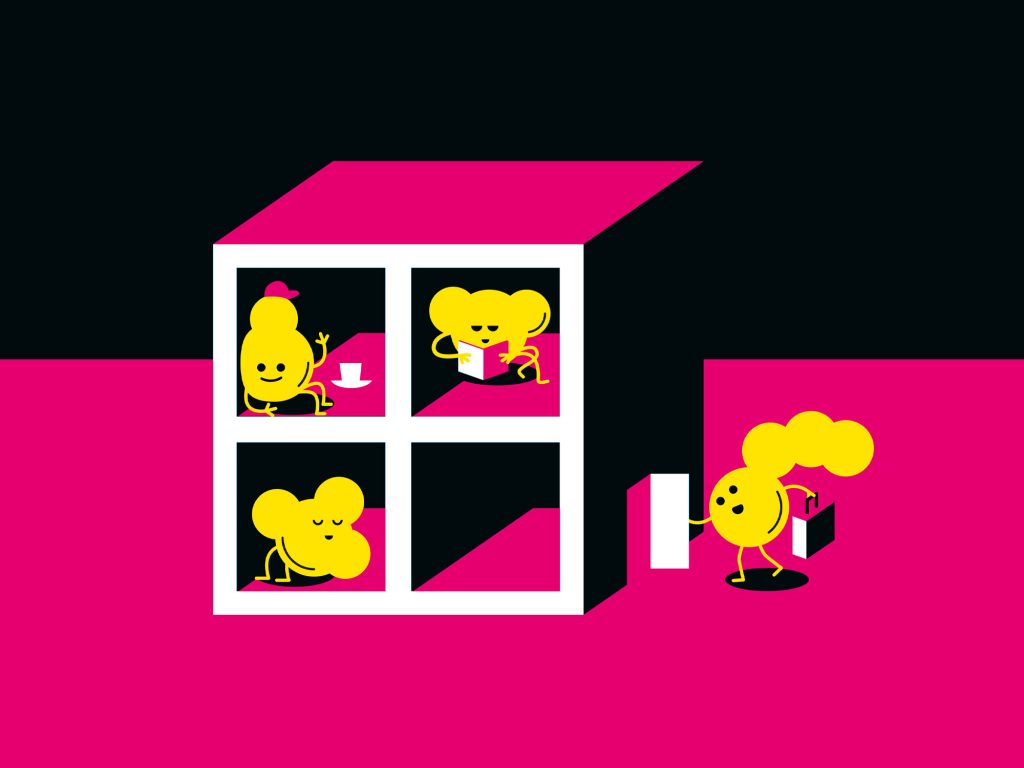
Bio-Psycho-Social model: The L-shaped room
changes in reporting incidents, data returns,
psycho | bio |
| social | ? |
Hodges' model is a conceptual framework to support reflection and critical thinking. Situated, the model can help integrate all disciplines (academic and professional). Amid news items, are posts that illustrate the scope and application of the model. A bibliography and A4 template are provided in the sidebar. Welcome to the QUAD ...
psycho | bio |
| social | ? |
Posted by
Peter Jones
at
7:40 pm
| PERMALINK
Labels: biopsychosocial , care , care architecture , domains , frameworks , health , Hodges' model , integrated care , international , L-shaped model , local , models , national , nursing , nursing theory , policy , political , politics , power , theory
'Surgery theory investigates the homotopy types of manifolds, using a combination of algebra and topology. It is the aim of these notes to provide an introduction to the more algebraic aspects of the theory, without losing sight of the geometric motivation.' Ranicki, 2001.
'IV. Surgery and the Fundamental Theorem
In this chapter we develop the techniques of surgery for constructing normal cobordisms and use them to prove the Fundamental Theorem. The ideas of surgery have their origins in the theory of 2-manifolds, in the process of "cutting off handles", and in general, in the theory of Marston Morse of non-degenerate critical points of differentiable functions.' Browder, 1972.
| |||
Try to - follow the language* ... |
"Follow the money!" |
Posted by
Peter Jones
at
3:10 pm
| PERMALINK
Labels: associations , boundaries , concepts , diffeomorphism , form , geometry , health , languages , logic , manifolds , mathematics , mechanistic , morphism , space , surfaces , surgery , theory , thought , topology
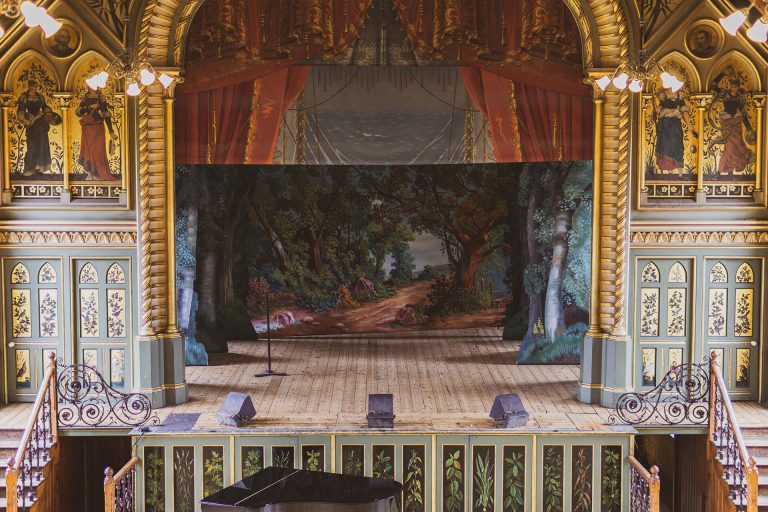
Normansfield Theatre in Teddington
'My favourite building is the amazing Normansfield Theatre in Teddington that John Langdon Down (1828-1896) built to provide positive and stimulating education for learning disabled people (Down syndrome is named after him). At a time when most disabled people would have been shut away in horrific asylums, Down adapted his own house as a residential home, and built a beautiful theatre for creative rehabilitation. It's one of the few surviving private theatres from the period, with original painted scenery and other ornate fixtures, recently remodelled. For me, it's also a reminder of how the wealthy often used their money for good causes, which feels less common now. Jos Boys, guest curator and co-director of The DisOrdinary Architecture Project'
My source: The pick of London Open House. House&Home, FTWeekend. 6/7 September 2025. p.8.
Image: Langdon Down Centre
Previously: 'learning disability' : 'theatre' : 'architecture'
Posted by
Peter Jones
at
9:21 pm
| PERMALINK
Labels: activity , architecture , arts , buildings , communications , engagement , environment , equality , equity , FT , history , inclusion , learning disability , person-centred , relationships , self expression , skills , space , theatre
'The Indo-Caribbean community has played a key part in the life of the United Kingdom, but this has not often been recognised. Little is known about this populations’ physical and mental health needs and its experience of health and social services in the UK.
"The absence of a unique category designating ‘Indo-Caribbean’ as a unique category in the UK Census was identified as a major barrier to obtaining vital epidemiological data on the UK’s Indo-Caribbean population."
Posted by
Peter Jones
at
6:20 pm
| PERMALINK
Labels: absence , categories , census , community , data , ethnicity , experience , health , indo-caribbean , knowledge , mental health , physical health , policy , political , population , race , report , social care , statistics , UK
Ack: © Johan Jarnestad /
The Royal Swedish Academy of Sciences
'This morning’s Nobel Prize in Chemistry is one that’s been anticipated for several years now: it goes to Susumu Kitagawa of Kyoto, Richard Robson of Melbourne, and Omar Yaghi of Berkeley for metal-organic frameworks.'
'So what’s a MOF? This goes back to the idea of “coordination chemistry”, a huge topic in the inorganic and metal-organic fields.'
'One astonishing characteristic is the amount of surface area locked away in these new materials: a MOF weighing one gramme can have an internal surface area the size of a football pitch^. MOFs are often likened to Hermione Granger's bottomless handbag in the Harry Potter books: a tiny exterior concealing a seemingly infinite interior. Rice University chemist Stavroula Alina Kampouri has called MOFs "magical sponges", describing them as "not just elegant crystals you'd admire under a microscope; they're an entire universe of structures, each like a miniature city of tunnels and rooms waiting to be filled."'
'This is not an ivory-tower sort of topic, though: the importance of these sorts of complexes cannot be overstated. They were the basis for the first Nobel awarded in inorganic chemistry (1913, Alfred Werner) and metal coordination is how the iron atoms in hemoglobin carry oxygen to the cells of your body to keep you alive, for starters. You can say the same thing about photosynthesis in plants, and about the actions of the many crucial enzymes in every living creature on the planet that have metal-ion centers in them. Outside of biology and biochemistry, the structures of minerals similarly cannot be understood without a knowledge of coordination chemistry.' | |||
Posted by
Peter Jones
at
9:32 am
| PERMALINK
Labels: 3D , coordination , crystals , frameworks , inorganic , interior , materials , micro , nano , Nobel prize , organic , planet , research , scale , sciences , space , sponge , surface , volume
'The science of politics is the oldest of the social sciences but still perhaps the most dependent: it derives much of its methodology from statistics (the science of the state turned into the science of numerical data), from economics and from sociology and it steals much of its substance from anthropology, from history and from law. Yet there is little doubt about the core of the subject: it focuses on the ways in which decisions are taken by men acting within territorially or functionally defined networks and constellations of organizations. And the hallmark of the discipline is 'its systematic analysis', whether couched in verbal and literary terms or in the formalized language of statistics or of mathematical logic.' Preface viiHayward R. Alker, Karl W. Deutsch, Antoine H. Stoetzel (eds.), Mathematical Approaches to Politics, Amsterdam, Elsevier, 1973, pp. 475.
Posted by
Peter Jones
at
10:32 pm
| PERMALINK
Labels: analysis , book , data , decisions , history , logic , math , mathematics , methodology , models , networks , organisations , policy , political , politics , quantitative , social sciences , sociology , statistics , territory
Within philosophy it is recognised that Immanuel Kant provided a means by which the rationalists and empricists can be reconciled. Some background:
In philosophy, rationalism is the epistemological view that "regards reason as the chief source and test of knowledge"[1] or "the position that reason has precedence over other ways of acquiring knowledge",[2] often in contrast to other possible sources of knowledge such as faith, tradition, or sensory experience. More formally, rationalism is defined as a methodology or a theory "in which the criterion of truth is not sensory but intellectual and deductive".[3] https://en.wikipedia.org/wiki/Rationalism
In philosophy, empiricism is an epistemological view which holds that true knowledge or justification comes only or primarily from sensory experience and empirical evidence.[1] It is one of several competing views within epistemology, along with rationalism and skepticism. Empiricists argue that empiricism is a more reliable method of finding the truth than purely using logical reasoning, because humans have cognitive biases and limitations which lead to errors of judgement.[2] Empiricism emphasizes the central role of empirical evidence in the formation of ideas, rather than innate ideas or traditions.[3] Empiricists may argue that traditions (or customs) arise due to relations of previous sensory experiences.[4]
Historically, empiricism was associated with the "blank slate" concept (tabula rasa), according to which the human mind is "blank" at birth and develops its thoughts only through later experience.[5] https://en.wikipedia.org/wiki/Empiricism
If health and social care, must be evidence-based, then as far as Hodges' model is concerned we are then duty-bound to use the most readily available 'evidence' to us, including (while taking liberties?):
![]() |
| Hodges' model: Structure and Content |
Using this evidence, we still see the Cartesian divide, the mind-body distinction writ large in health and social care. The continuing impact is evident in theory, practice, (hence) lived experience, policy and managment. Since its creation in the 1980s, Hodges' model mirrors (literally) this philosophical, epistemological and ontological legacy, thereby acknowledging the ancient history of medicine, and 'modern' development of healthcare and nursing. Through this device, Hodges' model can facilitate debate, critique, reflection, and critical thinking; to encourage progress in our thought, motivations, action and subsequent evaluation.
This explains the structure of Hodges' model and predicts the range (contextual signature) of content when the model is applied.
Evidence permitting of course!
See also: BBC The Great Philosophers:
Series 1: 4. Descartes
Series 1: 5. Spinoza and Leibniz
n.b. I video taped this marvellous series when first screened. When studying for my BA(Hons), audio taped, they also provided a great learning resource in the car. The programmes are on BBC 4 (UK) once again, but are readily accessible.
Posted by
Peter Jones
at
5:37 pm
| PERMALINK
Labels: body , Descartes , divide , empirical , energy , evidence , experience , explanation , extension , Hodges' model , interaction , Kant , matter , mental , mind , philosophy , rationalism , reality , Spinoza , spirit
Dear all,
Posted by
Peter Jones
at
3:11 pm
| PERMALINK
Labels: arts , body , call , cognition , criteria , ethics , exercise , health , invitation , martial arts , mind , mindfulness , online , participation , practice , programme , psychology , research , stress , study
'The challenge of overheating in Britain is our buildings are built to retain heat in our temperate climate. Energy efficiency regulations for new dwellings now require high insulation and few drafts to reduce the need for heating in winter, but broadly make it harder to cool homes in summer. Residents of cities are particularly vulnerable to overheating due to urban heat island effects.
There are two ways buildings can be cooled – mechanical methods (primarily air conditioning) and passive cooling methods that use the design of the building to limit heat gain and retain cooler air inside the dwelling.
Passive cooling is much easier in dual-aspect dwellings with windows on multiple external facades, which as shown in Figure 1, are contrasted to single-aspect flats that face out on to only one external facade. Dual aspect allows breezes to blow through dwellings and easily exchange stuffy indoors air for cooler air from the outdoors. Even if outside temperatures are high, cross-ventilation or overnight air exchange and limits to solar gain (daylight indoors) can keep indoor environments cooler than the outdoors.'
https://www.centreforcities.org/reader/breaking-the-bottlenecks/overheating-and-dual-aspect/
That's why we say the model is situated.
Posted by
Peter Jones
at
7:38 pm
| PERMALINK
Labels: air , air pollution , architecture , climate change , corners , cost , design , dualistic , field of view , health , heat , housing , planning , public health , regulation , safety , standards , temperature , windows
'This year’s prize relates to the explanations for sustained growth based on technological innovation. Economic historian Joel Mokyr is rewarded with one half of the prize for his description of the mechanisms that enable scientific breakthroughs and practical applications to enhance each other and create a self-generating process, leading to sustained economic growth. Because this is a process that challenges prevailing interests, he also demonstrates the importance of a society that is open to new ideas and permits change.' 'The other half of the prize is awarded to the economists Philippe Aghion and Peter Howitt. In a joint publication from 1992, they constructed a mathematical model of how companies invest in improved production processes and new, better-quality products, while the companies that previously had the best products are outcompeted. Growth arises through creative destruction. This process is creative because it builds upon innovation, but it is also destructive because older products become obsolete and lose their commercial value.' | |
| |
'It is apparent that, in the long run, sustained growth does not only have positive consequences for human wellbeing. First, sustained growth is not synonymous with sustainable growth. Innovations can have significant negative side effects. Mokyr argues that such negative effects sometimes initiate processes that uncover solutions to problems, making technological development a self-correcting process. Clearly, however, this often requires well-designed policies, such as in the areas of climate change, pollution, antibiotic resistance, increasing inequality and the unsustainable use of natural resources.' |
Posted by
Peter Jones
at
6:31 pm
| PERMALINK
Labels: AMR , benefits , climate change , commerce , creativity , destruction , economics , growth , history , innovation , math , mechanisms , models , nature , Nobel prize , obsolescence , pollution , sciences , sustainability , value
Steven Pinker's latest book When Everyone Knows That Everyone Knows...:
is subtitled: Common Knowledge and the Mysteries of Money, Power, and Everyday Life.
It is 'common knowledge' that caught my attention. In health care we seek common knowledge on several levels:
person (patient, client) 🠜🠞 healthcare practitioner (whatever their training)
carer - guardian 🠜🠞 healthcare practitioner
person / carer 🠜🠞 team
If we think about the referral processes, interfaces, gateways that people have to negotiate on their way to the above, you see how hard-won common knowledge is.
Critically, the knowledge may be 'common' but how accurate is it?
For the team common knowledge is essential to ensure safety, understanding and continually assessing risk.
In healthcare (and education) for person-centredness we take note of what data is available, but simultaneously begin with a blank sheet. ...
| 'Sometimes, though, private knowledge can no longer be contained even if it is desirable; sometimes something is so evident that it does not even need words to express it. The presidential debate brings to mind a joke Pinker tells about a man in the Soviet Union arrested by the KGB for handing out leaflets, which turn out to be blank sheets of paper. "What is the meaning of this?" they demand. The man replies, "What is there to write? It's so obvious!"' Kelly, p.9. |
Posted by
Peter Jones
at
6:34 pm
| PERMALINK
Labels: belief , blank , book , common , communication , conspiracy theories , control , data , dystopia , group , human nature , I , information , intution , knowledge , leadership , politics , power , private , relationships
Posted by
Peter Jones
at
5:34 pm
| PERMALINK
Labels: art , artist , collective , elevation , empty , expectations , figures , leaders , leadership , many , meaning , occupation , political , politics , power , sculpture , self , space , status , structure
Just imagine ... no, not like that - really imagine!
You are in a situation. Unsurprisingly, let's say it's in health, or social care. We find ourselves in a care or nursing home, on a ward, or in the individual's home, even if the patient does not currently recognise it as such.
The patient is mobile. That is, and isn't a problem.
Physically, apart from thoughts about a chest, or urine infection, yes they are mobile, but they're also confused - disoriented.
We are concerned about their safety.
Noisy, increasingly agitated, they are making it clear they want to leave.
Their carer, family, or staff are trying to limit the patient / resident's access to the exits, be that the front, or back door, the spare room, their room, or main entrance. They are not in agreement about where they need to be. Persuasion and distraction aren't working either. They appear to lack the level of mental capacity required to decide for themselves what needs to happen.
It is one thing to have this assessment of the situation running through one's mind; but quite another to 'pick up' a care concept mentally and carry it over the care (knowledge) domains of Hodges' model.
![]() |
| Hodges' Health Career - Care Domains - Model |
Posted by
Peter Jones
at
5:48 pm
| PERMALINK
Labels: assessment , balance , careload , caseload , concepts , critical thinking , critique , emotional labour , envision , ethics , evaluation , Hodges' model , imagination , judgement , location , payload , reflect , situated , supervision , weigh
Dear Colleagues
Please help connect people in your network with this ERC-funded postdoc opportunity in our department.
"The project will combine computational modelling and group-based experiments to scale individual models of epistemic vulnerability (i.e., belief in misinformation/conspiracy theories) to a social level."
Many thanks,
Mike
________________________________
The ERC-funded IDENTITY ERROR project is hiring 2 Postdoctoral Researchers (hosted in the Psychology Department in UL). The project will combine computational modelling and group-based experiments to scale individual models of epistemic vulnerability (i.e., belief in misinformation/conspiracy theories) to a social level. There is a computational post that will require some knowledge of network analysis and/or agent-based modelling, and a social psychology post that will require experience conducting behavioral experiments. We are a supportive group of interdisciplinary researchers, and we do not expect either postdoc to have full knowledge of these methods. We only expect a willingness to learn and a curious attitude. Further details on each post can be found at the links below. The closing dates for applications are October 28th (computational postdoc) and November 3rd (psychology postdoc).
Posted by
Peter Jones
at
4:01 pm
| PERMALINK
Labels: behavioural , beliefs , curiosity , epistemic vulnerability , experiment , funding , group , identity , interdisciplinary , Ireland , learning , methods , misinformation , modelling , network analysis , postdoc , research , social psychology
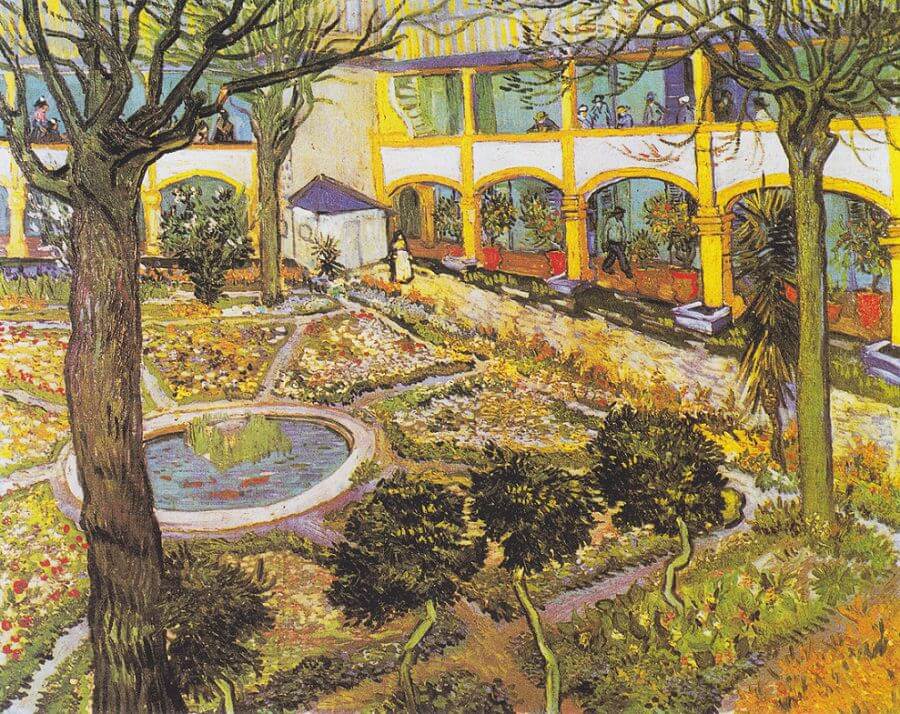
Posted by
Peter Jones
at
2:53 pm
| PERMALINK
Labels: art , asylum , colour , creativity , green , history , hospital , mental illness , mood , nature , outdoors , painting , perception , reablement , recovery , rehabilitation , seasons , suffering , time , trees
Conceptual engineering has emerged in recent times as a significant topic in current philosophical literature. The now vast list of references includes works on more general or conceptual issues, such as describing the nature of conceptual engineering, how we may respond to the different objections to it, how it is related to philosophical analysis or empirical philosophy, or toward which target conceptual engineering should be directed, among others. But research on the topic also includes applications of conceptual engineering to many different areas. This Introduction opens with a short overview of the state of the art on conceptual engineering, aiming to clarify the most important features associated with it. The Introduction moves on to introduce and discuss the eight articles collected here, whose topics range from the nature and the functionality of conceptual engineering to reconstructing the entire conceptual engineering practice. Taken as a whole, this special issue is meant to provide enlightening, informative, and thought-provoking views on the topic, its functions, targets, and challenges.
Posted by
Peter Jones
at
6:27 pm
| PERMALINK
Labels: challenges , cognition , concepts , conceptual engineering , debate , design , functionality , language , meaning , metaphysics , methodology , papers , philosophy , political , practice , proof , research , social , theory , value
Dear ERCIM News reader,
My source with thanks: Peter Kunz ERCIM https://www.ercim.eu https://ercim-news.ercim.eu Join the ERCIM LinkedIn Group: https://www.linkedin.com/groups/81390/ Follow us on X: https://x.com/ercim_news
Posted by
Peter Jones
at
6:52 pm
| PERMALINK
Labels: accessibility , age estimation , AI , children , digital futures , disability , ethics , Europe , health , inclusion , intersectionality , law , online , pollution , research , safety , security , situated , sustainability
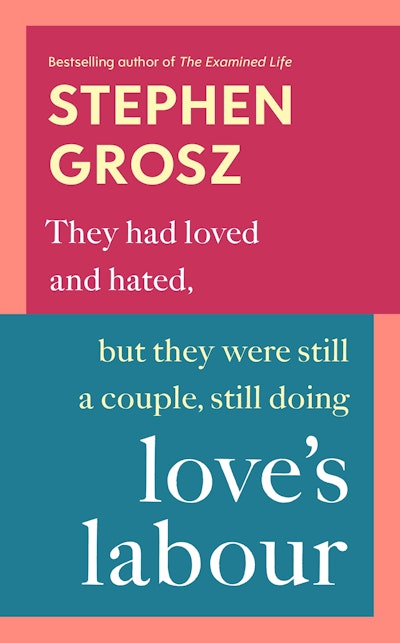
Luminous and necessary stories from the psychoanalyst's consulting room; on desire, heartbreak and learning how to love.
When it comes to love why do we find things so difficult? Drawing on over forty years of candid and surprising conversations with his patients, Stephen Grosz asks, what gets in the way of our falling in love? And what must we do to stay there? Penguin UK.
'Ravi, a maths lecturer, is tormented by his wife Sonal's supposed infidelity, but won't look at the CCTV - even though that might reveal her to be innocent. This chapter has a sting in its tail when 19 years later Grosz is contacted by Sonal. She is dying of cancer and Ravi is cruelly neglecting her. Grosz feels that he missed a vital clue all those years ago, concerning Ravi's ingratitude and envy.
This moment of "failure" on Grosz's part forms an aspect of this small book's power. It shows that the psychoanalyst is not a machine, and the process is fallible. But it is also a testament to human complexity. When he hasn't understood the patient sufficiently, Grosz brings the case to his supervisor, and we, the reader, are witness to their exchange.' Life&Arts, FTWeekend.
Posted by
Peter Jones
at
9:59 am
| PERMALINK
Labels: book , change , counselling , future , hate , humanity , listening , love , mental health , mental illness , past , present , psychiatry , psychoanalysis , psychotherapy , relational , self , talking , therapy , time
Abstract
Infectious diseases have had devastating effects on human populations throughout history, but important questions about their origins and past dynamics remain1. To create an archaeogenetic-based spatiotemporal map of human pathogens, we screened shotgun-sequencing data from 1,313 ancient humans covering 37,000 years of Eurasian history. We demonstrate the widespread presence of ancient bacterial, viral and parasite DNA, identifying 5,486 individual hits against 492 species from 136 genera. Among those hits, 3,384 involve known human pathogens2, many of which had not previously been identified in ancient human remains. Grouping the ancient microbial species according to their likely reservoir and type of transmission, we find that most groups are identified throughout the entire sampling period. Zoonotic pathogens are only detected from around 6,500 years ago, peaking roughly 5,000 years ago, coinciding with the widespread domestication of livestock3. Our findings provide direct evidence that this lifestyle change resulted in an increased infectious disease burden. They also indicate that the spread of these pathogens increased substantially during subsequent millennia, coinciding with the pastoralist migrations from the Eurasian Steppe4,5.
Sikora, M., Canteri, E., Fernandez-Guerra, A. et al. The spatiotemporal distribution of human pathogens in ancient Eurasia. Nature 643, 1011–1019 (2025). https://doi.org/10.1038/s41586-025-09192-8
Posted by
Peter Jones
at
1:16 pm
| PERMALINK
Labels: agriculture , ancient history , animals , anthropology , bacteria , disease , DNA , eurasia , farming , humans , maps , migration , nomads , open access , pandemics , paper , plague , spatiotemporal , virus , zoonosis
The 2025 peace laureate
'The Norwegian Nobel Committee has decided to award the Nobel Peace Prize for 2025 to Maria Corina Machado “for her tireless work promoting democratic rights for the people of Venezuela and for her struggle to achieve a just and peaceful transition from dictatorship to democracy.”
In the past year, Ms Machado has been forced to live in hiding. Despite serious threats against her life she has remained in the country, a choice that has inspired millions of people. She has brought her country’s opposition together. She has never wavered in resisting the militarisation of Venezuelan society. She has been steadfast in her support for a peaceful transition to democracy.'
Posted by
Peter Jones
at
6:08 pm
| PERMALINK
Labels: activism , citizens , courage , democracy , girls , government , human rights , justice , Nobel prize , peace , politics , prize , role models , South , South America , transition , Venezuela , voting , women
![]() |
| 28th May 1997 |
Posted by
Peter Jones
at
6:33 pm
| PERMALINK
Labels: Brian E Hodges , creativity , critical thinking , diagrams , history , Hodges' model , holistic , ideas , integrated care , MMU , models , models of care , nurse education , nurses , nursing , nursing theory , person-centred care , reflection , vision
Dear all,
11th Living Knowledge Conference
Attached please find a communication kit that can help to amplify this Call For Proposals. Please share with your networks, community partners, students and faculty.
With thanks,
The Living Knowledge Conference team
Posted by
Peter Jones
at
9:12 am
| PERMALINK
Labels: call , citizen science , community of practice , conference , epistemology , ethics , global South , movement , network , planetary , policy , public engagement , region , research , science , science shops , solidarity
Dear CHAIN member,
We would like to draw your attention to the following funding opportunity offered by NIHR. Please pass on the information as appropriate. Thank you.
‘Short Placement Award for Research Collaboration (SPARC) (Cohort 12)
This award offers a unique opportunity to design and undertake a short, bespoke placement within a part of the NIHR. Tailored to your individual research training needs and background, the award aims to enhance your research career, skills, and professional network.
What are the priority themes for an NIHR SPARC?
If you wish to publicise information on the CHAIN Network please email your request to: enquiries AT chain-network.org.uk
CHAIN - Contact, Help, Advice and Information Network – is an online international network for people working in health and social care. For more information on CHAIN and joining the network please visit website: www.chain-network.org.uk
Follow CHAIN on X: @CHAIN_Network ; Connect with CHAIN on LinkedIn
See also: 'long term' : 'academia' : 'interfaces' : 'industry' : 'social care'
Posted by
Peter Jones
at
9:05 am
| PERMALINK
Labels: academia , collaboration , entrepreneur , food , funding , industry , innovation , interfaces , life sciences , long-term medical conditions , placement , public health , research , social care , tech , work
Born in Liverpool, UK.
Community Mental Health Nurse NHS, Part-time Lecturer,
Researcher Nursing & Technology Enhanced Learning
Registered Nurse - Mental Health & General
Community Psychiatric Nursing (Cert.) MMU
PG Cert. Ed.
BA(Joint Hons.) Computing and Philosophy - BIHE - Bolton
PG(Dip.) Collaboration on Psychosocial Education [COPE] Univ. Man.
MRES. e-Research and Technology Enhanced Learning, Lancaster Univ.
Live and work in NW England - seeking a global perspective.
The views expressed on W2tQ are entirely my own, unless stated otherwise.
Comments are disabled.
If you would like to get in touch please e-mail me at h2cmng AT yahoo.co.uk
orcid.org/0000-0002-0192-8965