Hodges' Model: Welcome to the QUAD: Search results for maps

Hodges' model is a conceptual framework to support reflection and critical thinking. Situated, the model can help integrate all disciplines (academic and professional). Amid news items, are posts that illustrate the scope and application of the model. A bibliography and A4 template are provided in the sidebar. Welcome to the QUAD ...

Showing posts sorted by date for query maps. Sort by relevance Show all posts

Saturday, May 09, 2026

v WCCS26: World Conference on Complex Systems 20-22nd April

Day 2 Tuesday 21st April (Revisiting) Keynote Speaker: Abderrazak El Albani - 
Emergence of Intercellular Cooperation: At the Origins of Eukaryotic Complexity
Session Chair: Khawla Tadist

This keynote was fasacinating. As I begin this post on the 100th birthday of Sir David Attenborough, who would have us all see life in the broadest terms, value life and diverse habits, and Earth as our collective and shared home.

Abderrazak El Albani explained the search for LUCA the last universal common ancestor - 3.8 billion years ago. Many dates in the emergence story of humanity, have been progressively pushed back. The first fire, art, languages, our co-habitation and intimate relationships with Neanderthals.

In healthcare, as a practitioner you have to be aware of your scope of practice. At WCCS, scale (as in iv) was ever present across research in complexity, and complex systems. Not just physical size nano-to-mega but temporal too, as we journeyed billions of years. Several of the slides are presented here:

https://www.synchrotron-soleil.fr/en/news/discovery-oldest-macroscopic-planktonic-eukaryotes-contribution-nanoscopium-beamline (with a reference).

There is a video (French): https://www.youtube.com/watch?v=bh3t26cU7xc

I asked a question, which may have been psychological preparation for own presentation to follow. Listening, I could see how the work Abderrazak El Albani and his team are doing, could be readily translated to the search for life on Mars. There has been a 'routine' interchange of planetary material between Earth and Mars over the aeons. Fitting surely that the sedimentary rocks sought lie in  A key lesson, is that light helps us see, but not all lights are equal. Light sources brighter than the sun become incredible scientific instruments. The longevity of the dinosaurs was highlighted, at least 140 million years. There is no comparison with homo sapiens then, even as those dates have been pushed further back in time. Time defeated me as I tried to make the observation that even the dinosaurs did not make it to their first galactic birthday (c.250 million years - and what a carousel). I like the thought (slide) of 'Earth as Memory'. 

What really counted was the expressed concern about what is happening now: in the Anthropocene.

The second keynote:
Nigel Gilbert - Policy in a Complex World: Towards Complexity-Aware Policymaking
Session Chair: Ali Idri 

Was helpful to me, as the dated conundrum of benefits realisation from our technologies, and evidence-based policy still leaves a gap (for me) within the POLITICAL care/knowledge domain of Hodges' model. The illustration/graphic elements of Prof. Gilbert's slides were a brilliant complement to the content:

Prof. Nigel Gilbert - WCCS26 21st April

I wonder if within policy the constant in the equation is continuity and as a quantity it is an unknown? This seems to the case in health policy, across successive governments. You may (also) find this chart informative: https://www.cecan.ac.uk/news/the-visual-representation-of-complexity/

Perhaps, a key factor in complexity is the fact that nothing stays the same, so continuity is nuanced? Michael Quinn Patton's book Developmental Evaluation was noted re. learning while doing. Now I wish I'd held on to Qualitative Research & Evaluation Methods (4th ed.). The discussion of 'obesity system map' and 'whole systems analysis' was appreciated here.*

Since Marrakech and WCCS, I've noticed acknowledgement in the literature that 'research' is currently flooded with AI tools. I'm sure PRSM Participatory System Mapper is a welcome addition, (as noted in iv) tools to facilitate participation are much needed:

Collaborative Creativity

The Participatory System Mapper (PRSM) is an app that makes it easy to draw networks (or 'maps') of systems, working together collaboratively.'

I will definitely check this resource out; and CECAN. After Prof. Gilbert, the next Track included my contribution, which I will return to. Rather distracted, I have a somewhat blurred slide, with: 'The global tensor of educational research is' then headed 'Learning poverty. Being unable to read and understsand a simple text; with points 1-4.'. I'm not sure which presentation this was, but zeroed in on the literacy theme, and the word tensor. Another slide refers to '6. Topological substitution for Success'. I think it is (writing this is helping recall!):

Harvey Spencer Sánchez-Restrepo, Jorge Louçã, Martha Belén Carmona-Soto and Sofialeticia Morales-Garza
Topological Patterns of Academic Success: Insights from Complex Network Analysis

'Always Label Your Axes' - Zazzle.

Before that there was another model, as the next keynote speaker: Chris Bauch demonstrated during the conference wearing a t-shirt:

Critical Transitions in Coupled Human-and-Natural Systems and their Early Warning Signals
Session Chair: Mohamed Essaaidi  

Previously: 'nexus'


*Jones P, Wirnitzer K. Hodges’ model: the Sustainable Development Goals and public health – universal health coverage demands a universal framework. BMJ Nutrition, Prevention & Health 2022;5: doi:10.1136/bmjnph-2021-000254

Wirnitzer, KC. et al. (2025) Toward a roadmap for addressing today's health dilemma – The 101-statement consensus report. Frontiers in Nutrition. Volume 12.
https://frontiersin.org/journals/nutrition/articles/10.3389/fnut.2025.1676080 DOI:10.3389/fnut.2025.1676080

S. Bettiol, P. Jones, H. A. Onyedikachi, and W. G. Kernohan, (2026) Bridging Gaps in Oral Health Frameworks: Mapping With Hodges' Health Career - Care Domains - Model, Journal of Public Health Dentistry. 1–14, https://doi.org/10.1111/jphd.70034
Wednesday, January 28, 2026

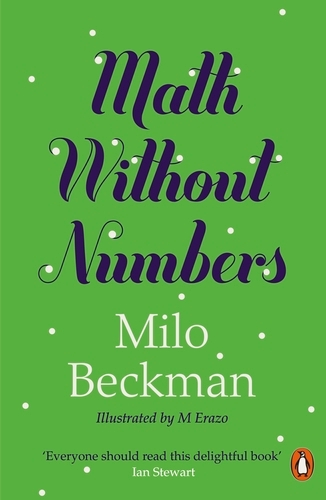
ii Math Without Numbers - final notes & obs

In Math Without Numbers the chapters and topics flow and slot in really well, even for novices. There is no index, the inclusion of which is a first-check usually. The book's appeal was its non-technical title and invitation reading the sleeve notes. The title throws up words and visuals, the latter, to repeat, are ably and simply furnished by M Erazo. Remaining notes to highlight (record here) include (and capture overthinking!):

Math Without Numbers

Reference to 'ideology space', 'conceptual space' and the role of visual analogies, idioms, and how 'the list of spaces to choose from is always the same.' ... pp.28 & 29. On page 30, 'When you say that gender is a spectrum rather than a binary, that's a topological claim: You're  saying gender space is one-dimensional (a line) rather than zero-dimensional (two separate points). 'Questions about which conceptual paradigm to use sometimes boil down to questions of dimensionality.' Discussion of an infinite continuum had me making an axis of Hodges' model warp, this way and that: concave-convex (p.59). Maps and correspondence is already well established, as per a new paper (abstract and thanks to follow 1st Feb):

S. Bettiol, P. Jones, H. A. Onyedikachi, and W. G. Kernohan, “Bridging Gaps in Oral Health Frameworks: Mapping With Hodges' Health Career - Care Domains - Model”, Journal of Public Health Dentistry (2026): 114, https://doi.org/10.1111/jphd.70034 

Interesting to read of general map facts, flowing substances inside a rigid container, and vector maps. A pencilled note to share:

'Because when you look at things in the abstract like this, dusting off the specifics of a situation to focus on underlying dynamics, you start to realize there are only so many different patterns and structures out there. These patterns and structures are called mathematical objects, and thinking about them is called math.' p.79

The chapter on (generalised) Algebra, forced me to reconsider the Socratic, guided discovery and arrival at the structure of Hodges' model. (lines & points : nodes & edges). For page 88, I noted 'generic' invites abstraction. Isomorphism is discussed. Again I tested this against Hodges' model. I've always found it helps to immerse oneself in a new vocabulary: so welcome (anew) - structures, fields, rings, groups, loops, graphs, lattices, orderings, semigroups, groupoids, monoids, magmas, modules . . . algebras, p.101. Some are named only, but on graphs raises questions ... p.103.

'How densely interconnected is it? How segregated into different cliques? Does it cut clean into two subgraphs, with no connections between them? Can it be drawn without any lines crossing? Are there any lone dots without any connections?' 

There's the matter of 'friend of a friend' who have broken out of the sociological domain. Other notes to self: Significance of concepts - patient-centred, service-centred? The distance between between (vertical, horizontal, diametric)? There are weighted graphs (p. 104) and acknowledgement of category theory (p.115). A chapter on modelling pp.161-175, and models p.164 & p.169 are just a selection of highlights on a marvellous tour.

A hidden puzzle in the book remains a mystery for me.

Milo Beckman (2021) Math Without Numbers. London, Penguin Books. Illustrated by M. Erazo.

Previously: 'math' : 'diagrams
Plus, now archived Science domain links: 
https://web.archive.org/web/20150414125339/http://www.p-jones.demon.co.uk/linksTwo.htm

Believe it or not, this 'diversion' does help my reading of Order and the Virtual

Thursday, December 11, 2025

Bourdieu: systems, axes, maps, practical logics

I have checked these quotes and am fairly sure they are accurate. The first, I feel, improves with re-reading, and presents a clearing at the end? 

The clearing could be a template, and as per the second it may be old; but retains its practical function.

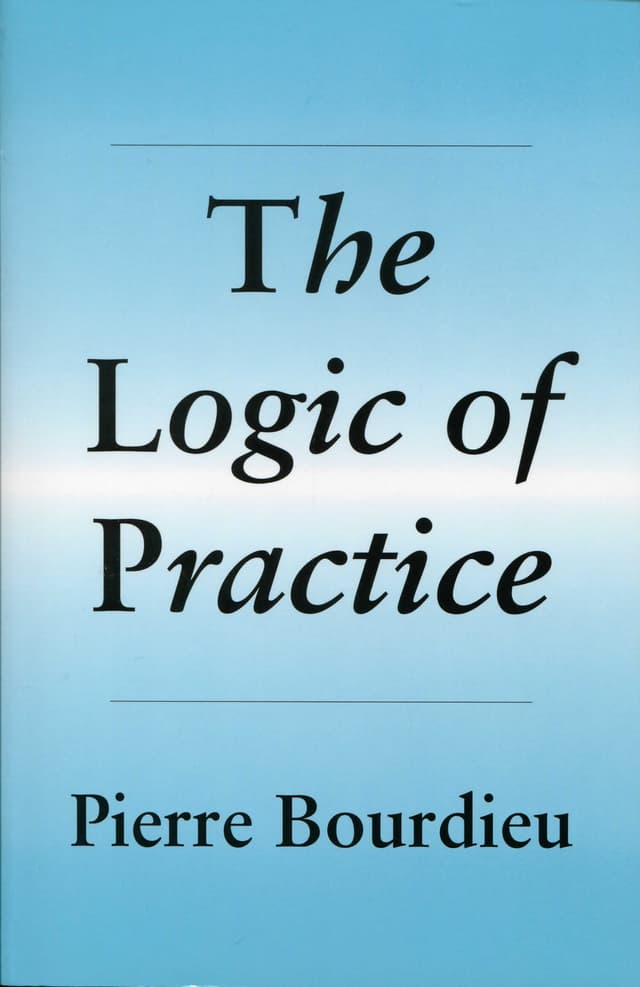
'Intellectualism is inscribed in the fact of introducing into the object the intellectual relation to the object, of substituting the observer's relation to practice for the practical relation to practice. Anthropologists would be able to escape from all their metaphysical questioning about the ontological status or even the 'site' of culture only if they were to objectify their relation to the object, that of the outsider who has to procure a substitute for practical mastery in the form of an objectified model. Genealogies and other models are to the social orientation which makes possible the relation of immediate immanence to the familiar world, as a map, an abstract mode of all possible routes, is to the practical sense of space, a "system of axes linked unalterably to our bodies, which we carry about with us wherever we go", as Poincaré put it.' p.34.
The Logic of Practice
'The logical [kinship] relations he constructs are to 'practical' relations - practical because continuously practised, kept up and cultivated - as the geometrical space of a map, a representation of all possible routes for all possible subjects, is to the network of pathways that are really maintained and used, 'beaten tracks' that are really practicable for a particular agent. The family tree, a spatial diagram that can be taken in at a glance, uno intuitu and scanned indifferently in any direction from any point, causes the complete network of kinship relations over several generations to exist in the mode of temporal existence which is that of theoretical objects, that is, tota simul, as a totality in simultaneity. It puts on the same footing official relationships, which, for lack of regular maintenance, tend to become what they are for the genealogist, that is, theoretical relationships, like abandoned roads on an old map; and practical relationships which really function because they fulfil practical functions.' p.35.


My source:
Bourdieu, P. (1990). The Logic of Practice. Stanford University Press. https://doi.org/10.1515/9781503621749 [and image source].

Bourdieu, Pierre, "The Logic of Practice (1990)" (1990). eTextbooks for Students. 875.
https://stars.library.ucf.edu/etextbooks/875

See also: https://hodges-model.blogspot.com/search?q=bourdieu

Friday, September 26, 2025

Book: Atlas of Finance

Individual
|
      INTERPERSONAL    :     SCIENCES               
HUMANISTIC  --------------------------------------  MECHANISTIC      
 SOCIOLOGY  :    POLITICAL 
|


Dariusz Wójcik, James Cheshire, Oliver Uberti. (2024). Atlas of Finance: Mapping the Global Story of Money. Yale University Press. https://atlasoffinance.com/

Previously: 'atlas' : 'finance' : 'visualization'

My source:Guthrie, J. Tresure maps. Life& Arts. FT Weekend. 26/27 October 2024. p.12.

Friday, July 04, 2025

Diagrams - AMO/OMA at Prada Foundation Venice

"There is no such thing as an innocent map, observes Philippe Rekacewicz in his catalogue essay that accompanies Diagrams, a new exhibition at the Prada Foundation in Venice.

A renowned cartographer, the Paris-born Rekacewicz is well aware of his medium's capacity to transform narratives for good and ill. His own work includes maps that illustrate the deaths of migrants as they bid for new lives in Europe. "A map," Rekacewicz continues, "is above all a social and political act - and therefore inherently subjective."' p.5.

Individual
|
      INTERPERSONAL    :     SCIENCES               
HUMANISTIC  --------------------------------------  MECHANISTIC      
 SOCIOLOGY  :    POLITICAL 
|
Group
Am I Free?

My history ...
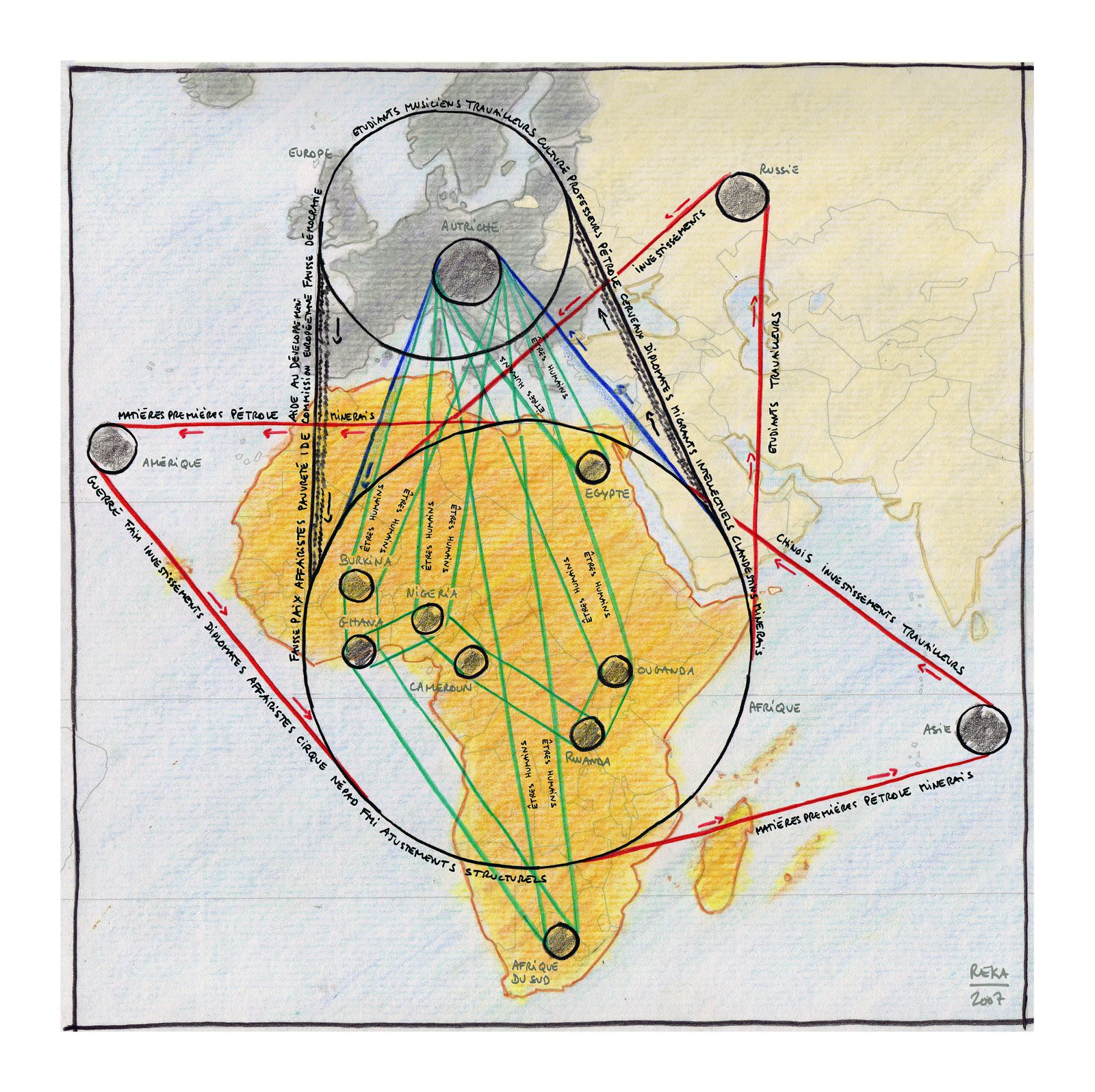
Philippe Rekacewicz / The African big wheel, 2007
The wheel symbolizes permanence and continuity in the context of a profoundly unequal exchange, drawing, color pencil and ink, exhibition copy.
Courtesy Philippe Rekacewicz
(Image credit: Philippe Rekacewicz)

SOCIETY

... is our history ...

Freedom

National & International Law

Justice


'Other pictures are equally revealing for what they conceal. Consider the diagram entitled "Universal commercial history", a visual analysis drawn up by the Scottish engineer William Playfair in 1805 which traces the rise and fall of global wealth since 1500 BC against what he terms "Remarkable Events Relative to Commerce". Playfair, who is said to have invented the pie chart, includes moments such as "Rome founded" "Mahomet's Flight" and "America discovered". He never mentions slavery.

With such a broad-brush approach, lacunae are inevitable. It is a shame that the work of Viennese social scientist Otto Neurath - who, along with his wife Marie and colleague Gerd Arntz, invented the Isotype (International System of Typographic Picture Education) - is not on show. Based on pictograms, Neurath's Isotypes are an lmportant forerunner to the digital vernacular (from emojis to icons) so familiar to us today. Nor does the exhibition include maps of the devastation of Gaza since October 2023, such as those made by investigative research agency Forensic Architecture, which are proving among the most critical diagrams of our time.' p.5.

Philippe Rekacewicz - https://www.grida.no/resources/10988

My source:
Rachel Spence. Hidden truths in the best laid plans. Diagrams | What charts, maps and graphics can - and can't - tell us. Collecting, FTWeekend. 26-27 April 2025. p.5. 
With many thanks acknowledging length of quotation.

Image source:
https://www.wallpaper.com/architecture/oma-amo-diagrams-prada-foundation-venice

See also: 'icon' : 'symbols' : 'diagram' : 'map' : 'Forensic Architecture'

Archived listing Links II Sciences - inc. 'Diagrams' & 'Visualization I' and 'II': 

Tuesday, June 17, 2025

Theatre - which one?

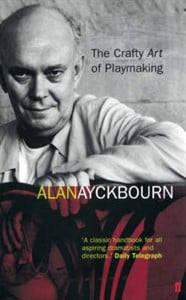
The Crafty Art of Playmaking
Summer reading includes Ayckbourne's The Crafty Art of Playmaking published in 2004. Already half way through, writing has been covered, directing follows.

Looking at what I can learn in contrasting health and theatre, there is more than both laying claim to having a 'theatre'. Perhaps health got there first in a very primitive, existential, and fundamental sense. The 'theatre of war' covering battle, and the fight for food and survival. Even as civilisation emerged, on the battle field, triage was practised in a more deliberate way with skills that were built on emerging knowledge handed down orally - to become art.

So, no doubt there was a concurrency going on. Heroics in so many guises, shared around the fire. Plus, our individual dreams and nightmares that are framed collectively.

Ayckbourn offer pithy lessons learned over his career that began in 1959. There's an acting maxim:

'When playing a miser, stress his generosity.'

So can we restate the acting maxim as:

'When playing a patient, stress their strengths'?

Or. 'When playing a patient, stress their personhood'? . . .

If that is a challenge to the healthcare sector (even if unintended), then it is one that is actually long-standing. There are the three R's: rehabilitation, reablement and recovery.

Ayckbourn explains how the darker the subject the more a writer needs to find the light. And vice-versa. This suits me fine, and medicine is recognised as a great source of humour across several cultures.

The book lists a series of  'Obvious Rules' all numbered. 

Of No. 1: Born in Liverpool, I never would look down on comedy; and never as a poor cousin of drama.

After reading his obvious Rule No. 2, 'Never start a play without an idea'; I put my pants back on.

Do I have an idea? Oh my! Well Brian's at least.

In a way it's the other way around. The shout goes up - "Eratosthenes! Please pass me a sieve."

On having an idea, Ayckbourn writes: 'They assume, I think, that if they start the journey, maybe an idea will occur on the way. Perhaps a map of where they're going will blow in through the car window. In my experience this never happens.' p.6.

This is good advice, with the additional complication of having many maps, and yes, none: c/o Hodges' model. I need a theme, a situation and a thread. I'm writing a few ideas down. And helpfully Sir Alan advises not to throw ideas away. He describes, from experience how disparate things can come together.

Today (19th), I finished TCAoP here in Corfu. A great help for me, that is, the writing section pp.3-96; as I will try to explain in further posts. Sooner than expcted, I've started a book that will be a 'review'. 

A visit to Albania tomorrow - early start pick-up 0710.

The Crafty Art of Playmaking by Alan Ayckbourn. Faber, 2004, softcover, ISBN 0571215106.
https://www.concordtheatricals.co.uk/s/45898/the-crafty-art-of-playmaking

Saturday, February 15, 2025

'Life's compass' ...

'... I have been thinking a lot about the responsibilities of leadership. How do people in positions of power reach decisions and do they fully consider the consequences of these decisions? In questioning how someone chooses to lead, I'm also asking how that individual navigates the possible courses of action, and what kind of compass is being used to guide them. It has made me think about how any of us choose to navigate our way through life and where we look for a sense of direction. I wonder what we might change about the choices we make if we were more reflective about what serves as a compass in our lives.'

'"The Invention of the Compass" is attributed to an anonymous painter of the late 16th century, although there exists a roughly contemporaneous plate of the same title, and of an almost identical image, engraved by the Dutch artist Jan Collaert the Elder. In the original painting an old man with a long white beard, and dressed in a voluminous red and brown cloak, sits behind a large table in the centre of a room. As well as a canopied bed and another desk spread with books and scientific instruments, there is a model, or vision perhaps, of a carrack sailing ship hanging from the ceiling. There is also a large round compass device that sits heavy on the floor on the left foreground of the canvas. ...'

'It is as if this painting (Caravaggio) intended to serve as a compass, helping to move our steps and actions in the direction of caring for others. This is a powerful idea, and it suggests that all images contain that potential to influence how we live. Where we choose to direct and keep our gaze to some extent can determine how we permit our lives to be guided, if not in a physical sense then toward a value system that can end up having an impact on the way we engage with the wider world.' (My emphasis)

Ack. Enuma Okoro, Life's compass, The art of life, Life&Arts, FTWeekend, 1-2 February 2025. p.2. (Still need to subscribe, marvellous reading!)


Caravaggio, The Seven Works of Mercy


The Invention of the Compass


INDIVIDUAL
|
      INTERPERSONAL    :     SCIENCES               
HUMANISTIC  --------------------------------------  MECHANISTIC      
 SOCIOLOGY  :    POLITICAL 
|
GROUP

moral compass
personal values
my choices

maps - compass
position - navigation
direction - distance
degrees of freedom

the public
the public good
group think


leadership
power
political freedom


Enuma Okoro, Life's compass, The art of life, Life&Arts, FTWeekend, 1-2 February 2025. p.2.

Images: 

New Inventions of Modern Times [Nova Reperta], The Invention of the Compass, plate 2
https://collectionapi.metmuseum.org/api/collection/v1/iiif/659663/1403273/main-image

By Caravaggio - Unknown source, Public Domain, https://commons.wikimedia.org/w/index.php?curid=10286196

Previously:

'compass' :: 'map'

Sunday, February 02, 2025

Social Capital - related to Hodges' model: c/o Andy Haldane FT

'The world is more diverse and interwoven than ever before - economically, culturally, ethnically, generationally. This is largely the result of the postwar explosion in cross-border flows of:'
ME
|
      INTERPERSONAL    :     SCIENCES               
HUMANISTIC  --------------------------------------  MECHANISTIC      
 SOCIOLOGY  :    POLITICAL 
|
WE

INFORMATION*

GOODS

PEOPLE

MONEY

 *Here I am treating information as analog - attached to meaning and sense-making, human reasoning - thought; information is of course also digital and an economy in itself.

'There is no ecosystem on the planet that is not enriched by increased diversity. The complexity of rainforests and oceans explains their abundance. In social systems, the cross-pollination of ideas, cultures and practices in diverse communities has been a driver of innovation and dynamism for millennia.
Yet this is a double-edged sword. A rainforest or an ocean are vulnerable to antagonistic arrivals such as humans seeking timber or fish. If cultures clash rather than cohere, diverse communities exhibit similar fragility.
Every complex system faces this balancing act, but it can be improved by strengthening ties and trust - what Harvard political scientist Robert Putnam calls social capital. The depletion of social capital over the past half-century, documented by Putnam, has tilted the scales decisively towards fragility. Today's open, connected economies are nested in brittle, disconnected societies. Neither can flourish like this.
One policy response is to reverse economic course, tightening restrictions on cross-border flows of people, goods, technologies and information. While economists (like me) tell us that doing so would diminish economic dynamism, given these policies address the insecurities felt by many at source, it is no surprise they are gaining support - especially on immigration and trade.' 

ME
|
      INTERPERSONAL    :     SCIENCES               
HUMANISTIC  --------------------------------------  MECHANISTIC      
 SOCIOLOGY  :    POLITICAL 
|
Group

My - sense of security
My - trust

 (AFTER) -
FORETHOUGHT


... Rainforest : Ocean
Wetlands : Kelp forests ...^

Maps of Social Capital1

Spatial planning


Social capital
Social mobility
Sociable housing2
Social cohesion

Social -

Policy
Curricula
Governance, Citizen Trust
Nat. Strategy for social connection3

Capitalism

'An Office of the President or Prime Minister, charged with lacing social cohesion through policy, should be hard-wired into the machinery of governments.'

(Here, here!).

1. Raj Chetty - Social Capital Atlas: https://www.socialcapital.org/
2. Richard Sennett
3. Chris Murphy

^Sometimes perhaps the map is the territory? Discuss.

With thanks to:
Andy Haldane, How to get from the me to the we society. Opinion: FT Weekend, 14/15 December 2024, p.12.

Upswing image: 
https://www.allenandunwin.com/browse/book/Robert-D.-Putnam-and-Shaylyn-Romney-Garrett-Upswing-9781800750371

Tuesday, January 28, 2025

Sticky Categories and Their Negative Consequences c/o Mikulak et al.

Category - Theory and Practice

Hodges' model -
A model for care in whatever situation, care environment*.

 
Individual
|
      INTERPERSONAL    :     SCIENCES               
HUMANISTIC  --------------------------------------  MECHANISTIC      
 SOCIOLOGY  :    POLITICAL 
|
Group
'I'
Me
My name is . . .
I am a person.
I am an individual.

Even if I don't thank you,
there may be someone out
there who thanks you for
acknowledging, confirming,
sustaining, preserving and
respecting my identity.

Even if I don't ask you
for your name please share
it with me, when you feel
 the time is right.

Together ...

[Abstract] "‘Behaviours that challenge others’ are attributed to 20% of people with learning disabilities. These behaviours are not a diagnosis, it is something people are labelled with. We conducted qualitative interviews with social care staff in the UK within four models of care: independent supported living, residential nursing home, Shared Lives, and living with family and attending a day opportunities centre*. We examine how the category of ‘behaviours that challenge others’ is produced, applied, and contested in adult social care settings. We demonstrate its stickiness and discuss its stigmatising consequences. How behaviours are understood, felt, and talked about matters for the support people with learning disabilities receive and maps onto their consequent inclusion or exclusion from society. We point out the harms the category carries for people who receive it and argue that it should be abandoned." p.110.


"Labeling theory suggests that labels lead to stigma, through changing how a group is perceived by others and supporting stratification (Haft et al. 2023). According to Link and Phelan (2001: 383), stigma ‘exists when elements of labeling, stereotyping, separating, status loss, and discrimination co-occur in a power situation that allows these processes to unfold’ (emphasis added). The acceptance of categories as valid and important differences is described by the labeling element of stigma (Link and Phelan 2001). Here, we attend to how this ‘labeling’ aspect of stigma interacts with its other mechanisms in the category of ‘behaviours that challenge others’." p.112.


"Emotions are not private, rather, they ‘circulate between bodies and signs’ producing meanings and creating ‘the surfaces or boundaries of bodies and worlds’ (Ahmed 2004b: 117); thus, affect is always distributed (Wetherell 2015). We propose the category—and the labeling process behind it—should be understood within an ableist (Campbell 2009) distribution of affect and politics of emotion; one that subordinates the experiences of people with learning disabilities through establishing the ‘truth’ of the reading as external and mediated through the emotions of people without learning disabilities. ‘Behaviours that challenge others’ (and synonyms of the category) are inherently relational but also reflect and reproduce existing power imbalances. We suggest their stickiness rehearses and reinforces the ableist politics of emotion that positions people with learning disabilities as ‘less human’ (Goodley 2021) and at times as monstrous. The category is a product of this politics, one that repeats its rehearsed, sticky associations, making the reading of the proximity of people with learning disabilities in the present a result of histories marked by dehumanization. The method of categorizing people through labels also makes them more susceptible to what McClimens has described as ‘reauthoring’, with collective histories ‘presented in a way that condones or even justifies their current situation’ (2007: 259)." p.113.


Mikulak, Magdalena, Sara Ryan, Elizabeth Tilley, Susan Ledger, Lisa Davidson, Pam Bebbigton, and Dawn Wiltshire. 2024. “Sticky Categories and Their Negative Consequences: People with Learning Disabilities and ‘Behaviours that Challenge Others’.” Scandinavian Journal of Disability Research 26(1): 110–123.
DOI: https://doi. org/10.16993/sjdr.1069 (with my emphasis)

I have cited Mikulak et al. in 1/2 papers submitted yesterday after revision on: threshold concepts, deprivation of liberty, residential care and Hodges' model.

Saturday, December 14, 2024

The Science of Conceptual Systems - and Hodges' model

Wallis, S.E. The Science of Conceptual Systems: A Progress Report. Found Sci 21, 579–602 (2016). https://doi.org/10.1007/s10699-015-9425-z

From the conclusion:
'The approaches presented here do not provide a ‘‘map’’ for advancing the sciences. Indeed, none is available because we are advancing across that new terrain. What it does provide is a compass suggesting a new and potentially exciting direction to travel. Historically/traditionally, scholars have travelled about the countryside of the social/behavioral land making useful observations and gathering interesting data. They have often staked claims regarding the importance of their terrain. They could not advance more purposefully because they were guided only by intuition. So, they did not know what direction was ‘‘forward’’ although it seemed to have something to do with empirical analysis. Today, with the creation of a new science, we have a new direction.

When we do have a choice between theoretical maps, generally, and metaphorically, this paper suggests that we should choose to create and use roadmaps with many dots connected by many lines; not maps with few disconnected dots.' p.594.

There is also a glossary [pp.594-599] that includes:
'Integral thinking

Understanding (or attempting to understand) the world from a transdisciplinary perspective where those many perspectives are interrelated'
'Integrative propositional analysis (IPA)

Combined processes of qualitative and quantitative analysis involving rigorous hermeneutic deconstruction of propositions found in formal texts including the rigorous reintegration of propositions from those texts following a structured methodology. Also a process of meta-analysis for investigating conceptual systems to determine the Complexity of conceptual systems (diversity of concepts) and the Systemicity of the conceptual system (connectedness between concepts)'

'Mental model 

A representation within one’s mind about how the world works. Useful for understanding and engaging the world and for making predictions'

'Parsimony 

Generally, the understanding that a theory is better when it is smaller. Or, as small as possible while including ideas that are necessary or useful. Ockham’s Razor is a common example'

INDIVIDUAL
|
INTERPERSONAL : SCIENCES              
humanistic ---------------------------- mechanistic
SOCIOLOGY : POLITICAL   
|
GROUP

more SUBJECTIVE

more OBJECTIVE
QUALITY

QUANTITY


'Reflexive dimensional analysis (RDA) 

A process for creating a unified conceptual system from multiple conceptual systems through a process of categorization, abstraction, dimensionalization, and the identification of causal connections'
'Theory 

An ordered set of assertions. Weick (1989, p. 517. Drawing on Southerland)'
Cited above: 
Weick, K. E. (1989). Theory construction as disciplined imagination. Academy of Management Review, 14(4), 516–531.

Previously:
terrain : landscape : line-of-sight (with overlap; of interest in itself)

Friday, November 29, 2024

'Domain-specific is wider than specific domain knowledge' Kalyuga (2013)

 'Developing learner ability to apply knowledge in relatively new situations is an important aim of learning and instruction, and many instructional programs and materials explicitly state this goal. However, not many of them demonstrate a consistency in achieving this goal using sufficiently well-specified instructional procedures and techniques. According to a popular view, transferable knowledge and skills in complex domains result from problem solving experiences (e.g. Inagaki and Miyake 2007). At the same time, there is evidence indicating the importance and effectiveness of explicit learning generalized theoretical frameworks and abstract conceptual knowledge for deep understanding of tasks and en hancing transfer capabilities (Karpov and Bransford 1995; Hinds et al. 2001). Gick and Holyoak (1983) convincingly demonstrated the value of the acquisition of abstract schémas as mediators of analogical transfer between very different task areas.'

'Many studies in expert problem solving have demonstrated that relying on highly contextualized domain-specific knowledge associated with concrete situations is the most effective way to solve problems in familiar task areas and that expert performance is largely based on the acquisition of organized domain-specific knowledge structures (schémas; Chi et al. 1982). ... For example, the game of chess has traditionally represented a classical example of expertise based on the acquisition of a huge amount of highly specific knowledge structures (chunks) corresponding to various concrete game situations (De Groot 1965; Chase and Simon 1973). However, more recent studies have indicated that experts use not only concrete chunks but also more general patterns, such as "templates" (Gobet and Simon 1998) or generalized chunks (Walczak and Fishwick 1997) representing typical classes of chess positions with substantial variations in concrete board locations. Based on his observations of the behaviour of rats in maze situations, Tolman (1948) was one of the first to discuss the role of broad vs. narrow cognitive constructs (cognitive maps) in both animal and human learning. 

Domain-specific knowledge that is applicable only to a limited range of tasks represents the most powerful tool for dealing with these tasks in terms of efficiency of achieving immediate results. On the other hand, knowledge that can be applied more broadly is likely to be less efficient for solving specific problems since it would require additional searching, reasoning, and elaborating activities, whilst specific knowledge directly leads to a definite solutions.' pp.1478-1479.

Kalyuga, S. (2013). Enhancing transfer by learning generalized domain knowledge structures. European Journal of Psychology of Education, 28(4), 1477–1493. http://www.jstor.org/stable/23580919

Tuesday, November 26, 2024

The naïve approach ii - Seeking / Avoiding a Catastrophe

In addition to Dodson's book I borrowed:

Zeeman, E.C. (1977) Catastrophe Theory-Selected Papers 1972–1977, Reading, MA: Addison-Wesley.

From the mid-1970s I remember catastrophe theory rather bursting on to the science scene. Articles in New Scientist (in a box somewhere?), Scientific American plus a BBC TV episode of Horizon (seeking details - originally aired July 28, 1975, 60 minutes 'Happy Catastrophe')*, that highlighted potential for new insights into the behaviour inside prisons. and other applications in the social sciences.

The CONTENTS reads:
GENERAL INTRODUCTORY PAPERS 

1. Catastrophe theory : Draft for a Scientific American article 1
2. Levels of structure in catastrophe theory 65

 BIOLOGICAL SCIENCES 80

3. Differential equations for the heartbeat and nerve impulse 81 
4. Primary and secondary waves in developmental biology 141 
5. A clock and wavefront model for the control of repeated structures during animal morphogenesis (with J.Cooke) 235
6. Gastrulation and formation of somites in amphibia and birds (Addendum by R. Bellairs.) 257 
7. Dialogue between a Biologist and a Mathematician 267 
8. Brain modelling 287 
9. Duffing's equation in brain modelling 293

 SOCIAL SCIENCES 302

10. Some models in the social sciences (with C.A.Isnard) 303 
11. On the unstable behaviour of stock exchanges 361 
12. Conflicting judgements caused by stress 373 
13. A model for institutional disturbances (with C.S.Hall, P.J.Harrison, G.H.Marriage, P.H.Shapland) 387
14. Prison disturbances 403 

PHYSICAL SCIENCES 408 

15. A catastrophe machine 409
16. Euler buckling 417 
17. Stability of ships 441

MATHEMATICS 496

18. The classification of elementary catastrophes of codimension <= 5 (with D.J.A.Trotman) 497
19. The umbilic bracelet and the double-cusp catastrophe 563 

DISCUSSION 604

20. Research ancient and modern 605 
21. Catastrophe theory : its present state and future perspectives (with R.Thom) 615
22. Afterthought 651 
As an area of contention the subject of catastrophe theory (CT) possibly presents(?) a dual-cusp of contention. Firstly, CT brought with it controversy within academia and mathematics. The book was reviewed by T. W. Barrett, Department of Physiology and Biophysics, University of Tennessee Center for the Health Sciences, Memphis, TN 38163: 
'Catastrophe theory (CT), as a new field in mathematics with many possible ramifications for both the physical and biological sciences, has recently been the subject of much controversy (see [1]-[5]). This controversy, in this reviewer's opinion, has served a valuable purpose insofar as it has stimulated the theory's proponents to refine and delineate their concepts more clearly. Catastrophe theory was developed by the Field prize winner, Rene Thom; but much work has been accomplished by E. C. Zeeman and his group, especially with respect to applications.' pp.609-610. IEEE TRANSACTIONS ON SYSTEMS, MAN, AND CYBERNETICS, VOL. SMC-9, NO. 9, SEPTEMBER 1979. https://ieeexplore.ieee.org/stamp/stamp.jsp?arnumber=4310286 
Stephen Smale also reviewed Zeeman's book; BULLETIN OF THE AMERICAN MATHEMATICAL SOCIETY Volume 84, Number 6, November 1978. 1360-1368. 
https://www.ams.org/journals/bull/1978-84-06/S0002-9904-1978-14580-7/S0002-9904-1978-14580-7.pdf
'To write a review in this environment has a very personal side for me. On one hand my own work on dynamical systems is closely connected to the origins of CT. I have had a long and close personal and professional relationship with both Thorn and Zeeman. More than 20 years ago I was discussing singularities of maps, transversality, and immersions with René Thom. Thom tried to interest me in an early draft of chapters of his book Structural stability and morphogenesis in 1966.

On the other hand I have remained skeptical and aloof from CT, perhaps due to my conservatism in science. While my colleagues and students were showing enthusiasm for CT, I gave critical lectures, one at the University of Chicago in 1974, one at the Aspen Institute of Physics in 1975. More recently I have been quoted negatively in the "Science" and New York Times references above. This is the first time I have written on the subject, and I should warn the reader of this negative bias, far from shared by many of my fellow mathematicians.' p.1360.

Some defenders of CT may accuse me of discussing very special examples not characteristic of the literature of the subject. I feel that the problem of lack of justification discussed above, is also found in Zeeman's other models. Furthermore Thorn's models are even less specific and less developed. On the other hand, Thorn's work in CT covers many subjects; in this connection Zeeman writes in his Scientific American article, April 1976, p. 65: "The method has the potential for describing the evolution of form in all aspects of nature, and hence it embodies a theory of great generality."' p.1366.
The book's introductory papers are somewhat confusing in content, as drawn to 'SOCIAL SCIENCES' it is the introductory section (and Part Two) that includes  'Anorexia nervosa', Example 9 pp.33-52. 

This is the second 'cusp' as the assessment, diagnosis, intervention, outcomes, skilled staff, access to specialised mental health services remains contentious to this day. As a charge nurse on a female acute admission mental health ward in the early 1980s, eating disorders have always presented a 'clinical' challenge. Often within a staff group and for individual staff members too.

Twitter/X is hardly an objective record but it appears today, that people and families affected by eating disorder continue to advocate for appropriate service provision, treatment and recognition. Recognition that can also develop evidence-based interventions. As discussed by Dr. Agnes Ayton, consultant psychiatrist and others in the video below:


A related paper:

Ibrahim, A., Ryan, S., Viljoen, D. et al. Integrated enhanced cognitive behavioural (I-CBTE) therapy significantly improves effectiveness of inpatient treatment of anorexia nervosa in real life settings. J Eat Disord 10, 98 (2022). https://doi.org/10.1186/s40337-022-00620-y [ My source: @AgnesAyton ]

The Zeeman chapter on anorexia nervosa is interesting graphically and conceptually ...

Page 42. Figure 20. The effect of the butterfly factor, d>0.
(Sorry for the image quality)

- but is of course 'from another time' and is clearly not person-centred. Eating disorders affect many people in the UK and are a cause of trauma, distress, disrupted life-chances and mortality. Referring to Hodges' model, such graphics, reinforce the idea that 'solutions' are to be found in the mechanistic and quantitative domains of the sciences and politics (choice, power, services, safety..). Here, maths and theories (seemingly) provide an explanation for people who are ill, and need treatment. As a teenager for most of the 1970s, Hodges' model was not yet a reality. As I have found since 1987-8 looking at the POLITICAL care/knowledge domain, the model's relevance has increased since the start of my nursing career in 1977. Consider for example, the politics of:
  • the global phenomena of famine
  • - whether or not associated with economic crisis, drought, other natural disaster, or conflict, political crisis
  • ultra-processed foods
  • obesity pandemic
  • weight loss drugs
  • appetite stimulants
  • appetite suppressants
  • eating disorder (anorexia and bulimia) across care sectors - primary, secondary, specialist
    • community / in-patient care
    • person-centred care
    • user involvement in service design
  • the availability of treatment modalities - psychotherapy (as in the video)
  • the impact on family relationships and peer group (estranged - loss of friends)
  • diagnostic blurring - psychosis, borderline personality disorder - the rise of 'anti-psychiatry'
Here then is the purpose of this post, what potential is there to look at nutrition from a situated individual and collective (global) perspective? This could be focussed on nutrition, or eating disorder; or alternately take a collective stance to encompass the global food supply and the industry. Discovering the diffeomorphism, I wonder if there are others, and their respective properties and character? 

INDIVIDUAL
|
INTERPERSONAL : SCIENCES              
humanistic ------------------------------- mechanistic
SOCIOLOGY : POLITICAL   
|
GROUP
COGNITIVE THERAPY
EMPATHY&RAPPORT
LISTENING - MUTUAL ENGAGEMENT
MENTAL HEALTH
DIAGNOSIS
TRAINED / SKILLED STAFF
EVIDENCE-BASED INTERVENTIONS*
MOTIVATION
MOOD
MULTIMORBIDITY

RESEARCH
EATING
DIET
NUTRITION
NUTRITIONAL VALUE
WEIGHT
BMI
IN-PATIENT UNIT
place of safety


PUBLIC HEALTH
SOCIETY
FAMILY
CARERS


Developed nations
are collectively and increasingly
'eating disordered'
and exporting this 'lifestyle'.


Before I return the book, I will revisit the discussion section.

See also:
Jones P, Wirnitzer K. Hodges’ model: the Sustainable Development Goals and public health – universal health coverage demands a universal framework. BMJ Nutrition, Prevention & Health 2022;5:doi: 10.1136/bmjnph-2021-000254

*I could not find on BBC website. I have contacted the Open University. I did find - 'In this Horizon episode, Rene Thom's mathematical discovery of the catastrophe theory is investigated.' at  https://thetvdb.com/series/horizon/episodes/1385431

Friday, August 30, 2024

Still sorting books: "The holographic paradigm and other paradoxes"

There has been overlap in my subscription to the Laws of Form mail list and a (David) Bohm list. With the difference, I unsubscribed from the latter, in an effort to focus. The work of Bohm is still very much on the radar and book shelves (well, boxes currently). Continuing to clear books, I've been reading through some relevant sections and quote here at length from:

Wilber, K. (Ed.), (1982) The holographic paradigm and other paradoxes. Boulder, CO: Shambhala.

The Enfolding-Unfolding Universe: A conversation with David Bohm (pp.44-104)

"WEBER: You've spoken of clarity often today and in the past: therefore, isn't it necessary at this point to consider consciousness and the knower, the one who is or isn't clear?

BOHM: Yes, we could come to that. The point is that consciousness is confused. Confusion is nonclarity. And if you say, a person is not clear, you mean he's confused, although it is more polite to say he's not clear. And confusion means "melting together." Things that are different are seen as one and things that are one are seen as broken up into many. So confusion clearly causes chaos." p.61.

"BOHM: Well, yes, we can consider that maybe that is what is, but, at the same time we have to be very  careful to say that thought cannot grasp it, so at some stage thought has to put this question aside as to what is, you see. Thought cannot grasp that which is. And any attempt to grasp that which is engages us in serious self-deception which confuses everything. So that thought has to learn or somehow come to a state of discipline, or whatever you want to call it, spontaneous discipline, its own discipline. 

WEBER: Order?  

BOHM: Yes, order, in which it does not attempt to grasp the questions which are beyond it, such as the question of that which is. It can grasp any relative question which is conditioned, or in some way, conditional. So even the nonmanifest consciousness of the  nonmanifest matter, which is highly subtle, is still within the possible area of thought."  p.64.


"WEBER: Deeply. So you're saying that prior to this current awareness of the centrality of consciousness, what we've been trying to do is hopeless because we've addressed small social problems all in the wrong domain, so to speak. 

BOHM: Yes. Well, really not going to their source at all." p.80.


"WEBER: Which was the old Cartesian or dualistic model.  

BOHM: Right. It also leads to infinite regress, unless you end it by  God or somewhere.
Now I think we come to a point where we're raising a question which was similar to what was raised in  yesterday's discussion.  How long can we go on trying to talk about what is beyond thought by making an intellectual construction? You see, because when we  make such an intellectual construction we  have a content and we have implied that the one who is constructing it is also supposed to be beyond that content. So he evades the very thing we attempt to include him in and in that very attempt he gets out. And so it seems that there is some limit to how far you can go in that  process, in that approach. Therefore it's best to say that in this approach in which we attempt to make a map, or a sketch of some  kind of what reality is, that we are really dealing with something limited. Korzybski used to say: "Whatever we say it is, it isn't."

WEBER: The map is not the territory. . . .

BOHM: That's right. Yes. And therefore what we are doing is making maps, making sketches, making concepts. And see, that's why I said the other night that science, for example, theoretical  science, is not primarily concerned with observing things but with observing ideas. ..."  p.84


The Tao of Physics Revisited  (pp.215-248)

"CAPRA: Yes, they would look at genetics, individual parts and so on. 

WEBER: They have the Cartesian view, whereas you're saying that this is the new vision, emphasizing interdependence, interconnectedness, the dynamics of the whole. 

CAPRA: But I should say that both reductionism and holism are necessary. 

WEBER: I understand. You are not suggesting that we abolish the other. You are saying we should supplement one with the other. 

CAPRA: If you want to get the full story, then you need both views. Because either one gives you only half of the story. This is what I see as the future of science, and I see a future science as no longer distinguishing between disciplines. 

WEBER: That's a very radical view. 

CAPRA: Yes, and by the way Heinsenberg already said that years ago. In one of his books, The Part and the Whole, he ends with his view of future science, and I agree very much with that. I have come to believe that in the future we will apply a network of models, and we will use different languages to describe different phenomena at different levels. We will not worry any longer whether we are doing biology or psychology or physics or anthropology or whatever; we won't be worried about these classifications." p.241.

Reading of The Systems View of Life - A Unifying Vision is also ongoing (p.240 ... and a joy) with posts to follow.

See also:
https://kfoundation.org/krishnamurti-and-david-bohm/

Saturday, June 29, 2024

Book for review: iv "Philosophy of Care - New Approaches to Vulnerability, Otherness and Therapy"

Don't worry this is not a chapter-by-chapter review. Having cast the stone that is Hodges' model we will skip a few times.

The use of footnotes varies from chapter to chapter. They inform the text, in several instances being quite illuminating. Beside the footnote (1/3 of a page) I noted - 'baby, cacophony, perception - brain - not overwhelmed but can't ignore' (p.41). Stoicism is the focus in chapter 3; perception, fields, manifold, circles of care, self, time, situation! We have field, subfields, domains.
"Perception is always about a diagnosis of the situation in which the living being finds itself. ...

... perception is always about finding one's "whereabouts" or one's "location" in life's journey." p.42.

On the features of perception, 4/4: "might be termed the breadth or width of the perceptual field." p.42. 

"As pointed out above, all perception has the structure of a compact, continuous, and uninterrupted manifold. In other words, it forms what we have termed a field. But the perceptual field  could contain nothing but the "bare bones" of "inert" qualia, (a manifold of simple qualities impinging themselves upon the perceiver)." p.42. 

The author, Jorge de Carvalho continues another view of qualities that take place in "each given moment". This is the challenge of salience, what is significant? How to 'read' in care: the spoken, the unspoken? 

Developing notes on Hodges' model as a mathematical object, Hodges' model in its basic form as a template, I'm proposing as an empty set. The structure of Hodges' model, its two axes instantiate the "bare bones". In programming/instruction terms ... Hodges' model provides INITIALISATION. A reset. This can act as a prompt for learners to acknowledge the person - the other and consider 'unconditional positive regard'. There's polarity too (p.46) and each living being lives in its own global field, in its own global 'map' - in its own geography" (p.49). Physical geography and the change 'there' is giving rise to cogeographical (a neologism?) disruption - eco-anxiety and climate-angst. 

Psycho-geography: the polarity of our times?

Another note, amongst Hierocles' circles is 'reflex arc'. So many feedback loops, cascades to worry about. 

As Jorge de Carvalho writes: 'what we are talking about is a very complex field of fields. ... described both as a compass rose and as a framework of concentric circles" (p.51). [There's a relay race, a torch relay in ancient terms p.54. Care is the object that is passed on. I've a dual-shaped baton to pass on.]

Care is more than perception (p.52), care presupposes a degree of activity or action. I like the acknowledgement of 'vigilant waiting' too. For me this draws in the importance of communication; Watzlawick's Five Axioms of Communication. After all, what happens to all these perceptions? There's vulnerability, fragility and care for the sheer existence and the whole content of a given being (p.56). Jorge de Carvalho, deploys a series of numbered points which helps reading. Page 60's footnote had me drawing circles, unborn at the centre: as one. But the collective unborn in another rough circle. Eachtimeness: I like this Stoic formulation through circles. Fourthly, we arrive at pure care. I'm still pondering on ".. there is no absolute either/or dichotomy between care and its opposite" (p.61). Integration is also here, an issue for modern times, a legacy problem from ancient times?

Luis Mendes's chapter I must read again. The abstract includes:
"Three fundamental aspects will be identified: (a) the need to consider self-existence from a global point of view; (b) the need for an axis for that life-view; (c) the need for correspondence between self-existence and life-view. Apparently, this structure is formal and arbitrary. Secondly, I will analyse the structure of despair. Three fundamental aspects will be analysed: (α) the requirement for a life-view which can be applied to the totality of subjective existence; (β) the requirement for an unconditioned instance of meaning; (γ) the requirement for the exclusion of the possibility of failure." p.79.
I'm sure Kierkegaard has featured in Philosophy Now, and The Philosophers' Magazine. Mendes' focus is arbitrariness. The hypothesis is well explained (p.80) structure of care. There's much for me here: care, life-view (health career - life chances), "a global understanding maps the world" (p.81), existential map, fulfilment, meaning (of course!). Reading -
"So, a life-view needs to be stabilized, to have unity. It needs an instance that works as an axis and as a point of support. We need something to support our life" (p.83).
I could have jumped up, waved and shouted "OVER HERE!" Would Kierkegaard have been pleased? Perhaps I should have read Kierkegaard, not Michel Serres (please see bibliography in the sidebar)? Still time (fingers x'd); especially if there's any interest in the form of co-author(s)? Care is full of ideals. Mendes through Kierkegaard gives my  project encouragement: "Truth is to live for an idea." p.84. Not necessarily truth but the idealism in care, including identity. It is helpful in care to be reminded of the ideal as a calling, hence motivation (intrinsic and extrinsic) is still key. If you're intrinsically motivated, devoted to your chosen vocation, is your pay that important - to the government/organisation that employs you? A shame this is so often lost to political leaders; who, given their chosen vocation, exhibit a markedly short memory.

Braga, J. & Santiago de Carvalho, M. (Eds.), (2021) Philosophy of care: New approaches to vulnerability, otherness therapy. Springer. 

Many thanks again to Springer for my copy, especially given a follow-up request, well post-publication date.

Individual
|
      INTERPERSONAL    :     SCIENCES                   
HUMANISTIC  --------------------------------------  MECHANISTIC      
 SOCIOLOGY  :    POLITICAL 
|
Group

personal courage

relational - (emotional) care

despair - fulfilment

motivation

ideals

unity - stability

maps

compass - orientation

models - frameworks

geography

life as a whole

society - community of practice

external validation

extrnisic motivation


sustainable development goals

policy

accountability

failure (courage here - political convictions?)


See also:

body & soul - Book: Philosophy of care: New approaches to vulnerability, otherness therapy


Book for review: iii "Philosophy of Care - New Approaches to Vulnerability, Otherness and Therapy"